
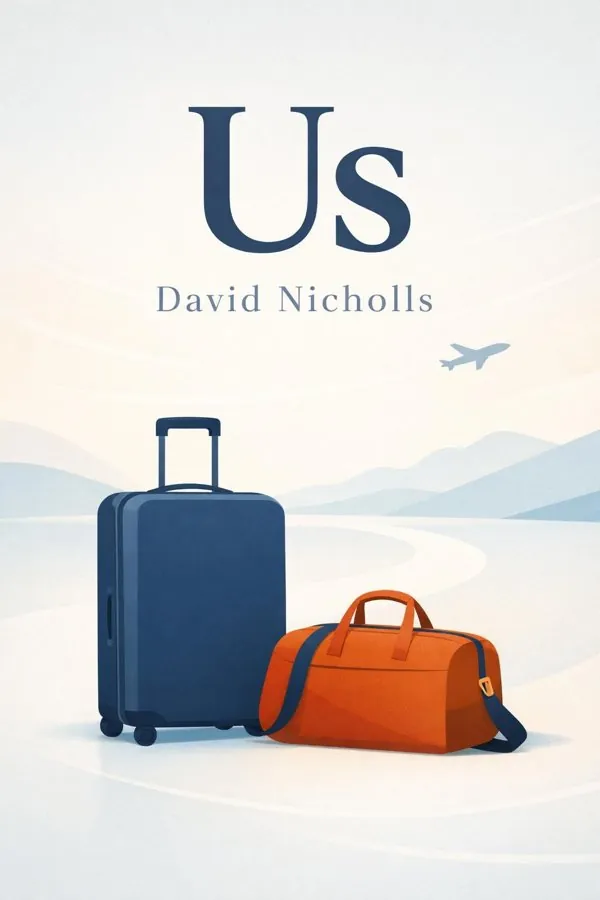
Us: Summary & Key Insights
 10 min8 chaptersAudio available
Key Takeaways from Us
Sometimes the trips we plan to bring a family together reveal how far apart everyone already feels.
One of the most moving insights in Us is that people can love each other deeply and still fail to make that love legible.
Few experiences are more destabilizing than realizing your child is becoming a person you cannot manage.
Families do not usually collapse in one dramatic instant; they fracture after a sequence of small failures to understand one another.
There is a special kind of truth that only humor can deliver.
What Is Us About?
Us by David Nicholls is a bestsellers book spanning 3 pages. David Nicholls’s Us is a tender, funny, and deeply perceptive novel about what happens when a marriage begins to fracture just as a family is supposed to be making memories together. The story centers on Douglas Petersen, a cautious, rational biochemist whose wife, Connie, tells him that she may want to leave him once their son Albie has grown up. Hoping to repair what feels suddenly breakable, Douglas clings to a long-planned European family trip as a final chance to reconnect with both his wife and his increasingly distant teenage son. What follows is part travel narrative, part love story, part family reckoning. Nicholls uses Douglas’s dry, self-aware voice to explore how love changes over time, how parents and children misunderstand one another, and how difficult it is to control the people we care about most. The novel matters because it captures ordinary heartbreak with unusual warmth and precision. Nicholls, celebrated for One Day and his emotionally intelligent relationship fiction, brings wit, psychological insight, and humane honesty to a story about failure, forgiveness, and learning to love people as they really are.
This FizzRead summary covers all 8 key chapters of Us in approximately 10 minutes, distilling the most important ideas, arguments, and takeaways from David Nicholls's work. Also available as an audio summary and Key Quotes Podcast.
Us
David Nicholls’s Us is a tender, funny, and deeply perceptive novel about what happens when a marriage begins to fracture just as a family is supposed to be making memories together. The story centers on Douglas Petersen, a cautious, rational biochemist whose wife, Connie, tells him that she may want to leave him once their son Albie has grown up. Hoping to repair what feels suddenly breakable, Douglas clings to a long-planned European family trip as a final chance to reconnect with both his wife and his increasingly distant teenage son. What follows is part travel narrative, part love story, part family reckoning. Nicholls uses Douglas’s dry, self-aware voice to explore how love changes over time, how parents and children misunderstand one another, and how difficult it is to control the people we care about most. The novel matters because it captures ordinary heartbreak with unusual warmth and precision. Nicholls, celebrated for One Day and his emotionally intelligent relationship fiction, brings wit, psychological insight, and humane honesty to a story about failure, forgiveness, and learning to love people as they really are.
Who Should Read Us?
This book is perfect for anyone interested in bestsellers and looking to gain actionable insights in a short read. Whether you're a student, professional, or lifelong learner, the key ideas from Us by David Nicholls will help you think differently.
- ✓Readers who enjoy bestsellers and want practical takeaways
- ✓Professionals looking to apply new ideas to their work and life
- ✓Anyone who wants the core insights of Us in just 10 minutes
Want the full summary?
Get instant access to this book summary and 100K+ more with Fizz Moment.
Get Free SummaryAvailable on App Store • Free to download
Key Chapters
Sometimes the trips we plan to bring a family together reveal how far apart everyone already feels. That is the painful irony at the heart of Us. Douglas has spent years believing that devotion, stability, and careful planning are the clearest expressions of love. So when Connie tells him, quietly and devastatingly, that she thinks their marriage may be over, he responds in the only way he understands: by trying to fix things. The planned European “Grand Tour” becomes, in his mind, a last opportunity to restore intimacy, impress his wife, and prove himself to his son Albie.
What makes this idea so powerful is that the novel does not mock Douglas for hoping. His optimism is misguided, but it is sincere. He believes that beautiful cities, shared meals, museums, and family time might somehow repair emotional distance. Many readers will recognize this instinct. People often imagine that the right vacation, milestone, or change of scenery can solve deeper relational problems. But Nicholls shows that unresolved tensions do not disappear in transit; they become more visible. The trip amplifies every difference between Douglas’s rigidity, Connie’s spontaneity, and Albie’s craving for freedom.
The opening movement of the novel establishes a key truth: crises rarely arrive all at once. They emerge from years of small misunderstandings, mismatched temperaments, and love expressed in forms the other person cannot fully receive. Douglas is not a bad husband or father. He is simply a man whose methods of care no longer work.
A practical lesson follows from this. When relationships feel fragile, resist the urge to rely only on grand gestures. Before planning the perfect rescue, ask what the other people involved actually need. Actionable takeaway: do not use experiences to avoid difficult conversations; use honest conversation to make shared experiences meaningful.
One of the most moving insights in Us is that people can love each other deeply and still fail to make that love legible. Douglas adores Connie. He also reveres her. From the beginning, he sees her as freer, more intuitive, and more alive than he is. Their marriage has always contained this contrast: his order against her artistry, his caution against her openness. For years, that difference feels complementary. Over time, however, it becomes a source of alienation. Douglas offers reliability, structure, and provision; Connie longs for emotional ease, wonder, and acceptance.
Nicholls is especially good at showing how this mismatch plays out in ordinary moments. Douglas thinks responsibility proves devotion. Connie experiences some of that same behavior as suffocating or joyless. Neither is wholly right or wrong. They are speaking different emotional dialects. This is why the novel resonates beyond its plot. It captures a common relationship problem: the assumption that if our intentions are loving, our actions will automatically be received as love. They are not.
This idea extends to family life more broadly. Parents often give children advice, money, education, and safety, believing these things will be understood as care. Children may instead experience control, criticism, or emotional distance. Partners may offer loyalty while withholding tenderness. Good intentions matter, but they are not the whole story. The form love takes is as important as the feeling behind it.
In practical terms, Us invites readers to examine not only whether they care, but how they communicate that care. Ask a partner or family member what support actually feels supportive to them. You may be surprised by the answer. Actionable takeaway: instead of assuming your love is obvious, ask the people closest to you, “What helps you feel loved by me?” and listen without defensiveness.
Few experiences are more destabilizing than realizing your child is becoming a person you cannot manage. Douglas’s relationship with Albie embodies this transition with painful clarity. Albie is witty, restless, impulsive, and increasingly resistant to his father’s supervision. Douglas interprets many of his son’s choices as risky or irresponsible, so he responds with lectures, strategies, and attempts at correction. The more he tightens his grip, the more Albie pulls away.
Us treats this tension with both humor and sadness. Douglas is not controlling because he lacks love. He controls because he is frightened: frightened that Albie will waste his potential, make poor decisions, or stop needing him altogether. That fear is recognizable to many parents. Adolescence forces adults to confront the limits of parental authority. There comes a point when guidance must compete with the young person’s need to experiment, rebel, and self-define.
Nicholls avoids easy sentimental lessons. Albie is not always reasonable, and Douglas is not always wrong. But the novel makes clear that a teenager on the threshold of adulthood does not need perfect management; he needs space, trust, and respect. Douglas’s tragedy is that he tries to preserve connection through correction, when what Albie most wants is to be seen as himself.
This dynamic applies beyond parenting. In friendships, workplaces, and romantic relationships, overmanagement often masks anxiety. We try to reduce uncertainty by directing others. Yet relationships deepen when people feel free rather than handled.
The practical application is especially important for parents of teenagers and young adults. Support them, set essential boundaries, but recognize when instruction has become intrusion. Actionable takeaway: before offering advice, pause and ask whether the person needs guidance, help, or simply the dignity of being trusted.
Families do not usually collapse in one dramatic instant; they fracture after a sequence of small failures to understand one another. In Us, Amsterdam becomes the city where this simmering strain finally erupts. By this point in the trip, Douglas has already struggled to keep pace with Connie’s emotional withdrawal and Albie’s mounting resentment. His efforts to impose order on the journey have produced the opposite result. In Amsterdam, a conflict with Albie escalates into a break that feels both shocking and inevitable.
The brilliance of this section lies in how clearly it exposes Douglas’s blind spots. He believes he is acting responsibly, even protectively. But his son hears accusation, mistrust, and disappointment. The confrontation is not only about one argument; it is about years of accumulated misunderstanding. Albie’s anger becomes a declaration of independence. Douglas’s panic becomes a sign that he never truly understood how close he was to losing influence.
This is a crucial turning point because it strips Douglas of his fantasy that love plus organization will be enough. Once Albie leaves, the trip changes from a family itinerary into something closer to a pursuit, and eventually into a reckoning. Douglas can no longer rely on roles alone. Being “the father” does not automatically grant authority. Being “the husband” does not guarantee loyalty.
In life, many relationships have an Amsterdam moment: a rupture that reveals what can no longer be ignored. Such moments are painful, but they can also be clarifying. They force people to confront patterns that politeness or routine has concealed.
When conflict explodes, the instinct is often to justify yourself immediately. Yet the wiser move is often to ask what the argument is really about beneath the surface details. Actionable takeaway: after any major conflict, identify the deeper unmet need underneath the argument before trying to solve the visible problem.
There is a special kind of truth that only humor can deliver. Us is often very funny, even as it tells a story about a marriage in danger and a family coming apart. Douglas’s self-conscious narration, his social awkwardness, and his earnest attempts to do the right thing create moments of real comedy. But the humor is not decorative. It is essential to the novel’s emotional power.
Nicholls understands that people rarely experience sorrow in pure form. Embarrassment, absurdity, irritation, and irony sit alongside grief. Douglas may be devastated, but he is also capable of noticing the ridiculousness of his own behavior. That self-awareness makes him more human. Readers trust him because he is not presenting himself as a tragic hero; he is a flawed man trying, failing, overexplaining, and occasionally making matters worse.
This tonal balance matters because it prevents the novel from becoming heavy-handed. Humor creates space for compassion. It allows readers to remain open to Douglas even when he is exasperating. It also reflects how families actually function. Longstanding intimacy often produces comic patterns: repeated arguments, familiar weaknesses, and jokes that barely conceal pain.
The broader lesson is that humor can be a form of emotional intelligence when used kindly. In difficult situations, the ability to laugh at oneself can reduce defensiveness and preserve dignity. This is different from avoiding pain with constant joking. In Us, humor does not erase heartbreak; it makes heartbreak bearable enough to examine.
In everyday life, people often become rigid when they feel rejected or afraid. A touch of humility can soften conflict and restore perspective. Actionable takeaway: in a tense conversation, try naming one of your own absurd or imperfect behaviors with honesty; self-aware humor can invite connection where self-justification only hardens distance.
A relationship is never just what is happening now; it is also the story each person tells about how they got here. Throughout Us, Douglas revisits the history of his marriage with Connie: how they met, why he fell in love with her, and the ways their differences once felt magical rather than divisive. These flashbacks are not sentimental interruptions. They show how memory shapes present emotion. Douglas is trying not only to save his marriage but also to preserve a version of its meaning.
This matters because people in long relationships rarely argue only about current events. They argue through layers of remembered affection, old disappointments, and revised interpretations of the past. Douglas remembers devotion, effort, and shared life. Connie seems to remember, or at least feel more strongly, the limits of that life: the narrowing, the predictability, the parts of herself that may have gone unseen. Both perspectives contain truth.
Nicholls’s great insight is that memory is not fixed. As circumstances change, the past changes too. A happy beginning can later seem like the start of an incompatibility. A period once dismissed as ordinary can, in retrospect, appear precious. This fluidity makes relationships difficult to judge in simple terms. A marriage can be real, meaningful, and loving even if it does not last.
Readers can apply this insight by revisiting their own narratives with humility. The story you tell about a relationship may be accurate, but it is unlikely to be complete. Another person may be carrying a very different emotional record of the same events.
Actionable takeaway: when reflecting on a strained relationship, write down your version of the story, then ask what the other person’s version might emphasize that you have overlooked.
Put people in motion, remove their routines, and their core habits quickly become visible. One reason the European trip in Us works so well is that travel functions as a pressure chamber. Delays, logistics, exhaustion, unfamiliar settings, and constant proximity leave little room for performance. Douglas’s need for structure intensifies. Connie’s appetite for spontaneity becomes more pronounced. Albie’s resistance to parental choreography hardens into open rebellion.
Nicholls uses cities, museums, hotels, and train stations not just as scenery but as emotional stages. Travel strips life to essentials: Who decides? Who adapts? Who notices beauty? Who worries about safety? Who gets blamed when things go wrong? In this sense, the trip is less an escape from family life than a concentrated version of it. The ordinary negotiations of marriage and parenthood become impossible to ignore.
There is a practical wisdom here. Many people think stressful situations reveal a “different” side of a person, but often they reveal a truer one. Under pressure, values become behavior. A planner plans more. A free spirit resists more. A people-pleaser overaccommodates until resentment surfaces. A teenager seeking autonomy pushes harder when watched too closely.
That does not mean stress defines us permanently, but it can teach us how we operate. The benefit of seeing these patterns clearly is that it creates an opportunity for adjustment. If travel repeatedly produces the same conflict, the issue is probably not the itinerary.
This idea applies to families, couples, and even teams at work. Shared stress can become diagnostic. Actionable takeaway: after any demanding shared experience, discuss not just what happened but what each person learned about their own habits under pressure, then agree on one change for next time.
The most meaningful change in Us does not come from Douglas becoming more impressive; it comes from his growing ability to see other people more clearly. At the start of the novel, he interprets much of family life through his own framework of reason, duty, and planning. He sees Connie as mysterious and luminous, but not always fully as she is in the present. He sees Albie as vulnerable and wayward, but not enough as an emerging adult. As the story unfolds, loss forces him into a more generous awareness.
This is what makes the novel emotionally satisfying even when it resists tidy resolution. Redemption here is not winning Connie back by means of a perfect gesture or reclaiming paternal authority through force of will. It is subtler. Douglas begins to understand that love is not ownership, and that family cannot be held together by competence alone. He must learn curiosity, flexibility, and humility. He must ask not, “How can I make them return to my preferred version of us?” but “Who are they, and how can I love them honestly from where we now stand?”
That shift has wide application. In many relationships, the urge to fix is really the urge to reduce complexity. We want others to become easier to understand, easier to predict, easier to keep. But mature love makes room for the fact that people change, conceal things, outgrow roles, and surprise us.
Better seeing does not guarantee reconciliation. Some relationships mend; others evolve into something different. Yet clearer perception is still a kind of grace because it replaces fantasy with reality, and reality is the only place genuine connection can occur.
Actionable takeaway: choose one important relationship and replace one assumption with one question; understanding begins when certainty gives way to curiosity.
All Chapters in Us
About the Author
David Nicholls is an English novelist and screenwriter celebrated for his sharp, heartfelt writing about love, time, and human relationships. Before becoming a bestselling author, he worked as an actor and later moved into screenwriting, a background that helped shape his strong sense of dialogue, pacing, and character. He is best known for the novels Starter for Ten, One Day, and Us, all of which combine humor with emotional depth and close observation of ordinary life. One Day became an international phenomenon and significantly expanded his reputation as a writer of intelligent, accessible literary fiction. Nicholls has also adapted several works for film and television, including some of his own. His fiction is widely admired for its wit, compassion, and ability to capture the subtle complexities of modern relationships.
Get This Summary in Your Preferred Format
Read or listen to the Us summary by David Nicholls anytime, anywhere. FizzRead offers multiple formats so you can learn on your terms — all free.
Available formats: App · Audio · PDF · EPUB — All included free with FizzRead
Download Us PDF and EPUB Summary
Key Quotes from Us
“Sometimes the trips we plan to bring a family together reveal how far apart everyone already feels.”
“One of the most moving insights in Us is that people can love each other deeply and still fail to make that love legible.”
“Few experiences are more destabilizing than realizing your child is becoming a person you cannot manage.”
“Families do not usually collapse in one dramatic instant; they fracture after a sequence of small failures to understand one another.”
“There is a special kind of truth that only humor can deliver.”
Frequently Asked Questions about Us
Us by David Nicholls is a bestsellers book that explores key ideas across 8 chapters. David Nicholls’s Us is a tender, funny, and deeply perceptive novel about what happens when a marriage begins to fracture just as a family is supposed to be making memories together. The story centers on Douglas Petersen, a cautious, rational biochemist whose wife, Connie, tells him that she may want to leave him once their son Albie has grown up. Hoping to repair what feels suddenly breakable, Douglas clings to a long-planned European family trip as a final chance to reconnect with both his wife and his increasingly distant teenage son. What follows is part travel narrative, part love story, part family reckoning. Nicholls uses Douglas’s dry, self-aware voice to explore how love changes over time, how parents and children misunderstand one another, and how difficult it is to control the people we care about most. The novel matters because it captures ordinary heartbreak with unusual warmth and precision. Nicholls, celebrated for One Day and his emotionally intelligent relationship fiction, brings wit, psychological insight, and humane honesty to a story about failure, forgiveness, and learning to love people as they really are.
You Might Also Like

The Godfather
Mario Puzo
10 min
The Handmaid's Tale
Margaret Atwood
10 min
The Hunger Games
Suzanne Collins
10 min
The Nightingale
Kristin Hannah
10 min
The Seven Husbands of Evelyn Hugo
Taylor Jenkins Reid
10 min
Backwater Justice
Fern Michaels
10 minBrowse by Category
Ready to read Us?
Get the full summary and 100K+ more books with Fizz Moment.