
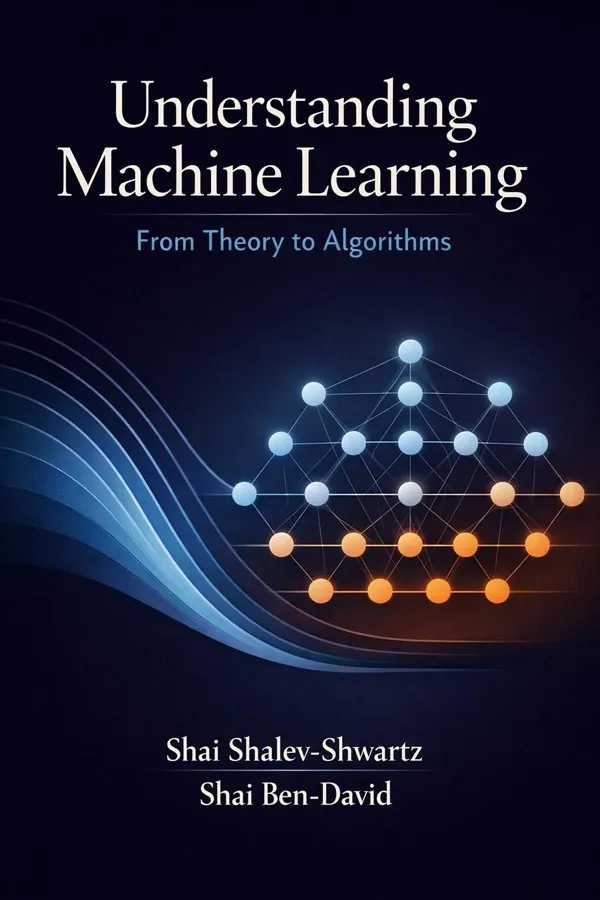
Understanding Machine Learning: From Theory to Algorithms: Summary & Key Insights
by Shai Shalev-Shwartz, Shai Ben-David
 10 min10 chaptersAudio available
What Is Understanding Machine Learning: From Theory to Algorithms About?
Understanding Machine Learning: From Theory to Algorithms by Shai Shalev-Shwartz, Shai Ben-David is a ai_ml book spanning 10 pages. This book provides a comprehensive introduction to the theoretical foundations of machine learning. It covers fundamental concepts such as PAC learning, VC dimension, boosting, kernel methods, and online learning. The authors present rigorous mathematical formulations alongside intuitive explanations, making it suitable for advanced undergraduate and graduate students in computer science and related fields.
This FizzRead summary covers all 10 key chapters of Understanding Machine Learning: From Theory to Algorithms in approximately 10 minutes, distilling the most important ideas, arguments, and takeaways from Shai Shalev-Shwartz, Shai Ben-David's work. Also available as an audio summary and Key Quotes Podcast.
Understanding Machine Learning: From Theory to Algorithms
This book provides a comprehensive introduction to the theoretical foundations of machine learning. It covers fundamental concepts such as PAC learning, VC dimension, boosting, kernel methods, and online learning. The authors present rigorous mathematical formulations alongside intuitive explanations, making it suitable for advanced undergraduate and graduate students in computer science and related fields.
Who Should Read Understanding Machine Learning: From Theory to Algorithms?
This book is perfect for anyone interested in ai_ml and looking to gain actionable insights in a short read. Whether you're a student, professional, or lifelong learner, the key ideas from Understanding Machine Learning: From Theory to Algorithms by Shai Shalev-Shwartz, Shai Ben-David will help you think differently.
- ✓Readers who enjoy ai_ml and want practical takeaways
- ✓Professionals looking to apply new ideas to their work and life
- ✓Anyone who wants the core insights of Understanding Machine Learning: From Theory to Algorithms in just 10 minutes
Want the full summary?
Get instant access to this book summary and 100K+ more with Fizz Moment.
Get Free SummaryAvailable on App Store • Free to download
Key Chapters
At the start of our exploration, we realized the term 'learning' needed precision. Informally, we say an algorithm learns when it improves through experience. Formally, we define learning in the framework introduced by Valiant—the Probably Approximately Correct (PAC) model. The PAC framework gives us the theoretical backbone to quantify what success means in learning: a learner must find a hypothesis that, with high probability, performs approximately as well as the best possible hypothesis on the underlying distribution.
A key assumption in this setting is that examples are drawn independently from an unknown distribution, and our learner receives only a finite sample. With limited data, the challenge is to balance accuracy and reliability. PAC learning measures this balance through two parameters: ε, representing the accuracy requirement, and δ, representing the confidence level. The learner’s aim is to produce a hypothesis whose true error is within ε of the optimal one with probability at least 1 − δ.
By formalizing the problem this way, we move from vague notions of 'good enough' to a concrete mathematical standard. This clarity allows us to reason about sample size requirements, about which hypothesis classes can be learned, and under what conditions. When we say an algorithm is PAC-learnable, we express that there is both an algorithm and a feasible number of samples able to guarantee this level of performance. This framework thereby unites probability, approximation, and computational efficiency under one rigorous definition.
Most importantly, the PAC model demonstrates that learning is not merely data fitting—it is statistical inference under uncertainty. The theory paves the way to understanding sample complexity, the minimum number of examples needed to ensure reliable generalization. As we explore later, the richness of the hypothesis class determines how many samples are required.
Once the PAC model sets the stage, we must ask what controls the learner’s ability to generalize from finite samples. A central insight of learning theory is that generalization does not depend solely on the amount of data but on the capacity of the hypothesis space. The hypothesis space represents all possible models or functions the learner might consider. If this space is too large or too flexible, it will fit the training data perfectly but fail to generalize—a phenomenon known as overfitting.
We introduce the concept of sample complexity, which quantifies how many examples are needed to guarantee PAC learning. The sample complexity depends on two factors: the desired level of accuracy and confidence, and the expressiveness of the hypothesis class. To ground these ideas, we analyze the Empirical Risk Minimization (ERM) principle, where an algorithm selects the hypothesis minimizing the training error. While ERM sounds natural, to prove its legitimacy we need to ensure that minimization on training data leads to low true error—this is where uniform convergence becomes crucial.
Intuitively, uniform convergence means that with enough samples, the empirical error approximates the true error uniformly across all hypotheses in the class. When this property holds, ERM becomes theoretically justified: minimizing empirical risk is equivalent to minimizing true risk. However, uniform convergence holds only for classes with limited capacity—a constraint elegantly captured by the VC dimension. The interplay of sample complexity, capacity, and uniform convergence forms the core of statistical learning theory and explains why simpler models can generalize better than complex ones in limited data regimes.
+ 8 more chapters — available in the FizzRead app
All Chapters in Understanding Machine Learning: From Theory to Algorithms
About the Authors
Shai Shalev-Shwartz is a professor at the Hebrew University of Jerusalem specializing in machine learning and optimization. Shai Ben-David is a professor at the University of Waterloo known for his contributions to theoretical computer science and learning theory.
Get This Summary in Your Preferred Format
Read or listen to the Understanding Machine Learning: From Theory to Algorithms summary by Shai Shalev-Shwartz, Shai Ben-David anytime, anywhere. FizzRead offers multiple formats so you can learn on your terms — all free.
Available formats: App · Audio · PDF · EPUB — All included free with FizzRead
Download Understanding Machine Learning: From Theory to Algorithms PDF and EPUB Summary
Key Quotes from Understanding Machine Learning: From Theory to Algorithms
“At the start of our exploration, we realized the term 'learning' needed precision.”
“Once the PAC model sets the stage, we must ask what controls the learner’s ability to generalize from finite samples.”
Frequently Asked Questions about Understanding Machine Learning: From Theory to Algorithms
Understanding Machine Learning: From Theory to Algorithms by Shai Shalev-Shwartz, Shai Ben-David is a ai_ml book that explores key ideas across 10 chapters. This book provides a comprehensive introduction to the theoretical foundations of machine learning. It covers fundamental concepts such as PAC learning, VC dimension, boosting, kernel methods, and online learning. The authors present rigorous mathematical formulations alongside intuitive explanations, making it suitable for advanced undergraduate and graduate students in computer science and related fields.
You Might Also Like
Life 3.0
Max Tegmark
10 min
Superintelligence
Nick Bostrom
10 min
TensorFlow in Action
Thushan Ganegedara
10 min
AI Made Simple: A Beginner’s Guide to Generative AI, ChatGPT, and the Future of Work
Rajeev Kapur
10 min
AI Snake Oil
Arvind Narayanan, Sayash Kapoor
10 min
AI Superpowers: China, Silicon Valley, and the New World Order
Kai-Fu Lee
10 minBrowse by Category
Ready to read Understanding Machine Learning: From Theory to Algorithms?
Get the full summary and 100K+ more books with Fizz Moment.