
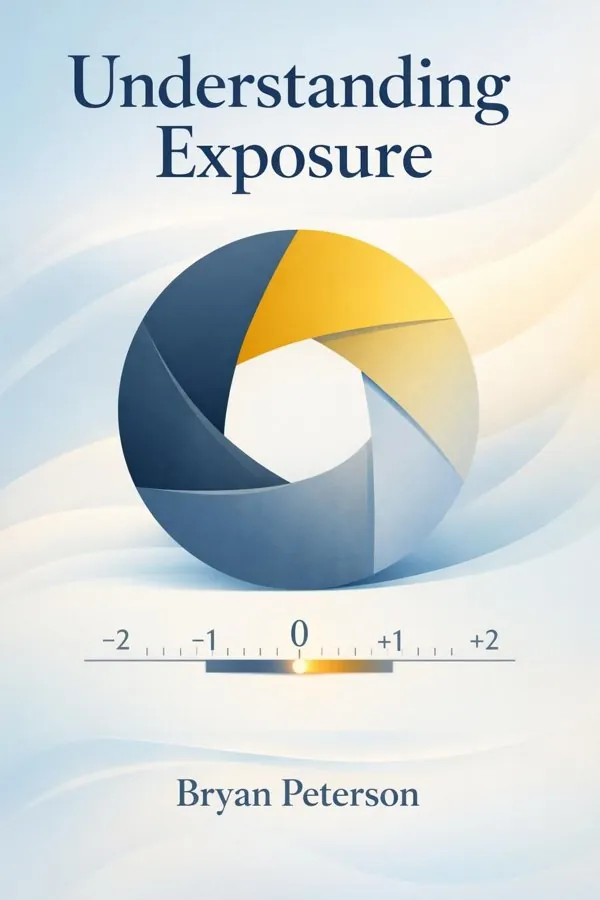
Understanding Exposure: How to Shoot Great Photographs with Any Camera: Summary & Key Insights
 10 min11 chaptersAudio available
What Is Understanding Exposure: How to Shoot Great Photographs with Any Camera About?
Understanding Exposure: How to Shoot Great Photographs with Any Camera by Bryan Peterson is a photography book spanning 11 pages. Understanding Exposure is a comprehensive guide that demystifies the relationship between aperture, shutter speed, and ISO, helping photographers master the art of exposure. Bryan Peterson uses clear explanations and vivid examples to teach how to creatively control light and achieve desired photographic effects, regardless of camera type or experience level.
This FizzRead summary covers all 11 key chapters of Understanding Exposure: How to Shoot Great Photographs with Any Camera in approximately 10 minutes, distilling the most important ideas, arguments, and takeaways from Bryan Peterson's work. Also available as an audio summary and Key Quotes Podcast.
Understanding Exposure: How to Shoot Great Photographs with Any Camera
Understanding Exposure is a comprehensive guide that demystifies the relationship between aperture, shutter speed, and ISO, helping photographers master the art of exposure. Bryan Peterson uses clear explanations and vivid examples to teach how to creatively control light and achieve desired photographic effects, regardless of camera type or experience level.
Who Should Read Understanding Exposure: How to Shoot Great Photographs with Any Camera?
This book is perfect for anyone interested in photography and looking to gain actionable insights in a short read. Whether you're a student, professional, or lifelong learner, the key ideas from Understanding Exposure: How to Shoot Great Photographs with Any Camera by Bryan Peterson will help you think differently.
- ✓Readers who enjoy photography and want practical takeaways
- ✓Professionals looking to apply new ideas to their work and life
- ✓Anyone who wants the core insights of Understanding Exposure: How to Shoot Great Photographs with Any Camera in just 10 minutes
Want the full summary?
Get instant access to this book summary and 100K+ more with Fizz Moment.
Get Free SummaryAvailable on App Store • Free to download
Key Chapters
The concept of the exposure triangle forms the mathematical and creative heart of photography. Each point—aperture, shutter speed, ISO—controls how light interacts with your image, but what many forget is that these three variables never exist in isolation. They are interdependent. Adjust one, and the others must respond accordingly. My philosophy as a teacher has always been to demystify this relationship by showing how simple it really is once you stop thinking of your camera as a machine and start thinking of it as an instrument for seeing.
Aperture controls how much light enters the camera. Shutter speed determines how long that light is allowed to enter. ISO sets how sensitive the sensor (or film) is to that light. When you understand how these factors influence each other, exposure stops being guesswork and becomes deliberate artistic choice. For instance, when photographing a dancer, I choose a faster shutter speed to freeze movement, and therefore must compensate by opening the aperture or increasing ISO. The exposure remains balanced, but the image gains character through intent.
The exposure triangle isn’t a formula to memorize; it’s a framework to shape expression. Think of it as the grammar of light—a way to compose visual sentences with clarity and nuance. The triangle allows you to define depth, motion, texture, and mood. Mastering it liberates you from automation, and instead you begin crafting the image before pressing the shutter. Once you internalize this interplay, every technical decision supports what you feel, not just what you see.
Aperture, controlled by f-stops, is the lens opening that determines how much light enters your camera. But beyond mere exposure, aperture defines depth of field—the measure of how much of your scene appears sharp. To me, aperture is one of the most emotionally expressive tools in photography. A wide f-stop like f/2.8 isolates your subject with a beautifully blurred background, creating intimacy and focus. A narrow aperture like f/16 expands clarity across the frame, conveying connection and context.
Learning aperture is like learning to direct an audience’s attention. When I photograph portraits, I use shallow depth to draw you into the subject’s eyes while allowing the world behind them to fade away. In landscapes, a smaller aperture reveals every detail from foreground to horizon, inviting your gaze to wander and explore. The choice is never arbitrary but deliberate; it reflects how you interpret the world.
Understanding aperture also means you begin to sense light with your instincts. In bright conditions, a smaller aperture maintains exposure while preserving sharpness. At dusk, a wider aperture welcomes scarce light, allowing you to maintain natural ambiance. With practice, you stop thinking in numbers and start sensing relationships—the aperture becomes your brush, painting clarity or softness as the scene demands.
+ 9 more chapters — available in the FizzRead app
All Chapters in Understanding Exposure: How to Shoot Great Photographs with Any Camera
About the Author
Bryan Peterson is an acclaimed photographer, instructor, and author known for his accessible teaching style and deep understanding of photographic technique. He has written several bestselling photography books and founded the Bryan Peterson School of Photography, inspiring photographers worldwide.
Get This Summary in Your Preferred Format
Read or listen to the Understanding Exposure: How to Shoot Great Photographs with Any Camera summary by Bryan Peterson anytime, anywhere. FizzRead offers multiple formats so you can learn on your terms — all free.
Available formats: App · Audio · PDF · EPUB — All included free with FizzRead
Download Understanding Exposure: How to Shoot Great Photographs with Any Camera PDF and EPUB Summary
Key Quotes from Understanding Exposure: How to Shoot Great Photographs with Any Camera
“The concept of the exposure triangle forms the mathematical and creative heart of photography.”
“Aperture, controlled by f-stops, is the lens opening that determines how much light enters your camera.”
Frequently Asked Questions about Understanding Exposure: How to Shoot Great Photographs with Any Camera
Understanding Exposure: How to Shoot Great Photographs with Any Camera by Bryan Peterson is a photography book that explores key ideas across 11 chapters. Understanding Exposure is a comprehensive guide that demystifies the relationship between aperture, shutter speed, and ISO, helping photographers master the art of exposure. Bryan Peterson uses clear explanations and vivid examples to teach how to creatively control light and achieve desired photographic effects, regardless of camera type or experience level.
You Might Also Like

An American In Provence
Jamie Beck
10 min
Camera Lucida: Reflections on Photography
Roland Barthes
10 min
Girl on Girl: Art and Photography in the Age of the Female Gaze
Charlotte Jansen
10 min
Mastering Composition: The Definitive Guide for Photographers
Richard Garvey-Williams
10 min
On Photography
Susan Sontag
10 min
Photography Q&A: Real Questions. Real Answers.
Zack Arias
10 minBrowse by Category
Ready to read Understanding Exposure: How to Shoot Great Photographs with Any Camera?
Get the full summary and 100K+ more books with Fizz Moment.