
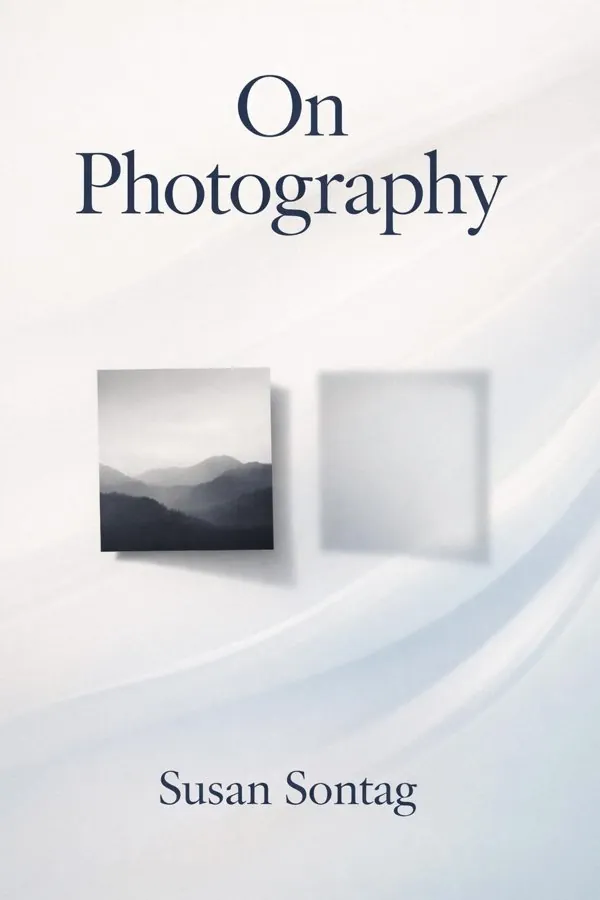
On Photography: Summary & Key Insights
by Susan Sontag
 10 min9 chaptersAudio available
Key Takeaways from On Photography
We increasingly believe we know the world because we have seen pictures of it.
A culture reveals itself through what it chooses to photograph.
Every photograph is a small elegy.
To photograph is not only to observe; it is also, in a subtle sense, to appropriate.
Photographs do more than record events; they teach people what is worth noticing, believing, and desiring.
What Is On Photography About?
On Photography by Susan Sontag is a photography book spanning 6 pages. Susan Sontag’s On Photography is one of the most influential books ever written about images, looking, and modern life. First published in 1977 as a series of essays, it asks a deceptively simple question: what does photography do to the way we see the world? Sontag argues that photographs are never neutral records. They shape memory, define reality, turn suffering into spectacle, and teach us how to desire, consume, and judge. In her view, the camera is both a tool of knowledge and a tool of power. What makes this book endure is that Sontag saw, decades before social media, how image-saturated culture changes attention, empathy, and experience itself. Her insights speak directly to an age of smartphones, selfies, surveillance, and endless scrolling. She shows that taking a picture is not just preserving a moment; it is claiming, framing, and often distancing it. Sontag writes with unusual authority because she was not only a literary stylist but also a major cultural critic who moved effortlessly across philosophy, politics, art, and media. On Photography remains essential for anyone who wants to understand why images feel so powerful—and so dangerous.
This FizzRead summary covers all 9 key chapters of On Photography in approximately 10 minutes, distilling the most important ideas, arguments, and takeaways from Susan Sontag's work. Also available as an audio summary and Key Quotes Podcast.
On Photography
Susan Sontag’s On Photography is one of the most influential books ever written about images, looking, and modern life. First published in 1977 as a series of essays, it asks a deceptively simple question: what does photography do to the way we see the world? Sontag argues that photographs are never neutral records. They shape memory, define reality, turn suffering into spectacle, and teach us how to desire, consume, and judge. In her view, the camera is both a tool of knowledge and a tool of power.
What makes this book endure is that Sontag saw, decades before social media, how image-saturated culture changes attention, empathy, and experience itself. Her insights speak directly to an age of smartphones, selfies, surveillance, and endless scrolling. She shows that taking a picture is not just preserving a moment; it is claiming, framing, and often distancing it.
Sontag writes with unusual authority because she was not only a literary stylist but also a major cultural critic who moved effortlessly across philosophy, politics, art, and media. On Photography remains essential for anyone who wants to understand why images feel so powerful—and so dangerous.
Who Should Read On Photography?
This book is perfect for anyone interested in photography and looking to gain actionable insights in a short read. Whether you're a student, professional, or lifelong learner, the key ideas from On Photography by Susan Sontag will help you think differently.
- ✓Readers who enjoy photography and want practical takeaways
- ✓Professionals looking to apply new ideas to their work and life
- ✓Anyone who wants the core insights of On Photography in just 10 minutes
Want the full summary?
Get instant access to this book summary and 100K+ more with Fizz Moment.
Get Free SummaryAvailable on App Store • Free to download
Key Chapters
We increasingly believe we know the world because we have seen pictures of it. That is the unsettling premise behind Sontag’s opening argument in “In Plato’s Cave.” Like the prisoners in Plato’s allegory who mistake shadows for reality, modern people often relate to life through images rather than direct experience. Photography does not merely document reality; it creates a new visual order in which what is photographed feels more real, more important, and more memorable than what is simply lived.
Sontag argues that photographs become proof. We trust them as evidence, souvenirs, and tokens of presence. A vacation seems incomplete without pictures. A meal, protest, or reunion can feel strangely unfinished until it is recorded. Yet the act of photographing can also remove us from the moment. We stop participating and begin collecting. The camera turns events into objects we can possess.
This shift matters because it changes the meaning of memory and attention. Instead of remembering through reflection, we outsource remembering to images. Instead of encountering the world openly, we often scan it for picture-worthy scenes. Today this insight is even sharper: people attend concerts through phone screens, evaluate destinations by their “Instagrammability,” and experience news as a rapid sequence of compelling images.
Sontag does not ask us to reject photography altogether. She asks us to see the tradeoff. Images preserve, but they also mediate. They enlarge access, but they can flatten reality into surfaces.
Actionable takeaway: the next time you reach for your camera, pause for a few seconds first. Ask whether you want to witness the moment, own it, share it, or understand it. That question alone can restore awareness to your seeing.
A culture reveals itself through what it chooses to photograph. In “America, Seen Through Photographs, Darkly,” Sontag suggests that American photography is marked by a peculiar duality: exuberance on one side, decay on the other. The United States has produced vast archives of aspiration, mobility, family life, glamour, consumption, and novelty. At the same time, it has also generated a persistent fascination with damage, loneliness, poverty, madness, and ruin.
Sontag discusses photographers such as Walker Evans, Robert Frank, Diane Arbus, and others who helped define this visual self-portrait of America. Their work often strips away official optimism and exposes a more unsettling truth. Even images that appear ordinary or documentary can carry undertones of alienation. Photography in America becomes both a democratic inventory and a moral diagnosis.
This contradiction matters because photographs shape national self-understanding. They can celebrate a society, but they can also reveal what that society excludes or represses. A glossy ad campaign and a street documentary may depict the same country while telling opposite stories. Think about how contemporary America is seen through lifestyle influencers, police bodycam footage, campaign imagery, disaster coverage, and portraits of inequality. Each image stream constructs a different nation.
Sontag’s insight is that photography does not settle reality; it multiplies interpretations of it. A nation can be photographed as thriving and broken at once. That is why visual literacy is inseparable from civic literacy.
Actionable takeaway: when you look at photographs of a place or culture, compare at least two visual narratives—the celebratory and the critical. Doing so helps you resist mistaking one curated image-world for the whole truth.
Every photograph is a small elegy. Even when it captures joy, it silently announces that the moment is gone. In “Melancholy Objects,” Sontag explores photography’s intimate bond with loss, nostalgia, and mortality. A photograph freezes time, but precisely by freezing it, it reminds us that life moves on. The image survives while the instant vanishes.
This is why photographs can feel haunting. A family portrait becomes more charged after someone dies. A snapshot of childhood looks innocent until years pass and we see everything that changed. The camera creates objects of memory, but these objects are tinged with sadness because they preserve what cannot return. Photography, in this sense, is an art of possession shadowed by absence.
Sontag also notes that photographs gain meaning over time. An image that once seemed casual may later become historically significant or emotionally devastating. Think of old street scenes, pre-disaster skylines, pictures of friends before estrangement, or images of cities before war. The melancholy is not always in the subject itself; it emerges from distance and hindsight.
In everyday life, this helps explain why people revisit photo albums, camera rolls, and social media memories with mixed emotions. Images comfort us, but they can also sharpen grief, regret, and longing. The photograph is never just “there”; it is charged by what happened after it was taken.
Sontag’s point is not cynical. It is clarifying. Photography lets us hold onto fragments of time, but those fragments become precious because time cannot be held.
Actionable takeaway: choose a few meaningful photographs and write a sentence about what each image cannot show—the before, the after, or the feeling outside the frame. This practice deepens memory instead of reducing it to nostalgia.
To photograph is not only to observe; it is also, in a subtle sense, to appropriate. In “The Heroism of Vision,” Sontag examines the prestige attached to the photographic eye. The photographer is often celebrated as a brave witness, someone who enters unfamiliar territory, notices what others ignore, and brings back visible truth. Yet this heroic image of the photographer can hide a more complicated reality: looking itself can become an act of control.
The camera selects, frames, excludes, and freezes. It decides what deserves attention and how it should appear. This gives the photographer authority, especially when photographing strangers, the poor, the sick, or the socially marginal. Images presented as candid or honest may still reflect the photographer’s desire, curiosity, or aesthetic agenda.
Sontag is especially alert to the moral ambiguity of turning pain or strangeness into compelling images. A photographer may intend to reveal injustice, but the resulting image can also aestheticize suffering. The viewer admires the picture without confronting the conditions it depicts. This tension remains urgent today in street photography, documentary work, war reporting, and viral footage of private distress.
At the same time, photography can genuinely expand awareness. It can reveal hidden realities, challenge official narratives, and honor unnoticed lives. The issue is not whether photographers should look, but whether they understand the responsibility attached to looking.
For ordinary image-makers, this insight applies whenever we photograph children, workers, strangers, or vulnerable people. The ease of image capture can obscure questions of consent, dignity, and context.
Actionable takeaway: before taking or sharing a photograph of another person, ask yourself three things: Do I have the right? What story does this image tell? Who benefits from it? Those questions make vision more ethical.
Photographs do more than record events; they teach people what is worth noticing, believing, and desiring. In “Photographic Evangels,” Sontag explores how certain photographers and traditions turn photography into a kind of secular gospel. The camera becomes a doctrine of attention: it promises truth, revelation, authenticity, and even redemption through seeing.
Different photographic schools preach different gospels. Some celebrate beauty in the ordinary, insisting that every object can become meaningful under sufficient scrutiny. Others valorize shock, ugliness, or social extremity, teaching viewers that the hidden truth of society lies in what is damaged or taboo. In either case, photography does not merely reflect values; it actively organizes them.
This explains why certain visual styles carry moral force. Black-and-white documentary images often feel serious and truthful. Grainy or unpolished photos may seem more authentic than polished ones. Personal snapshots can signal intimacy, while highly staged photographs can imply artifice or power. None of these meanings are natural. They are culturally learned.
In the digital era, entire platforms function as photographic evangelists. Fitness imagery preaches discipline. luxury feeds preach aspiration. activist imagery preaches urgency. lifestyle photography preaches self-branding. Each visual system encourages people to adopt particular habits of feeling and judgment.
Sontag’s deeper insight is that photography shapes taste and conscience at the same time. What we repeatedly see, we come to accept; what we are taught to admire, we begin to seek.
Actionable takeaway: audit the image streams you consume most often. Ask what they are training you to value—beauty, outrage, envy, intimacy, status, or compassion. Curating your visual diet is one way to protect your mind.
When images multiply without limit, reality itself begins to feel secondary. In “The Image-World,” Sontag argues that modern society increasingly lives inside a vast circulation of pictures. Photographs do not just accompany reality; they compete with it, define it, and in many contexts replace it. We understand war, celebrity, travel, poverty, politics, and even ourselves through endlessly reproduced images.
This image-world has several effects. First, it creates familiarity without experience. People feel they know distant places, historical events, and public figures because they have seen many pictures of them. Second, it encourages consumption. Images make everything available as a spectacle, inviting desire, comparison, and acquisition. Third, it blurs boundaries between information, entertainment, memory, and advertising. A tragedy, a product launch, and a personal milestone can appear in the same visual stream.
Sontag’s analysis now feels prophetic. Social media has intensified what she diagnosed in print culture and mass media. We inhabit feeds where identity is curated, events are filtered through aesthetics, and visibility itself becomes a form of power. To be unseen can feel like nonexistence; to be overexposed can mean commodification.
Yet Sontag’s warning is not that images are false and reality is pure. It is that saturation dulls judgment. When everything becomes photographable and shareable, significance becomes harder to assess. We can become informed without being transformed.
Actionable takeaway: practice slower looking. Spend a full minute with one meaningful image instead of scrolling past fifty. Ask what is framed, what is omitted, and what response the image seeks from you. Depth is an antidote to saturation.
Few inventions have made image-making as accessible as photography. That accessibility is liberating, but it also changes the status of art itself. Sontag argues that photography democratizes visual culture by allowing ordinary people to produce and own images on a massive scale. At the same time, abundance can cheapen attention. When images become easy to make and easy to duplicate, their meaning can become thinner.
Photography challenged older ideas about artistic skill and originality. A painting required visible craftsmanship; a photograph seemed mechanically produced, though Sontag insists that choice, framing, timing, and context still matter. Because photographs can be reproduced endlessly, they circulate in books, newspapers, advertisements, museums, and private albums with unusual fluidity. This gives photography a unique cultural power: it is both art and mass object.
The tension remains visible today. A powerful photograph can move millions, but images are also disposable, endlessly edited, reposted, and forgotten. Museums display photographs as fine art while platforms treat them as content. Creators pursue vision, but algorithms reward speed, novelty, and engagement. The result is a culture in which art is widely available yet often weakly encountered.
Sontag helps us see that democratization is not the enemy of art. The danger lies in mistaking abundance for understanding. Seeing more images does not automatically mean seeing better.
For readers, creators, and viewers alike, the challenge is to preserve seriousness in a medium built for duplication.
Actionable takeaway: choose one photographer you admire and study a full body of work rather than isolated famous images. Context restores depth and helps you distinguish art from mere visual noise.
One of Sontag’s most troubling insights is that repeated exposure to shocking photographs can weaken, rather than deepen, moral response. Images of war, hunger, disaster, and violence may initially provoke horror and sympathy. But when such images are consumed continually, they risk becoming familiar. The extraordinary becomes routine. Compassion gives way to fatigue.
Sontag does not say photographs are useless as moral instruments. Far from it: they can reveal atrocities, stir public awareness, and preserve evidence. But she insists that looking is not the same as acting, and feeling shocked is not the same as understanding. Without context, repetition can turn suffering into spectacle. Viewers may seek emotional intensity while remaining distant from the people depicted.
This insight is especially relevant in digital culture, where disturbing footage spreads instantly. A user may move from scenes of catastrophe to jokes, recipes, and vacation photos in seconds. The surrounding stream undermines sustained attention. Outrage becomes episodic, quickly replaced by the next image.
Sontag’s challenge is ethical as much as psychological. How do we remain responsive without becoming overwhelmed or desensitized? Part of the answer lies in resisting passive consumption. A photograph should lead to questions: What happened here? Who is responsible? What structures made this possible? What can be done?
Images alone rarely generate lasting moral clarity. They need interpretation, history, and action.
Actionable takeaway: when a disturbing photograph moves you, do one concrete follow-up step within 24 hours—read reporting, donate, contact an organization, or discuss the issue seriously. Turning reaction into response prevents compassion from dissolving into spectacle.
Photographs often appear objective because the camera records what was in front of it. Sontag pushes back against that assumption. Every photograph, she argues, is an interpretation shaped by choices: where to stand, when to click, what to include, what to crop, whether to publish, and how to caption. Even the most documentary image is never raw reality.
This does not mean photographs are lies. It means they are framed truths. Two photographers at the same event can produce radically different impressions: one emphasizes chaos, another solidarity; one isolates a grieving face, another shows the broader political setting. Editors and platforms add further layers of interpretation through sequencing, headlines, filters, and circulation.
Understanding this is crucial for media literacy. News photography, personal branding, family albums, and travel imagery all depend on selective presentation. A “candid” image may be carefully chosen from many takes. A protest photo can exaggerate either menace or momentum depending on angle. A family portrait can conceal conflict just as documentary photography can exaggerate dysfunction.
Sontag’s point is liberating as well as cautionary. If photographs are interpretations, viewers are not helpless. We can ask better questions and resist being overpersuaded by immediacy. We can also become more honest image-makers by acknowledging our own framing habits.
In a world of edited realities, skepticism is not cynicism; it is discipline.
Actionable takeaway: whenever a photograph seems to settle an issue instantly, pause and ask four questions: Who took it? Why this moment? What lies outside the frame? How would a different angle change the story? Those questions sharpen visual judgment.
All Chapters in On Photography
About the Author
Susan Sontag (1933–2004) was an American writer, critic, novelist, and public intellectual whose work reshaped discussions of art, media, illness, war, and interpretation. Educated at the University of Chicago, Harvard, and Oxford, she became known for combining philosophical seriousness with literary style. Her breakthrough essay collection Against Interpretation established her as one of the most daring cultural critics of her time, and later books such as On Photography, Illness as Metaphor, and Regarding the Pain of Others confirmed her international influence. Sontag wrote fiction, directed films and theater, and engaged publicly with political crises around the world. She remains celebrated for her ability to connect aesthetics with ethics and to challenge readers to think harder about how culture shapes perception.
Get This Summary in Your Preferred Format
Read or listen to the On Photography summary by Susan Sontag anytime, anywhere. FizzRead offers multiple formats so you can learn on your terms — all free.
Available formats: App · Audio · PDF · EPUB — All included free with FizzRead
Download On Photography PDF and EPUB Summary
Key Quotes from On Photography
“We increasingly believe we know the world because we have seen pictures of it.”
“A culture reveals itself through what it chooses to photograph.”
“Even when it captures joy, it silently announces that the moment is gone.”
“To photograph is not only to observe; it is also, in a subtle sense, to appropriate.”
“Photographs do more than record events; they teach people what is worth noticing, believing, and desiring.”
Frequently Asked Questions about On Photography
On Photography by Susan Sontag is a photography book that explores key ideas across 9 chapters. Susan Sontag’s On Photography is one of the most influential books ever written about images, looking, and modern life. First published in 1977 as a series of essays, it asks a deceptively simple question: what does photography do to the way we see the world? Sontag argues that photographs are never neutral records. They shape memory, define reality, turn suffering into spectacle, and teach us how to desire, consume, and judge. In her view, the camera is both a tool of knowledge and a tool of power. What makes this book endure is that Sontag saw, decades before social media, how image-saturated culture changes attention, empathy, and experience itself. Her insights speak directly to an age of smartphones, selfies, surveillance, and endless scrolling. She shows that taking a picture is not just preserving a moment; it is claiming, framing, and often distancing it. Sontag writes with unusual authority because she was not only a literary stylist but also a major cultural critic who moved effortlessly across philosophy, politics, art, and media. On Photography remains essential for anyone who wants to understand why images feel so powerful—and so dangerous.
You Might Also Like

An American In Provence
Jamie Beck
10 min
Camera Lucida: Reflections on Photography
Roland Barthes
10 min
Girl on Girl: Art and Photography in the Age of the Female Gaze
Charlotte Jansen
10 min
Mastering Composition: The Definitive Guide for Photographers
Richard Garvey-Williams
10 min
Photography Q&A: Real Questions. Real Answers.
Zack Arias
10 min
Picture Perfect Practice: A Self-Training Guide to Mastering the Challenges of Taking World-Class Photographs
Roberto Valenzuela
10 minBrowse by Category
Ready to read On Photography?
Get the full summary and 100K+ more books with Fizz Moment.