
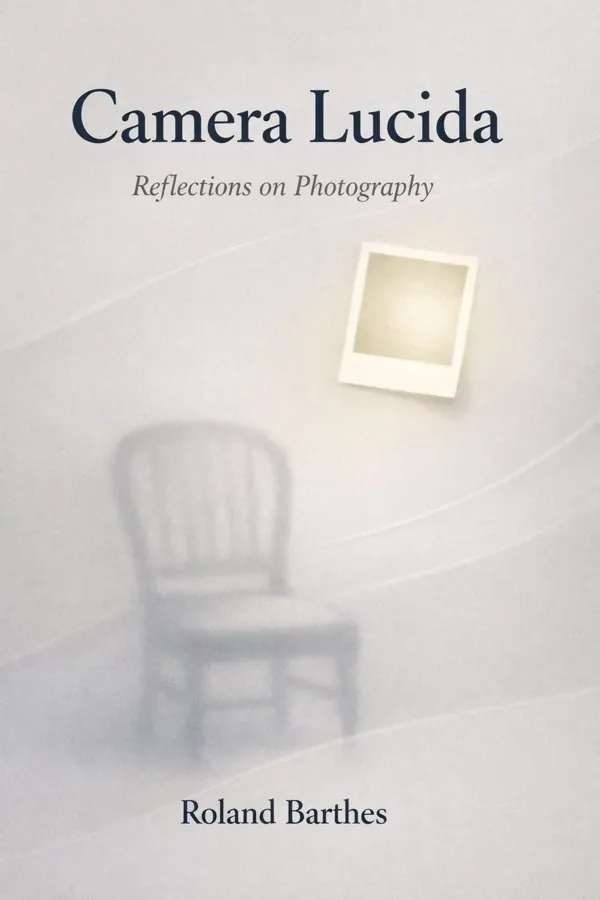
Camera Lucida: Reflections on Photography: Summary & Key Insights
 10 min6 chaptersAudio available
What Is Camera Lucida: Reflections on Photography About?
Camera Lucida: Reflections on Photography by Roland Barthes is a photography book spanning 6 pages. Camera Lucida is Roland Barthes’s final book, a profound meditation on photography as a medium of memory, mortality, and subjectivity. Divided into two parts, it explores the cultural and semiotic dimensions of photography before turning into a deeply personal reflection on the photograph of Barthes’s mother and the nature of presence and loss.
This FizzRead summary covers all 6 key chapters of Camera Lucida: Reflections on Photography in approximately 10 minutes, distilling the most important ideas, arguments, and takeaways from Roland Barthes's work. Also available as an audio summary and Key Quotes Podcast.
Camera Lucida: Reflections on Photography
Camera Lucida is Roland Barthes’s final book, a profound meditation on photography as a medium of memory, mortality, and subjectivity. Divided into two parts, it explores the cultural and semiotic dimensions of photography before turning into a deeply personal reflection on the photograph of Barthes’s mother and the nature of presence and loss.
Who Should Read Camera Lucida: Reflections on Photography?
This book is perfect for anyone interested in photography and looking to gain actionable insights in a short read. Whether you're a student, professional, or lifelong learner, the key ideas from Camera Lucida: Reflections on Photography by Roland Barthes will help you think differently.
- ✓Readers who enjoy photography and want practical takeaways
- ✓Professionals looking to apply new ideas to their work and life
- ✓Anyone who wants the core insights of Camera Lucida: Reflections on Photography in just 10 minutes
Want the full summary?
Get instant access to this book summary and 100K+ more with Fizz Moment.
Get Free SummaryAvailable on App Store • Free to download
Key Chapters
In trying to grasp photography’s essence, I began with a distinction: every image, from a painting to a film frame, represents something. But a photograph does not merely represent—it testifies. It bears witness to reality itself. The camera, mechanical and indifferent, captures what once stood before its lens. Unlike a painting, which interprets, or a drawing, which imagines, photography has what I call a 'referential nature.' It is chemically and physically tethered to the thing photographed. Nothing can undo that connection.
This is why photography is inseparable from time. The photograph exists in a suspended temporality—it announces both presence and absence. Each photograph says, 'This is what I once saw, and it is gone.' This relation to time is not abstract but deeply human, for in every act of looking at a photograph, we confront mortality. The image freezes a moment that can never be relived, and yet it keeps a trace of that moment eternally available to our gaze.
Still, to understand the photograph fully, one must also understand that it has no reverse. What it shows remains bound to a specific 'that-has-been.' When I look at the photographic portrait of a condemned man in the 19th century, what moves me is not his historical context but the undeniable truth that he was there—alive, before the camera—and that by the time I encounter him, he has long become a shadow. In this way, photography intensifies the awareness of existence precisely by exposing its fragility.
Every photograph involves three presences. The Operator is the photographer—the one who manipulates the device, frames the shot, and determines what the lens will record. The Spectator is the viewer, who comes later and experiences the image within their own web of emotions, memories, and culture. And the Spectrum—the most enigmatic of all—is the photographed subject. The word, derived from the Latin for 'appearance' or 'ghost,' captures photography’s uncanny essence: the subject becomes at once present and spectral.
For me, facing a photograph is always a duel between these forces. The Operator brings intention, but that intention dies at the moment of exposure, because once the shutter clicks, control is gone—the image becomes autonomous. The Spectator, on the other hand, may perceive meanings the Operator never intended. And the Spectrum, the one who was photographed, lives an afterlife within that image. Their body becomes an eidolon, a visual echo. When I look at a face in a photograph, I am not seeing merely a sign; I am seeing the residue of life, the literal trace of light that touched the subject.
This triadic relationship explains why photographing people always carries an element of violence, however gentle. To photograph is to appropriate, to fix the living in a state of immobility. The person photographed becomes both immortal and forever mute. This paradox—between presence and silence—is the space where photography’s deepest truth vibrates.
+ 4 more chapters — available in the FizzRead app
All Chapters in Camera Lucida: Reflections on Photography
About the Author
Roland Barthes (1915–1980) was a French literary critic, philosopher, and semiotician. A leading figure in structuralist and post-structuralist thought, he is known for works such as 'Mythologies', 'Writing Degree Zero', and 'Camera Lucida'. His writings have had a lasting influence on literary theory, cultural studies, and visual analysis.
Get This Summary in Your Preferred Format
Read or listen to the Camera Lucida: Reflections on Photography summary by Roland Barthes anytime, anywhere. FizzRead offers multiple formats so you can learn on your terms — all free.
Available formats: App · Audio · PDF · EPUB — All included free with FizzRead
Download Camera Lucida: Reflections on Photography PDF and EPUB Summary
Key Quotes from Camera Lucida: Reflections on Photography
“In trying to grasp photography’s essence, I began with a distinction: every image, from a painting to a film frame, represents something.”
“Every photograph involves three presences.”
Frequently Asked Questions about Camera Lucida: Reflections on Photography
Camera Lucida: Reflections on Photography by Roland Barthes is a photography book that explores key ideas across 6 chapters. Camera Lucida is Roland Barthes’s final book, a profound meditation on photography as a medium of memory, mortality, and subjectivity. Divided into two parts, it explores the cultural and semiotic dimensions of photography before turning into a deeply personal reflection on the photograph of Barthes’s mother and the nature of presence and loss.
You Might Also Like

An American In Provence
Jamie Beck
10 min
Girl on Girl: Art and Photography in the Age of the Female Gaze
Charlotte Jansen
10 min
Mastering Composition: The Definitive Guide for Photographers
Richard Garvey-Williams
10 min
On Photography
Susan Sontag
10 min
Photography Q&A: Real Questions. Real Answers.
Zack Arias
10 min
Picture Perfect Practice: A Self-Training Guide to Mastering the Challenges of Taking World-Class Photographs
Roberto Valenzuela
10 minBrowse by Category
Ready to read Camera Lucida: Reflections on Photography?
Get the full summary and 100K+ more books with Fizz Moment.