
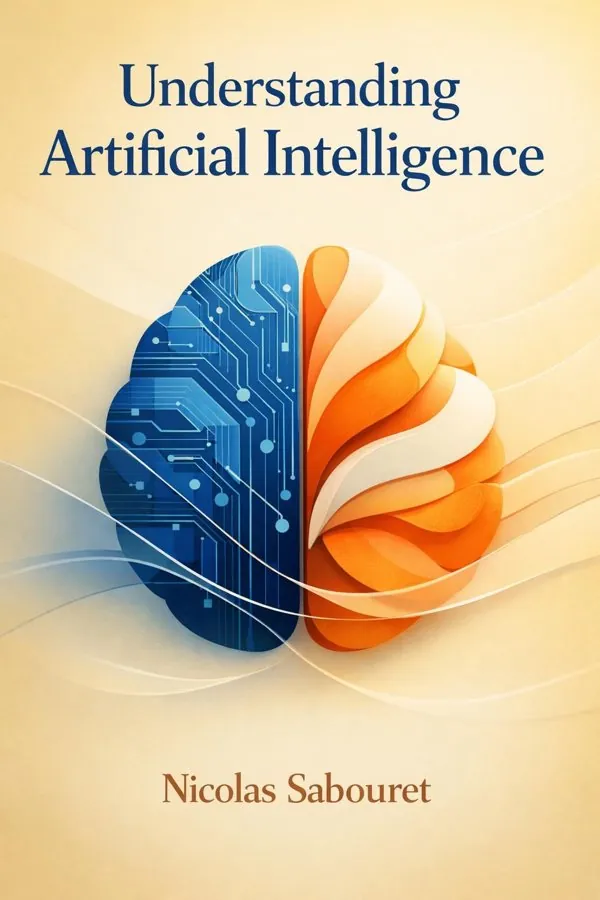
Understanding Artificial Intelligence: Summary & Key Insights
 10 min9 chaptersAudio available
Key Takeaways from Understanding Artificial Intelligence
Every major technological revolution begins as a philosophical question.
We speak easily about “intelligent machines,” yet intelligence itself is surprisingly difficult to define.
One powerful dream in AI is that thinking can be expressed as rules.
Sometimes the smartest way to program a machine is not to tell it what to do, but to let it discover patterns for itself.
Some breakthroughs happen not because machines suddenly become intelligent, but because a method finally becomes practical at scale.
What Is Understanding Artificial Intelligence About?
Understanding Artificial Intelligence by Nicolas Sabouret is a ai_ml book spanning 9 pages. Artificial intelligence is often discussed in extremes: either as a miraculous solution to human problems or as a looming threat beyond our control. In Understanding Artificial Intelligence, Nicolas Sabouret cuts through that confusion with a balanced, lucid introduction to what AI really is, how it developed, and what it can and cannot do. Rather than relying on hype, he explains the core ideas behind intelligent systems: reasoning, learning, perception, language, robotics, and interaction. He also shows how these ideas appear in everyday technologies, from recommendation engines and voice assistants to self-driving systems and decision-making tools. What makes this book especially valuable is its ability to connect technical foundations with human questions. Sabouret does not present AI as a mysterious black box, but as a set of methods designed by people, shaped by data, and embedded in society. As a professor of computer science and researcher in artificial intelligence and human-computer interaction, he brings both academic rigor and pedagogical clarity. The result is an accessible guide for readers who want to understand AI beyond headlines and buzzwords, and to think more critically about its growing role in human life.
This FizzRead summary covers all 9 key chapters of Understanding Artificial Intelligence in approximately 10 minutes, distilling the most important ideas, arguments, and takeaways from Nicolas Sabouret's work. Also available as an audio summary and Key Quotes Podcast.
Understanding Artificial Intelligence
Artificial intelligence is often discussed in extremes: either as a miraculous solution to human problems or as a looming threat beyond our control. In Understanding Artificial Intelligence, Nicolas Sabouret cuts through that confusion with a balanced, lucid introduction to what AI really is, how it developed, and what it can and cannot do. Rather than relying on hype, he explains the core ideas behind intelligent systems: reasoning, learning, perception, language, robotics, and interaction. He also shows how these ideas appear in everyday technologies, from recommendation engines and voice assistants to self-driving systems and decision-making tools.
What makes this book especially valuable is its ability to connect technical foundations with human questions. Sabouret does not present AI as a mysterious black box, but as a set of methods designed by people, shaped by data, and embedded in society. As a professor of computer science and researcher in artificial intelligence and human-computer interaction, he brings both academic rigor and pedagogical clarity. The result is an accessible guide for readers who want to understand AI beyond headlines and buzzwords, and to think more critically about its growing role in human life.
Who Should Read Understanding Artificial Intelligence?
This book is perfect for anyone interested in ai_ml and looking to gain actionable insights in a short read. Whether you're a student, professional, or lifelong learner, the key ideas from Understanding Artificial Intelligence by Nicolas Sabouret will help you think differently.
- ✓Readers who enjoy ai_ml and want practical takeaways
- ✓Professionals looking to apply new ideas to their work and life
- ✓Anyone who wants the core insights of Understanding Artificial Intelligence in just 10 minutes
Want the full summary?
Get instant access to this book summary and 100K+ more with Fizz Moment.
Get Free SummaryAvailable on App Store • Free to download
Key Chapters
Every major technological revolution begins as a philosophical question. Artificial intelligence did not suddenly appear with modern computers; it emerged from centuries of reflection on thought, logic, language, and the nature of the mind. Sabouret shows that to understand AI properly, we must look beyond software and algorithms to the intellectual roots of the field. Philosophers asked whether reasoning could be formalized, mathematicians developed symbolic logic, and early computer scientists began to wonder whether machines could manipulate symbols in ways that resembled human thought.
The formal birth of AI is usually traced to the 1956 Dartmouth conference, where the term “artificial intelligence” was coined. That moment gathered researchers who believed that learning, reasoning, and problem-solving could be described so precisely that a machine could simulate them. This optimism led to impressive early advances, such as theorem proving and game-playing programs. But progress was uneven. Periods of excitement were followed by “AI winters,” when funding and public enthusiasm collapsed because the technology could not meet inflated expectations.
This history matters because AI has always moved in cycles of ambition, disappointment, and renewal. The recent boom in data-driven methods may feel unprecedented, but it follows the same pattern: breakthroughs attract attention, then society must separate genuine capability from exaggeration. Practical examples include the shift from rule-based expert systems in the 1980s to machine learning systems today, as well as changing public reactions to chatbots, autonomous vehicles, and predictive tools.
Actionable takeaway: When evaluating any AI claim, place it in historical context. Ask what problem it actually solves, what methods it uses, and whether the promise reflects demonstrated capability or another wave of hype.
We speak easily about “intelligent machines,” yet intelligence itself is surprisingly difficult to define. Sabouret emphasizes that before discussing artificial intelligence, we must first clarify what we mean by intelligence in humans. Human intelligence is not one single ability. It includes perception, memory, abstraction, learning, reasoning, adaptation, creativity, communication, and social understanding. Some of these abilities can be modeled computationally; others remain deeply resistant to formalization.
This distinction is essential because AI does not reproduce human intelligence as a whole. Instead, it typically captures narrow functions that resemble parts of human cognition. A chess engine can outperform grandmasters in a bounded domain without understanding the broader human meaning of competition, strategy, or emotion. A translation system can generate fluent sentences without possessing lived experience or common sense in the human sense. Sabouret encourages readers to see AI not as an artificial person, but as a collection of techniques that solve specific cognitive tasks.
This helps explain both the strengths and limits of AI applications. Recommendation systems are “intelligent” because they detect patterns in behavior and predict preferences. Medical support tools are “intelligent” because they classify images or estimate risks. But neither system is wise, conscious, or morally aware. Confusing performance with understanding leads to misplaced trust.
In daily life, this insight can change how we use digital tools. Voice assistants may seem conversational, but they do not “know” us as humans do. Customer support bots may answer efficiently, yet they lack empathy unless carefully designed to simulate it.
Actionable takeaway: Replace the vague question “Is this AI intelligent?” with a sharper one: “What specific human ability is this system imitating, and where are its limits?”
One powerful dream in AI is that thinking can be expressed as rules. Symbolic AI, one of the earliest major approaches in the field, is built on this premise. Sabouret explains that symbolic systems represent knowledge explicitly using symbols, categories, and logical relationships. If a machine can store facts and apply rules consistently, then it can reason through problems in a structured way.
This approach works especially well in domains where the rules are clear and stable. For example, a medical expert system might encode symptoms, diagnoses, and treatment rules. A legal support tool might navigate regulations and precedents. Chess-playing programs historically relied on symbolic search methods, exploring possible moves through formal structures. The great strength of symbolic AI is transparency: humans can often inspect the rules and understand why a system reached a conclusion.
However, symbolic AI also reveals a central difficulty of intelligence: the world is messy. Humans rely not only on explicit rules but on intuition, background knowledge, context, and flexibility. It is extremely hard to write rules for everything we know implicitly. A robot told to “bring the cup from the kitchen” must deal with ambiguity, obstacles, changing layouts, and unstated assumptions that humans handle naturally. This is known in part as the problem of common sense.
Still, symbolic reasoning remains important today. It is used in planning systems, knowledge graphs, automated theorem proving, and hybrid AI architectures that combine logical structure with machine learning. In business contexts, rule-based systems are still valuable in compliance, fraud detection, and decision workflows where interpretability matters.
Actionable takeaway: Use symbolic AI thinking when a problem depends on clear rules, traceable decisions, and domain knowledge. If you need explainability, do not overlook the power of explicit reasoning systems.
Sometimes the smartest way to program a machine is not to tell it what to do, but to let it discover patterns for itself. That is the core insight behind machine learning. Sabouret presents machine learning as a major shift in AI: instead of encoding intelligence manually through rules, developers provide examples, data, and objectives, and the system learns statistical regularities from them.
This approach has transformed modern technology because many real-world problems are too complex for hand-written rules. Consider spam filtering. It is nearly impossible to list every possible form of spam in advance, because spammers constantly adapt. But a machine learning model can analyze thousands of emails, detect patterns associated with unwanted messages, and improve with more data. The same principle drives credit scoring, recommendation engines, image classification, predictive maintenance, and demand forecasting.
Sabouret also clarifies that machine learning is not magic. Its effectiveness depends on data quality, task definition, and evaluation. If training data is biased, incomplete, or unrepresentative, the learned model will inherit those weaknesses. If a company trains a hiring algorithm on past recruitment data shaped by discrimination, the model may reproduce that bias. If a system is optimized for the wrong metric, it may perform well statistically while failing in practical use.
Understanding supervised, unsupervised, and reinforcement learning helps readers make sense of the landscape. A supervised model learns from labeled examples, such as identifying tumors in annotated scans. An unsupervised model detects hidden structures, like customer segments. Reinforcement learning improves through trial and error, as in game-playing or robotic control.
Actionable takeaway: Whenever you encounter a machine learning system, ask three questions: what data trained it, what objective it optimizes, and how its performance is measured in the real world.
Some breakthroughs happen not because machines suddenly become intelligent, but because a method finally becomes practical at scale. Deep learning is one of those breakthroughs. Sabouret explains neural networks as computational models inspired loosely by the brain: large numbers of simple units are connected in layers, and learning consists of adjusting those connections so the system can map inputs to useful outputs.
What made deep learning revolutionary was its ability to learn complex representations automatically from huge amounts of data. Earlier systems often required humans to define features manually. Deep learning reduced that dependence by allowing models to discover relevant patterns on their own. In image recognition, for instance, lower layers may detect edges and textures, while deeper layers capture shapes and objects. In speech recognition, neural networks can learn acoustic patterns directly from audio. In natural language processing, they can model subtle relationships among words and sentences.
This has led to dramatic improvements in facial recognition, medical imaging, machine translation, text generation, and autonomous driving components. A photo app can group images by person; a hospital tool can help detect anomalies in scans; a navigation system can identify pedestrians and road signs. Yet Sabouret also highlights the cost of this success. Deep learning models often require massive datasets, expensive computing power, and substantial energy. They can also be opaque, making it difficult to explain individual decisions.
The lesson is not that deep learning solves intelligence, but that it excels in pattern-rich tasks where traditional programming struggled. Its weaknesses become visible when context, causality, robustness, or explanation are essential.
Actionable takeaway: Treat deep learning as a powerful pattern-recognition tool, not a universal solution. Use it where data is abundant and outcomes are measurable, but pair it with human oversight when consequences are significant.
Language is where AI feels most human, which is exactly why it can be most misleading. Sabouret examines natural language processing and human-computer interaction as areas where machines appear to understand us, yet often operate through sophisticated statistical approximations rather than genuine comprehension. A chatbot, translator, or voice assistant can process language impressively, but language is more than syntax. It carries context, intention, emotion, cultural references, and shared background knowledge.
This makes language one of the hardest frontiers in AI. A person can interpret irony, resolve ambiguity, and infer meaning from minimal cues. Machines struggle because words depend on context. The phrase “That was just great” may express satisfaction or sarcasm depending on tone and situation. Human conversation also relies on turn-taking, memory, social norms, and implicit expectations. Designing systems that interact naturally requires not just linguistic models but attention to user experience, trust, and usability.
Practical applications are everywhere: customer service bots, search engines, voice interfaces, accessibility tools, automatic transcription, and writing assistants. These systems can save time and widen access, especially for users with disabilities or those navigating multilingual environments. But poor design can frustrate users, hide errors, or create the illusion of competence where none exists.
Sabouret’s broader point is that interaction design matters as much as raw technical performance. A system that communicates uncertainty clearly may be more useful than one that answers confidently but incorrectly. Human-centered AI is not simply about making machines talk more like people; it is about designing tools that support human goals responsibly.
Actionable takeaway: When using or designing language-based AI, focus on clarity, context, and user trust. The best systems do not merely generate words; they help people understand what the machine can and cannot do.
Intelligence becomes far more difficult when it must leave the screen and enter the physical world. Sabouret uses robotics and autonomous agents to show that acting intelligently requires more than computation. A robot must perceive its environment, interpret uncertain information, make decisions, plan actions, and adapt when reality does not match expectation. In a digital game, the environment may be controlled; in the real world, it is dynamic, noisy, and unpredictable.
This is why robotics sits at the intersection of AI, mechanics, sensors, control systems, and human factors. A warehouse robot must navigate aisles, avoid collisions, and handle objects safely. A self-driving car must integrate cameras, radar, maps, and behavioral models to react in real time. A household robot may need to distinguish between routine clutter and dangerous obstacles. Even simple tasks become hard when environments change constantly.
Sabouret also broadens the discussion to autonomous agents: systems that perceive, decide, and act in pursuit of goals. Software agents can manage traffic flows, optimize energy usage, or monitor cybersecurity threats. Physical agents can inspect infrastructure, assist in surgery, or explore hazardous areas where humans would be at risk.
The key challenge is robustness. Humans tolerate uncertainty because we can improvise. Machines often fail in edge cases that designers did not anticipate. That is why safety, testing, and fallback mechanisms are so important. A practical deployment is never just about whether a system works in ideal conditions, but whether it behaves acceptably when conditions deteriorate.
Actionable takeaway: For any autonomous system, ask not only “Can it perform the task?” but also “How does it respond when the world becomes messy, unexpected, or unsafe?”
The most important question about AI may not be what machines can do, but what humans choose to do with them. Sabouret closes the circle by addressing ethics, social impact, and the future of human-AI relations. He argues that AI is never purely technical. Every system reflects decisions about data, objectives, incentives, design, and deployment. That means ethical issues are not side topics added after innovation; they are central to the meaning and consequences of AI itself.
Several concerns stand out. Bias can enter through skewed data or flawed assumptions, leading to unfair outcomes in hiring, policing, lending, or healthcare. Opacity can make it hard to contest decisions that affect people’s lives. Automation can improve efficiency while also displacing workers or degrading professional judgment. Surveillance tools can enhance security while threatening privacy and civil liberties. Powerful generative systems can support creativity while also enabling misinformation and manipulation.
Sabouret does not adopt either utopian or catastrophic rhetoric. Instead, he encourages informed responsibility. AI should be evaluated according to the values it serves: fairness, transparency, accountability, safety, and human dignity. In practical terms, that means stronger oversight, interdisciplinary collaboration, better public understanding, and the design of systems that augment rather than diminish human agency.
This ethical lens applies at every level. A developer should question training data and intended use. A manager should examine incentives and governance. A citizen should ask who benefits, who bears the risks, and how decisions can be challenged.
Actionable takeaway: Do not ask only whether an AI system works. Ask whether it is justifiable, accountable, and aligned with human values in the context where it will be used.
All Chapters in Understanding Artificial Intelligence
About the Author
Nicolas Sabouret is a computer science professor at the University of Paris-Saclay and a researcher associated with the Laboratory for Computer Science (LRI). His work focuses on artificial intelligence, human-computer interaction, and the ways intelligent systems communicate and cooperate with people. In addition to his academic research, he is known for making complex technological topics accessible to non-specialist readers. Sabouret writes with the clarity of a teacher and the rigor of a researcher, helping audiences understand both how AI systems function and why they matter socially. His interest extends beyond technical performance to include interaction, usability, and ethics, which gives his work a distinctly human-centered perspective. Through books like Understanding Artificial Intelligence, he helps bridge the gap between expert knowledge and public understanding.
Get This Summary in Your Preferred Format
Read or listen to the Understanding Artificial Intelligence summary by Nicolas Sabouret anytime, anywhere. FizzRead offers multiple formats so you can learn on your terms — all free.
Available formats: App · Audio · PDF · EPUB — All included free with FizzRead
Download Understanding Artificial Intelligence PDF and EPUB Summary
Key Quotes from Understanding Artificial Intelligence
“Every major technological revolution begins as a philosophical question.”
“We speak easily about “intelligent machines,” yet intelligence itself is surprisingly difficult to define.”
“One powerful dream in AI is that thinking can be expressed as rules.”
“Sometimes the smartest way to program a machine is not to tell it what to do, but to let it discover patterns for itself.”
“Some breakthroughs happen not because machines suddenly become intelligent, but because a method finally becomes practical at scale.”
Frequently Asked Questions about Understanding Artificial Intelligence
Understanding Artificial Intelligence by Nicolas Sabouret is a ai_ml book that explores key ideas across 9 chapters. Artificial intelligence is often discussed in extremes: either as a miraculous solution to human problems or as a looming threat beyond our control. In Understanding Artificial Intelligence, Nicolas Sabouret cuts through that confusion with a balanced, lucid introduction to what AI really is, how it developed, and what it can and cannot do. Rather than relying on hype, he explains the core ideas behind intelligent systems: reasoning, learning, perception, language, robotics, and interaction. He also shows how these ideas appear in everyday technologies, from recommendation engines and voice assistants to self-driving systems and decision-making tools. What makes this book especially valuable is its ability to connect technical foundations with human questions. Sabouret does not present AI as a mysterious black box, but as a set of methods designed by people, shaped by data, and embedded in society. As a professor of computer science and researcher in artificial intelligence and human-computer interaction, he brings both academic rigor and pedagogical clarity. The result is an accessible guide for readers who want to understand AI beyond headlines and buzzwords, and to think more critically about its growing role in human life.
You Might Also Like
Life 3.0
Max Tegmark
10 min
Superintelligence
Nick Bostrom
10 min
TensorFlow in Action
Thushan Ganegedara
10 min
AI Made Simple: A Beginner’s Guide to Generative AI, ChatGPT, and the Future of Work
Rajeev Kapur
10 min
AI Snake Oil
Arvind Narayanan, Sayash Kapoor
10 min
AI Superpowers: China, Silicon Valley, and the New World Order
Kai-Fu Lee
10 minBrowse by Category
Ready to read Understanding Artificial Intelligence?
Get the full summary and 100K+ more books with Fizz Moment.