
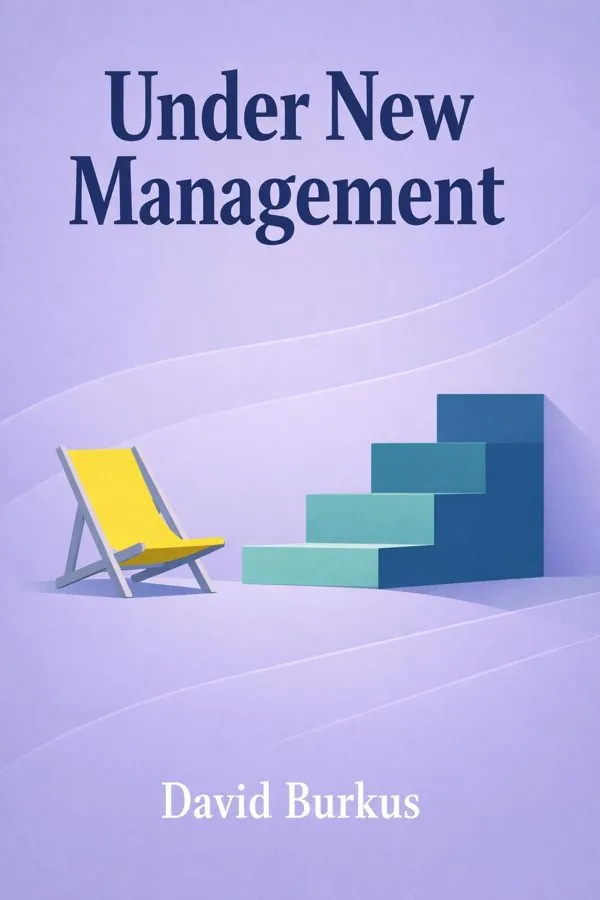
Under New Management: How Leading Organizations Are Upending Business as Usual: Summary & Key Insights
by David Burkus
 10 min11 chaptersAudio available
What Is Under New Management: How Leading Organizations Are Upending Business as Usual About?
Under New Management: How Leading Organizations Are Upending Business as Usual by David Burkus is a leadership book spanning 11 pages. Under New Management challenges traditional management practices and explores how innovative companies are redefining the workplace. David Burkus presents research and case studies showing how organizations that abandon outdated rules—such as open salary policies, unlimited vacation, and the elimination of performance reviews—are achieving greater success and employee engagement.
This FizzRead summary covers all 11 key chapters of Under New Management: How Leading Organizations Are Upending Business as Usual in approximately 10 minutes, distilling the most important ideas, arguments, and takeaways from David Burkus's work. Also available as an audio summary and Key Quotes Podcast.
Under New Management: How Leading Organizations Are Upending Business as Usual
Under New Management challenges traditional management practices and explores how innovative companies are redefining the workplace. David Burkus presents research and case studies showing how organizations that abandon outdated rules—such as open salary policies, unlimited vacation, and the elimination of performance reviews—are achieving greater success and employee engagement.
Who Should Read Under New Management: How Leading Organizations Are Upending Business as Usual?
This book is perfect for anyone interested in leadership and looking to gain actionable insights in a short read. Whether you're a student, professional, or lifelong learner, the key ideas from Under New Management: How Leading Organizations Are Upending Business as Usual by David Burkus will help you think differently.
- ✓Readers who enjoy leadership and want practical takeaways
- ✓Professionals looking to apply new ideas to their work and life
- ✓Anyone who wants the core insights of Under New Management: How Leading Organizations Are Upending Business as Usual in just 10 minutes
Want the full summary?
Get instant access to this book summary and 100K+ more with Fizz Moment.
Get Free SummaryAvailable on App Store • Free to download
Key Chapters
To understand the revolution now reshaping management, we must first recognize how the old system came to dominate. Traditional management evolved as an answer to a specific kind of problem—the efficient coordination of people performing repetitive tasks on assembly lines. Frederick Taylor’s principles of scientific management and later bureaucratic hierarchies under thinkers like Max Weber optimized for control, predictability, and compliance. But as the economy shifted from industrial to creative, those same principles began to stifle performance.
I argue that the real turning point for contemporary leaders lies in questioning assumptions we rarely notice: the belief that control drives productivity, that employees need supervision to stay motivated, and that hierarchy inherently produces order. In practice, these beliefs create anxiety and disengagement. They silence initiative and build barriers between the people who think and those who do.
The companies that inspired this book began not by chasing novelty but by confronting these inherited assumptions. When they asked, “Why do we need performance reviews?” or “Why can’t everyone know what others are paid?” they found that many 'rules' existed merely because they had always existed. Challenging them led to transformation. Throughout my research, I saw how leaders who dared to experiment not only improved business results but also created cultures where people felt seen, trusted, and connected to something larger than themselves. The first step toward reinvention, then, is intellectual honesty—the willingness to say, 'We’ve always done it this way, but that doesn’t mean we should.'
One of the most entrenched rituals in the corporate world is the annual performance review. For decades, companies have relied on it as a way to evaluate employees, tie compensation to performance, and identify future leaders. Yet psychological research consistently shows that traditional performance reviews do more harm than good. They focus on past failures rather than future growth, promote competition over collaboration, and often leave both managers and employees frustrated.
In exploring this topic, I found that innovative companies like Adobe had already abolished formal reviews entirely, choosing instead to focus on ongoing conversations called 'check-ins.' These informal, regular discussions between managers and employees emphasize developmental feedback, coaching, and goal alignment—not judgment. The effect was startling. Engagement soared, voluntary turnover dropped, and employees reported feeling more invested in their growth.
This shift signals a broader truth: meaningful feedback thrives in continuous dialogue, not in bureaucratic rituals. When we stop quantifying human potential through outdated rating systems and start listening, we turn evaluation into learning. In my own teaching and consulting, I’ve seen how simple changes—inviting open reflection, scheduling spontaneous recognition, building mentorship networks—can reposition performance conversations as acts of shared growth rather than compliance audits. The result is a culture where development is lived every day, not suffered once a year.
+ 9 more chapters — available in the FizzRead app
All Chapters in Under New Management: How Leading Organizations Are Upending Business as Usual
About the Author
David Burkus is an American author, speaker, and professor of leadership and innovation. He has written several books on organizational behavior and creativity, and his work has been featured in major publications such as Harvard Business Review and Forbes.
Get This Summary in Your Preferred Format
Read or listen to the Under New Management: How Leading Organizations Are Upending Business as Usual summary by David Burkus anytime, anywhere. FizzRead offers multiple formats so you can learn on your terms — all free.
Available formats: App · Audio · PDF · EPUB — All included free with FizzRead
Download Under New Management: How Leading Organizations Are Upending Business as Usual PDF and EPUB Summary
Key Quotes from Under New Management: How Leading Organizations Are Upending Business as Usual
“To understand the revolution now reshaping management, we must first recognize how the old system came to dominate.”
“One of the most entrenched rituals in the corporate world is the annual performance review.”
Frequently Asked Questions about Under New Management: How Leading Organizations Are Upending Business as Usual
Under New Management: How Leading Organizations Are Upending Business as Usual by David Burkus is a leadership book that explores key ideas across 11 chapters. Under New Management challenges traditional management practices and explores how innovative companies are redefining the workplace. David Burkus presents research and case studies showing how organizations that abandon outdated rules—such as open salary policies, unlimited vacation, and the elimination of performance reviews—are achieving greater success and employee engagement.
More by David Burkus
The Myths of Creativity: The Truth About How Innovative Companies and People Generate Great Ideas
David Burkus
10 min
Leading from Anywhere: The Essential Guide to Managing Remote Teams
David Burkus
10 min
Friend Of A Friend…: Understanding The Hidden Networks That Can Transform Your Life And Your Career
David Burkus
10 minYou Might Also Like

Extreme Ownership
Jocko Willink
10 min
Dare to Lead
Brene Brown
10 min
Leaders Eat Last
Simon Sinek
10 min
The 21 Irrefutable Laws of Leadership
John Maxwell
10 min
Start With Why
Simon Sinek
10 min
How to Lead When You're Not in Charge
Clay Scroggins
10 minBrowse by Category
Ready to read Under New Management: How Leading Organizations Are Upending Business as Usual?
Get the full summary and 100K+ more books with Fizz Moment.