
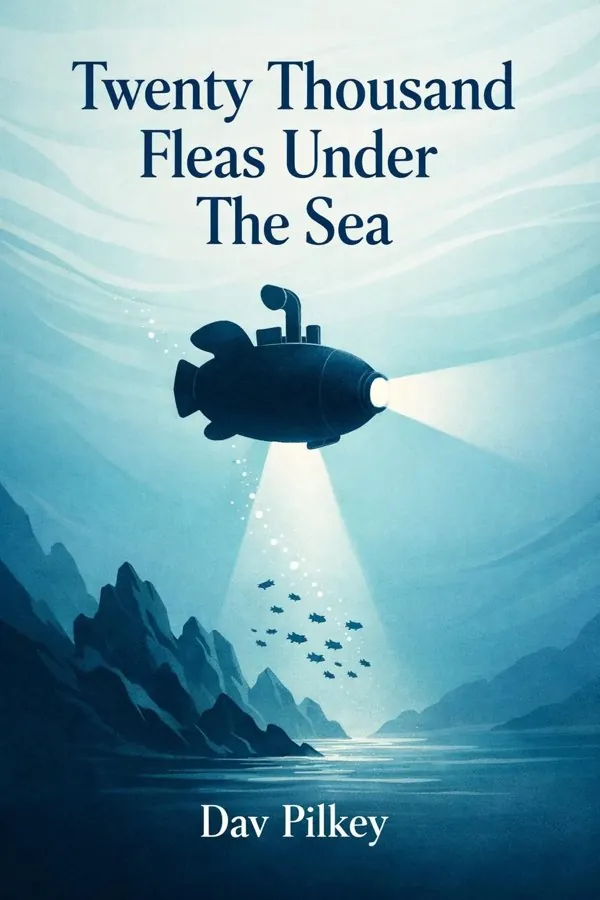
Twenty Thousand Fleas Under The Sea: Summary & Key Insights
by Dav Pilkey
 10 min9 chaptersAudio available
Key Takeaways from Twenty Thousand Fleas Under The Sea
Peace in a story is never empty; it reveals what is worth protecting.
Many villains are driven less by power than by pain.
Real courage begins where familiarity ends.
Big disasters are often built from tiny things working together.
Kindness is most powerful when it is least deserved.
What Is Twenty Thousand Fleas Under The Sea About?
Twenty Thousand Fleas Under The Sea by Dav Pilkey is a bestsellers book spanning 6 pages. In Twenty Thousand Fleas Under The Sea, Dav Pilkey sends Dog Man and his friends into one of their strangest and most imaginative adventures yet. What begins as a relatively calm moment in their crime-fighting world quickly turns into a deep-sea crisis involving old enemies, hurt feelings, giant ambitions, and the kind of absurd comedy that only the Dog Man series can deliver. Beneath the jokes, puns, and wild action scenes, this installment explores surprisingly meaningful ideas: how loneliness can twist into anger, how kindness can interrupt cycles of revenge, and how courage often means helping others even when they have made terrible choices. This book matters because it shows young readers that emotional depth and silliness do not have to compete. Pilkey uses comic-book energy, visual humor, and accessible storytelling to talk about empathy, accountability, forgiveness, and resilience in a way children can instantly understand. As the creator of both Captain Underpants and Dog Man, Pilkey has become one of the most influential voices in contemporary children's literature. His stories entertain relentlessly, but they also respect young readers enough to give them real moral and emotional questions to think about.
This FizzRead summary covers all 9 key chapters of Twenty Thousand Fleas Under The Sea in approximately 10 minutes, distilling the most important ideas, arguments, and takeaways from Dav Pilkey's work. Also available as an audio summary and Key Quotes Podcast.
Twenty Thousand Fleas Under The Sea
In Twenty Thousand Fleas Under The Sea, Dav Pilkey sends Dog Man and his friends into one of their strangest and most imaginative adventures yet. What begins as a relatively calm moment in their crime-fighting world quickly turns into a deep-sea crisis involving old enemies, hurt feelings, giant ambitions, and the kind of absurd comedy that only the Dog Man series can deliver. Beneath the jokes, puns, and wild action scenes, this installment explores surprisingly meaningful ideas: how loneliness can twist into anger, how kindness can interrupt cycles of revenge, and how courage often means helping others even when they have made terrible choices.
This book matters because it shows young readers that emotional depth and silliness do not have to compete. Pilkey uses comic-book energy, visual humor, and accessible storytelling to talk about empathy, accountability, forgiveness, and resilience in a way children can instantly understand. As the creator of both Captain Underpants and Dog Man, Pilkey has become one of the most influential voices in contemporary children's literature. His stories entertain relentlessly, but they also respect young readers enough to give them real moral and emotional questions to think about.
Who Should Read Twenty Thousand Fleas Under The Sea?
This book is perfect for anyone interested in bestsellers and looking to gain actionable insights in a short read. Whether you're a student, professional, or lifelong learner, the key ideas from Twenty Thousand Fleas Under The Sea by Dav Pilkey will help you think differently.
- ✓Readers who enjoy bestsellers and want practical takeaways
- ✓Professionals looking to apply new ideas to their work and life
- ✓Anyone who wants the core insights of Twenty Thousand Fleas Under The Sea in just 10 minutes
Want the full summary?
Get instant access to this book summary and 100K+ more with Fizz Moment.
Get Free SummaryAvailable on App Store • Free to download
Key Chapters
Peace in a story is never empty; it reveals what is worth protecting. At the beginning of Twenty Thousand Fleas Under The Sea, the world around Dog Man feels unusually stable. Dog Man is still the loyal, eager, sometimes clumsy hero readers love, and his circle of friends brings warmth and energy to everyday life. This quieter opening matters because it reminds us that heroism does not only exist in dramatic battles. It also lives in routines, friendships, and small acts of care.
Dav Pilkey uses this calm beginning to show the emotional foundation of the series. Dog Man is not powerful because he is the strongest character in every room. He is powerful because he loves deeply, acts sincerely, and tries to do the right thing even when he makes mistakes. His relationships create the emotional stakes for the adventure that follows. When danger rises, we understand that the threat is not just physical. It endangers trust, joy, and the fragile sense of community the characters have built.
This opening also teaches an important lesson for young readers: ordinary good moments matter. Time spent with friends, shared laughter, and everyday kindness are not filler between big events. They are the reason courage matters at all. In real life, we often overlook peaceful seasons because they feel less exciting than conflict. But those are the moments where loyalty is practiced and where people gather strength.
A practical way to apply this idea is to notice the “quiet good” in your own life. A family meal, a friend checking in, or a teacher encouraging you may seem small, but these moments build resilience. Before the next challenge arrives, appreciate what is already working. Actionable takeaway: protect the relationships and routines that bring stability, because they become your greatest source of strength when chaos appears.
Many villains are driven less by power than by pain. In this installment, Piggy returns as a force of chaos, but Pilkey makes him more than a simple troublemaker. Piggy’s actions are exaggerated and funny, yet beneath the humor lies a character shaped by bitterness, insecurity, and a desire to matter. His alliance with the fleas below turns a personal grudge into a larger threat, showing how wounded pride can escalate when it finds followers and a mission.
The fleas themselves represent more than tiny pests. They embody the idea that small irritations, if ignored, can grow into serious problems. Individually they seem ridiculous, but together they become dangerous. Pilkey turns this into an adventurous plot device while also making a subtle point about emotions and conflict. Resentment often begins as something small. A feeling of being excluded, overlooked, or mocked can multiply if it is not understood or addressed.
This idea has practical value for both children and adults. In a classroom, one unkind comment can become a larger conflict if nobody steps in early. In friendships, a minor misunderstanding can grow if each person adds more frustration to it. Pilkey does not excuse Piggy’s choices, but he does encourage readers to look beyond behavior and ask what hurt may be underneath it.
At the same time, the story reminds us that understanding pain is not the same as approving harmful actions. Compassion and boundaries must work together. You can recognize that someone feels rejected while still refusing to accept cruelty or destruction.
A useful application is to pay attention to small signs of conflict before they spread. Ask questions, listen early, and address hurt feelings directly. Actionable takeaway: do not ignore little resentments, because what starts as a flea-sized problem can grow into a full-scale storm.
Real courage begins where familiarity ends. As Dog Man and his friends move into the underwater world, the book shifts from ordinary comic chaos into a setting that feels mysterious, risky, and unpredictable. The deep sea is more than a fun backdrop. It symbolizes the unknown places people must sometimes enter to solve problems that cannot be fixed from the surface.
Pilkey shows that bravery is not the absence of fear. Dog Man does not become heroic because he suddenly knows exactly what to do. He becomes heroic because he keeps moving despite uncertainty. This distinction matters. Young readers often imagine courage as something effortless, a trait that belongs only to naturally fearless people. But this story frames courage as persistence through confusion, discomfort, and surprise.
The underwater setting also reinforces the need for adaptation. Characters cannot rely only on old habits. New environments require new thinking. In real life, that might mean learning how to navigate a new school, handle a conflict differently, or try a skill that initially feels intimidating. Success often depends less on confidence than on willingness to keep adjusting.
Pilkey’s humor softens these lessons without weakening them. The bizarre dangers and visual gags keep the story energetic, but beneath the comedy is a truth children can use immediately: growth often feels strange before it feels rewarding. Entering the “deep” may mean joining a club, apologizing after an argument, or asking for help when you are embarrassed.
A practical way to apply this idea is to identify one area where discomfort has been stopping progress. Then take one small step into that unknown rather than waiting to feel completely ready. Actionable takeaway: when a challenge feels unfamiliar, do not treat discomfort as a stop sign; treat it as evidence that you are entering a place where growth can happen.
Big disasters are often built from tiny things working together. One of the cleverest ideas in Twenty Thousand Fleas Under The Sea is the way Pilkey transforms fleas, creatures associated with annoyance and itchiness, into a large-scale threat. This is funny on the surface, but it also reflects a pattern readers can recognize in everyday life: neglected small problems become harder to control over time.
The chaos from beneath is not just about danger arriving from an unexpected place. It is about accumulation. A single flea seems trivial. A mass of them becomes overwhelming. The same principle applies to messes, lies, bad habits, and unresolved feelings. One missed responsibility may not matter much. Many missed responsibilities create stress. One unkind thought may pass quickly. Repeated resentment can damage relationships.
Pilkey’s storytelling turns this principle into a memorable visual metaphor. Children may laugh at the absurdity of a flea uprising, but the image sticks because it captures how little things can suddenly feel huge. It also teaches vigilance without creating fear. The lesson is not to panic over every tiny issue. It is to respond before problems multiply.
This concept is especially useful in practical life. Students can apply it to homework, where delaying one assignment often makes the next one harder. Families can apply it to communication, addressing misunderstandings before they become arguments. Even emotional health follows this pattern. Small frustrations need healthy outlets before they turn into explosions.
What makes the book effective is that it pairs the warning with hope. If small problems can grow, small good actions can grow too. One apology can stop a bigger conflict. One act of cleaning can restore order. One kind choice can shift a mood.
Actionable takeaway: when something small keeps bothering you, deal with it early. Tiny issues rarely stay tiny when ignored.
Kindness is most powerful when it is least deserved. One of the emotional centers of Twenty Thousand Fleas Under The Sea is its insistence that anger does not have to be answered with more anger. As conflict intensifies, the story keeps returning to a difficult question: what happens when someone has caused real harm, but still needs compassion? Pilkey does not offer a simplistic answer, yet he strongly suggests that revenge traps everyone in the same cycle.
Dog Man’s world often includes outrageous villains and chaotic situations, but the moral vision behind the series remains consistent. People can make damaging choices without becoming permanently unreachable. That does not mean consequences disappear. It means goodness remains possible even in tense and messy situations. This perspective is especially valuable for children, who are still learning how to respond when someone hurts them, embarrasses them, or acts unfairly.
Kindness in this story is not weakness. It does not mean letting danger continue or pretending harm never happened. Instead, it means refusing to let hatred decide your own behavior. In practical terms, this can look like correcting someone without humiliating them, setting limits without cruelty, or choosing calm language when emotions are rising.
Pilkey shows that forgiveness is often less about excusing the past and more about making a different future possible. Readers see that empathy can interrupt escalation. A person who expects rejection may react differently when they are met with patience. Again, this does not guarantee instant change, but it opens a door that revenge slams shut.
In everyday life, children can apply this by pausing before retaliating after a conflict. Adults can model it by addressing bad behavior firmly but respectfully. Actionable takeaway: when anger pushes you to “get even,” choose one response that protects what is right without copying the harm that was done.
Children often understand serious ideas best when laughter lets them approach without fear. One reason Twenty Thousand Fleas Under The Sea works so well is that Dav Pilkey uses humor not as a distraction from the story’s themes, but as the vehicle that carries them. The ridiculous villainy, visual puns, exaggerated reactions, and comic-book chaos make the book instantly entertaining. Yet those same elements create enough safety for readers to engage with loneliness, anger, forgiveness, and responsibility.
This is one of Pilkey’s great strengths as a storyteller. He knows that humor lowers defensiveness. A child who might resist a direct lecture about empathy will happily absorb that lesson through a talking dog hero, absurd fleas, and over-the-top underwater action. The laughter creates openness, and once that openness is there, deeper truths can land.
Humor also models emotional resilience. The characters face danger and confusion, but the book keeps a playful tone that suggests hardship is real without becoming hopeless. This matters for young readers, who need stories that acknowledge difficulty while still feeling manageable. Comedy can make fear less overwhelming and mistakes less paralyzing.
In practical life, this principle applies beyond books. Families and teachers often get better results when they use warmth and humor appropriately rather than relying only on correction. A gentle joke can release tension during a stressful moment. Playfulness can help children talk about difficult feelings more honestly.
Of course, Pilkey also shows that humor should not be used to deny hurt or avoid accountability. The best humor helps people connect, reflect, and recover. It does not mock pain; it creates room to handle pain.
Actionable takeaway: use humor as a tool for connection and understanding, especially during stressful situations, but make sure the laughter helps people feel safer rather than smaller.
Heroes rarely succeed alone, and this book quietly insists that connection is a superpower. While Dog Man stands at the center of the story, Twenty Thousand Fleas Under The Sea repeatedly shows that his effectiveness depends on the people around him. Friends contribute ideas, encouragement, perspective, and emotional grounding. In Pilkey’s universe, teamwork is not a side note. It is one of the main engines of hope.
This matters because many stories celebrate the lone genius or unstoppable individual. Pilkey offers a different model for young readers. Dog Man is brave, but he is also dependent. He needs help. He benefits from support. He does not lose dignity by relying on others; he becomes stronger through that reliance. This is an important corrective to the belief that needing people is a sign of weakness.
Friendship in the book also includes patience for imperfection. Characters misunderstand one another, make poor choices, and create messes, but the possibility of reconnection remains. Healthy friendship does not require flawless behavior. It requires care, honesty, and willingness to keep showing up.
Readers can apply this insight in concrete ways. If a problem feels too big, asking for help can be the smartest move rather than an embarrassing one. In group settings, different people bring different strengths. One friend may be calm under pressure, another imaginative, another practical. Strong teams recognize and use those differences.
The story also suggests that being a good friend is itself heroic. Encouraging someone, including someone, or standing beside someone in a difficult moment may not look dramatic, but those actions change outcomes. Actionable takeaway: when facing a challenge, do not ask only, “How can I solve this?” Also ask, “Who can help, and how can we combine our strengths?”
Imagination is not an escape from reality; it is a way of reshaping it. Dav Pilkey fills Twenty Thousand Fleas Under The Sea with bizarre inventions, wild scenarios, and gleefully exaggerated comic logic. That creativity is delightful, but it also serves a deeper purpose. The story suggests that imagination helps people respond to problems with flexibility rather than panic.
When characters face unusual threats, ordinary thinking is not enough. They need creativity. This lesson reaches beyond the book. Children often encounter situations where there is no obvious solution: a social problem, a school challenge, or a difficult feeling they do not know how to name. Imagination allows them to experiment mentally, picture alternatives, and believe change is possible.
Pilkey has long championed the creative instincts of children, especially those who may not fit traditional expectations in school. His visual style, playful structure, and irreverent tone all communicate that creative minds matter. In this book, imagination is tied to resilience. The weirder the challenge becomes, the more the characters must invent, adapt, and think in unexpected ways.
This idea can be applied practically by encouraging brainstorming before giving up. If one approach fails, list three strange or unconventional alternatives. In a classroom, creative expression through drawing, storytelling, or comic-making can help children process emotions and solve conflicts. At home, imaginative play can become a safe rehearsal space for courage and communication.
The broader message is empowering: you do not have to face fear with the limited tools you used yesterday. New ideas are available, especially when you stay curious. Actionable takeaway: when a problem feels overwhelming, pause and ask yourself for three imaginative solutions, even silly ones, because creativity often opens doors that worry cannot see.
All Chapters in Twenty Thousand Fleas Under The Sea
About the Author
Dav Pilkey is an American author and illustrator whose work has shaped modern children’s publishing. He is best known for creating the hugely popular Captain Underpants and Dog Man series, both of which combine energetic humor, cartoon-style art, and themes of friendship, kindness, and imagination. As a child, Pilkey struggled with ADHD and dyslexia, experiences that later influenced his belief that books should be accessible, funny, and welcoming to all kinds of readers. His stories are especially beloved by children who may feel intimidated by traditional books, and he has helped countless reluctant readers discover the joy of reading. Through his playful storytelling and emotional insight, Pilkey has become one of the most influential and widely read children’s authors of his generation.
Get This Summary in Your Preferred Format
Read or listen to the Twenty Thousand Fleas Under The Sea summary by Dav Pilkey anytime, anywhere. FizzRead offers multiple formats so you can learn on your terms — all free.
Available formats: App · Audio · PDF · EPUB — All included free with FizzRead
Download Twenty Thousand Fleas Under The Sea PDF and EPUB Summary
Key Quotes from Twenty Thousand Fleas Under The Sea
“Peace in a story is never empty; it reveals what is worth protecting.”
“Many villains are driven less by power than by pain.”
“Real courage begins where familiarity ends.”
“Big disasters are often built from tiny things working together.”
“Kindness is most powerful when it is least deserved.”
Frequently Asked Questions about Twenty Thousand Fleas Under The Sea
Twenty Thousand Fleas Under The Sea by Dav Pilkey is a bestsellers book that explores key ideas across 9 chapters. In Twenty Thousand Fleas Under The Sea, Dav Pilkey sends Dog Man and his friends into one of their strangest and most imaginative adventures yet. What begins as a relatively calm moment in their crime-fighting world quickly turns into a deep-sea crisis involving old enemies, hurt feelings, giant ambitions, and the kind of absurd comedy that only the Dog Man series can deliver. Beneath the jokes, puns, and wild action scenes, this installment explores surprisingly meaningful ideas: how loneliness can twist into anger, how kindness can interrupt cycles of revenge, and how courage often means helping others even when they have made terrible choices. This book matters because it shows young readers that emotional depth and silliness do not have to compete. Pilkey uses comic-book energy, visual humor, and accessible storytelling to talk about empathy, accountability, forgiveness, and resilience in a way children can instantly understand. As the creator of both Captain Underpants and Dog Man, Pilkey has become one of the most influential voices in contemporary children's literature. His stories entertain relentlessly, but they also respect young readers enough to give them real moral and emotional questions to think about.
More by Dav Pilkey




You Might Also Like

The Godfather
Mario Puzo
10 min
The Handmaid's Tale
Margaret Atwood
10 min
The Hunger Games
Suzanne Collins
10 min
The Nightingale
Kristin Hannah
10 min
The Seven Husbands of Evelyn Hugo
Taylor Jenkins Reid
10 min
Backwater Justice
Fern Michaels
10 minBrowse by Category
Ready to read Twenty Thousand Fleas Under The Sea?
Get the full summary and 100K+ more books with Fizz Moment.