
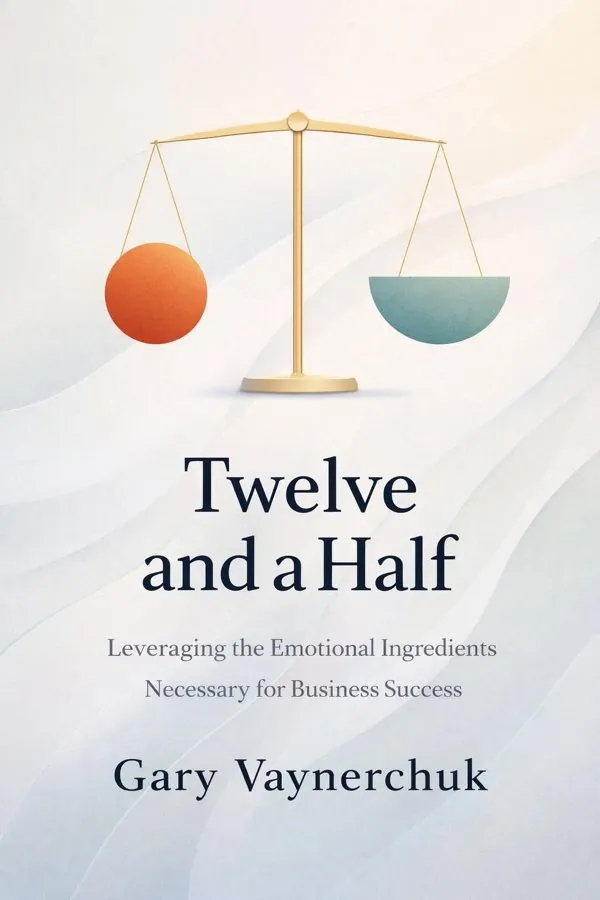
Twelve and a Half: Leveraging the Emotional Ingredients Necessary for Business Success: Summary & Key Insights
 10 min8 chaptersAudio available
Key Takeaways from Twelve and a Half: Leveraging the Emotional Ingredients Necessary for Business Success
Most people think business success is built on strategy first and personality second.
In competitive environments, kindness is often misunderstood as softness.
Three of Vaynerchuk’s most practical emotional ingredients are gratitude, accountability, and optimism because together they shape how people interpret reality.
A leader who cannot understand other people will eventually misread the room, the market, and the moment.
Many people admire hustle, but Vaynerchuk distinguishes sustainable success from frantic motion.
What Is Twelve and a Half: Leveraging the Emotional Ingredients Necessary for Business Success About?
Twelve and a Half: Leveraging the Emotional Ingredients Necessary for Business Success by Gary Vaynerchuk is a leadership book spanning 14 pages. In Twelve and a Half, Gary Vaynerchuk makes a bold argument: the qualities most people dismiss as “soft” are often the hardest to practice and the most decisive in business. Instead of focusing on tactics, trends, or productivity systems, he turns attention to emotional ingredients such as kindness, gratitude, accountability, empathy, patience, conviction, and ambition. These are not abstract virtues, he argues, but practical capabilities that shape hiring decisions, culture, negotiation, resilience, and long-term performance. What makes the book especially compelling is Vaynerchuk’s credibility. As the CEO of VaynerMedia, a prolific entrepreneur, and an early investor in companies like Facebook, Twitter, and Uber, he has spent years operating in highly competitive environments. His perspective comes not from theory alone, but from building teams, managing conflict, making bets, and learning publicly through success and failure. The “half” in the title—kind candor—captures the tension at the heart of modern leadership: how to be both compassionate and direct. For entrepreneurs, managers, and anyone who wants to lead more effectively, this book offers a practical framework for making emotional intelligence a real competitive advantage.
This FizzRead summary covers all 8 key chapters of Twelve and a Half: Leveraging the Emotional Ingredients Necessary for Business Success in approximately 10 minutes, distilling the most important ideas, arguments, and takeaways from Gary Vaynerchuk's work. Also available as an audio summary and Key Quotes Podcast.
Twelve and a Half: Leveraging the Emotional Ingredients Necessary for Business Success
In Twelve and a Half, Gary Vaynerchuk makes a bold argument: the qualities most people dismiss as “soft” are often the hardest to practice and the most decisive in business. Instead of focusing on tactics, trends, or productivity systems, he turns attention to emotional ingredients such as kindness, gratitude, accountability, empathy, patience, conviction, and ambition. These are not abstract virtues, he argues, but practical capabilities that shape hiring decisions, culture, negotiation, resilience, and long-term performance.
What makes the book especially compelling is Vaynerchuk’s credibility. As the CEO of VaynerMedia, a prolific entrepreneur, and an early investor in companies like Facebook, Twitter, and Uber, he has spent years operating in highly competitive environments. His perspective comes not from theory alone, but from building teams, managing conflict, making bets, and learning publicly through success and failure. The “half” in the title—kind candor—captures the tension at the heart of modern leadership: how to be both compassionate and direct. For entrepreneurs, managers, and anyone who wants to lead more effectively, this book offers a practical framework for making emotional intelligence a real competitive advantage.
Who Should Read Twelve and a Half: Leveraging the Emotional Ingredients Necessary for Business Success?
This book is perfect for anyone interested in leadership and looking to gain actionable insights in a short read. Whether you're a student, professional, or lifelong learner, the key ideas from Twelve and a Half: Leveraging the Emotional Ingredients Necessary for Business Success by Gary Vaynerchuk will help you think differently.
- ✓Readers who enjoy leadership and want practical takeaways
- ✓Professionals looking to apply new ideas to their work and life
- ✓Anyone who wants the core insights of Twelve and a Half: Leveraging the Emotional Ingredients Necessary for Business Success in just 10 minutes
Want the full summary?
Get instant access to this book summary and 100K+ more with Fizz Moment.
Get Free SummaryAvailable on App Store • Free to download
Key Chapters
Most people think business success is built on strategy first and personality second. Vaynerchuk turns that assumption upside down. His central claim is that emotional ingredients are not decorative extras added to technical skill; they are the hidden forces that determine how well strategy actually works. A brilliant plan can collapse in the hands of an insecure leader, a defensive teammate, or a culture ruled by fear. Meanwhile, an organization with strong emotional foundations can adapt, recover, and outperform even when conditions are uncertain.
By “emotional ingredients,” Vaynerchuk means the internal traits that shape how people communicate, decide, collaborate, and respond to adversity. These include qualities like kindness, accountability, optimism, humility, curiosity, and patience. In practice, they influence everything from recruiting and retention to product development and customer relationships. A patient founder resists short-term panic. A curious manager asks better questions. An accountable executive corrects mistakes faster. These are not vague ideals; they are operational advantages.
This perspective matters because modern workplaces are more interdependent than ever. Leadership is no longer just about issuing instructions. It is about creating trust, handling complexity, and helping people do their best work under pressure. Emotional ingredients are what make that possible. They affect morale, clarity, innovation, and speed of execution in ways traditional business metrics often miss.
A useful way to apply this idea is to audit your recent decisions. Ask: which emotional traits improved the outcome, and which missing traits made things harder? Treat emotional intelligence as a business asset, not a personality preference. The actionable takeaway: identify one emotional ingredient that consistently strengthens your work and one that repeatedly undermines it, then build a weekly habit to reinforce the first and correct the second.
In competitive environments, kindness is often misunderstood as softness. Vaynerchuk argues the opposite: kindness is a disciplined expression of confidence. People who are secure in themselves do not need intimidation, humiliation, or ego games to lead. They can treat others with respect while still holding high standards. That combination builds loyalty, trust, and stronger long-term performance than fear ever could.
Kindness in business does not mean avoiding difficult conversations or tolerating poor work. It means engaging with people as human beings rather than disposable tools. A kind leader gives feedback without contempt, handles pressure without cruelty, and remembers that every employee has ambitions, insecurities, and challenges outside the office. This approach improves morale, but more importantly, it improves execution. Teams that feel psychologically safe are more likely to speak up about risks, admit mistakes early, and contribute ideas honestly.
Consider two managers facing a missed deadline. One lashes out publicly, creating embarrassment and silence. The other addresses the issue directly, seeks to understand the root cause, and collaborates on a fix. Both managers may communicate urgency, but only one preserves trust. Over time, that difference compounds into retention, creativity, and reputation.
Kindness also matters externally. Customers, partners, and audiences remember how they are treated. In a world of abundant choices, emotional memory influences business decisions more than leaders often realize.
The challenge is that kindness can feel vulnerable, especially in cultures that reward aggression. But Vaynerchuk’s point is clear: if your power depends on fear, your leadership is fragile. The actionable takeaway: in your next difficult interaction, separate firmness from hostility. Be clear about expectations, but deliver your message in a way that preserves dignity.
Three of Vaynerchuk’s most practical emotional ingredients are gratitude, accountability, and optimism because together they shape how people interpret reality. Gratitude keeps perspective. Accountability creates ownership. Optimism fuels forward motion. Without gratitude, success feels empty and setbacks feel personal. Without accountability, problems linger because everyone looks elsewhere for blame. Without optimism, teams lose the energy to persist through uncertainty.
Gratitude is not denial. It does not ignore what is wrong. Instead, it anchors people in what is still possible and what is already valuable. A founder who appreciates the opportunity to build, even during hard seasons, is less likely to spiral into entitlement or resentment. Accountability then turns that mindset into action. Rather than blaming the market, competitors, or employees, accountable leaders ask, “What was my role in this outcome?” That question accelerates growth because it focuses on what can be changed. Optimism completes the sequence by making effort sustainable. It is the belief that better outcomes are achievable if you keep learning and adjusting.
These traits work especially well together during setbacks. Imagine a product launch that fails. Gratitude prevents emotional overreaction by preserving perspective. Accountability allows the team to examine messaging, timing, or execution honestly. Optimism keeps everyone engaged in iteration rather than defeat. The result is resilience instead of paralysis.
The danger is false optimism without accountability, which becomes fantasy, or accountability without gratitude, which becomes harsh self-judgment. Vaynerchuk’s point is balance.
The actionable takeaway: after any win or loss, run a three-part reflection. First, name one thing you are grateful for. Second, identify one thing you personally could have done better. Third, define one reason to remain optimistic about the next move.
A leader who cannot understand other people will eventually misread the room, the market, and the moment. Vaynerchuk treats empathy as a strategic capability because it helps leaders interpret motivations, fears, incentives, and emotional states more accurately. Humility supports that process by preventing the ego from assuming it already knows everything. Together, these qualities make better communication, better decisions, and better cultures possible.
Empathy means taking the time to see situations from another person’s point of view. In management, this can transform feedback, delegation, and conflict resolution. An empathetic leader recognizes that one employee may need autonomy, another reassurance, and another more explicit structure. Rather than imposing a single style on everyone, the leader adapts. This improves performance because people are far more likely to engage when they feel understood.
Humility keeps leadership grounded in reality. It allows someone to say, “I might be wrong,” “I need more context,” or “That idea is better than mine.” In fast-moving environments, that openness is a competitive advantage. Arrogance slows learning; humility speeds it up. A humble founder changes strategy when new evidence emerges. A humble manager solicits feedback from the team. A humble executive gives credit generously.
These traits also reinforce trust. Employees can spot ego-driven leadership quickly, and it tends to create silence, politics, and avoidance. Empathy and humility have the opposite effect: they make room for candor, creativity, and shared ownership.
To apply this, start using perspective-taking before reacting. If an employee misses expectations, ask what pressures, assumptions, or misunderstandings might be shaping the behavior. Then pair that with humility by checking your own role in the dynamic. The actionable takeaway: in your next conversation, spend more time understanding than asserting, and look for one place where humility would improve the outcome.
Many people admire hustle, but Vaynerchuk distinguishes sustainable success from frantic motion. Tenacity, curiosity, and patience form a more durable trio. Tenacity is the willingness to keep going through difficulty. Curiosity is the desire to keep learning rather than clinging to assumptions. Patience is the discipline to let worthwhile things take time. Combined, they help leaders stay persistent without becoming rigid or reckless.
Tenacity matters because every meaningful career includes rejection, delay, and disappointment. Whether you are building a company, changing industries, or leading a team through a difficult quarter, persistence is often the difference between eventual traction and premature surrender. But persistence alone can become stubbornness if it is not informed by curiosity. Curious people ask what the market is really saying, what customers actually need, and what new information should change their approach. They experiment instead of just grinding harder.
Patience is what protects both traits from short-term thinking. Without patience, leaders chase vanity metrics, force growth at the wrong time, or abandon good ideas before they mature. Vaynerchuk repeatedly emphasizes that many business outcomes are delayed. Trust takes time. Brand equity takes time. Talent development takes time. Impatient leaders often destroy value because they cannot tolerate the natural lag between effort and reward.
A startup founder offers a simple example. Tenacity keeps the founder pitching after multiple investor rejections. Curiosity leads to revising the story based on feedback. Patience prevents taking a bad deal out of desperation. The same pattern applies to content creators, executives, and job seekers.
The actionable takeaway: when progress feels slow, ask three questions: What requires persistence? What requires learning? What simply requires more time? Then adjust your response to match the real problem instead of reacting emotionally to the delay.
High achievers are often told to be more confident, more certain, and more driven. Vaynerchuk agrees that conviction and ambition matter, but he warns that they become dangerous when detached from self-awareness. Conviction helps leaders act decisively when information is incomplete. Ambition supplies the energy to pursue difficult goals. Yet if conviction hardens into ego or ambition turns into insecurity, the very traits that fuel success can begin to distort judgment and damage relationships.
Healthy conviction means believing in your vision enough to commit, while still remaining open to evidence. In entrepreneurship and leadership, endless hesitation can be fatal. Teams need direction, and markets reward clear moves. But conviction is most effective when paired with humility and curiosity. It should produce decisive action, not arrogance.
Ambition is similarly double-edged. At its best, it drives growth, excellence, and meaningful achievement. It pushes people to create, build, improve, and stretch beyond comfort. At its worst, it becomes external validation chasing. Leaders then start making choices to impress others instead of serving the mission. They overwork, compare compulsively, or sacrifice culture for status.
Vaynerchuk’s point is not to reduce ambition, but to purify it. The question is whether your drive comes from purpose or from fear of being unseen, outperformed, or left behind. A grounded ambition is energizing. An insecure ambition is exhausting.
A practical application is to examine major goals through two lenses: strategic and emotional. Strategically, does the goal make sense? Emotionally, what need is it serving? If the answer is mostly ego, the goal may still be achievable but not truly satisfying.
The actionable takeaway: before committing to your next major decision, define what you are certain about, what you are still testing, and why the goal matters to you personally. That balance strengthens conviction without letting ambition run unchecked.
The “half” in the title is one of the book’s most important ideas. Vaynerchuk calls it kind candor: the ability to tell the truth clearly without stripping away compassion. Many leaders fail on one side of this balance. They are kind but vague, which avoids discomfort while allowing confusion and poor performance to continue. Or they are candid but harsh, using honesty as an excuse for ego, impatience, or disrespect. Kind candor is harder because it asks for both courage and care.
In practice, kind candor means delivering feedback that is specific, timely, and useful while maintaining the other person’s dignity. It is not sugarcoating, but neither is it emotional carelessness. A leader practicing kind candor might say, “This presentation missed the mark because the customer problem wasn’t clear. I know you can improve it, and I want to help you get there.” The message is direct, but the intent is constructive rather than punishing.
This skill is essential because growth depends on truth. Teams cannot improve if people are afraid to address weaknesses. At the same time, fear-based feedback often creates defensiveness instead of development. Kind candor solves both problems by making honesty easier to hear and more likely to be acted on.
It also applies beyond management. In partnerships, hiring, negotiations, and even self-reflection, progress depends on being able to face reality without cruelty. That includes telling yourself difficult truths in a way that motivates change rather than shame.
The actionable takeaway: when giving feedback, use a simple formula—state the issue clearly, explain its impact, and communicate belief in improvement. If your message is true but not useful, or useful but not humane, revise it until it becomes both.
A book about emotional intelligence becomes valuable only when its ideas move from inspiration into behavior. Vaynerchuk’s broader contribution is not just naming twelve and a half traits, but encouraging readers to integrate them into how they hire, communicate, evaluate, and lead every day. Emotional ingredients matter most in repeated moments: how you respond to a mistake, how you praise effort, how you set expectations, how you handle pressure, and how you interpret setbacks.
Integration begins with self-awareness. Most people naturally possess some of these ingredients more than others. Someone may be highly ambitious and tenacious but weak in patience. Another may be deeply kind and empathetic but hesitant to practice candor. The goal is not to become personality-neutral. It is to understand your default patterns and intentionally strengthen what is underdeveloped.
Organizations can apply the framework structurally. During hiring, assess for humility, curiosity, and accountability alongside technical skill. In performance reviews, evaluate not only results but how those results were achieved. In meetings, create room for empathy and candor by rewarding thoughtful disagreement instead of punishing it. During stressful periods, use gratitude and optimism to keep perspective without ignoring reality.
The framework is especially useful because it links inner work with outer outcomes. Better emotional habits lead to clearer communication, stronger culture, and more sustainable execution. Over time, this becomes a competitive advantage because emotionally mature teams waste less energy on politics, defensiveness, and fear.
The actionable takeaway: choose two emotional ingredients to actively practice for the next month—one that strengthens your relationships and one that improves your decision-making. Track specific situations where you applied them, and review the results weekly. Growth becomes real when emotional values are translated into observable habits.
All Chapters in Twelve and a Half: Leveraging the Emotional Ingredients Necessary for Business Success
About the Author
Gary Vaynerchuk is a serial entrepreneur, investor, bestselling author, and media personality best known as the chairman of VaynerX and CEO of VaynerMedia, a global creative and media agency. He first built his reputation by transforming his family’s wine business through ecommerce and digital content, then expanded into marketing, investing, and brand strategy. Vaynerchuk was also an early investor in major companies including Facebook, Twitter, Tumblr, and Uber. Over the years, he has become a widely recognized voice on entrepreneurship, leadership, social media, and consumer attention. His work often blends business advice with personal development, emphasizing self-awareness, long-term thinking, and execution. In Twelve and a Half, he brings that perspective to emotional intelligence, arguing that leadership success depends heavily on character-based traits that many professionals overlook.
Get This Summary in Your Preferred Format
Read or listen to the Twelve and a Half: Leveraging the Emotional Ingredients Necessary for Business Success summary by Gary Vaynerchuk anytime, anywhere. FizzRead offers multiple formats so you can learn on your terms — all free.
Available formats: App · Audio · PDF · EPUB — All included free with FizzRead
Download Twelve and a Half: Leveraging the Emotional Ingredients Necessary for Business Success PDF and EPUB Summary
Key Quotes from Twelve and a Half: Leveraging the Emotional Ingredients Necessary for Business Success
“Most people think business success is built on strategy first and personality second.”
“In competitive environments, kindness is often misunderstood as softness.”
“Three of Vaynerchuk’s most practical emotional ingredients are gratitude, accountability, and optimism because together they shape how people interpret reality.”
“A leader who cannot understand other people will eventually misread the room, the market, and the moment.”
“Many people admire hustle, but Vaynerchuk distinguishes sustainable success from frantic motion.”
Frequently Asked Questions about Twelve and a Half: Leveraging the Emotional Ingredients Necessary for Business Success
Twelve and a Half: Leveraging the Emotional Ingredients Necessary for Business Success by Gary Vaynerchuk is a leadership book that explores key ideas across 8 chapters. In Twelve and a Half, Gary Vaynerchuk makes a bold argument: the qualities most people dismiss as “soft” are often the hardest to practice and the most decisive in business. Instead of focusing on tactics, trends, or productivity systems, he turns attention to emotional ingredients such as kindness, gratitude, accountability, empathy, patience, conviction, and ambition. These are not abstract virtues, he argues, but practical capabilities that shape hiring decisions, culture, negotiation, resilience, and long-term performance. What makes the book especially compelling is Vaynerchuk’s credibility. As the CEO of VaynerMedia, a prolific entrepreneur, and an early investor in companies like Facebook, Twitter, and Uber, he has spent years operating in highly competitive environments. His perspective comes not from theory alone, but from building teams, managing conflict, making bets, and learning publicly through success and failure. The “half” in the title—kind candor—captures the tension at the heart of modern leadership: how to be both compassionate and direct. For entrepreneurs, managers, and anyone who wants to lead more effectively, this book offers a practical framework for making emotional intelligence a real competitive advantage.
More by Gary Vaynerchuk

Crush It!: Why Now Is the Time to Cash In on Your Passion
Gary Vaynerchuk
10 min
The Thank You Economy
Gary Vaynerchuk
10 min
Jab, Jab, Jab, Right Hook: How to Tell Your Story in a Noisy Social World
Gary Vaynerchuk
10 min
Crushing It!: How Great Entrepreneurs Build Their Business and Influence—and How You Can, Too
Gary Vaynerchuk
10 minYou Might Also Like

Extreme Ownership
Jocko Willink
10 min
Dare to Lead
Brene Brown
10 min
Leaders Eat Last
Simon Sinek
10 min
The 21 Irrefutable Laws of Leadership
John Maxwell
10 min
Start With Why
Simon Sinek
10 min
How to Lead When You're Not in Charge
Clay Scroggins
10 minBrowse by Category
Ready to read Twelve and a Half: Leveraging the Emotional Ingredients Necessary for Business Success?
Get the full summary and 100K+ more books with Fizz Moment.