
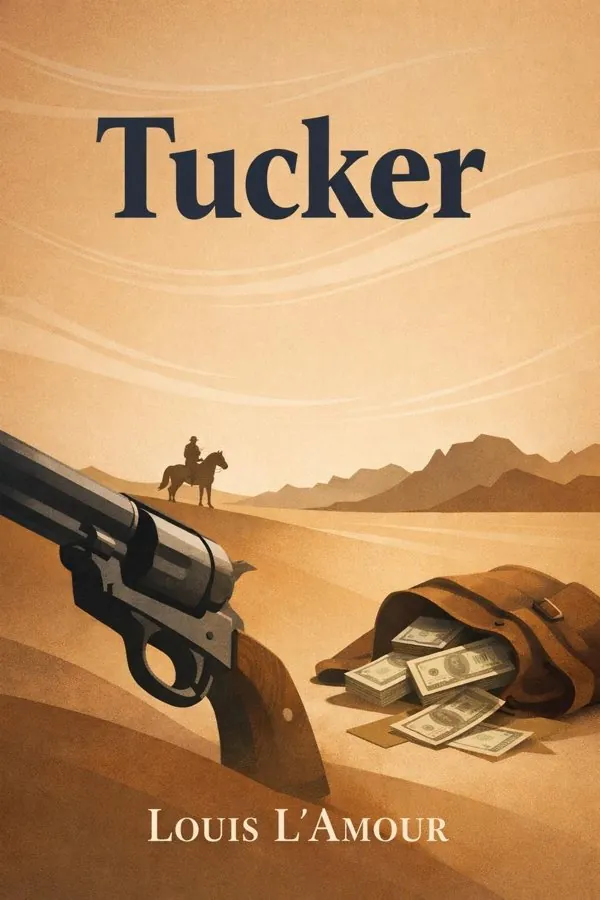
Tucker: Summary & Key Insights
 10 min8 chaptersAudio available
Key Takeaways from Tucker
Some promises do more than bind us to another person—they reveal who we are willing to become.
A harsh landscape does not create character from nothing—it exposes what was already there.
Courage is not the absence of fear; it is the decision to act while fear is fully present.
In a world shaped by violence and greed, trust becomes both necessary and dangerous.
A person’s character is measured less by what he says about himself than by what he does when no one is there to praise him.
What Is Tucker About?
Tucker by Louis L'Amour is a bestsellers book spanning 5 pages. Louis L'Amour’s Tucker is a frontier novel about duty, grit, and the making of a man under pressure. At its center is Shell Tucker, a young man set on a dangerous path after his father is fatally wounded in a robbery and leaves behind one final charge: recover the stolen money and restore the family’s name. What follows is not just a chase across the American West, but a moral journey through violence, temptation, loneliness, and hard-earned self-knowledge. Tucker matters because it captures what made L'Amour one of the great storytellers of the frontier: he turns action into character, landscape into destiny, and simple conflicts into tests of honor. Beneath the gunfights and pursuit lies a deeper question: what kind of person will you become when the world gives you every reason to compromise? L'Amour writes with the authority of an author who understood both the mythology and the reality of the West, grounding adventure in practical details, human motives, and timeless values. The result is a classic Western that still feels vivid, purposeful, and emotionally true.
This FizzRead summary covers all 8 key chapters of Tucker in approximately 10 minutes, distilling the most important ideas, arguments, and takeaways from Louis L'Amour's work. Also available as an audio summary and Key Quotes Podcast.
Tucker
Louis L'Amour’s Tucker is a frontier novel about duty, grit, and the making of a man under pressure. At its center is Shell Tucker, a young man set on a dangerous path after his father is fatally wounded in a robbery and leaves behind one final charge: recover the stolen money and restore the family’s name. What follows is not just a chase across the American West, but a moral journey through violence, temptation, loneliness, and hard-earned self-knowledge. Tucker matters because it captures what made L'Amour one of the great storytellers of the frontier: he turns action into character, landscape into destiny, and simple conflicts into tests of honor. Beneath the gunfights and pursuit lies a deeper question: what kind of person will you become when the world gives you every reason to compromise? L'Amour writes with the authority of an author who understood both the mythology and the reality of the West, grounding adventure in practical details, human motives, and timeless values. The result is a classic Western that still feels vivid, purposeful, and emotionally true.
Who Should Read Tucker?
This book is perfect for anyone interested in bestsellers and looking to gain actionable insights in a short read. Whether you're a student, professional, or lifelong learner, the key ideas from Tucker by Louis L'Amour will help you think differently.
- ✓Readers who enjoy bestsellers and want practical takeaways
- ✓Professionals looking to apply new ideas to their work and life
- ✓Anyone who wants the core insights of Tucker in just 10 minutes
Want the full summary?
Get instant access to this book summary and 100K+ more with Fizz Moment.
Get Free SummaryAvailable on App Store • Free to download
Key Chapters
Some promises do more than bind us to another person—they reveal who we are willing to become. Tucker begins with such a promise. Shell Tucker’s father is mortally wounded in a robbery, and in those last moments Shell receives not merely a request, but an inheritance of duty. The stolen money matters, but what matters even more is the restoration of honor. In L'Amour’s world, reputation is not vanity; it is the visible proof of a person’s integrity. When Shell accepts the task, he steps out of youth and into moral adulthood.
This opening matters because it frames the entire story as more than revenge. Shell is not simply chasing thieves. He is trying to live up to a standard set by a father whose life represented quiet strength, endurance, and self-respect. That gives the novel emotional depth. The frontier may be lawless, but Shell’s actions are governed by an inner code. He could walk away, excuse himself as too young, too poor, or too outmatched. Instead, he chooses responsibility.
In everyday life, many defining moments work this way. A family obligation, a promise to a mentor, or a commitment made during crisis can become the event that shapes our character. The key is not romanticizing hardship, but recognizing that responsibility often arrives before we feel ready for it. Like Shell, people grow by carrying what feels heavy.
L'Amour suggests that honor is preserved through action, not sentiment. A noble intention means little unless it is pursued with persistence and sacrifice. Shell’s journey begins in grief, but grief becomes discipline.
Actionable takeaway: Identify one promise, value, or responsibility you claim to care about, and ask yourself what concrete action would prove it this week.
A harsh landscape does not create character from nothing—it exposes what was already there. As Shell Tucker crosses difficult country in pursuit of the stolen money, the frontier becomes far more than scenery. Rivers, open plains, mountain passes, weather, distance, and isolation all work as relentless tests. In Tucker, survival depends not on brute force alone, but on awareness, patience, and the ability to read both land and human behavior.
L'Amour was a master at showing that terrain shapes decision-making. A wrong trail can waste days. A careless campfire can reveal a position. A dry stretch of land can turn confidence into desperation. Shell’s journey through this wild expanse teaches him that courage without judgment is reckless. To keep going, he must observe details, conserve energy, and learn the rhythms of the land. This practical intelligence is one of the hallmarks of L'Amour’s fiction.
The idea reaches beyond Western adventure. Every person has a frontier: a new career, a financial struggle, a family upheaval, a demanding goal. The “landscape” may not be physical, but it still punishes naivete. Progress often depends on preparation, self-control, and respecting the realities of the environment rather than wishing they were different. Shell succeeds not because the world becomes easier, but because he becomes more attentive.
There is also a spiritual dimension here. Solitude strips away noise. Long travel leaves a person alone with motives, fears, and memory. In that silence, Shell is forced to discover whether he is truly committed or merely emotionally stirred by loss.
Actionable takeaway: Before tackling a difficult goal, spend time understanding the terrain—constraints, risks, resources, and timing—so your effort is guided by reality instead of impulse.
Courage is not the absence of fear; it is the decision to act while fear is fully present. Throughout Tucker, Shell faces threats that are immediate and physical: armed men, uncertain loyalties, ambush, pursuit, and the ever-present possibility of dying far from help. Yet L'Amour does not portray bravery as swagger. Shell’s courage is meaningful because it is repeatedly chosen in moments where retreat would be understandable.
This distinction matters. Many people admire dramatic heroism, but real courage usually appears in smaller, less glamorous forms: standing firm when intimidated, making a difficult call with incomplete information, or continuing a mission after setbacks. In Shell’s confrontations, the essential question is not whether danger exists, but whether he can keep his head when danger arrives. He must judge when to fight, when to wait, when to bluff, and when to move. Courage in the novel is inseparable from discipline.
L'Amour also shows that courage has consequences. Every confrontation leaves a mark. Violence is not celebrated as entertainment alone; it is treated as costly, risky, and morally serious. Shell is not becoming fearless. He is becoming steadier. That is a more mature and useful kind of strength.
Modern readers can apply this by rethinking what bravery looks like in their own lives. Speaking honestly in a difficult conversation, leaving an unhealthy situation, defending a principle at work, or admitting a mistake can require as much courage as any visible act of toughness. The lesson is that courage becomes reliable only when it is connected to purpose.
Actionable takeaway: The next time you feel fear in an important situation, ask not “How do I get rid of this feeling?” but “What is the right action despite this feeling?”
In a world shaped by violence and greed, trust becomes both necessary and dangerous. One of the most compelling tensions in Tucker is Shell’s struggle to decide whom he can rely on. The frontier offers chance encounters, temporary alliances, and relationships shadowed by hidden motives. L'Amour understands that in unstable environments, betrayal often comes not from obvious enemies alone, but from those who seem useful, kind, or close.
The novel’s treatment of a woman and the shadow of betrayal adds emotional complexity to Shell’s journey. Human connection offers comfort, hope, and even the possibility of a life beyond pursuit. At the same time, attachment can cloud judgment. Shell must learn that loneliness should not make a person gullible, and desire should not erase caution. This is one of the book’s most adult insights: emotional need can become a liability when people are operating in dangerous circumstances.
That does not mean the lesson is to trust no one. L'Amour is too wise for that. Instead, he suggests that trust should be earned through consistency, observed action, and tested character. Words are cheap on the frontier; behavior is evidence. Shell grows by learning to read intent, notice contradictions, and remain open without becoming careless.
This applies strongly to modern life. Whether in business, friendship, romance, or partnerships, trust should be built through patterns rather than promises. People reveal themselves over time in how they handle pressure, conflict, and advantage.
Actionable takeaway: When evaluating whether to trust someone, look for repeated alignment between what they say, what they do, and what they do when it costs them something.
A person’s character is measured less by what he says about himself than by what he does when no one is there to praise him. In Tucker, Shell’s central pursuit is tied to reclaiming stolen money, but the deeper goal is the restoration of honor. L'Amour treats honor not as a grand speech or a public image, but as a lived consistency between values and conduct. Shell must prove himself through endurance, restraint, loyalty, and follow-through.
This is what gives the novel its moral force. Many frontier stories revolve around revenge, but Tucker is more interested in legitimacy. Does Shell deserve the name he carries? Can he complete the task his father left him without becoming corrupted by anger, greed, or pride? Honor in this book is a standard that disciplines desire. Shell cannot simply win; he must win rightly.
That distinction remains relevant. In modern culture, people often confuse image management with integrity. It is easy to appear principled when convenient. It is harder to act with fairness under pressure, to keep a commitment when no one would blame you for quitting, or to refuse a shortcut that offers immediate gain. Shell’s transformation shows that honor emerges from repeated choices, especially the unseen ones.
L'Amour also implies that family legacy is not automatic. Inheriting a name or a story does not guarantee worth. Each generation must prove itself. Shell’s return with honor is therefore not a return to who he was, but an arrival into who he has become.
Actionable takeaway: Choose one core value—honesty, loyalty, discipline, fairness—and define one behavior that would make that value visible in your daily life.
Raw determination can start a journey, but only skill can carry it to the end. One of the quiet strengths of Tucker is its respect for competence. Shell is not saved by luck alone or by dramatic emotion. He survives because he learns to observe carefully, interpret signs, and act with practical intelligence. L'Amour repeatedly shows that on the frontier, carelessness is punished and competence is a form of moral seriousness.
This idea appears in tracking, travel, reading terrain, managing supplies, evaluating threats, and anticipating how other people will move. Shell’s progress depends on details many would ignore: a trail mark, a pattern of movement, a clue left in camp, the timing of a crossing, the behavior of animals, the silence where there should be sound. L'Amour’s fiction often honors this kind of knowledge because it reflects a broader truth: reality rewards those who pay attention.
There is an important contrast here between emotion and method. Shell has powerful motives, but motives alone would get him killed if they were not paired with discipline. The novel argues, in effect, that passion without skill is wasteful. To achieve something difficult, a person must learn how the world actually works.
Readers can apply this by investing in craft rather than relying on intensity. In work, relationships, or personal goals, success often comes from preparation, systems, and attention to small signals. Wanting something deeply is useful, but not enough.
Actionable takeaway: Think of a goal you care about and ask, “What specific skill or kind of knowledge would make me significantly more effective?” Then spend time developing that, not just thinking about the outcome.
When a story is set in the Old West, violence can easily become spectacle. L'Amour avoids that trap by giving violence consequence. In Tucker, force may sometimes be necessary, but it is never trivial. Every confrontation carries risk, every decision to fight closes off other possibilities, and every act of violence reveals something about motive, restraint, and character. This gives the novel seriousness beneath its action.
Shell lives in a world where justice is unreliable and danger may have to be met directly. Yet the book does not suggest that the strongest or fastest gun is automatically the most admirable person. What matters is why force is used, whether it is proportionate, and whether the person using it remains governed by principle. Shell’s challenge is not merely defeating opponents but avoiding moral degradation in the process.
This perspective matters because it complicates simplistic ideas about power. Strength without conscience becomes brutality. Conscience without strength can become helplessness. L'Amour’s best heroes try to hold both together. They act when they must, but do not mistake capacity for permission.
In contemporary life, most people will not face gunfights, but they do face conflicts involving power: authority at work, verbal aggression, legal pressure, public embarrassment, or strategic competition. The lesson is that power should be used deliberately and ethically. Winning at any cost can destroy the thing you were trying to protect.
Actionable takeaway: In your next major conflict, define in advance what line you will not cross, even if crossing it would make success easier.
We often discover ourselves only after comfort is stripped away. Tucker is, at heart, a novel of transformation. Shell begins as a young man with a mission, but the journey reshapes him into someone more self-aware, more capable, and more morally grounded. The trials he endures are not random obstacles placed for excitement; they are the means by which identity is tested and refined.
L'Amour’s frontier fiction consistently returns to this idea: hardship is a forge. Distance, loneliness, danger, betrayal, and uncertainty burn away illusion. Under those conditions, excuses become less convincing. A person learns whether he is resilient or fragile, selfish or loyal, reactive or disciplined. Shell’s return with honor is meaningful precisely because he cannot come back unchanged. If he completes the journey, he does so as a different man.
This theme explains why the novel still resonates. Most readers are not chasing stolen money across the West, but many are facing experiences that alter them—loss, relocation, failure, responsibility, recovery, or the end of innocence. The book offers a sober but hopeful vision: adversity does not automatically improve us, but it can, if we meet it with reflection and resolve.
Transformation in Tucker is earned through action. Shell does not become stronger by thinking about strength; he becomes stronger by surviving tests that demand it. The deeper message is that identity is built behavior by behavior.
Actionable takeaway: Reflect on a current hardship and ask, “What quality is this situation forcing me to develop?” Then practice that quality intentionally rather than merely enduring the struggle.
All Chapters in Tucker
About the Author
Louis L'Amour (1908–1988) was an American novelist and short-story writer best known for transforming the Western into one of the most widely read forms of popular fiction. Born in Jamestown, North Dakota, he drew on a life rich in travel, labor, and observation, experiences that gave his writing unusual authenticity and practical detail. His novels are celebrated for their vivid frontier settings, fast-paced plots, and strong emphasis on courage, self-reliance, and honor. Over the course of his career, L'Amour wrote dozens of bestselling books that reached millions of readers worldwide and helped define the mythology of the American West for modern audiences. Beyond gunfights and adventure, his stories often explore character, responsibility, and the shaping power of hardship, which is why his work continues to endure.
Get This Summary in Your Preferred Format
Read or listen to the Tucker summary by Louis L'Amour anytime, anywhere. FizzRead offers multiple formats so you can learn on your terms — all free.
Available formats: App · Audio · PDF · EPUB — All included free with FizzRead
Download Tucker PDF and EPUB Summary
Key Quotes from Tucker
“Some promises do more than bind us to another person—they reveal who we are willing to become.”
“A harsh landscape does not create character from nothing—it exposes what was already there.”
“Courage is not the absence of fear; it is the decision to act while fear is fully present.”
“In a world shaped by violence and greed, trust becomes both necessary and dangerous.”
“A person’s character is measured less by what he says about himself than by what he does when no one is there to praise him.”
Frequently Asked Questions about Tucker
Tucker by Louis L'Amour is a bestsellers book that explores key ideas across 8 chapters. Louis L'Amour’s Tucker is a frontier novel about duty, grit, and the making of a man under pressure. At its center is Shell Tucker, a young man set on a dangerous path after his father is fatally wounded in a robbery and leaves behind one final charge: recover the stolen money and restore the family’s name. What follows is not just a chase across the American West, but a moral journey through violence, temptation, loneliness, and hard-earned self-knowledge. Tucker matters because it captures what made L'Amour one of the great storytellers of the frontier: he turns action into character, landscape into destiny, and simple conflicts into tests of honor. Beneath the gunfights and pursuit lies a deeper question: what kind of person will you become when the world gives you every reason to compromise? L'Amour writes with the authority of an author who understood both the mythology and the reality of the West, grounding adventure in practical details, human motives, and timeless values. The result is a classic Western that still feels vivid, purposeful, and emotionally true.
You Might Also Like

The Godfather
Mario Puzo
10 min
The Handmaid's Tale
Margaret Atwood
10 min
The Hunger Games
Suzanne Collins
10 min
The Nightingale
Kristin Hannah
10 min
The Seven Husbands of Evelyn Hugo
Taylor Jenkins Reid
10 min
Backwater Justice
Fern Michaels
10 minBrowse by Category
Ready to read Tucker?
Get the full summary and 100K+ more books with Fizz Moment.