
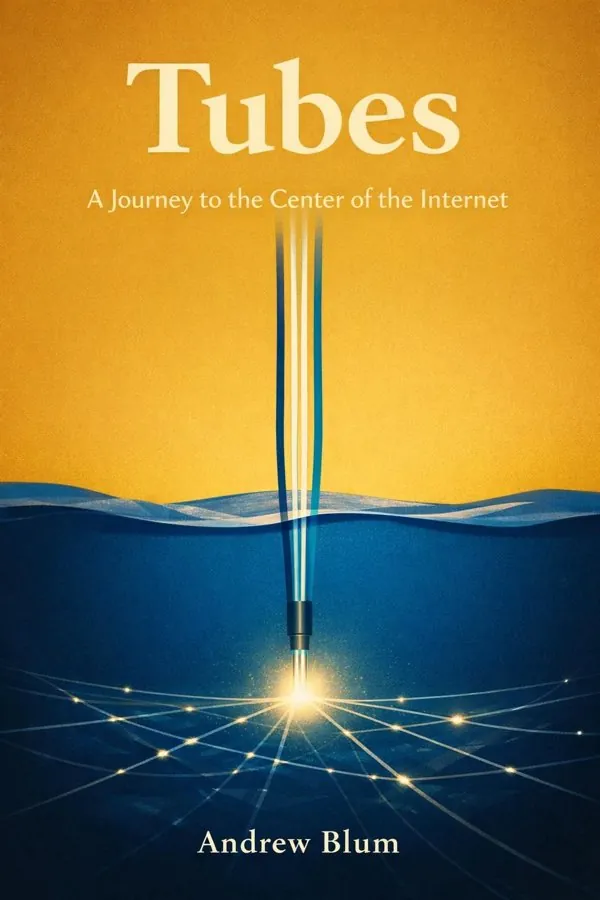
Tubes: A Journey to the Center of the Internet: Summary & Key Insights
by Andrew Blum
 10 min9 chaptersAudio available
What Is Tubes: A Journey to the Center of the Internet About?
Tubes: A Journey to the Center of the Internet by Andrew Blum is a digital_culture book spanning 9 pages. In 'Tubes: A Journey to the Center of the Internet', journalist Andrew Blum explores the physical infrastructure of the Internet, tracing the cables, data centers, and switching stations that make global connectivity possible. Through his travels to undersea cable landing sites, Internet exchange points, and server farms, Blum reveals the tangible, human-built network that underlies the digital world we often imagine as virtual.
This FizzRead summary covers all 9 key chapters of Tubes: A Journey to the Center of the Internet in approximately 10 minutes, distilling the most important ideas, arguments, and takeaways from Andrew Blum's work. Also available as an audio summary and Key Quotes Podcast.
Tubes: A Journey to the Center of the Internet
In 'Tubes: A Journey to the Center of the Internet', journalist Andrew Blum explores the physical infrastructure of the Internet, tracing the cables, data centers, and switching stations that make global connectivity possible. Through his travels to undersea cable landing sites, Internet exchange points, and server farms, Blum reveals the tangible, human-built network that underlies the digital world we often imagine as virtual.
Who Should Read Tubes: A Journey to the Center of the Internet?
This book is perfect for anyone interested in digital_culture and looking to gain actionable insights in a short read. Whether you're a student, professional, or lifelong learner, the key ideas from Tubes: A Journey to the Center of the Internet by Andrew Blum will help you think differently.
- ✓Readers who enjoy digital_culture and want practical takeaways
- ✓Professionals looking to apply new ideas to their work and life
- ✓Anyone who wants the core insights of Tubes: A Journey to the Center of the Internet in just 10 minutes
Want the full summary?
Get instant access to this book summary and 100K+ more with Fizz Moment.
Get Free SummaryAvailable on App Store • Free to download
Key Chapters
It used to sound quaint—asking where the Internet is. We’d point upward, reflexively, as though data lived in the sky. Corporate marketing had taught us to imagine a cloud. But clouds are vapor, and the Internet is the opposite of vapor. It is cables, wires, and machines—dense, humming, power-hungry.
As I began my travels, this realization became my first awakening: everything digital is ultimately physical. That abstraction we call 'the Internet' is in fact a vast web of tangible infrastructure. When you send an email, it doesn’t dissolve into immaterial space; instead, it becomes a pattern of light impulses flashing through glass fibers thinner than a human hair. When you stream a movie, thousands of servers spin and fans whir to keep them cool. The Internet exists because we have learned how to move light—efficiently, predictably, and securely—across continents and under seas.
It is tempting to think of cyberspace as separate from the real world. Yet every 'virtual' action depends on very real logistics. The cloud has an address, usually an obscure industrial park, perhaps a guarded room with biometric locks. The routers and switches that form the Internet’s nervous system are not mysterious esoterica—they are appliances engineered and maintained by human hands. Recognizing this grounded reality changes the story entirely: it makes the Internet as much a part of our built environment as roads, power lines, or pipelines.
Once I accepted this, I began to see the Internet not merely as a technology, but as an architecture—a spatial network with form and style, the modern cathedral of our interconnected age.
To understand what the Internet has become, I had to retrace where it came from. The story begins in the 1960s, with an audacious experiment called ARPANET. Conceived by scientists under the U.S. Department of Defense’s Advanced Research Projects Agency, ARPANET connected a handful of computers across research institutions, enabling them to share data through packet switching—a revolutionary alternative to traditional communication lines.
Over time, that network evolved organically, each new connection forming at points of necessity: university labs, government facilities, later corporate campuses. What’s most remarkable is that these networks didn’t replace one another—they interlinked. That interlinking, maintained through rules called protocols, gave rise to the capital-I Internet.
By the 1980s and 1990s, the Internet began to escape academia and become a commercial and civic enterprise. New interconnection points grew where multiple networks met, their locations chosen by convenience, infrastructure, and economics. The architecture of interconnection mirrored the architecture of cities: dense at the cores, looser toward the edges. This layered geography still shapes the global network today.
What began as a defense research project became the world’s central nervous system. The Internet’s origins remind us that at its heart are collaboration, experimentation, and the persistent human desire to communicate. Every packet that moves today follows paths mapped by early pioneers who simply wanted to share data more efficiently.
+ 7 more chapters — available in the FizzRead app
All Chapters in Tubes: A Journey to the Center of the Internet
About the Author
Andrew Blum is an American journalist and author who writes about architecture, technology, and infrastructure. His work has appeared in publications such as Wired, The New Yorker, and The Atlantic. He is known for his accessible explorations of complex systems that shape modern life.
Get This Summary in Your Preferred Format
Read or listen to the Tubes: A Journey to the Center of the Internet summary by Andrew Blum anytime, anywhere. FizzRead offers multiple formats so you can learn on your terms — all free.
Available formats: App · Audio · PDF · EPUB — All included free with FizzRead
Download Tubes: A Journey to the Center of the Internet PDF and EPUB Summary
Key Quotes from Tubes: A Journey to the Center of the Internet
“It used to sound quaint—asking where the Internet is.”
“To understand what the Internet has become, I had to retrace where it came from.”
Frequently Asked Questions about Tubes: A Journey to the Center of the Internet
Tubes: A Journey to the Center of the Internet by Andrew Blum is a digital_culture book that explores key ideas across 9 chapters. In 'Tubes: A Journey to the Center of the Internet', journalist Andrew Blum explores the physical infrastructure of the Internet, tracing the cables, data centers, and switching stations that make global connectivity possible. Through his travels to undersea cable landing sites, Internet exchange points, and server farms, Blum reveals the tangible, human-built network that underlies the digital world we often imagine as virtual.
You Might Also Like

An Ugly Truth: Inside Facebook’s Battle for Domination
Sheera Frenkel, Cecilia Kang
10 min
Cyber Citizens
Ian Goodfellow
10 min
Digital Minimalism: Choosing a Focused Life in a Noisy World
Cal Newport
10 min
E‑Books & Beyond
Various Authors
10 min
The Future of Media
Various Authors
10 min
This Is Why We Can't Have Nice Things
Whitney Phillips
10 minBrowse by Category
Ready to read Tubes: A Journey to the Center of the Internet?
Get the full summary and 100K+ more books with Fizz Moment.