
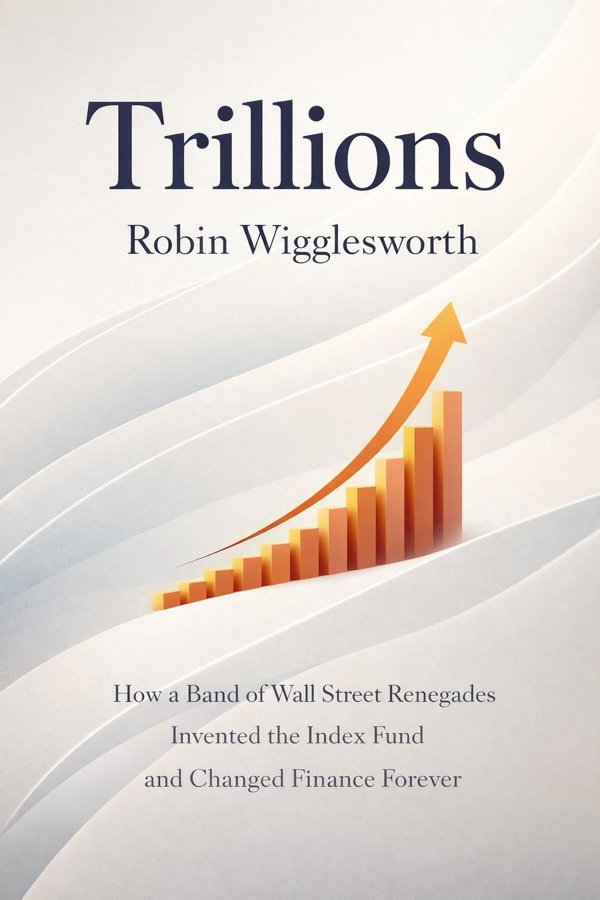
Trillions: How a Band of Wall Street Renegades Invented the Index Fund and Changed Finance Forever: Summary & Key Insights
 10 min9 chaptersAudio available
Key Takeaways from Trillions: How a Band of Wall Street Renegades Invented the Index Fund and Changed Finance Forever
Every investing revolution begins by challenging a deeply held belief, and before index funds, the dominant faith was in human brilliance.
Sometimes the most disruptive ideas emerge not from practice but from theory.
A financial idea matters only when someone figures out how to implement it.
Some revolutions need a theorist, but others need a crusader.
Financial ideas become permanent when large institutions adopt them.
What Is Trillions: How a Band of Wall Street Renegades Invented the Index Fund and Changed Finance Forever About?
Trillions: How a Band of Wall Street Renegades Invented the Index Fund and Changed Finance Forever by Robin Wigglesworth is a finance book spanning 7 pages. Trillions tells the remarkable story of one of the most important financial inventions of the modern era: the index fund. What began as a radical, even laughable, challenge to Wall Street orthodoxy became a force that transformed investing for pension funds, institutions, and everyday savers around the world. In this lively and deeply reported book, Robin Wigglesworth traces how an unlikely coalition of academics, data obsessives, contrarian money managers, and stubborn idealists dismantled the old belief that expensive experts could reliably beat the market. Instead, they advanced a simpler proposition: for most investors, owning the market cheaply and patiently is the winning strategy. The book matters because passive investing now shapes retirement systems, asset management, and even corporate power on a global scale. Understanding its rise means understanding modern finance itself. Wigglesworth, a seasoned Financial Times journalist, brings unusual authority to the subject. He combines historical depth, market knowledge, and sharp storytelling to explain not just the mechanics of indexing, but also the personalities, rivalries, and cultural clashes behind it. The result is both a history of finance and a guide to how investing was permanently changed.
This FizzRead summary covers all 9 key chapters of Trillions: How a Band of Wall Street Renegades Invented the Index Fund and Changed Finance Forever in approximately 10 minutes, distilling the most important ideas, arguments, and takeaways from Robin Wigglesworth's work. Also available as an audio summary and Key Quotes Podcast.
Trillions: How a Band of Wall Street Renegades Invented the Index Fund and Changed Finance Forever
Trillions tells the remarkable story of one of the most important financial inventions of the modern era: the index fund. What began as a radical, even laughable, challenge to Wall Street orthodoxy became a force that transformed investing for pension funds, institutions, and everyday savers around the world. In this lively and deeply reported book, Robin Wigglesworth traces how an unlikely coalition of academics, data obsessives, contrarian money managers, and stubborn idealists dismantled the old belief that expensive experts could reliably beat the market. Instead, they advanced a simpler proposition: for most investors, owning the market cheaply and patiently is the winning strategy.
The book matters because passive investing now shapes retirement systems, asset management, and even corporate power on a global scale. Understanding its rise means understanding modern finance itself. Wigglesworth, a seasoned Financial Times journalist, brings unusual authority to the subject. He combines historical depth, market knowledge, and sharp storytelling to explain not just the mechanics of indexing, but also the personalities, rivalries, and cultural clashes behind it. The result is both a history of finance and a guide to how investing was permanently changed.
Who Should Read Trillions: How a Band of Wall Street Renegades Invented the Index Fund and Changed Finance Forever?
This book is perfect for anyone interested in finance and looking to gain actionable insights in a short read. Whether you're a student, professional, or lifelong learner, the key ideas from Trillions: How a Band of Wall Street Renegades Invented the Index Fund and Changed Finance Forever by Robin Wigglesworth will help you think differently.
- ✓Readers who enjoy finance and want practical takeaways
- ✓Professionals looking to apply new ideas to their work and life
- ✓Anyone who wants the core insights of Trillions: How a Band of Wall Street Renegades Invented the Index Fund and Changed Finance Forever in just 10 minutes
Want the full summary?
Get instant access to this book summary and 100K+ more with Fizz Moment.
Get Free SummaryAvailable on App Store • Free to download
Key Chapters
Every investing revolution begins by challenging a deeply held belief, and before index funds, the dominant faith was in human brilliance. For decades, Wall Street ran on the conviction that talented fund managers, armed with insight, discipline, and intuition, could identify mispriced securities and consistently outperform the market. This belief was not only widespread; it was central to the prestige and economics of the asset management industry. Portfolio managers were treated as stars, and high fees were justified as the price of superior judgment.
Wigglesworth shows that this earlier era was shaped as much by culture as by evidence. Investing was personal, performative, and often ego-driven. Firms sold stories about genius, access, and skill. Clients wanted to believe that someone extraordinary was steering their money. But over time, data started to expose an uncomfortable truth: while some managers beat the market for periods of time, very few could do so reliably after costs. Fees, turnover, taxes, and overconfidence quietly eroded returns.
The practical lesson is easy to see in modern investing. An actively managed mutual fund charging high fees must clear a significant hurdle just to match a low-cost index fund. If a fund charges 1% annually while an index fund charges 0.05%, that difference compounds dramatically over decades. For retirement savers, the cost of believing in stock-picking talent can become enormous.
The key takeaway is to question investment narratives that rely on charisma or reputation. Before paying for supposed expertise, compare long-term after-fee performance against a simple benchmark and ask whether skill is truly visible or merely well marketed.
Sometimes the most disruptive ideas emerge not from practice but from theory. One of the intellectual foundations of indexing came from Eugene Fama and the development of the Efficient Market Hypothesis, which argued that market prices already incorporate available information so quickly and broadly that persistent outperformance is extremely difficult. If this is even roughly true, then the traditional asset management model begins to look less like science and more like expensive speculation.
Wigglesworth explains how revolutionary this idea was. It did not claim that markets are perfectly rational in every moment, nor that prices never deviate from value. Instead, it suggested that consistently identifying those deviations ahead of everyone else is extraordinarily hard. By the time an investor acts on public information, the market has usually already adjusted. This insight undermined the romantic image of the all-seeing stock picker.
The theory had practical implications. If markets are broadly efficient, then investors should focus less on trying to outguess prices and more on capturing broad market returns at minimal cost. That logic laid the groundwork for indexing. For example, a pension plan deciding between hiring multiple active managers or simply tracking the S&P 500 could increasingly justify the latter based on evidence rather than tradition.
Importantly, the lesson is not that thinking is useless. Rather, it is that markets are highly competitive ecosystems where thousands of smart participants are simultaneously searching for edge. The odds of beating them after fees are low.
The actionable takeaway is to treat market efficiency as a default assumption. Build your investment plan around diversification, low costs, and long time horizons, and only pursue active strategies if you can clearly define why you believe your edge is real and durable.
A financial idea matters only when someone figures out how to implement it. The leap from academic insight to investable product was one of the boldest transitions in modern finance. Early indexing experiments faced ridicule because they appeared to surrender the game. Why would anyone deliberately settle for average returns? Yet the pioneers realized something subtle but profound: average market performance, achieved cheaply and consistently, often beats the majority of attempts to do better.
Wigglesworth brings to life the engineers of this transition. These were not glamorous financiers but practical innovators willing to operationalize a theory. Building an index fund required more than a concept. It demanded decisions about benchmark construction, portfolio replication, trading methods, rebalancing, and cost control. Early institutional adopters, especially pension funds, played an outsized role because they cared about long-term liabilities and consistency rather than flashy outperformance.
A useful example is a large retirement fund choosing broad market exposure over a stable of expensive active managers. By indexing, the institution gains transparency, lowers fees, reduces manager risk, and aligns its portfolio more closely with its benchmark. The result is not merely lower cost, but cleaner governance. Trustees can focus on asset allocation and discipline rather than constant manager replacement.
This step from theory to product also offers a broader lesson in innovation. Disruptive change often looks inferior at first because it removes status rather than adding excitement. Early index funds were mocked as mechanical and unimaginative, but that simplicity was precisely their strength.
The actionable takeaway is to value implementation as much as insight. A sound strategy is only useful if it can be executed reliably, at scale, and at low cost over many years.
Some revolutions need a theorist, but others need a crusader. John Bogle was the figure who turned indexing from an institutional curiosity into a populist movement. He believed that ordinary investors were being quietly exploited by an industry that charged too much, traded too often, and delivered too little. His answer was not complexity but fairness: give investors broad market exposure at the lowest possible cost and let compounding do the rest.
Wigglesworth portrays Bogle as both visionary and combative. His creation of Vanguard and his relentless advocacy for low-cost investing were not universally celebrated. Many on Wall Street saw indexing as a threat to their business model. Even the first retail index fund was derided as un-American and destined to fail because it did not promise to beat the market. But Bogle understood that for long-term savers, especially those investing through retirement accounts, minimizing costs could be more powerful than chasing star managers.
The practical importance of Bogle’s contribution is immense. Consider two investors contributing regularly over 30 years. One pays 1.2% in annual fund expenses; the other pays 0.05%. Assuming similar market exposure, the lower-cost investor retains far more of the market’s return. What appears to be a small difference in fees becomes a life-changing gap through compounding.
Bogle also reframed investing as a behavior problem. The best strategy is often not the most exciting one, but the one an investor can stick with through booms and crashes. Low-cost index funds make that easier by reducing the temptation to constantly react.
The actionable takeaway is simple: treat fees as one of the few investment variables you can control. Choosing low-cost, broad-market funds is not settling for less; it is often the most rational way to build long-term wealth.
Financial ideas become permanent when large institutions adopt them. Indexing may have started as an intellectual rebellion, but it gained real power when pension funds, endowments, and large fiduciaries began to embrace it. These investors were less interested in market myths and more focused on measurable outcomes: cost efficiency, benchmark consistency, governance simplicity, and long-term reliability. Once institutional capital began flowing into passive strategies, indexing moved from fringe concept to structural force.
Wigglesworth explains that this shift was tied to the rise of quantitative thinking. As computing power improved and data analysis became more sophisticated, institutions could evaluate manager performance more rigorously. Many discovered that active management often failed to justify its fees. Index funds, by contrast, offered transparency and predictability. They did what they claimed to do, and that honesty itself became a competitive advantage.
A practical example is a pension board overseeing billions in retirement assets. Hiring multiple active managers creates complexity: style drift, uneven performance, overlapping holdings, high fees, and endless reviews. Switching part of the portfolio to indexed exposure can reduce these frictions and allow the board to focus on higher-level decisions such as risk tolerance and funding obligations.
This institutional embrace also changed the culture of finance. Portfolio management began to look less like art and more like systems design. Data, benchmarks, and implementation discipline mattered more. The rise of quantitative methods made markets more measurable, and that measurability often favored passive approaches.
The actionable takeaway is to think like a fiduciary, even with personal money. Ask whether each investment choice improves clarity, lowers unnecessary cost, and serves a long-term objective. If it does not, simplicity may be the smarter path.
A revolution accelerates when it becomes more convenient. Exchange-traded funds, or ETFs, transformed indexing from a sensible long-term strategy into a highly flexible financial tool. By allowing investors to buy and sell diversified baskets of securities throughout the trading day, ETFs combined the broad exposure of index funds with the accessibility and speed of stocks. This innovation helped passive investing move from retirement accounts and institutions into the center of global markets.
Wigglesworth shows that ETFs were more than a packaging tweak. They changed investor behavior, product development, and market structure. Suddenly, exposure to an index could be gained instantly, cheaply, and in almost any corner of the world. Investors could buy the entire U.S. stock market, emerging markets, bonds, sectors, factors, or commodities with a few clicks. Technology platforms and digital brokerage systems amplified this convenience, making diversified investing easier than ever.
The practical benefits are obvious. A small investor who once needed significant capital and multiple transactions to build a diversified portfolio can now buy a total-market ETF and gain instant exposure to hundreds or thousands of securities. Advisors can rebalance client portfolios more efficiently. Institutions can adjust allocations quickly and transparently.
But Wigglesworth also hints at a paradox. The same product that enables patient, low-cost investing can also tempt investors into constant trading. Sector ETFs, thematic ETFs, and leveraged products may pull people back toward speculation under the banner of passive investing.
The actionable takeaway is to separate the wrapper from the behavior. ETFs are powerful tools, but their value depends on how you use them. Favor broad, low-cost funds for strategic investing, and do not let convenience turn disciplined investing into impulsive trading.
Success changes the system that created it. As passive investing swelled from an outsider strategy into a multi-trillion-dollar force, it did more than lower investor fees; it began to reshape the structure of markets themselves. A small number of giant asset managers came to hold significant stakes in large public companies through index funds. That raised a new set of questions: What happens when ownership becomes concentrated, even if decision-making remains broadly rules-based? Who exercises influence in corporate governance, and in whose interest?
Wigglesworth explores this tension without reducing it to slogans. On one hand, the rise of passive investing has delivered enormous benefits: lower costs, broader access, and better long-term outcomes for many investors. On the other hand, the sheer scale of firms managing indexed assets has sparked concerns about voting power, competition, and market dynamics. Passive managers may not pick stocks in the traditional sense, but they still vote proxies, engage with executives, and shape governance norms.
A practical example is the role of large index providers and asset managers in environmental, social, and governance debates. Because they hold shares in thousands of companies, they cannot simply sell every firm they dislike. Instead, they often engage through stewardship and proxy voting. That gives them influence, even if they are not active stock pickers.
This scale also changes how markets absorb information. If a large share of money is invested mechanically according to indexes, critics argue that price discovery could weaken at the margin. Supporters respond that active investors still set prices and that passive investors simply free-ride efficiently on that process.
The actionable takeaway is to recognize that low-cost investing has system-level consequences. Investors should pay attention not only to returns and fees, but also to how their fund provider approaches stewardship, governance, and market responsibility.
No financial innovation is beyond criticism, and Wigglesworth is careful not to present indexing as a flawless triumph. As passive investing grew, so did the backlash. Critics warned that indexing could fuel asset bubbles, distort price signals, encourage complacency, and concentrate too much power in a handful of firms. Others argued that passive investing benefits from a contradiction: it depends on active investors to do the hard work of price discovery while claiming superiority over them.
These objections deserve serious attention. If everyone indexed, markets would not function well because there would be too few participants trying to determine fair value. But in practice, markets contain a mix of active and passive capital, and that mix has so far proved sustainable. Active investors continue to analyze companies, exploit mispricings, and react to news. Passive investors, meanwhile, provide low-cost exposure and discipline. The relationship is competitive but also interdependent.
There is also a behavioral critique. Passive investing is often sold as simple, but true passive behavior is emotionally difficult. Investors still panic in downturns, chase trends, and confuse access with wisdom. Owning an index fund does not eliminate human weakness.
A practical example is the investor who buys a broad ETF but sells during a market crash because losses feel intolerable. Technically passive, behaviorally active. The product alone does not guarantee good outcomes.
The actionable takeaway is to embrace passive investing with clear eyes. Use indexing for its strengths, but remain aware of its limits. Pair low-cost market exposure with a sound behavioral plan, realistic expectations, and an understanding that even the best strategy can fail if abandoned at the wrong moment.
The deepest message in Trillions is not just that index funds are cheap, but that they align with how difficult investing really is. Markets are noisy, competitive, and emotionally exhausting. Most investors do not fail because they lack access to clever ideas; they fail because they overtrade, overpay, and overestimate their ability to predict. Indexing succeeds in part because it removes opportunities for self-sabotage.
Wigglesworth’s story repeatedly returns to humility. The pioneers of passive investing did not claim to know the future better than everyone else. Instead, they designed a system that worked even when forecasting was unreliable. That mindset has practical power far beyond finance. In uncertain environments, robust processes often beat brilliant but fragile predictions.
Consider a household investor saving monthly for retirement. Rather than trying to guess which sectors or managers will outperform this year, they automate contributions into diversified index funds, rebalance occasionally, and ignore short-term noise. This approach may appear boring, but it captures the market’s long-term growth while reducing taxes, fees, and emotionally driven mistakes.
The elegance of the strategy is that it shifts attention from market forecasting to personal behavior. Can you save consistently? Can you stay invested during declines? Can you avoid chasing what just went up? These questions matter more than finding the next market genius.
The actionable takeaway is to build an investment process that protects you from your own impulses. Automate contributions, keep costs low, diversify broadly, and set rules for rebalancing. In the long run, disciplined behavior is often the most reliable source of investment success.
All Chapters in Trillions: How a Band of Wall Street Renegades Invented the Index Fund and Changed Finance Forever
About the Author
Robin Wigglesworth is a senior financial journalist best known for his work at the Financial Times, where he has covered global markets, asset management, and the changing architecture of modern finance. His reporting often focuses on how ideas from economics and technology reshape real-world investing, making him especially well positioned to tell the story of the index fund’s rise. Wigglesworth has earned a reputation for translating complex financial developments into clear, engaging narratives without losing analytical depth. In Trillions, he brings together years of reporting, interviews, and market knowledge to explain how passive investing moved from academic theory to global dominance. His work is valued for combining sharp insight, historical perspective, and an eye for the personalities driving financial change.
Get This Summary in Your Preferred Format
Read or listen to the Trillions: How a Band of Wall Street Renegades Invented the Index Fund and Changed Finance Forever summary by Robin Wigglesworth anytime, anywhere. FizzRead offers multiple formats so you can learn on your terms — all free.
Available formats: App · Audio · PDF · EPUB — All included free with FizzRead
Download Trillions: How a Band of Wall Street Renegades Invented the Index Fund and Changed Finance Forever PDF and EPUB Summary
Key Quotes from Trillions: How a Band of Wall Street Renegades Invented the Index Fund and Changed Finance Forever
“Every investing revolution begins by challenging a deeply held belief, and before index funds, the dominant faith was in human brilliance.”
“Sometimes the most disruptive ideas emerge not from practice but from theory.”
“A financial idea matters only when someone figures out how to implement it.”
“Some revolutions need a theorist, but others need a crusader.”
“Financial ideas become permanent when large institutions adopt them.”
Frequently Asked Questions about Trillions: How a Band of Wall Street Renegades Invented the Index Fund and Changed Finance Forever
Trillions: How a Band of Wall Street Renegades Invented the Index Fund and Changed Finance Forever by Robin Wigglesworth is a finance book that explores key ideas across 9 chapters. Trillions tells the remarkable story of one of the most important financial inventions of the modern era: the index fund. What began as a radical, even laughable, challenge to Wall Street orthodoxy became a force that transformed investing for pension funds, institutions, and everyday savers around the world. In this lively and deeply reported book, Robin Wigglesworth traces how an unlikely coalition of academics, data obsessives, contrarian money managers, and stubborn idealists dismantled the old belief that expensive experts could reliably beat the market. Instead, they advanced a simpler proposition: for most investors, owning the market cheaply and patiently is the winning strategy. The book matters because passive investing now shapes retirement systems, asset management, and even corporate power on a global scale. Understanding its rise means understanding modern finance itself. Wigglesworth, a seasoned Financial Times journalist, brings unusual authority to the subject. He combines historical depth, market knowledge, and sharp storytelling to explain not just the mechanics of indexing, but also the personalities, rivalries, and cultural clashes behind it. The result is both a history of finance and a guide to how investing was permanently changed.
You Might Also Like
Browse by Category
Ready to read Trillions: How a Band of Wall Street Renegades Invented the Index Fund and Changed Finance Forever?
Get the full summary and 100K+ more books with Fizz Moment.