
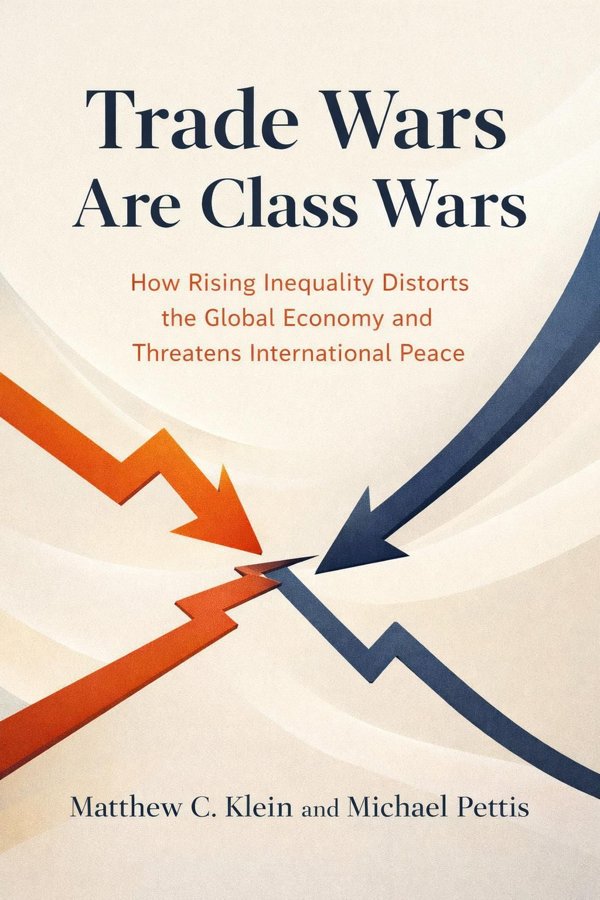
Trade Wars Are Class Wars: How Rising Inequality Distorts the Global Economy and Threatens International Peace: Summary & Key Insights
by Matthew C. Klein, Michael Pettis
 10 min7 chaptersAudio available
What Is Trade Wars Are Class Wars: How Rising Inequality Distorts the Global Economy and Threatens International Peace About?
Trade Wars Are Class Wars: How Rising Inequality Distorts the Global Economy and Threatens International Peace by Matthew C. Klein and Michael Pettis is a economics book spanning 7 pages. This book argues that global trade imbalances are not primarily the result of national competitiveness but of domestic inequality. Klein and Pettis explain how the concentration of income and wealth within countries leads to excess savings and weak demand, fueling trade conflicts and financial instability. They analyze the economic relationships between the United States, China, and Europe, showing how class divisions within nations drive international tensions and distort the global economy.
This FizzRead summary covers all 7 key chapters of Trade Wars Are Class Wars: How Rising Inequality Distorts the Global Economy and Threatens International Peace in approximately 10 minutes, distilling the most important ideas, arguments, and takeaways from Matthew C. Klein and Michael Pettis's work. Also available as an audio summary and Key Quotes Podcast.
Trade Wars Are Class Wars: How Rising Inequality Distorts the Global Economy and Threatens International Peace
This book argues that global trade imbalances are not primarily the result of national competitiveness but of domestic inequality. Klein and Pettis explain how the concentration of income and wealth within countries leads to excess savings and weak demand, fueling trade conflicts and financial instability. They analyze the economic relationships between the United States, China, and Europe, showing how class divisions within nations drive international tensions and distort the global economy.
Who Should Read Trade Wars Are Class Wars: How Rising Inequality Distorts the Global Economy and Threatens International Peace?
This book is perfect for anyone interested in economics and looking to gain actionable insights in a short read. Whether you're a student, professional, or lifelong learner, the key ideas from Trade Wars Are Class Wars: How Rising Inequality Distorts the Global Economy and Threatens International Peace by Matthew C. Klein and Michael Pettis will help you think differently.
- ✓Readers who enjoy economics and want practical takeaways
- ✓Professionals looking to apply new ideas to their work and life
- ✓Anyone who wants the core insights of Trade Wars Are Class Wars: How Rising Inequality Distorts the Global Economy and Threatens International Peace in just 10 minutes
Want the full summary?
Get instant access to this book summary and 100K+ more with Fizz Moment.
Get Free SummaryAvailable on App Store • Free to download
Key Chapters
After World War II, the architects of the global economy recognized that balance mattered—not only between nations, but within them. The Bretton Woods system, led by figures like Keynes and White, was built to ensure that no country could grow at the expense of another without consequence. Domestic demand was maintained by rising wages and widespread consumption. When workers shared in productivity gains, the world economy stayed balanced: American laborers could afford the goods they produced, European societies rebuilt with strong welfare states, and global trade expanded sustainably.
Yet by the late twentieth century, this equilibrium began to fracture. The liberalization of capital flows, deregulation, and the political shift toward market fundamentalism altered the equation. The postwar compact between labor and capital weakened. Governments became less willing—or less able—to manage income distribution, and workers’ bargaining power eroded under the pressures of globalization and automation. Meanwhile, household consumption—especially in the advanced economies—stagnated, while savings grew among the wealthy and within corporate sectors.
The authors trace how this structural change reconfigured the entire global economy. The United States, once the world’s great exporter, turned into the consumer of last resort, absorbing the excess production of others through growing deficits. China, emerging from reform and industrialization, pursued export-led growth as a development strategy but relied on suppressing domestic consumption to sustain it. Europe, too, became unbalanced: Germany’s surpluses mirrored the debts of its southern neighbors. The cohesive system that once balanced production and demand globally gave way to one polarized between savers and spenders, lenders and borrowers—class divides projected onto the international stage.
To understand how inequality drives trade conflicts, Pettis and Klein build a deceptively simple model grounded in the relationship between income, savings, and consumption. Every economy must balance its output with its spending: what is produced must be bought by someone. When income is distributed evenly, most of it is spent on goods and services, maintaining strong domestic demand. But when income pools among the wealthy or among firms that save rather than consume, aggregate spending falls short of potential output.
This excess of production relative to consumption shows up as a surplus of savings. Economists often frame this as a virtue, but in the authors’ framework, an economy that saves more than it invests domestically must export its surplus savings abroad—often in the form of lending to deficit countries. Those borrowing countries, to maintain growth, run trade deficits, importing more than they export to absorb the world’s excess production. Thus, domestic inequality in one country generates international imbalances.
The mechanics are clear in accounting terms, but the deeper insight lies in the politics of distribution. The authors argue that these dynamics are not the result of ‘competitiveness’ or ‘industrial efficiency’ but of who gets paid and who gets left out. In countries where workers capture less income, households cannot spend enough to sustain output, pushing the national savings rate up artificially. Conversely, in countries where inequality leads to debt-fueled consumption, deficits emerge—not because citizens lack discipline, but because their incomes cannot keep pace with the costs of living. The world’s trade tensions thus reflect a struggle between those with excess capital to lend and those who must borrow to fill the gap.
+ 5 more chapters — available in the FizzRead app
All Chapters in Trade Wars Are Class Wars: How Rising Inequality Distorts the Global Economy and Threatens International Peace
About the Authors
Matthew C. Klein is an American economics writer and editor known for his work at Barron’s and the Financial Times. Michael Pettis is a professor of finance at Peking University and a senior fellow at the Carnegie Endowment for International Peace, specializing in Chinese and global macroeconomics.
Get This Summary in Your Preferred Format
Read or listen to the Trade Wars Are Class Wars: How Rising Inequality Distorts the Global Economy and Threatens International Peace summary by Matthew C. Klein and Michael Pettis anytime, anywhere. FizzRead offers multiple formats so you can learn on your terms — all free.
Available formats: App · Audio · PDF · EPUB — All included free with FizzRead
Download Trade Wars Are Class Wars: How Rising Inequality Distorts the Global Economy and Threatens International Peace PDF and EPUB Summary
Key Quotes from Trade Wars Are Class Wars: How Rising Inequality Distorts the Global Economy and Threatens International Peace
“After World War II, the architects of the global economy recognized that balance mattered—not only between nations, but within them.”
“To understand how inequality drives trade conflicts, Pettis and Klein build a deceptively simple model grounded in the relationship between income, savings, and consumption.”
Frequently Asked Questions about Trade Wars Are Class Wars: How Rising Inequality Distorts the Global Economy and Threatens International Peace
Trade Wars Are Class Wars: How Rising Inequality Distorts the Global Economy and Threatens International Peace by Matthew C. Klein and Michael Pettis is a economics book that explores key ideas across 7 chapters. This book argues that global trade imbalances are not primarily the result of national competitiveness but of domestic inequality. Klein and Pettis explain how the concentration of income and wealth within countries leads to excess savings and weak demand, fueling trade conflicts and financial instability. They analyze the economic relationships between the United States, China, and Europe, showing how class divisions within nations drive international tensions and distort the global economy.
You Might Also Like

Business Adventures
John Brooks
10 min
Nudge
Richard H. Thaler, Cass R. Sunstein
10 min
The Hitchhiker"s Guide to the Galaxy
Douglas Adams
10 minThe Muqaddimah
Ibn Khaldun
10 minThe Outsiders
William N. Thorndike
10 min
A Little History of Economics
Niall Kishtainy
10 minBrowse by Category
Ready to read Trade Wars Are Class Wars: How Rising Inequality Distorts the Global Economy and Threatens International Peace?
Get the full summary and 100K+ more books with Fizz Moment.