
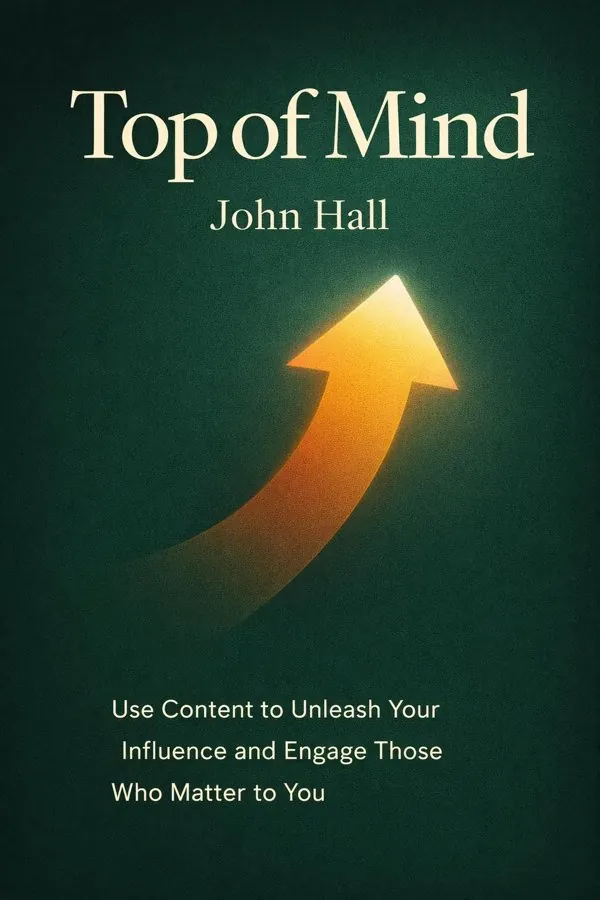
Top of Mind: Use Content to Unleash Your Influence and Engage Those Who Matter to You: Summary & Key Insights
by John Hall
 10 min9 chaptersAudio available
Key Takeaways from Top of Mind: Use Content to Unleash Your Influence and Engage Those Who Matter to You
The biggest shift in modern communication is simple: people are no longer impressed by polished persuasion alone.
Trust is rarely built in one dramatic moment.
The most effective content begins not with what you want to say, but with what your audience needs to hear.
Being remembered is not a one-time achievement.
Facts inform, but stories persuade and endure.
What Is Top of Mind: Use Content to Unleash Your Influence and Engage Those Who Matter to You About?
Top of Mind: Use Content to Unleash Your Influence and Engage Those Who Matter to You by John Hall is a leadership book spanning 9 pages. Top of Mind is a leadership and marketing book about one of the hardest challenges in modern business: staying relevant to the people who matter most. John Hall argues that influence is no longer built through interruption, aggressive promotion, or one-off campaigns. Instead, it is earned by consistently creating useful, trustworthy content that helps others solve problems, make decisions, and feel understood. When people repeatedly associate your name or brand with value, you become the first person they think of when opportunities arise. The book matters because attention is fragmented, trust is fragile, and audiences are increasingly skilled at ignoring anything that feels self-serving. Hall shows that content is not just a marketing tool; it is a relationship-building system that can strengthen leadership, deepen loyalty, and create long-term business growth. His approach blends strategy with practicality, explaining how authenticity, consistency, storytelling, and smart distribution work together. Hall writes from experience as the cofounder of Influence & Co., a company that has helped leaders and organizations build authority through content. His message is clear: if you want lasting influence, earn a place in people’s minds by being genuinely helpful over time.
This FizzRead summary covers all 9 key chapters of Top of Mind: Use Content to Unleash Your Influence and Engage Those Who Matter to You in approximately 10 minutes, distilling the most important ideas, arguments, and takeaways from John Hall's work. Also available as an audio summary and Key Quotes Podcast.
Top of Mind: Use Content to Unleash Your Influence and Engage Those Who Matter to You
Top of Mind is a leadership and marketing book about one of the hardest challenges in modern business: staying relevant to the people who matter most. John Hall argues that influence is no longer built through interruption, aggressive promotion, or one-off campaigns. Instead, it is earned by consistently creating useful, trustworthy content that helps others solve problems, make decisions, and feel understood. When people repeatedly associate your name or brand with value, you become the first person they think of when opportunities arise.
The book matters because attention is fragmented, trust is fragile, and audiences are increasingly skilled at ignoring anything that feels self-serving. Hall shows that content is not just a marketing tool; it is a relationship-building system that can strengthen leadership, deepen loyalty, and create long-term business growth. His approach blends strategy with practicality, explaining how authenticity, consistency, storytelling, and smart distribution work together.
Hall writes from experience as the cofounder of Influence & Co., a company that has helped leaders and organizations build authority through content. His message is clear: if you want lasting influence, earn a place in people’s minds by being genuinely helpful over time.
Who Should Read Top of Mind: Use Content to Unleash Your Influence and Engage Those Who Matter to You?
This book is perfect for anyone interested in leadership and looking to gain actionable insights in a short read. Whether you're a student, professional, or lifelong learner, the key ideas from Top of Mind: Use Content to Unleash Your Influence and Engage Those Who Matter to You by John Hall will help you think differently.
- ✓Readers who enjoy leadership and want practical takeaways
- ✓Professionals looking to apply new ideas to their work and life
- ✓Anyone who wants the core insights of Top of Mind: Use Content to Unleash Your Influence and Engage Those Who Matter to You in just 10 minutes
Want the full summary?
Get instant access to this book summary and 100K+ more with Fizz Moment.
Get Free SummaryAvailable on App Store • Free to download
Key Chapters
The biggest shift in modern communication is simple: people are no longer impressed by polished persuasion alone. They are overwhelmed by noise, suspicious of manipulation, and far more likely to trust those who sound human, honest, and relevant. John Hall explains that today’s consumers do not want to be marketed at as if they are passive targets. They want to engage with people and brands that understand their needs and respect their intelligence.
This change has major implications for leaders and organizations. Traditional interruption tactics may still create short-term visibility, but they rarely build lasting influence. If your message feels overly promotional, audiences tune out. If it feels useful and sincere, they lean in. Hall’s point is not that promotion is wrong, but that promotion without trust is weak. Authenticity becomes the foundation of sustainable influence because it signals that you are not merely trying to extract attention; you are trying to create value.
In practice, this means replacing generic messaging with specific, audience-centered communication. A financial advisor, for example, will be more memorable by publishing practical guidance on retirement mistakes than by repeatedly claiming expertise. A founder can build stronger credibility by sharing lessons learned from failure than by posting only polished success stories. The more your content reflects real experience, clear thinking, and a genuine desire to help, the more believable your brand becomes.
Hall encourages readers to treat content as a conversation rather than a broadcast. Ask what your audience worries about, what slows them down, and what decisions they struggle to make. Then respond with material that is clear, relevant, and honest.
Actionable takeaway: Audit your current messaging and remove anything that sounds inflated, vague, or self-congratulatory. Replace it with content that answers real questions and reflects your authentic voice.
Trust is rarely built in one dramatic moment. More often, it grows quietly through repeated evidence that you are dependable, honest, and aligned with the audience’s interests. Hall emphasizes that being top of mind is not just about frequency. It is about showing up consistently in ways that reinforce credibility. If your tone changes wildly, your promises shift, or your content appears only when you need something, people sense the instability.
Consistency tells people what to expect from you. Transparency tells them why they should believe you. Together, they form the backbone of influence. A leader who publishes thoughtful insights every month, responds honestly to criticism, and acknowledges uncertainty when appropriate creates a stronger foundation than one who speaks only during launches or crises. Hall’s framework suggests that every interaction either strengthens trust or weakens it.
Transparency is especially important in a crowded digital environment. Audiences understand that companies have goals, but they appreciate honesty about motives, limitations, and trade-offs. For example, a software company might earn respect by openly explaining which clients its product serves best and where it may not be the right fit. A consultant can deepen trust by sharing both what clients can expect and what results depend on the client’s own effort. Such candor reduces hype and increases confidence.
Operationally, consistency requires systems. Editorial calendars, brand guidelines, approval workflows, and clear ownership all help maintain a reliable presence. Transparency requires cultural discipline: admitting mistakes, citing sources, avoiding exaggerated claims, and treating the audience as capable adults.
Hall’s message is that trust compounds. Every useful article, honest email, and thoughtful response adds another layer. Over time, people do not just remember you; they rely on you.
Actionable takeaway: Create a simple consistency plan with a publishing rhythm, a clear voice, and rules for honest communication so your audience learns they can count on you.
The most effective content begins not with what you want to say, but with what your audience needs to hear. Hall argues that relevance is the difference between content that gets ignored and content that builds influence. Too many organizations create material based on internal priorities alone: product updates, brand slogans, executive opinions, or sales goals. But people pay attention when content helps them solve problems, avoid mistakes, or seize opportunities.
This requires a shift from self-expression to service. Instead of asking, “What do we want to publish?” ask, “What questions are our customers already asking?” The strongest content strategy maps directly to the audience’s journey: awareness, evaluation, decision, and ongoing success. A B2B firm might create beginner guides for prospects early in the buying cycle, comparison articles for those evaluating options, and implementation checklists for new clients. Each piece becomes a form of assistance, not just promotion.
Hall also suggests looking beyond surface-level demographics. Two people in the same role may consume content differently depending on urgency, industry pressure, or level of experience. To create material that resonates, you need insight from customer conversations, sales calls, support tickets, search behavior, and social feedback. The better you understand the emotional and practical context of your audience, the more useful your content becomes.
A practical example is a healthcare practice that notices patients repeatedly asking what to expect before a procedure. By creating a clear article, short video, and downloadable checklist answering that question, the practice reduces anxiety, improves preparedness, and strengthens trust before the appointment even begins. The content is valuable because it is tied to a real concern.
Hall’s larger point is that useful content earns attention because it respects time. It delivers clarity instead of clutter and support instead of noise.
Actionable takeaway: Build a list of your audience’s top 20 recurring questions and turn them into a content plan that addresses each need with clarity and specificity.
Being remembered is not a one-time achievement. Hall makes the case that top-of-mind influence depends on ongoing engagement. Even strong relationships fade if there is too much silence, and even great content loses power if it appears irregularly or too late to matter. Relevance is maintained when you continue to show up with timely, useful insight that reflects the audience’s changing world.
This is especially important because markets, customer expectations, and digital platforms move quickly. What mattered to your audience six months ago may not matter now. A content strategy that once worked can become stale if it fails to evolve. Hall encourages readers to treat engagement as a living process, not a fixed campaign. The goal is not constant activity for its own sake, but sustained visibility through meaningful touchpoints.
For example, a leadership coach may publish evergreen articles on management fundamentals, but can remain especially relevant by addressing current workplace realities such as hybrid communication, burnout, or economic uncertainty. A company serving small businesses might supplement foundational resources with short updates on regulation changes or new industry trends. By connecting durable principles with current context, you remain useful and present.
Maintaining engagement also means varying format and channel. Some people prefer newsletters, others podcasts, short videos, webinars, or social posts. Hall does not argue for chasing every platform. Rather, he recommends meeting your audience where they already pay attention and delivering content in forms they can easily absorb.
The discipline here is strategic consistency with adaptive execution. Keep your core message steady, but refresh the way you deliver value. Review performance, listen for new questions, and revisit older content that can be updated.
Actionable takeaway: Set a recurring monthly review to identify new audience concerns, refresh older high-value content, and publish at least one timely piece that connects your expertise to current events or trends.
Facts inform, but stories persuade and endure. Hall emphasizes that storytelling is one of the most powerful ways to connect content with emotion, and emotion is what helps people remember. Audiences may forget a list of features or a well-argued point, but they often remember the narrative that gave those ideas meaning. Stories transform abstract expertise into something human, relatable, and credible.
This matters because trust is not built through information alone. People want evidence that you understand lived experience. A story demonstrates empathy, context, and consequence. It allows the audience to see themselves in the problem and imagine the result. Hall encourages leaders to use stories not as decoration, but as a bridge between knowledge and action.
A compelling story usually includes tension, insight, and resolution. A business owner might describe the moment their company realized its marketing was attracting attention but not loyalty. A physician might recount a patient interaction that revealed why better communication matters. A manager might share how a failed hiring decision taught the importance of values alignment. In each case, the story gives shape to the lesson and increases emotional engagement.
Importantly, storytelling also supports authenticity. It reveals voice, judgment, and vulnerability. It signals that the speaker is not hiding behind abstractions. Yet Hall’s approach remains practical: stories should serve the audience, not indulge the ego. The best stories are chosen because they clarify a principle, reduce resistance, or make a decision easier.
Effective storytelling can appear in articles, presentations, newsletters, interviews, and even sales conversations. The key is to ground your message in real moments that illustrate the why behind the what. When people feel the truth of your insight, they are more likely to act on it.
Actionable takeaway: For each major idea you publish, pair it with a short real-world story that illustrates the problem, the turning point, and the practical lesson.
Many people want to be seen as thought leaders, but Hall makes an important distinction: authority does not come from self-labeling. It comes from repeatedly contributing ideas, insights, and frameworks that help others think better and act more effectively. Thought leadership is not a branding trick. It is the long-term outcome of disciplined generosity, clarity, and expertise shared in public.
This is why content plays such a central role. If people never see how you think, they cannot trust your perspective. When you publish useful analysis, challenge assumptions, explain trends, or articulate new ways of solving common problems, you begin to shape how others understand your field. Over time, that creates influence beyond immediate transactions. People seek your opinion, cite your work, and associate your name with insight.
Hall also reminds readers that thought leadership does not require fame. In many industries, being top of mind within a focused niche is far more valuable than broad visibility. A cybersecurity expert who consistently explains emerging risks to healthcare organizations may become indispensable within that sector. A real estate professional who creates sharp local market analysis may become the trusted voice in a specific region. Relevance to the right people matters more than mass attention.
The process involves patience. Strong thought leadership often begins with practical education, then matures into original perspective. You may start by clarifying basic concepts, then gradually introduce your own frameworks, predictions, or critiques. As your content deepens, your authority strengthens.
Hall’s approach encourages readers to move from reactive communication to proactive contribution. Do not wait until someone asks for your opinion. Publish ideas that deserve attention because they are well-considered and genuinely useful. Authority grows when your audience repeatedly learns something valuable from you.
Actionable takeaway: Choose one narrow area where you want to be known, then create a six-month content series that combines practical guidance, informed perspective, and original insights within that niche.
Great content that nobody encounters cannot build influence. Hall stresses that creation and distribution must work together. Many organizations invest heavily in producing articles, videos, or reports, then assume the work is done once something is published. But publishing is only the midpoint. To become top of mind, your message has to reach the right people repeatedly through the right channels.
This does not mean flooding every platform. It means being strategic about where your audience spends attention and how content can be adapted for each environment. A long-form article might become a newsletter summary, a LinkedIn post, a short video clip, a conference talking point, and a sales enablement resource. The core idea remains the same, but the format changes to fit how people consume information.
Hall’s perspective is especially relevant in digital environments where algorithms, inbox competition, and fragmented habits make organic discovery unreliable. Distribution requires intention: email lists, social sharing, partnerships, media placements, employee advocacy, search optimization, and repurposing. A leader who writes one excellent essay per month can dramatically increase its impact by promoting it thoughtfully over several weeks rather than mentioning it once and moving on.
Amplification also benefits from credibility borrowed through networks. Guest articles, podcast interviews, co-created webinars, and industry collaborations introduce your ideas to audiences that already trust the host or platform. This expands reach while reinforcing authority.
Importantly, Hall does not frame distribution as vanity. The point is not exposure for ego’s sake, but access. If your content can truly help people, then making it discoverable is part of the service. Visibility is not separate from value; it allows value to travel.
Actionable takeaway: For every major content piece, create a simple distribution plan that includes owned channels, social adaptation, partner outreach, and at least three repurposed formats.
A content strategy can only be as strong as the culture behind it. Hall argues that if an organization’s internal values do not support openness, service, and expertise-sharing, its external messaging will eventually feel hollow. Audiences are remarkably good at detecting gaps between what a company says and how it behaves. To become truly top of mind, your content must reflect a real organizational commitment to helping people and communicating honestly.
This has practical implications for leadership. Content should not be treated as the isolated job of the marketing department while the rest of the company operates with indifference or secrecy. The strongest content ecosystems draw on insights from across the organization: sales understands objections, customer support knows recurring frustrations, product teams understand trade-offs, and executives shape long-term vision. When these voices contribute, content becomes richer, more accurate, and more aligned with reality.
Culture also affects whether content creation is sustainable. If leaders encourage employees to share expertise, recognize thoughtful communication, and prioritize customer understanding, useful content becomes a natural extension of how the company works. If they discourage transparency, rush messaging, or focus only on short-term sales, content becomes shallow and inconsistent.
Consider a professional services firm that wants to build trust in a competitive market. If its internal culture rewards collaboration and knowledge-sharing, consultants can contribute case-based insights, analysts can publish trend breakdowns, and client teams can surface practical lessons. The resulting content feels grounded because it comes from actual practice. By contrast, if people are too siloed or fearful to speak honestly, the public message becomes generic.
Hall’s broader lesson is that influence is organizational, not merely promotional. What you publish should emerge from what you believe and how you operate. When content reflects culture, trust deepens because the audience encounters the same values in both message and experience.
Actionable takeaway: Involve multiple departments in a quarterly content planning session and identify which internal expertise, customer insights, and values should be visible in your external communication.
Not everything that matters can be captured by page views alone. Hall acknowledges that while metrics are essential, the real goal of content is not just traffic or impressions. It is trust, engagement, and ultimately meaningful business relationships. This means organizations need a broader way to evaluate success. If you measure only clicks, you may optimize for attention but miss whether your content is actually building credibility and staying power.
Hall encourages readers to connect content measurement with strategic intent. Some indicators are quantitative: return visits, time spent, email engagement, qualified leads, referral traffic, share rates, and conversion quality. Others are more qualitative but equally important: the kinds of conversations content triggers, whether prospects mention your material in sales calls, whether partners seek collaboration, and whether your brand is being cited as a trusted resource.
A useful example is a consulting firm whose article series generates modest traffic but consistently leads to higher-quality inquiries because readers arrive already educated and confident in the firm’s expertise. Another company may discover that a niche newsletter with a small audience drives better relationships than a widely viewed but shallow social campaign. In both cases, the right question is not “How many people saw this?” but “Did this strengthen the right relationships?”
Measurement should also inform iteration. Which topics create the strongest downstream engagement? Which formats build more trust? Which channels attract the best-fit audience? Data becomes powerful when it helps you refine your strategy rather than simply report activity.
Hall’s view is that trust leaves signals. They may be subtle at first, but over time they become visible in loyalty, referrals, shorter sales cycles, stronger retention, and increased reputation. The challenge is to measure what aligns with your actual goals.
Actionable takeaway: Build a content scorecard that tracks not only reach, but also engagement quality, relationship outcomes, and business impact so you can improve influence rather than just visibility.
All Chapters in Top of Mind: Use Content to Unleash Your Influence and Engage Those Who Matter to You
About the Author
John Hall is an entrepreneur, speaker, and content strategy expert best known as the cofounder of Influence & Co., a company that helps businesses and leaders grow their authority through high-quality content. Through his work, he has advised organizations on how to build trust, strengthen brand reputation, and create long-term influence in crowded markets. Hall has been recognized by major business publications, including Forbes, for his insights on entrepreneurship, leadership, and communication. His writing and speaking focus on the idea that sustained relevance comes from delivering value consistently rather than relying on short-term promotional tactics. In Top of Mind, he brings together his experience in content marketing and business leadership to offer a practical framework for becoming memorable, credible, and useful to the audiences that matter most.
Get This Summary in Your Preferred Format
Read or listen to the Top of Mind: Use Content to Unleash Your Influence and Engage Those Who Matter to You summary by John Hall anytime, anywhere. FizzRead offers multiple formats so you can learn on your terms — all free.
Available formats: App · Audio · PDF · EPUB — All included free with FizzRead
Download Top of Mind: Use Content to Unleash Your Influence and Engage Those Who Matter to You PDF and EPUB Summary
Key Quotes from Top of Mind: Use Content to Unleash Your Influence and Engage Those Who Matter to You
“The biggest shift in modern communication is simple: people are no longer impressed by polished persuasion alone.”
“Trust is rarely built in one dramatic moment.”
“The most effective content begins not with what you want to say, but with what your audience needs to hear.”
“Being remembered is not a one-time achievement.”
“Facts inform, but stories persuade and endure.”
Frequently Asked Questions about Top of Mind: Use Content to Unleash Your Influence and Engage Those Who Matter to You
Top of Mind: Use Content to Unleash Your Influence and Engage Those Who Matter to You by John Hall is a leadership book that explores key ideas across 9 chapters. Top of Mind is a leadership and marketing book about one of the hardest challenges in modern business: staying relevant to the people who matter most. John Hall argues that influence is no longer built through interruption, aggressive promotion, or one-off campaigns. Instead, it is earned by consistently creating useful, trustworthy content that helps others solve problems, make decisions, and feel understood. When people repeatedly associate your name or brand with value, you become the first person they think of when opportunities arise. The book matters because attention is fragmented, trust is fragile, and audiences are increasingly skilled at ignoring anything that feels self-serving. Hall shows that content is not just a marketing tool; it is a relationship-building system that can strengthen leadership, deepen loyalty, and create long-term business growth. His approach blends strategy with practicality, explaining how authenticity, consistency, storytelling, and smart distribution work together. Hall writes from experience as the cofounder of Influence & Co., a company that has helped leaders and organizations build authority through content. His message is clear: if you want lasting influence, earn a place in people’s minds by being genuinely helpful over time.
You Might Also Like

Extreme Ownership
Jocko Willink
10 min
Dare to Lead
Brene Brown
10 min
Leaders Eat Last
Simon Sinek
10 min
The 21 Irrefutable Laws of Leadership
John Maxwell
10 min
Start With Why
Simon Sinek
10 min
How to Lead When You're Not in Charge
Clay Scroggins
10 minBrowse by Category
Ready to read Top of Mind: Use Content to Unleash Your Influence and Engage Those Who Matter to You?
Get the full summary and 100K+ more books with Fizz Moment.