
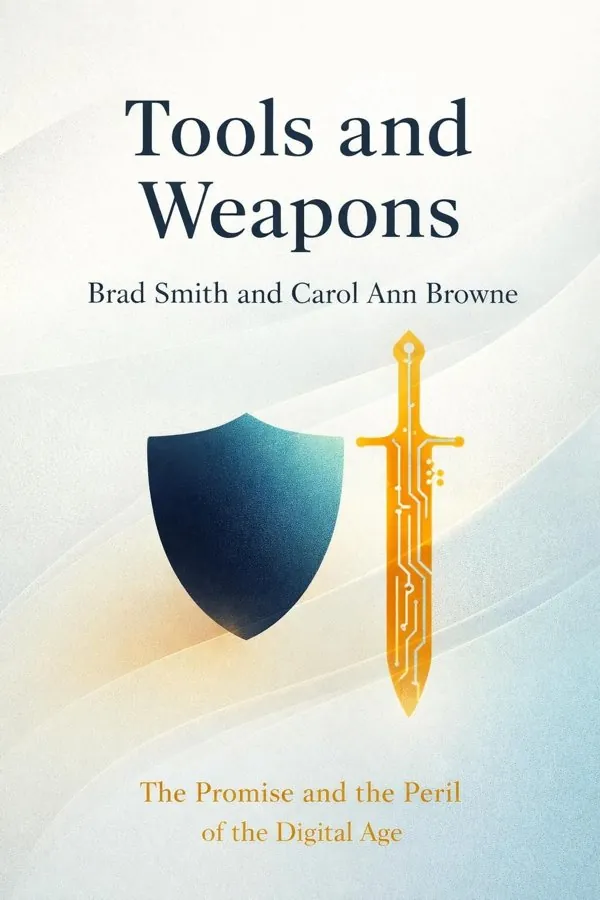
Tools and Weapons: The Promise and the Peril of the Digital Age: Summary & Key Insights
by Brad Smith, Carol Ann Browne
 10 min7 chaptersAudio available
What Is Tools and Weapons: The Promise and the Peril of the Digital Age About?
Tools and Weapons: The Promise and the Peril of the Digital Age by Brad Smith and Carol Ann Browne is a digital_culture book spanning 7 pages. Written by Microsoft President Brad Smith and Senior Director Carol Ann Browne, this book explores how technology has become both a powerful tool and a dangerous weapon in the modern world. It examines the ethical, political, and social challenges posed by digital innovation, cybersecurity, privacy, and artificial intelligence, offering insights into how governments and companies can navigate the digital age responsibly.
This FizzRead summary covers all 7 key chapters of Tools and Weapons: The Promise and the Peril of the Digital Age in approximately 10 minutes, distilling the most important ideas, arguments, and takeaways from Brad Smith and Carol Ann Browne's work. Also available as an audio summary and Key Quotes Podcast.
Tools and Weapons: The Promise and the Peril of the Digital Age
Written by Microsoft President Brad Smith and Senior Director Carol Ann Browne, this book explores how technology has become both a powerful tool and a dangerous weapon in the modern world. It examines the ethical, political, and social challenges posed by digital innovation, cybersecurity, privacy, and artificial intelligence, offering insights into how governments and companies can navigate the digital age responsibly.
Who Should Read Tools and Weapons: The Promise and the Peril of the Digital Age?
This book is perfect for anyone interested in digital_culture and looking to gain actionable insights in a short read. Whether you're a student, professional, or lifelong learner, the key ideas from Tools and Weapons: The Promise and the Peril of the Digital Age by Brad Smith and Carol Ann Browne will help you think differently.
- ✓Readers who enjoy digital_culture and want practical takeaways
- ✓Professionals looking to apply new ideas to their work and life
- ✓Anyone who wants the core insights of Tools and Weapons: The Promise and the Peril of the Digital Age in just 10 minutes
Want the full summary?
Get instant access to this book summary and 100K+ more with Fizz Moment.
Get Free SummaryAvailable on App Store • Free to download
Key Chapters
To understand where we are, we must look back at where we began. The story of the digital revolution is one of both raw ingenuity and gradual awakening. In the decades after World War II, computing evolved from a scientific curiosity into an instrument for mass empowerment. The personal computer democratized access to information. The internet then obliterated traditional boundaries, giving rise to a global digital society.
I remember the earliest optimism surrounding the internet’s birth: the giddy belief that open connectivity would automatically produce open societies. But as technology advanced, so did its shadow. We learned difficult lessons — that the same networks that connect also expose, the same algorithms that amplify knowledge can amplify lies, and the same platforms that democratize expression can undermine truth. The digital age has followed the same trajectory as the industrial one: first invention, then scale, then disruption, and finally, reckoning.
Throughout this progression, Microsoft and its peers found themselves not merely as innovators, but as shapers of history. Each innovation carried unintended social and political consequences that transcended product design. By tracing that lineage — from the early PC revolution to the rise of the internet and cloud computing — we see that our challenge is no longer what we can build, but what we should build.
One of the core themes of this book is that cyberspace has become the world’s fifth domain of conflict — alongside land, sea, air, and space. Yet, most governments and institutions are unprepared for what that truly means. Over the past decade, we’ve watched as states launched attacks not with bullets or bombs, but with code. The WannaCry and NotPetya attacks, in particular, marked a turning point: they showed that malware could cripple entire economies in minutes and that cyberweapons, once unleashed, rarely remain under control.
As someone in the center of this world, I have come to see technology companies as first responders in a digital battlefield. When hospitals are paralyzed or infrastructure is brought down, we are the ones called upon to restore stability. This realization pushed us to propose what we called a Digital Geneva Convention — a framework to hold states accountable for attacking civilian infrastructure online. The same moral principles that guided conduct in physical warfare must now extend to cyberspace.
Cybersecurity is no longer a niche technical issue; it is a matter of public safety and international peace. And as with all weapons, accountability is essential.
+ 5 more chapters — available in the FizzRead app
All Chapters in Tools and Weapons: The Promise and the Peril of the Digital Age
About the Authors
Brad Smith is the President of Microsoft, known for his leadership in technology policy and corporate responsibility. Carol Ann Browne is a Senior Director at Microsoft, specializing in communications and public affairs. Together, they provide a unique insider perspective on the intersection of technology, business, and society.
Get This Summary in Your Preferred Format
Read or listen to the Tools and Weapons: The Promise and the Peril of the Digital Age summary by Brad Smith and Carol Ann Browne anytime, anywhere. FizzRead offers multiple formats so you can learn on your terms — all free.
Available formats: App · Audio · PDF · EPUB — All included free with FizzRead
Download Tools and Weapons: The Promise and the Peril of the Digital Age PDF and EPUB Summary
Key Quotes from Tools and Weapons: The Promise and the Peril of the Digital Age
“To understand where we are, we must look back at where we began.”
“One of the core themes of this book is that cyberspace has become the world’s fifth domain of conflict — alongside land, sea, air, and space.”
Frequently Asked Questions about Tools and Weapons: The Promise and the Peril of the Digital Age
Tools and Weapons: The Promise and the Peril of the Digital Age by Brad Smith and Carol Ann Browne is a digital_culture book that explores key ideas across 7 chapters. Written by Microsoft President Brad Smith and Senior Director Carol Ann Browne, this book explores how technology has become both a powerful tool and a dangerous weapon in the modern world. It examines the ethical, political, and social challenges posed by digital innovation, cybersecurity, privacy, and artificial intelligence, offering insights into how governments and companies can navigate the digital age responsibly.
You Might Also Like
An Ugly Truth: Inside Facebook’s Battle for Domination
Sheera Frenkel, Cecilia Kang
10 min
Cyber Citizens
Ian Goodfellow
10 min
Digital Minimalism: Choosing a Focused Life in a Noisy World
Cal Newport
10 min
E‑Books & Beyond
Various Authors
10 min
The Future of Media
Various Authors
10 min
This Is Why We Can't Have Nice Things
Whitney Phillips
10 minBrowse by Category
Ready to read Tools and Weapons: The Promise and the Peril of the Digital Age?
Get the full summary and 100K+ more books with Fizz Moment.