
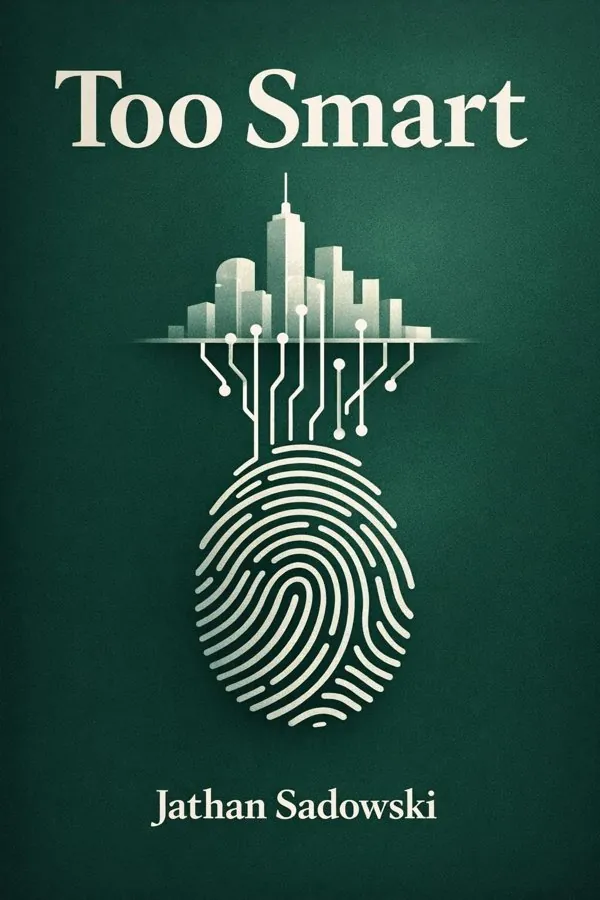
Too Smart: How Digital Capitalism Is Extracting Data, Controlling Our Lives, and Taking Over the World: Summary & Key Insights
 10 min9 chaptersAudio available
What Is Too Smart: How Digital Capitalism Is Extracting Data, Controlling Our Lives, and Taking Over the World About?
Too Smart: How Digital Capitalism Is Extracting Data, Controlling Our Lives, and Taking Over the World by Jathan Sadowski is a digital_culture book spanning 9 pages. In 'Too Smart', Jathan Sadowski critically examines how digital technologies—especially those branded as 'smart'—are reshaping capitalism, labor, and everyday life. He argues that the rise of smart devices and data-driven systems represents a new phase of digital capitalism, one that extracts value from users through surveillance and algorithmic control. The book explores the political economy of smart technologies and calls for a rethinking of how society engages with data and automation.
This FizzRead summary covers all 9 key chapters of Too Smart: How Digital Capitalism Is Extracting Data, Controlling Our Lives, and Taking Over the World in approximately 10 minutes, distilling the most important ideas, arguments, and takeaways from Jathan Sadowski's work. Also available as an audio summary and Key Quotes Podcast.
Too Smart: How Digital Capitalism Is Extracting Data, Controlling Our Lives, and Taking Over the World
In 'Too Smart', Jathan Sadowski critically examines how digital technologies—especially those branded as 'smart'—are reshaping capitalism, labor, and everyday life. He argues that the rise of smart devices and data-driven systems represents a new phase of digital capitalism, one that extracts value from users through surveillance and algorithmic control. The book explores the political economy of smart technologies and calls for a rethinking of how society engages with data and automation.
Who Should Read Too Smart: How Digital Capitalism Is Extracting Data, Controlling Our Lives, and Taking Over the World?
This book is perfect for anyone interested in digital_culture and looking to gain actionable insights in a short read. Whether you're a student, professional, or lifelong learner, the key ideas from Too Smart: How Digital Capitalism Is Extracting Data, Controlling Our Lives, and Taking Over the World by Jathan Sadowski will help you think differently.
- ✓Readers who enjoy digital_culture and want practical takeaways
- ✓Professionals looking to apply new ideas to their work and life
- ✓Anyone who wants the core insights of Too Smart: How Digital Capitalism Is Extracting Data, Controlling Our Lives, and Taking Over the World in just 10 minutes
Want the full summary?
Get instant access to this book summary and 100K+ more with Fizz Moment.
Get Free SummaryAvailable on App Store • Free to download
Key Chapters
To understand the rise of smartness, we must trace the trajectory of capitalism itself. Historically, each transformation of capitalism has been accompanied by new technological infrastructures and new rationalities of control. The industrial factory did not simply expand production—it reorganized labor, discipline, and daily rhythms. The same is true of today’s digital infrastructures.
In the twentieth century, information technologies began to redefine value creation. Data replaced raw materials as the core resource; networks supplanted physical factories as sites of accumulation. Companies like Google, Amazon, and Facebook emerged not as manufacturers but as extractors—harvesting and processing the behaviors, preferences, and interactions of billions. This is what I describe as the evolution from industrial capitalism to digital capitalism.
The smart revolution is the latest manifestation of that shift. It extends data extraction beyond screens and networks into the physical environment itself. Smart sensors, connected appliances, autonomous vehicles, and predictive systems create a seamless web in which the mundane acts of living—turning on lights, driving to work, adjusting thermostats—become captured moments of economic value.
This historical perspective reveals that the ideology of smartness does not arise naturally from clever inventions. It is built upon decades of political and economic restructuring that have prioritized data as capital. By embedding sensors and algorithms everywhere, digital capitalism achieves what earlier systems only dreamed of: the ability to monitor and modulate social life in real time. That unprecedented power comes at the expense of autonomy and privacy, transforming people into perpetual contributors to a global machine of accumulation.
At the heart of smartness lies a paradox. These technologies promise empowerment but often deliver subjugation. They invite us to participate willingly in systems that are fundamentally exploitative. The language of convenience, innovation, and personalization conceals the asymmetry between those who collect data and those who generate it.
I call this the ideology of smartness—a cultural narrative that naturalizes surveillance and turns participation into an obligation. A city is declared smart not when it serves its inhabitants, but when it supplies data to private platforms. A home becomes smart when it disciplines consumption and behavior to fit the expectations of digital monitoring. The ideology operates by reframing control as care: it is not watching you, it is protecting you; not managing you, but assisting you.
The brilliance of this ideology is its subtlety. Unlike the overt control systems of industrial capitalism, smart power masks itself as progress and rationality. The more we interact with these technologies, the more they seem indispensable. They teach us to adapt—to trust recommendations, rely on automation, and surrender decision-making to algorithms. And as we adapt, the ideological system deepens.
By unmasking this narrative, I seek to restore a critical lens to how we imagine technological futures. Smartness is not an inevitable stage of human evolution. It is an intentional configuration of power and profit, designed and deployed within specific corporate and political interests. Exposing its ideological core is essential if society hopes to reclaim technology as a tool for liberation rather than domination.
+ 7 more chapters — available in the FizzRead app
All Chapters in Too Smart: How Digital Capitalism Is Extracting Data, Controlling Our Lives, and Taking Over the World
About the Author
Jathan Sadowski is a researcher and writer focusing on technology, politics, and society. He has written extensively on digital capitalism, automation, and the social implications of emerging technologies. Sadowski holds a PhD in Human and Social Dimensions of Science and Technology from Arizona State University and is known for his critical analyses of smart technologies and data economies.
Get This Summary in Your Preferred Format
Read or listen to the Too Smart: How Digital Capitalism Is Extracting Data, Controlling Our Lives, and Taking Over the World summary by Jathan Sadowski anytime, anywhere. FizzRead offers multiple formats so you can learn on your terms — all free.
Available formats: App · Audio · PDF · EPUB — All included free with FizzRead
Download Too Smart: How Digital Capitalism Is Extracting Data, Controlling Our Lives, and Taking Over the World PDF and EPUB Summary
Key Quotes from Too Smart: How Digital Capitalism Is Extracting Data, Controlling Our Lives, and Taking Over the World
“To understand the rise of smartness, we must trace the trajectory of capitalism itself.”
“At the heart of smartness lies a paradox.”
Frequently Asked Questions about Too Smart: How Digital Capitalism Is Extracting Data, Controlling Our Lives, and Taking Over the World
Too Smart: How Digital Capitalism Is Extracting Data, Controlling Our Lives, and Taking Over the World by Jathan Sadowski is a digital_culture book that explores key ideas across 9 chapters. In 'Too Smart', Jathan Sadowski critically examines how digital technologies—especially those branded as 'smart'—are reshaping capitalism, labor, and everyday life. He argues that the rise of smart devices and data-driven systems represents a new phase of digital capitalism, one that extracts value from users through surveillance and algorithmic control. The book explores the political economy of smart technologies and calls for a rethinking of how society engages with data and automation.
You Might Also Like

An Ugly Truth: Inside Facebook’s Battle for Domination
Sheera Frenkel, Cecilia Kang
10 min
Cyber Citizens
Ian Goodfellow
10 min
Digital Minimalism: Choosing a Focused Life in a Noisy World
Cal Newport
10 min
E‑Books & Beyond
Various Authors
10 min
The Future of Media
Various Authors
10 min
This Is Why We Can't Have Nice Things
Whitney Phillips
10 minBrowse by Category
Ready to read Too Smart: How Digital Capitalism Is Extracting Data, Controlling Our Lives, and Taking Over the World?
Get the full summary and 100K+ more books with Fizz Moment.