
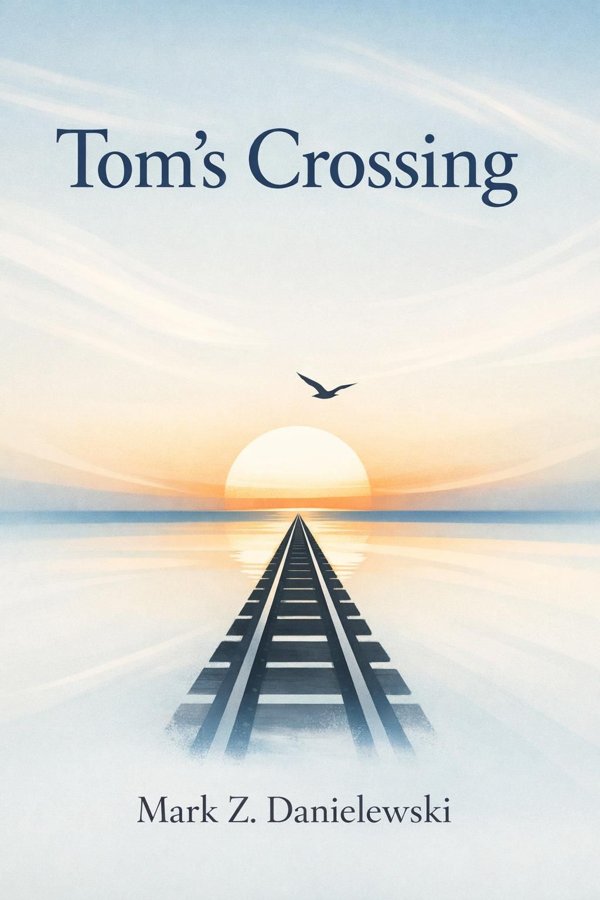
Tom's Crossing: Summary & Key Insights
 10 min8 chaptersAudio available
Key Takeaways from Tom's Crossing
Sometimes the most revealing thing about a book is not what it says, but the artistic lineage it emerges from.
A powerful literary project often matters before its plot is known because of the questions it is poised to ask.
When a novel is not yet publicly documented, speculation becomes most valuable when it is disciplined by pattern.
Some books are important not only because of their content, but because of the literary argument their existence makes.
In an age of recycled descriptions and invented certainty, intellectual honesty is a reading skill.
What Is Tom's Crossing About?
Tom's Crossing by Mark Z. Danielewski is a bestsellers book spanning 5 pages. Tom's Crossing occupies a curious and compelling place in the work of Mark Z. Danielewski: it is a title surrounded more by expectation than by confirmed detail, yet that very uncertainty tells us something important about the author and his fiction. Danielewski has built his reputation on books that do not simply tell stories but transform the act of reading into an experience of disorientation, discovery, and participation. From House of Leaves to Only Revolutions and The Familiar, his work asks readers to navigate unstable realities, layered voices, and forms that carry meaning as powerfully as plot. Because Tom's Crossing remains unreleased and officially undocumented in any substantial way, any serious summary must begin with honesty: there is no verified public plot synopsis to analyze in full. Still, the book matters because it belongs to an author whose projects are themselves literary events. To understand Tom's Crossing is therefore to understand its context—Danielewski's long-standing fascination with thresholds, perception, typography, memory, and the haunted spaces between narrative certainty and human experience. For readers, the title represents not just an upcoming novel, but another possible crossing into one of contemporary literature's most ambitious imaginations.
This FizzRead summary covers all 8 key chapters of Tom's Crossing in approximately 10 minutes, distilling the most important ideas, arguments, and takeaways from Mark Z. Danielewski's work. Also available as an audio summary and Key Quotes Podcast.
Tom's Crossing
Tom's Crossing occupies a curious and compelling place in the work of Mark Z. Danielewski: it is a title surrounded more by expectation than by confirmed detail, yet that very uncertainty tells us something important about the author and his fiction. Danielewski has built his reputation on books that do not simply tell stories but transform the act of reading into an experience of disorientation, discovery, and participation. From House of Leaves to Only Revolutions and The Familiar, his work asks readers to navigate unstable realities, layered voices, and forms that carry meaning as powerfully as plot.
Because Tom's Crossing remains unreleased and officially undocumented in any substantial way, any serious summary must begin with honesty: there is no verified public plot synopsis to analyze in full. Still, the book matters because it belongs to an author whose projects are themselves literary events. To understand Tom's Crossing is therefore to understand its context—Danielewski's long-standing fascination with thresholds, perception, typography, memory, and the haunted spaces between narrative certainty and human experience. For readers, the title represents not just an upcoming novel, but another possible crossing into one of contemporary literature's most ambitious imaginations.
Who Should Read Tom's Crossing?
This book is perfect for anyone interested in bestsellers and looking to gain actionable insights in a short read. Whether you're a student, professional, or lifelong learner, the key ideas from Tom's Crossing by Mark Z. Danielewski will help you think differently.
- ✓Readers who enjoy bestsellers and want practical takeaways
- ✓Professionals looking to apply new ideas to their work and life
- ✓Anyone who wants the core insights of Tom's Crossing in just 10 minutes
Want the full summary?
Get instant access to this book summary and 100K+ more with Fizz Moment.
Get Free SummaryAvailable on App Store • Free to download
Key Chapters
Sometimes the most revealing thing about a book is not what it says, but the artistic lineage it emerges from. That is especially true of Tom's Crossing, a project associated with Mark Z. Danielewski, an author whose career has been defined by formal risk, conceptual ambition, and a refusal to treat the novel as a fixed container. Even before publication details are widely established, the title can be approached through the trajectory of Danielewski's existing work. His fiction repeatedly returns to unstable houses, mythic journeys, layered archives, fractured family systems, and texts that act like physical spaces. In that sense, Tom's Crossing likely belongs to a larger creative pattern rather than standing as an isolated experiment.
Danielewski's books often begin with a recognizable premise and then push it beyond ordinary narrative expectations. House of Leaves turns a documentary-like manuscript into a labyrinth. Only Revolutions transforms speed, youth, and history into mirrored lyrical motion. The Familiar expands domestic life into a sprawling network of voices and systems. Seen against this background, a title like Tom's Crossing suggests movement, passage, transition, or confrontation with a boundary—geographical, emotional, moral, or ontological.
For readers and critics, this origin story matters because it sets appropriate expectations. Instead of waiting for a conventional plot summary, it is more useful to ask what aesthetic problem Danielewski may be trying to solve. Is the book about crossing from one reality into another? From childhood into history? From private memory into shared myth? This method of reading an unpublished or little-documented work can be applied more broadly: when information is sparse, examine the creator's recurring obsessions, formal habits, and philosophical concerns.
Actionable takeaway: approach Tom's Crossing through Danielewski's body of work first—identify recurring motifs in his earlier novels, and use them as a framework for understanding what this title may be attempting.
A powerful literary project often matters before its plot is known because of the questions it is poised to ask. With Tom's Crossing, the intellectual reach lies less in verified story details and more in the thematic territory Mark Z. Danielewski has consistently explored: perception, instability, mediation, language, technology, family, and the limits of narrative comprehension. His fiction rarely offers reality as a settled fact. Instead, reality is something readers assemble, doubt, revisit, and physically navigate through the page.
If Tom's Crossing follows this pattern, its significance will likely come from how it stages a crossing between ways of understanding the world. Danielewski is deeply interested in thresholds: inside and outside, self and other, record and memory, map and territory. The word "crossing" itself carries rich possibilities. It can mean a passage, a meeting point, a conflict, or a dangerous transit. That ambiguity makes the title intellectually charged. A crossing may be a route to transformation, but it can also be a site of risk, grief, or irreversibility.
Practically speaking, readers can use this thematic lens to gain more from Danielewski's work in general. Instead of asking only "What happened?" ask "What border is being tested here?" In House of Leaves, the border is spatial and psychological. In The Familiar, it is relational and systemic. In a book called Tom's Crossing, one might expect those thresholds to become central again, whether through character, setting, structure, or visual design.
This way of reading has applications beyond literary study. In life, the most important moments are often crossings too: changing careers, mourning loss, moving cities, entering parenthood, confronting memory. Literature becomes useful when it sharpens our awareness of these transitions rather than reducing them to simple events.
Actionable takeaway: read the title as a thematic clue—make a list of the kinds of crossings that define human life, and notice which ones Danielewski's existing work prepares you to recognize.
When a novel is not yet publicly documented, speculation becomes most valuable when it is disciplined by pattern. Tom's Crossing gives us almost no confirmed character information, yet even a title can suggest narrative possibilities. The name "Tom" is striking in its simplicity. Danielewski often works with highly charged conceptual structures, so a plain, familiar first name may be deliberate. It can imply a grounding human presence set against an unstable world—an ordinary figure asked to traverse extraordinary conditions.
In literary terms, that tension matters. Danielewski's narratives often gain force from the clash between intimate emotional stakes and overwhelming formal or metaphysical environments. A character named Tom might be a witness, a traveler, a father, a son, a fragmented identity, or even a figure split across narrative layers. "Crossing" could refer to his movement through a place, a text, a historical event, a digital system, or a private trauma. It might also signal intersection rather than journey: Tom at the point where multiple stories, timelines, or realities collide.
Readers can productively imagine several possible narrative models. One is the quest model, in which Tom must pass through a difficult threshold. Another is the archive model, where "Tom" is reconstructed through documents, voices, or contradictory accounts. A third is the network model, where Tom becomes a node connecting unrelated lives. All of these would be consistent with Danielewski's tendency to complicate authorship, identity, and sequence.
This interpretive exercise is useful because it changes passive waiting into active literary thinking. Teachers, book clubs, and curious readers can use titles alone to practice inferential reading: what does the syntax imply, what genre signals appear, and what emotional expectations are generated? Even if the eventual novel differs, this method deepens attention.
Actionable takeaway: before reading, write down three possible meanings of "Tom" and three meanings of "crossing," then compare your expectations to Danielewski's recurring character strategies in earlier books.
Some books are important not only because of their content, but because of the literary argument their existence makes. Tom's Crossing belongs to that category. Any major new title by Mark Z. Danielewski enters contemporary literature as a challenge to what novels can be. His work consistently refuses the idea that fiction is only verbal storytelling. For him, typography, page architecture, silence, interruption, sequence, and visual design are not ornaments. They are meaning. That gives even an as-yet-undocumented work philosophical importance.
At the deepest level, Danielewski asks whether form can tell truths that ordinary exposition cannot. A straight plot summary may explain events, but it cannot always reproduce confusion, dread, simultaneity, obsession, or spatial dislocation. Experimental form can. If Tom's Crossing continues that pursuit, then its significance will likely lie in how it makes readers experience a crossing rather than merely read about one. The novel may not simply depict transition; it may structurally enact transition.
This matters because it pushes back against the speed and simplification of much contemporary reading culture. Danielewski's books reward slowness, rereading, uncertainty, and active interpretation. They invite readers to become collaborators. In a media environment dominated by quick summaries and clean explanations, that stance is philosophical as much as aesthetic. It suggests that truth is layered, difficult, and sometimes inseparable from the way it is encountered.
Readers can apply this insight widely. When approaching any demanding text, ask not just what the author says, but why the author chose this form. Why fragmentation? Why repetition? Why unusual spacing? These are interpretive questions with practical consequences for reading comprehension and critical thinking.
Actionable takeaway: treat form as argument—when Tom's Crossing appears, pay attention to layout, pacing, and structural choices as carefully as you would to character and plot.
In an age of recycled descriptions and invented certainty, intellectual honesty is a reading skill. Tom's Crossing is a perfect example of why. Because the book has not been broadly published with verified plot details, the responsible approach is to distinguish clearly between confirmed information, informed inference, and unsupported speculation. That distinction is not merely academic; it protects readers from misinformation and preserves the integrity of literary discussion.
Scholarship around Danielewski has long focused on his treatment of textual instability, reader participation, trauma, media, and architecture. These critical frameworks can help us think about Tom's Crossing even in advance, but they cannot substitute for primary evidence. A useful research method starts with official author statements, publisher announcements, copyright listings, public interviews, and bibliographic records. From there, one can place the title in conversation with peer-reviewed criticism on Danielewski's earlier works. This creates a grounded interpretive context without pretending to know more than is publicly available.
This approach has practical value far beyond one book. Readers today regularly encounter AI-generated summaries, incomplete metadata, and enthusiastic but unreliable commentary. Learning to evaluate sources is essential. For example, if one website provides a detailed plot of an unpublished novel but cites no publisher, no galley, and no interview, skepticism is warranted. By contrast, a careful summary that states the limits of available information is more trustworthy, even if it appears less satisfying.
Book clubs, students, and reviewers can turn this into a useful habit: separate your notes into three columns—facts, interpretations, and questions. That simple structure reduces confusion and improves discussion quality.
Actionable takeaway: when researching Tom's Crossing, rely first on official and verifiable sources, and label every claim as confirmed, inferred, or unknown before repeating it.
Not knowing can be frustrating, but in literature it can also be revealing. The uncertainty surrounding Tom's Crossing is not just a temporary inconvenience; it highlights a deeper truth about Mark Z. Danielewski's artistic world. His work repeatedly confronts readers with gaps, missing frames, incomplete records, and unstable realities. In that sense, the absence of a fixed public summary almost feels thematically appropriate. The unknown is not the opposite of meaning in Danielewski; it is often one of meaning's primary engines.
This idea changes how we approach anticipation. Instead of treating uncertainty as a failure of information, we can see it as preparation for a kind of reading. Danielewski trains readers to tolerate ambiguity without surrendering rigor. The goal is not to abandon interpretation, but to interpret responsibly while accepting that some questions remain open. That balance—between curiosity and discipline—is central to serious reading.
A practical example helps. Imagine two readers approaching Tom's Crossing. One demands a neat answer immediately and becomes impatient with ambiguity. The other uses uncertainty to sharpen observation: title, context, pattern, genre expectations, and authorial history all become clues. The second reader is more prepared not only for Danielewski but for any sophisticated fiction that resists easy closure.
This mindset also has everyday application. Many important life decisions happen without full information: moving, ending relationships, beginning new work, caring for family, recovering from loss. Literature that teaches us to endure uncertainty without collapsing into fantasy or panic offers real value.
Actionable takeaway: treat unanswered questions as part of the reading experience—make a running list of what is unknown, why it matters, and what evidence might eventually clarify it.
The most rewarding way to approach Mark Z. Danielewski is to stop thinking like a consumer and start thinking like a participant. Tom's Crossing, whatever its eventual shape, is likely to demand that shift. Danielewski's books are famous for turning reading into navigation. You do not simply move from sentence to sentence; you track patterns, compare voices, follow visual cues, and assemble coherence from dispersed fragments. This participatory model is one of his greatest contributions to contemporary fiction.
Why does that matter? Because passive reading assumes that meaning arrives prepackaged. Active reading assumes that meaning is co-created through attention. In Danielewski's fiction, details that seem decorative may be structural. Repetition may signal emotional pressure. Blank space may create suspense or grief. A change in typography may indicate a new layer of reality or a shift in authority. Readers who accept this invitation often discover that the effort itself becomes part of the pleasure.
There are practical ways to prepare. Keep notes while reading. Mark recurring words or motifs. Notice where the physical page affects speed or interpretation. Discuss the text with others, because Danielewski's work often benefits from collaborative sense-making. If Tom's Crossing includes experimental design, these habits will help readers engage rather than feel excluded.
This approach also applies beyond one author. Active reading improves concentration, critical thinking, memory, and interpretive flexibility. It trains readers to ask how information is structured and why that structure matters. In an era of distraction, such reading is a form of intellectual discipline.
Actionable takeaway: when Tom's Crossing is released, read with a pencil or digital annotation tool in hand, tracking patterns in layout, repeated imagery, and shifts in voice from the very first page.
Expectation shapes interpretation, and few authors require better expectation-setting than Mark Z. Danielewski. Readers drawn to Tom's Crossing should not expect a standard bestseller experience built on transparent exposition and continuous narrative reassurance. If Danielewski's previous work is any guide, the reading experience will likely be immersive, disorienting, emotionally intense, and formally self-aware. That does not mean inaccessible. It means the book may ask for a different rhythm of attention.
One useful expectation is that confusion may be temporary but purposeful. Danielewski often withholds full orientation so that readers feel what characters feel: uncertainty, obsession, fear, compression, expansion, or wonder. Another is that physical presentation may matter. In his fiction, the page can become cinematic, architectural, or musical. Readers who approach such design with patience often find that the form clarifies the emotional logic of the work.
A practical reading strategy is to break the experience into layers. First, read for movement: who is speaking, what changes, what threshold appears? Second, read for pattern: what repeats, what interrupts, what visual features stand out? Third, read for implication: what does the structure suggest about memory, identity, or reality? This three-pass approach can make demanding fiction far more approachable.
It is also helpful to let go of the pressure to "solve" everything immediately. Some books are meant to be inhabited before they are mastered. Danielewski's strongest work rewards rereading because understanding accumulates through return.
Actionable takeaway: begin Tom's Crossing with flexible expectations—plan for a slower, layered reading process, and judge the experience by how deeply it engages you, not by how quickly it resolves every question.
All Chapters in Tom's Crossing
About the Author
Mark Z. Danielewski is an American novelist renowned for pushing the boundaries of literary form. He rose to international prominence with House of Leaves, a cult classic that combined horror, metafiction, and radical typographic design to create a deeply immersive reading experience. He later published Only Revolutions, a structurally daring novel of dual voices and historical motion, followed by The Familiar, an ambitious multi-volume project that fused domestic drama, global systems, and experimental page architecture. Danielewski's work often explores perception, memory, space, family, and the unstable relationship between text and reality. Widely discussed in both academic and popular literary circles, he is considered one of the most innovative contemporary writers in English, admired for treating the book itself as an artistic and conceptual medium.
Get This Summary in Your Preferred Format
Read or listen to the Tom's Crossing summary by Mark Z. Danielewski anytime, anywhere. FizzRead offers multiple formats so you can learn on your terms — all free.
Available formats: App · Audio · PDF · EPUB — All included free with FizzRead
Download Tom's Crossing PDF and EPUB Summary
Key Quotes from Tom's Crossing
“Sometimes the most revealing thing about a book is not what it says, but the artistic lineage it emerges from.”
“A powerful literary project often matters before its plot is known because of the questions it is poised to ask.”
“When a novel is not yet publicly documented, speculation becomes most valuable when it is disciplined by pattern.”
“Some books are important not only because of their content, but because of the literary argument their existence makes.”
“In an age of recycled descriptions and invented certainty, intellectual honesty is a reading skill.”
Frequently Asked Questions about Tom's Crossing
Tom's Crossing by Mark Z. Danielewski is a bestsellers book that explores key ideas across 8 chapters. Tom's Crossing occupies a curious and compelling place in the work of Mark Z. Danielewski: it is a title surrounded more by expectation than by confirmed detail, yet that very uncertainty tells us something important about the author and his fiction. Danielewski has built his reputation on books that do not simply tell stories but transform the act of reading into an experience of disorientation, discovery, and participation. From House of Leaves to Only Revolutions and The Familiar, his work asks readers to navigate unstable realities, layered voices, and forms that carry meaning as powerfully as plot. Because Tom's Crossing remains unreleased and officially undocumented in any substantial way, any serious summary must begin with honesty: there is no verified public plot synopsis to analyze in full. Still, the book matters because it belongs to an author whose projects are themselves literary events. To understand Tom's Crossing is therefore to understand its context—Danielewski's long-standing fascination with thresholds, perception, typography, memory, and the haunted spaces between narrative certainty and human experience. For readers, the title represents not just an upcoming novel, but another possible crossing into one of contemporary literature's most ambitious imaginations.
You Might Also Like
The Godfather
Mario Puzo
10 min
The Handmaid's Tale
Margaret Atwood
10 min
The Hunger Games
Suzanne Collins
10 min
The Nightingale
Kristin Hannah
10 min
The Seven Husbands of Evelyn Hugo
Taylor Jenkins Reid
10 min
Backwater Justice
Fern Michaels
10 minBrowse by Category
Ready to read Tom's Crossing?
Get the full summary and 100K+ more books with Fizz Moment.