
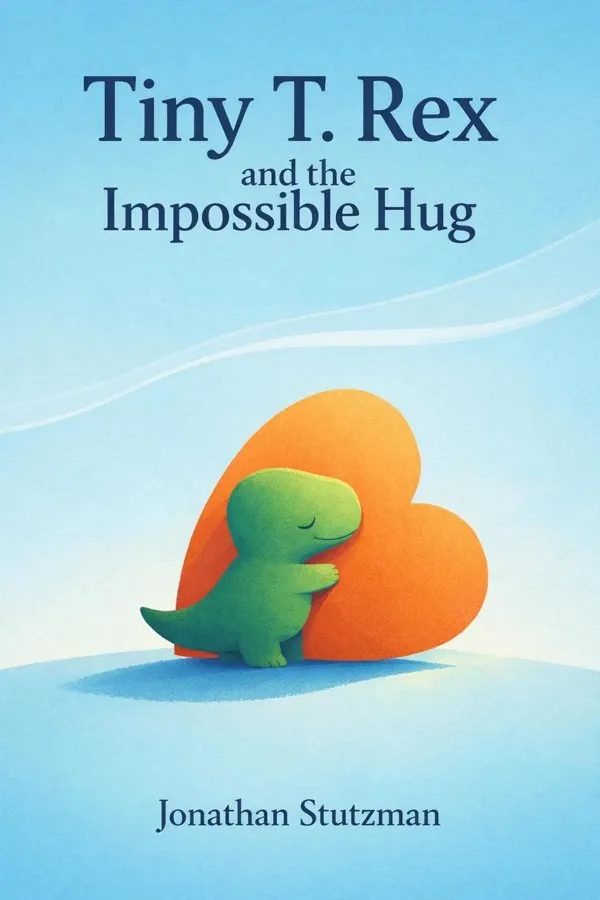
Tiny T. Rex and the Impossible Hug: Summary & Key Insights
 10 min9 chaptersAudio available
Key Takeaways from Tiny T. Rex and the Impossible Hug
Real courage often begins with honest self-awareness.
Compassion usually starts with attention.
Independence is admirable, but wisdom often begins when we admit we cannot figure everything out alone.
Love is meaningful, but love that takes shape through effort is transformative.
Setbacks feel final only when we stop too soon.
What Is Tiny T. Rex and the Impossible Hug About?
Tiny T. Rex and the Impossible Hug by Jonathan Stutzman is a bestsellers book spanning 5 pages. What do you do when someone you love is hurting, and the very thing you want to offer feels impossible to give? That simple but profound question sits at the center of Tiny T. Rex and the Impossible Hug, Jonathan Stutzman’s warm, funny, and emotionally resonant picture book. The story follows Tiny, a cheerful little dinosaur with very small arms, who learns that his friend Pointy is sad and becomes determined to comfort him with a hug. The problem, of course, is right there in Tiny’s anatomy: how can a dinosaur with tiny arms give a proper hug? What makes this book memorable is not just its playful premise, but the way it turns a physical limitation into a lesson about empathy, persistence, and creative care. Stutzman writes with humor and tenderness, speaking directly to the worries children often carry: Am I enough? Can I help? Do my limitations define me? His storytelling, paired with a picture-book sensibility that balances laughter and heart, gives young readers a reassuring answer. This is a story about friendship, emotional courage, and discovering that love is often most powerful when it finds a way forward, even through obstacles.
This FizzRead summary covers all 9 key chapters of Tiny T. Rex and the Impossible Hug in approximately 10 minutes, distilling the most important ideas, arguments, and takeaways from Jonathan Stutzman's work. Also available as an audio summary and Key Quotes Podcast.
Tiny T. Rex and the Impossible Hug
What do you do when someone you love is hurting, and the very thing you want to offer feels impossible to give? That simple but profound question sits at the center of Tiny T. Rex and the Impossible Hug, Jonathan Stutzman’s warm, funny, and emotionally resonant picture book. The story follows Tiny, a cheerful little dinosaur with very small arms, who learns that his friend Pointy is sad and becomes determined to comfort him with a hug. The problem, of course, is right there in Tiny’s anatomy: how can a dinosaur with tiny arms give a proper hug?
What makes this book memorable is not just its playful premise, but the way it turns a physical limitation into a lesson about empathy, persistence, and creative care. Stutzman writes with humor and tenderness, speaking directly to the worries children often carry: Am I enough? Can I help? Do my limitations define me? His storytelling, paired with a picture-book sensibility that balances laughter and heart, gives young readers a reassuring answer. This is a story about friendship, emotional courage, and discovering that love is often most powerful when it finds a way forward, even through obstacles.
Who Should Read Tiny T. Rex and the Impossible Hug?
This book is perfect for anyone interested in bestsellers and looking to gain actionable insights in a short read. Whether you're a student, professional, or lifelong learner, the key ideas from Tiny T. Rex and the Impossible Hug by Jonathan Stutzman will help you think differently.
- ✓Readers who enjoy bestsellers and want practical takeaways
- ✓Professionals looking to apply new ideas to their work and life
- ✓Anyone who wants the core insights of Tiny T. Rex and the Impossible Hug in just 10 minutes
Want the full summary?
Get instant access to this book summary and 100K+ more with Fizz Moment.
Get Free SummaryAvailable on App Store • Free to download
Key Chapters
Real courage often begins with honest self-awareness. One of the most appealing things about Tiny T. Rex is that he does not pretend his challenge does not exist. He knows his arms are tiny. He sees the problem clearly. Yet instead of allowing that fact to stop him, he lets it become the starting point of his effort. That combination of realism and hope is one of the book’s deepest strengths.
Tiny introduces himself with confidence and humor, setting the tone for a story that values self-acceptance rather than self-pity. He is not ashamed of who he is, even when who he is comes with obvious limitations. This matters because children are constantly measuring themselves against what others seem able to do more easily. Some are shy speakers, some struggle with sports, some find reading hard, and some feel physically small in a big world. Tiny reflects that universal experience in a way young readers immediately understand.
The story also shows that naming a limitation is not the same as surrendering to it. In daily life, this can look like a child saying, “I’m not very good at drawing, but I still want to make a card for my friend,” or an adult thinking, “I don’t have the perfect words, but I can still show up.” Tiny’s example teaches that being aware of a weakness can actually help us approach a problem more thoughtfully.
This idea is valuable far beyond childhood. Healthy confidence does not come from believing we can do everything. It comes from knowing who we are and still choosing to act with generosity and purpose. Tiny’s voice makes that lesson accessible, gentle, and memorable.
Actionable takeaway: The next time you feel limited, name the challenge honestly, then ask, “What can I still do with what I have?”
Compassion usually starts with attention. Tiny’s mission is set in motion when he learns that his friend Pointy is sad. That moment may seem simple, but it highlights an essential emotional skill: the ability to notice another person’s pain and let it matter. In a world full of distraction, that kind of noticing is a quiet form of love.
Pointy’s sadness gives the story its emotional weight. Tiny is not trying to solve a puzzle for fun or achieve something for personal glory. He wants to comfort a friend. That shift is important because it turns perseverance into empathy in action. The challenge of the hug is meaningful precisely because it is rooted in relationship.
Children often understand emotions before they know how to talk about them clearly. A friend seems quiet at school. A sibling cries after a hard day. A parent looks tired. Tiny models a generous response: instead of turning away from sadness because it is uncomfortable, he moves toward it. He does not ask whether helping will be convenient. He asks how he can help at all.
This has practical application in everyday life. Parents and teachers can use the story to ask children, “How can you tell when someone is sad?” and “What are ways to help besides talking?” Adults can learn from it too. Sometimes emotional support is not about profound advice. It is about paying close enough attention to realize support is needed.
By focusing on Pointy’s sadness, the book teaches that friendship is not only about sharing fun moments. It is also about responding when someone feels low, left out, or discouraged. The desire to comfort another person is presented not as extraordinary heroism, but as something small, loving, and deeply human.
Actionable takeaway: Practice noticing one person’s mood today and ask yourself what simple act of care might help.
Independence is admirable, but wisdom often begins when we admit we cannot figure everything out alone. In Tiny T. Rex and the Impossible Hug, Tiny does not simply charge forward without reflection. He seeks guidance, ideas, and ways to improve. This part of the story quietly teaches children that asking for help is not a sign of weakness; it is part of problem-solving.
For many young readers, this is a powerful lesson. Children are often praised for doing things by themselves, which can unintentionally make them feel that needing support means failure. Tiny offers a healthier model. He remains the hero of his own story, but he does not isolate himself in the process. He is willing to learn. He is teachable. That humility makes his determination more credible and more inspiring.
In practical terms, this lesson applies everywhere. A child struggling to tie shoes might ask a parent for another demonstration. A student unsure how to comfort a grieving friend might ask a teacher what to say. An adult trying to support a loved one through a hard time might reach out to someone more experienced. The goal is not to hand responsibility away, but to gather tools that make care more effective.
The book also suggests that effort improves through practice. Tiny’s challenge is emotional, but the method is almost scientific: observe the problem, seek advice, test solutions, and try again. That structure helps young readers understand that difficult things often become possible one step at a time.
This matters because emotional support is a skill, not just a feeling. Wanting to help is beautiful, but learning how to help is equally important. Tiny’s willingness to seek wisdom reinforces that growth comes through curiosity, not ego.
Actionable takeaway: When you face a caring challenge you do not know how to solve, ask one trusted person for guidance instead of assuming you must handle it alone.
Love is meaningful, but love that takes shape through effort is transformative. Tiny does not stop at wanting to hug Pointy. He practices. He experiments. He treats kindness as something worth working at. This is one of the book’s most useful and realistic messages: good intentions are only the beginning.
Many stories celebrate natural ability, but Tiny T. Rex celebrates persistence. Tiny is not instantly successful. His body presents a real obstacle, and that obstacle requires repeated attempts to overcome. Children need stories like this because life is full of moments when caring is not easy. Saying sorry may feel awkward. Including a lonely classmate may require courage. Making a gift for someone sad may not come out right the first time. Tiny normalizes the idea that meaningful acts often require rehearsal.
This lesson applies broadly. If a child wants to cheer up a grandparent, they might practice reading a card aloud first. If a student wants to apologize sincerely, they may need help finding the right words. If an adult wants to become more emotionally supportive, they may need to practice listening without interrupting. Compassion grows stronger when it is exercised.
The story also reinforces a growth mindset. Tiny’s challenge is not framed as proof that he cannot do the task; it is framed as evidence that he must try in different ways. That distinction is crucial. Instead of saying, “I can’t,” Tiny’s journey nudges readers toward, “I can’t do it this way yet.”
In a culture that often celebrates quick results, this quiet emphasis on practice is refreshing. It teaches children that trying, adjusting, and trying again is not embarrassing. It is how progress happens.
Actionable takeaway: Choose one caring action you want to improve and practice it in a small, low-pressure way before the moment really matters.
Setbacks feel final only when we stop too soon. Tiny’s attempts to create the perfect hug do not unfold smoothly, and that is exactly why the story works so well. His frustration is real, but it is not treated as the end of the road. Instead, it becomes part of the emotional honesty of the narrative. Readers see that caring deeply does not spare us from struggle.
This is especially important for children, who often experience frustration intensely. A difficult zipper, a wobbly block tower, a misunderstood feeling, or a social disappointment can seem overwhelming. Tiny models a response that acknowledges discouragement without surrendering to it. He does not become less kind when things are hard; he becomes more determined to find another way.
The broader application is powerful. Adults, too, often abandon worthy efforts when they become inconvenient or emotionally messy. We may want to support someone going through grief, but pull back because we are afraid of saying the wrong thing. We may try once to repair a relationship, fail awkwardly, and give up. Tiny reminds us that imperfect attempts are not proof that the goal is impossible.
Another key lesson here is emotional resilience. The book does not suggest that persistence means pretending everything is fine. Rather, persistence means continuing despite disappointment. That nuance matters. Resilience is not denial; it is recovery.
Parents and educators can use this part of the story to help children build language around effort: “What can we do when something important feels hard?” “How do we calm down and try again?” These are foundational life skills wrapped in a charming dinosaur adventure.
Tiny’s frustration ultimately makes his success more meaningful because it reflects real life: the best acts of love are often earned through patience, adjustment, and renewed courage.
Actionable takeaway: When a caring effort does not work the first time, pause, breathe, and ask, “What is one new approach I can try next?”
Some problems are not overcome by more force, but by a better idea. Tiny cannot simply stretch his arms longer or become someone else. The heart of the story lies in his creative adaptation. He learns that when the obvious method fails, imagination can open a new path. That lesson gives the book much of its charm and much of its practical wisdom.
Children naturally think creatively, but they can also become discouraged when their first plan does not work. Tiny shows that creativity is not random silliness; it is purposeful flexibility. He keeps the goal the same, but changes the strategy. That is an essential problem-solving skill in school, relationships, and emotional life.
Think about everyday examples. A child who cannot write a long sympathy note might draw a picture instead. A friend who struggles with words may show love by bringing a snack, sitting quietly nearby, or sharing a favorite toy. An adult with limited time or emotional energy may support a loved one through a short voice message or a thoughtful check-in rather than an elaborate gesture. In each case, the care is real because the intention is real, even if the form looks different from what was originally imagined.
This idea also combats perfectionism. Tiny’s challenge invites readers to rethink what counts as success. Maybe the “perfect hug” is not the one that looks standard from the outside, but the one that truly reaches another heart. Creativity allows us to move from rigid expectations to responsive generosity.
That is one reason the story resonates with both children and adults. It gently asks: when our usual methods do not work, can we become more inventive rather than more defeated? Tiny’s answer is yes.
Actionable takeaway: If your first way of helping someone is not possible, list two alternative ways to express the same care.
We often mistake size for significance. Tiny’s greatest emotional victory is discovering that love is not measured by reach, scale, or appearance. His body may be small, but his devotion is immense. This reversal is what gives the book its emotional payoff: the thing that seemed to make him inadequate does not stop him from offering something beautiful and meaningful.
This message is especially reassuring for children, who live in a world run by bigger people. They are frequently reminded of what they cannot do yet, where they cannot go alone, and how much they still need to learn. Tiny offers a counter-message: your size does not limit your capacity to care. You can comfort, encourage, notice, include, and love right now.
The lesson extends beyond literal size. Many readers, including adults, know what it feels like to believe they are too shy, too awkward, too busy, too inexperienced, or too ordinary to make a difference. Tiny challenges that belief. Emotional impact does not belong only to the strongest, loudest, or most naturally capable. It belongs to those willing to act with heart.
In practical life, this means a child’s handmade note can brighten someone’s day just as surely as an expensive gift. A short message sent at the right time can matter more than a grand speech. A quiet person can be an extraordinary friend. Presence, sincerity, and effort often matter more than polish.
The story’s emotional wisdom lies in its insistence that tenderness is powerful. Tiny’s limitation does not erase his love; it reveals it. Because he has to work harder to express care, the care feels even more intentional.
Actionable takeaway: Never dismiss a kind gesture as too small; ask instead whether it is sincere, timely, and rooted in real care.
The truest friendships are often revealed not in easy moments, but in inconvenient ones. Tiny’s journey is compelling because he does not wait until helping Pointy becomes effortless. He chooses to show up while the task is still difficult. That decision captures a mature idea in a child-friendly form: friendship is commitment, not just affection.
It is easy to enjoy friends when everyone is happy and playful. It is harder when someone is sad, withdrawn, frustrated, or in need. Children encounter this early. A classmate cries at recess. A friend loses a game and becomes quiet. Someone feels left out at a birthday party. Tiny models an important response: stay engaged. Care does not retreat at the first sign of emotional complexity.
This principle matters deeply for adults as well. Meaningful relationships require consistency. We do not always know the perfect thing to say, and sometimes our attempts feel clumsy. But showing up still matters. A text saying, “I’m thinking of you,” a visit, a shared silence, or a persistent effort to reconnect can all communicate love. Tiny’s determination reflects that truth in a way children can grasp.
There is also an ethical lesson here. Friendship is not transactional. Tiny does not help Pointy because he expects praise or reward. He helps because Pointy is his friend. That simple motivation is a powerful model for young readers learning what healthy relationships look like.
The story ultimately affirms that being dependable is one of the most loving things we can be. Tiny cannot erase Pointy’s sadness with magic, but he can refuse to look away. In many real situations, that is what support looks like.
Actionable takeaway: When someone you care about is struggling, choose one concrete way to show up rather than waiting for the perfect response.
Sometimes the best way to approach serious emotions is through warmth and playfulness. One reason Tiny T. Rex and the Impossible Hug works so well is that it balances sadness with humor. Tiny’s tiny arms and earnest narration create comic tension, but the laughter never undermines the emotional core. Instead, it helps make vulnerability feel approachable.
This is a major strength in children’s literature. Young readers often need emotional subjects presented in ways that feel manageable. If a story about sadness becomes too heavy, children may disengage. If it becomes too silly, the emotional truth gets lost. Jonathan Stutzman finds the middle ground. The book invites smiles while still honoring Pointy’s feelings and Tiny’s sincere desire to help.
This balance has practical relevance for parents, teachers, and caregivers. Humor can open the door to important conversations. A child may be more willing to talk about feeling sad, left out, or unable to help when those topics are introduced through a playful story rather than a direct lesson. Adults can also learn from this. Support does not always have to be solemn. Sometimes gentle lightness helps another person feel less alone.
The book’s tone also teaches that emotional bravery does not require becoming grim. Tiny remains hopeful and endearing throughout his challenge. That emotional steadiness reassures readers that hard feelings can be faced without fear.
In this way, the story becomes more than a lesson in perseverance. It becomes a model of how art can hold tenderness and comedy at the same time. That combination gives children room to feel deeply while still feeling safe.
Actionable takeaway: Use humor kindly when discussing difficult feelings, letting it soften the conversation without dismissing the emotion.
All Chapters in Tiny T. Rex and the Impossible Hug
About the Author
Jonathan Stutzman is an American children’s author and filmmaker known for stories that blend humor, emotional warmth, and imaginative charm. His books often explore themes like friendship, kindness, perseverance, and the small but meaningful ways people care for one another. He has built a reputation for creating picture books that entertain young readers while also giving parents, teachers, and caregivers thoughtful material to discuss. In Tiny T. Rex and the Impossible Hug, Stutzman shows a particular gift for turning a playful premise into a heartfelt lesson about empathy and determination. His storytelling is approachable, expressive, and well suited to read-aloud settings, which has helped his work resonate with both children and adults looking for stories with humor, heart, and emotional intelligence.
Get This Summary in Your Preferred Format
Read or listen to the Tiny T. Rex and the Impossible Hug summary by Jonathan Stutzman anytime, anywhere. FizzRead offers multiple formats so you can learn on your terms — all free.
Available formats: App · Audio · PDF · EPUB — All included free with FizzRead
Download Tiny T. Rex and the Impossible Hug PDF and EPUB Summary
Key Quotes from Tiny T. Rex and the Impossible Hug
“Real courage often begins with honest self-awareness.”
“Compassion usually starts with attention.”
“Independence is admirable, but wisdom often begins when we admit we cannot figure everything out alone.”
“Love is meaningful, but love that takes shape through effort is transformative.”
“Setbacks feel final only when we stop too soon.”
Frequently Asked Questions about Tiny T. Rex and the Impossible Hug
Tiny T. Rex and the Impossible Hug by Jonathan Stutzman is a bestsellers book that explores key ideas across 9 chapters. What do you do when someone you love is hurting, and the very thing you want to offer feels impossible to give? That simple but profound question sits at the center of Tiny T. Rex and the Impossible Hug, Jonathan Stutzman’s warm, funny, and emotionally resonant picture book. The story follows Tiny, a cheerful little dinosaur with very small arms, who learns that his friend Pointy is sad and becomes determined to comfort him with a hug. The problem, of course, is right there in Tiny’s anatomy: how can a dinosaur with tiny arms give a proper hug? What makes this book memorable is not just its playful premise, but the way it turns a physical limitation into a lesson about empathy, persistence, and creative care. Stutzman writes with humor and tenderness, speaking directly to the worries children often carry: Am I enough? Can I help? Do my limitations define me? His storytelling, paired with a picture-book sensibility that balances laughter and heart, gives young readers a reassuring answer. This is a story about friendship, emotional courage, and discovering that love is often most powerful when it finds a way forward, even through obstacles.
You Might Also Like

The Godfather
Mario Puzo
10 min
The Handmaid's Tale
Margaret Atwood
10 min
The Hunger Games
Suzanne Collins
10 min
The Nightingale
Kristin Hannah
10 min
The Seven Husbands of Evelyn Hugo
Taylor Jenkins Reid
10 min
Backwater Justice
Fern Michaels
10 minBrowse by Category
Ready to read Tiny T. Rex and the Impossible Hug?
Get the full summary and 100K+ more books with Fizz Moment.