
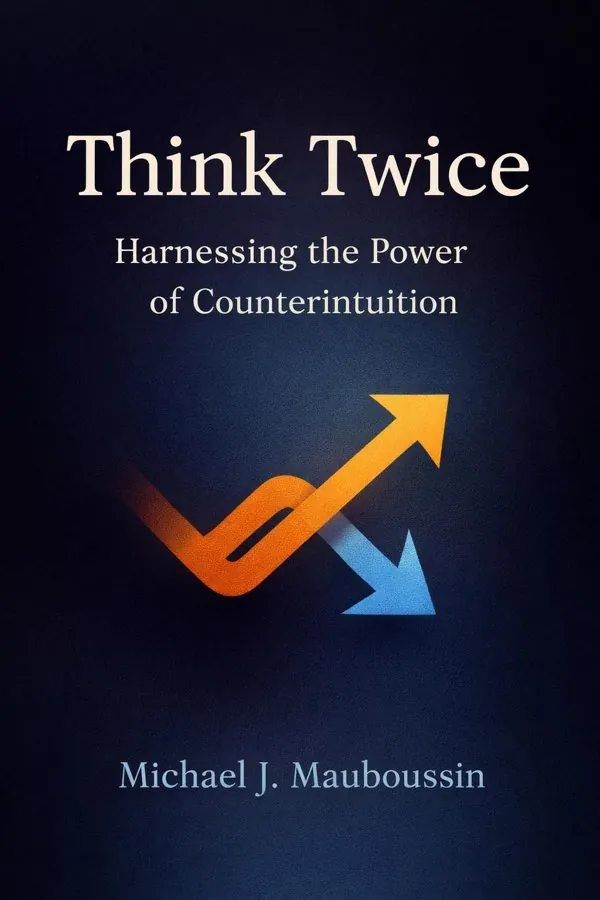
Think Twice: Harnessing the Power of Counterintuition: Summary & Key Insights
 10 min9 chaptersAudio available
Key Takeaways from Think Twice: Harnessing the Power of Counterintuition
The most dangerous decision errors often come not from ignorance, but from confidence.
What feels obvious is often only familiar.
One reason people make poor choices is that they think in absolutes when reality is probabilistic.
Humans are storytelling creatures, and that strength can also become a weakness.
Success is seductive because it invites a flattering conclusion: we did well because we were right.
What Is Think Twice: Harnessing the Power of Counterintuition About?
Think Twice: Harnessing the Power of Counterintuition by Michael J. Mauboussin is a mindset book. What if your biggest mistakes are not caused by lack of intelligence, but by the way your mind naturally works? In Think Twice, Michael J. Mauboussin explores a powerful idea: good decisions often require thinking against instinct. The book shows how even smart, experienced people fall into predictable cognitive traps, from overconfidence and confirmation bias to faulty pattern recognition and poor probability judgment. Rather than treating decision-making as a matter of talent or intuition alone, Mauboussin breaks it down into skills that can be improved. This matters because modern life constantly demands judgments under uncertainty: investing money, hiring people, choosing strategies, evaluating risks, and interpreting information. In all of these areas, intuition can help, but it can also mislead. Mauboussin argues that better outcomes come from understanding when to trust your gut and when to slow down, question assumptions, and use more rigorous thinking. Mauboussin brings unusual authority to this subject. Known for his work in investing, behavioral finance, and decision science, he blends research from psychology, economics, and real-world business into a practical guide for clearer thought. Think Twice is a smart, accessible reminder that better thinking starts with doubt, discipline, and intellectual humility.
This FizzRead summary covers all 9 key chapters of Think Twice: Harnessing the Power of Counterintuition in approximately 10 minutes, distilling the most important ideas, arguments, and takeaways from Michael J. Mauboussin's work. Also available as an audio summary and Key Quotes Podcast.
Think Twice: Harnessing the Power of Counterintuition
What if your biggest mistakes are not caused by lack of intelligence, but by the way your mind naturally works? In Think Twice, Michael J. Mauboussin explores a powerful idea: good decisions often require thinking against instinct. The book shows how even smart, experienced people fall into predictable cognitive traps, from overconfidence and confirmation bias to faulty pattern recognition and poor probability judgment. Rather than treating decision-making as a matter of talent or intuition alone, Mauboussin breaks it down into skills that can be improved.
This matters because modern life constantly demands judgments under uncertainty: investing money, hiring people, choosing strategies, evaluating risks, and interpreting information. In all of these areas, intuition can help, but it can also mislead. Mauboussin argues that better outcomes come from understanding when to trust your gut and when to slow down, question assumptions, and use more rigorous thinking.
Mauboussin brings unusual authority to this subject. Known for his work in investing, behavioral finance, and decision science, he blends research from psychology, economics, and real-world business into a practical guide for clearer thought. Think Twice is a smart, accessible reminder that better thinking starts with doubt, discipline, and intellectual humility.
Who Should Read Think Twice: Harnessing the Power of Counterintuition?
This book is perfect for anyone interested in mindset and looking to gain actionable insights in a short read. Whether you're a student, professional, or lifelong learner, the key ideas from Think Twice: Harnessing the Power of Counterintuition by Michael J. Mauboussin will help you think differently.
- ✓Readers who enjoy mindset and want practical takeaways
- ✓Professionals looking to apply new ideas to their work and life
- ✓Anyone who wants the core insights of Think Twice: Harnessing the Power of Counterintuition in just 10 minutes
Want the full summary?
Get instant access to this book summary and 100K+ more with Fizz Moment.
Get Free SummaryAvailable on App Store • Free to download
Key Chapters
The most dangerous decision errors often come not from ignorance, but from confidence. One of Mauboussin’s core insights is that intelligent, informed people are still vulnerable to systematic mistakes because the human brain is built for speed and efficiency, not perfect judgment. We rely on shortcuts, stories, and impressions to navigate complexity, and these mental habits usually feel right even when they are wrong.
The book emphasizes that bad decisions are not always the result of laziness or incompetence. They frequently emerge from normal cognitive processes such as anchoring on the first piece of information, seeing patterns in random events, or becoming too attached to a prior belief. This is why expertise alone does not guarantee good judgment. A seasoned executive can misread a market. A successful investor can become overconfident. A doctor can jump too quickly to a diagnosis. In each case, the problem is not intelligence but the mismatch between intuitive thinking and uncertain environments.
Mauboussin encourages readers to separate outcomes from process. A good decision can lead to a bad result because of luck, and a poor decision can occasionally work out well. This distinction is crucial because many people judge their decision quality only after seeing the result, which reinforces flawed habits. For example, a manager who makes a reckless bet and gets lucky may incorrectly conclude that their instincts are excellent.
A practical application is to review important decisions with a simple checklist: What assumptions am I making? What evidence might disprove my view? Am I relying on skill or just a compelling story? This creates distance between impulse and judgment.
Actionable takeaway: After every major decision, evaluate the quality of your reasoning before evaluating the outcome.
What feels obvious is often only familiar. Mauboussin shows that intuition is not inherently bad, but it is highly context-dependent. In stable environments with repeated feedback, intuition can become remarkably accurate. A chess master, firefighter, or experienced musician often develops rapid and reliable pattern recognition. But in noisy, unpredictable domains like investing, forecasting, or strategic planning, intuition can become a source of false confidence.
The problem is that people rarely notice when they have crossed from a domain where intuition works into one where it fails. We assume that because a judgment feels immediate and coherent, it must also be valid. Yet the same fast-thinking system that helps us recognize a friend’s face can also trick us into seeing market trends that are not there or believing a persuasive narrative unsupported by data.
Mauboussin urges readers to ask whether the environment offers enough regularity and feedback to justify intuitive trust. Consider a hiring decision. A recruiter may feel strongly that a candidate is a great fit after a brief interview, but first impressions are notoriously unreliable predictors of long-term performance. Structured interviews, scorecards, and comparison against clear criteria usually produce better outcomes than instinct alone.
The same principle applies to personal life. If you are deciding whether to move cities, launch a side business, or choose between job offers, your immediate emotional reaction may matter, but it should not be the sole guide. Better decisions combine intuitive impressions with explicit analysis.
Actionable takeaway: Before trusting your gut, ask whether the situation is one where intuition has earned the right to be trusted through repeated, accurate feedback.
One reason people make poor choices is that they think in absolutes when reality is probabilistic. Mauboussin argues that the world rarely offers certainty, yet the mind naturally prefers clear stories and definite conclusions. We say a product launch will succeed, a stock will rise, or a strategy will fail, when a better approach is to think in ranges, likelihoods, and distributions.
Probabilistic thinking improves judgment because it matches the way uncertainty actually works. Instead of asking, “Will this happen?” ask, “How likely is this, and what are the possible outcomes?” This shift reduces overconfidence and makes you more adaptable when new information appears. It also improves communication. A leader who says there is a 70 percent chance a project will hit its timeline creates a more realistic conversation than one who promises certainty.
Mauboussin also highlights the value of base rates, or what tends to happen on average in similar situations. People often focus on the vivid details of a specific case and ignore the broader statistical context. For example, an entrepreneur may believe their startup is different from the thousands that failed before it. That may be true, but base rates force discipline by reminding us what usually happens.
In practical terms, probabilistic thinking can be used in budgeting, forecasting, hiring, and investing. A portfolio manager might stop predicting a single target price and instead define multiple scenarios with probabilities attached. A student deciding whether to apply to a highly selective program can assess historical acceptance rates alongside personal strengths.
Actionable takeaway: Replace yes-or-no predictions with probability estimates and compare your judgment against real-world base rates whenever possible.
Humans are storytelling creatures, and that strength can also become a weakness. Mauboussin explains that we naturally build narratives to explain events, connect causes, and make the world feel understandable. The trouble is that reality is often messier than the stories we tell. We compress complexity into simple explanations, then mistake those explanations for truth.
A strong narrative can hide randomness, exaggerate causality, and encourage hindsight bias. After a company succeeds, people create a polished account of visionary leadership, flawless strategy, and perfect timing. After it fails, they tell a different but equally coherent story about obvious mistakes. In both cases, the story may overlook luck, market conditions, and the role of uncertainty. This leads us to believe we understand events more fully than we actually do.
The danger of neat stories appears everywhere. In investing, a compelling company story can overshadow weak fundamentals. In management, leaders may explain employee turnover with a single cultural issue while ignoring compensation, workload, and industry conditions. In personal life, someone may define a failed relationship by one clean reason when the reality involved many interacting factors.
Mauboussin’s remedy is to resist explanations that arrive too quickly or feel too satisfying. Ask what competing explanations could also fit the facts. Look for disconfirming evidence. Distinguish between what was known before an event and what only seems obvious afterward.
A useful exercise is the premortem: imagine that your plan failed badly and then write down the reasons why. This forces your mind to generate alternative narratives before reality chooses one for you.
Actionable takeaway: When an explanation feels perfectly clear, pause and ask what randomness, hidden variables, or alternative causes you might be missing.
Success is seductive because it invites a flattering conclusion: we did well because we were right. Mauboussin challenges this instinct by showing how often outcomes reflect a blend of skill and luck. In many fields, especially those involving uncertainty and competition, the line between the two is blurred. If you fail to distinguish them, you learn the wrong lessons.
This matters because people often copy visible winners without understanding whether their methods truly caused the result. A fund manager who outperforms for one year may simply have benefited from favorable market conditions. A salesperson who closes a huge account may have encountered unusually receptive buyers. If organizations reward outcomes without analyzing process, they risk promoting noise instead of competence.
Mauboussin does not deny the existence of talent. Instead, he argues for better calibration. The right question is not whether skill matters, but how much of a result can reasonably be attributed to it. Over short periods, luck can dominate. Over longer periods and larger sample sizes, skill becomes easier to detect. This is why decision-makers should avoid drawing grand conclusions from isolated events.
In practice, this idea can improve performance reviews, investment analysis, and personal growth. Instead of praising or criticizing only the result, examine whether the process was repeatable, evidence-based, and logically sound. A poker player can make the mathematically correct move and still lose a hand. That does not make the move bad.
Actionable takeaway: Judge yourself and others over many decisions, not one outcome, and always ask how much luck may have shaped the result.
The quality of a decision often depends less on brilliance than on structure. Mauboussin argues that one of the best defenses against bias is to create reliable processes that reduce the influence of mood, ego, and inconsistency. Good decision architecture does not eliminate uncertainty, but it improves the odds of thinking clearly.
A strong process includes defining the problem properly, identifying alternatives, gathering relevant evidence, considering base rates, and reviewing assumptions. It also means clarifying what success looks like before acting. Many poor decisions begin with fuzzy framing. If a company asks, “Should we launch this product?” it may miss the better question: “Under what market conditions would this product deserve investment relative to other opportunities?” Better framing expands options and sharpens evaluation.
Mauboussin also supports the use of checklists, decision journals, and postmortems. These tools may seem simple, but they are powerful because they create consistency and feedback. A decision journal records what you believed, what evidence you used, and what probabilities you assigned. Later, you can compare your forecast with reality and see where your thinking was strong or weak. This is one of the fastest ways to improve calibration.
Organizations can apply these ideas by separating idea generation from evaluation, encouraging dissent, and creating explicit criteria for major choices. Individuals can do the same when making financial, career, or family decisions.
Actionable takeaway: Design a repeatable decision process for important choices, and document your reasoning so you can learn from it instead of just reacting to outcomes.
Agreement feels comfortable, but comfort is often the enemy of good judgment. Mauboussin highlights how groups frequently make worse decisions when members suppress disagreement, follow authority, or converge too quickly on a shared story. The result is groupthink: a dangerous illusion of clarity created by social pressure rather than strong evidence.
Counterintuition often begins with hearing what you do not want to hear. Teams perform better when different perspectives are invited early, assumptions are challenged openly, and dissent is treated as a contribution instead of a threat. This is especially important in high-stakes settings where overconfidence can spread rapidly, such as corporate strategy, investment committees, medical teams, and government planning.
A practical example is a product team evaluating a major launch. If senior leaders express enthusiasm first, junior members may hesitate to raise concerns about customer demand, pricing, or technical risk. But if the process requires each participant to write an independent assessment before discussion, the group is more likely to surface useful disagreement. Likewise, in a family financial decision, partners may reach a stronger conclusion when each person first identifies risks separately rather than trying to maintain harmony.
Mauboussin’s broader point is that intellectual humility must be social as well as personal. Good decision cultures make it safe to say, “I see it differently,” and valuable to ask, “What if we are wrong?” Diverse thinking is not merely a moral or organizational preference; it is a practical tool for improving accuracy.
Actionable takeaway: In any important group decision, deliberately create a mechanism for independent opinions and protected dissent before finalizing the conclusion.
Experience alone does not make you wiser; interpreted experience does. Mauboussin stresses that improvement in judgment depends on timely, accurate feedback and the willingness to reflect honestly on mistakes. Without those elements, people repeat errors while becoming more certain in their views.
Many environments provide poor feedback. In business, a strategy may take years to reveal its weaknesses. In investing, random short-term gains can mask bad analysis. In personal life, decisions are entangled with emotion, memory, and selective interpretation. That is why reflection must be structured. You need a way to compare what you expected with what actually happened, and then ask why.
This process helps build calibration, the ability to align confidence with accuracy. Well-calibrated thinkers know when they are likely right, when they may be wrong, and how much uncertainty remains. They update beliefs instead of defending them. They see revision not as weakness but as evidence of learning.
A useful example is keeping a forecast log. Before making a decision, write down your expected outcome and confidence level. Later, revisit the entry. Were you too certain? Did you miss an important variable? Did you rely on weak evidence? Over time, patterns emerge. Perhaps you are consistently overconfident in time estimates, too pessimistic about new opportunities, or too easily persuaded by charismatic people.
Mauboussin’s approach turns thinking into a skill that can be trained. The goal is not perfection but gradual improvement through deliberate feedback loops.
Actionable takeaway: Create a regular habit of recording predictions and reviewing them later so you can refine your judgment based on evidence, not memory.
Speed is impressive, but slowness is often smarter. Mauboussin’s title captures his deepest message: in many important decisions, the first answer that comes to mind should be treated as a starting point, not a conclusion. Thinking twice means creating a pause between reaction and judgment, especially when stakes are high and uncertainty is real.
This does not mean endless hesitation. The book is not an argument for paralysis. It is an argument for disciplined second-order thinking. That means asking not only what seems true now, but what else could be true, what incentives are shaping the situation, what consequences may follow, and how your own mind might be distorting the picture. Second-order thinking is harder because it requires stepping outside the obvious and imagining how systems behave over time.
For example, a company may cut prices to win customers quickly, but second-order thinking asks how competitors will respond, whether margins will erode, and whether lower prices will weaken brand perception. A person tempted to quit a job after a frustrating week might ask whether the feeling is temporary, what tradeoffs a new role would bring, and whether the real issue is the work or a fixable conflict.
Mauboussin’s broader lesson is that wiser decisions come from resisting the seduction of immediacy. The pause to reconsider can reveal hidden assumptions, flawed incentives, and neglected alternatives.
Actionable takeaway: For every major decision, force a second pass by asking, “What would I think if my first instinct were wrong?”
All Chapters in Think Twice: Harnessing the Power of Counterintuition
About the Author
Michael J. Mauboussin is an influential author, investor, and strategist known for his work on decision-making, behavioral finance, and market expectations. He has spent much of his career studying how people make judgments under uncertainty and why outcomes are often misunderstood. Drawing from psychology, economics, and business strategy, he writes in a way that makes complex ideas practical and relevant. Mauboussin has held senior roles in investment research and asset management and is widely respected for his clear thinking on topics such as skill versus luck, probabilistic reasoning, and competitive advantage. His work is especially valued by investors, executives, and analytical readers who want to improve decision quality. In Think Twice, he brings together many of his signature themes into a compelling guide to more disciplined and accurate thinking.
Get This Summary in Your Preferred Format
Read or listen to the Think Twice: Harnessing the Power of Counterintuition summary by Michael J. Mauboussin anytime, anywhere. FizzRead offers multiple formats so you can learn on your terms — all free.
Available formats: App · Audio · PDF · EPUB — All included free with FizzRead
Download Think Twice: Harnessing the Power of Counterintuition PDF and EPUB Summary
Key Quotes from Think Twice: Harnessing the Power of Counterintuition
“The most dangerous decision errors often come not from ignorance, but from confidence.”
“What feels obvious is often only familiar.”
“One reason people make poor choices is that they think in absolutes when reality is probabilistic.”
“Humans are storytelling creatures, and that strength can also become a weakness.”
“Success is seductive because it invites a flattering conclusion: we did well because we were right.”
Frequently Asked Questions about Think Twice: Harnessing the Power of Counterintuition
Think Twice: Harnessing the Power of Counterintuition by Michael J. Mauboussin is a mindset book that explores key ideas across 9 chapters. What if your biggest mistakes are not caused by lack of intelligence, but by the way your mind naturally works? In Think Twice, Michael J. Mauboussin explores a powerful idea: good decisions often require thinking against instinct. The book shows how even smart, experienced people fall into predictable cognitive traps, from overconfidence and confirmation bias to faulty pattern recognition and poor probability judgment. Rather than treating decision-making as a matter of talent or intuition alone, Mauboussin breaks it down into skills that can be improved. This matters because modern life constantly demands judgments under uncertainty: investing money, hiring people, choosing strategies, evaluating risks, and interpreting information. In all of these areas, intuition can help, but it can also mislead. Mauboussin argues that better outcomes come from understanding when to trust your gut and when to slow down, question assumptions, and use more rigorous thinking. Mauboussin brings unusual authority to this subject. Known for his work in investing, behavioral finance, and decision science, he blends research from psychology, economics, and real-world business into a practical guide for clearer thought. Think Twice is a smart, accessible reminder that better thinking starts with doubt, discipline, and intellectual humility.
You Might Also Like


Browse by Category
Ready to read Think Twice: Harnessing the Power of Counterintuition?
Get the full summary and 100K+ more books with Fizz Moment.