
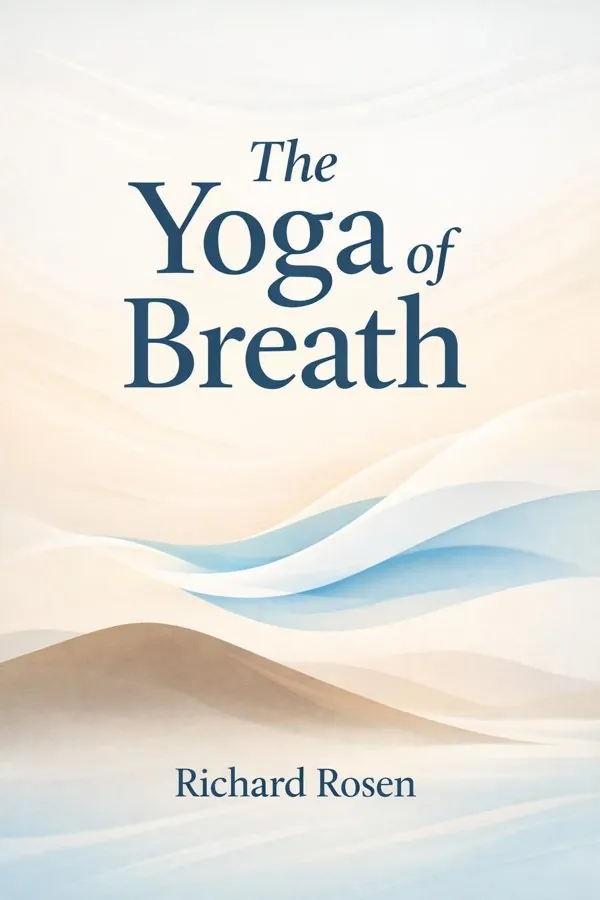
The Yoga of Breath: A Step-by-Step Guide to Pranayama: Summary & Key Insights
 10 min10 chaptersAudio available
What Is The Yoga of Breath: A Step-by-Step Guide to Pranayama About?
The Yoga of Breath: A Step-by-Step Guide to Pranayama by Richard Rosen is a wellness book spanning 10 pages. This book offers a practical and accessible introduction to pranayama, the ancient yogic art of breathing. Richard Rosen guides readers through progressive exercises designed to deepen awareness of the breath, improve physical health, and cultivate inner calm. Drawing on classical yoga teachings and modern insights, the book provides clear instructions and reflections for integrating breathwork into daily life and yoga practice.
This FizzRead summary covers all 10 key chapters of The Yoga of Breath: A Step-by-Step Guide to Pranayama in approximately 10 minutes, distilling the most important ideas, arguments, and takeaways from Richard Rosen's work. Also available as an audio summary and Key Quotes Podcast.
The Yoga of Breath: A Step-by-Step Guide to Pranayama
This book offers a practical and accessible introduction to pranayama, the ancient yogic art of breathing. Richard Rosen guides readers through progressive exercises designed to deepen awareness of the breath, improve physical health, and cultivate inner calm. Drawing on classical yoga teachings and modern insights, the book provides clear instructions and reflections for integrating breathwork into daily life and yoga practice.
Who Should Read The Yoga of Breath: A Step-by-Step Guide to Pranayama?
This book is perfect for anyone interested in wellness and looking to gain actionable insights in a short read. Whether you're a student, professional, or lifelong learner, the key ideas from The Yoga of Breath: A Step-by-Step Guide to Pranayama by Richard Rosen will help you think differently.
- ✓Readers who enjoy wellness and want practical takeaways
- ✓Professionals looking to apply new ideas to their work and life
- ✓Anyone who wants the core insights of The Yoga of Breath: A Step-by-Step Guide to Pranayama in just 10 minutes
Want the full summary?
Get instant access to this book summary and 100K+ more with Fizz Moment.
Get Free SummaryAvailable on App Store • Free to download
Key Chapters
Before we can guide the breath, we must understand what we are guiding. In the first part of the book, I explore how the respiratory system functions, and how yogic philosophy interprets breath as prana—the subtle life force that animates all beings. On the physical level, our lungs, diaphragm, and intercostal muscles cooperate to draw oxygen and expel carbon dioxide. This is familiar biology. But yoga teaches that breath also carries energy through invisible channels, known as nadis. When these channels are open, prana circulates freely, supporting health and vitality. When blocked, dullness or agitation appear.
Understanding this dual nature of breath brings humility. We cannot simply impose will upon it; we must learn to listen. Rather than forcing deeper inhalations, we cultivate sensitivity. Each exercise is a dialogue between awareness and the natural rhythms of the body. Over time, you learn to feel the nuances of prana as you might feel subtle changes in mood or temperature. That sensitivity becomes the foundation of all further yogic work.
Pranayama bridges the structural and the subtle, physiology and psychology. Breathing influences the nervous system; lengthened, slower breaths trigger the parasympathetic response, promoting calm and digestion. Fast or shallow breaths feed anxiety and disarray. Learning to recognize these patterns gives you tools to reshape them. Thus, pranayama is both science and art—a practical way to rewire the nervous system through mindful observation.
While many modern teachers present pranayama as a set of health exercises, its origins lie deep in the classical yoga tradition. I draw here from the *Hatha Yoga Pradipika* and Patanjali’s *Yoga Sutras*, two foundational texts. Patanjali describes pranayama as the pause between inhalation and exhalation, a moment where consciousness can slip between the layers of the self. The *Hatha Yoga Pradipika* expands this idea, describing techniques that purify the nadis and prepare the body for meditation.
These texts remind us that pranayama was never meant as a competition nor as a therapy alone—it is a spiritual discipline. The goal is not merely to hold the breath longer, but to still the fluctuations of the mind so that the soul’s quiet light can be perceived. When you practice today, you become part of this centuries-long conversation between body, breath, and awareness. You inherit a lineage that regards each breath as sacred.
Yet, I also emphasize that these teachings must be integrated into modern life with care. Traditional instructions often assumed a lifestyle of seclusion and austerity; we live in an age of constant stimulation. Therefore, I adapt the classical framework into practical exercises achievable by anyone with patience. This is how tradition remains alive—through understanding and thoughtful adaptation.
+ 8 more chapters — available in the FizzRead app
All Chapters in The Yoga of Breath: A Step-by-Step Guide to Pranayama
About the Author
Richard Rosen is an American yoga teacher and writer known for his expertise in pranayama and traditional yoga philosophy. He has been teaching yoga since the early 1980s and is a contributing editor to Yoga Journal. Rosen’s work emphasizes mindful breathing and the integration of ancient practices into contemporary life.
Get This Summary in Your Preferred Format
Read or listen to the The Yoga of Breath: A Step-by-Step Guide to Pranayama summary by Richard Rosen anytime, anywhere. FizzRead offers multiple formats so you can learn on your terms — all free.
Available formats: App · Audio · PDF · EPUB — All included free with FizzRead
Download The Yoga of Breath: A Step-by-Step Guide to Pranayama PDF and EPUB Summary
Key Quotes from The Yoga of Breath: A Step-by-Step Guide to Pranayama
“Before we can guide the breath, we must understand what we are guiding.”
“While many modern teachers present pranayama as a set of health exercises, its origins lie deep in the classical yoga tradition.”
Frequently Asked Questions about The Yoga of Breath: A Step-by-Step Guide to Pranayama
The Yoga of Breath: A Step-by-Step Guide to Pranayama by Richard Rosen is a wellness book that explores key ideas across 10 chapters. This book offers a practical and accessible introduction to pranayama, the ancient yogic art of breathing. Richard Rosen guides readers through progressive exercises designed to deepen awareness of the breath, improve physical health, and cultivate inner calm. Drawing on classical yoga teachings and modern insights, the book provides clear instructions and reflections for integrating breathwork into daily life and yoga practice.
You Might Also Like
How We Heal: Uncover Your Power and Set Yourself Free
Alexandra Elle
10 min
A Year of Self-Care: Daily Practices and Inspiration for Caring for Yourself
Zoe Shaw
10 min
Biohacker’s Handbook: Upgrade Your Life
Olli Sovijärvi, Teemu Arina, Jaakko Halmetoja
10 min
Bliss More: How to Succeed in Meditation Without Really Trying
Light Watkins
10 min
Body Kindness: Transform Your Health from the Inside Out—and Never Say Diet Again
Rebecca Scritchfield
10 min
Cook, Eat, Run: Cook Fast, Boost Performance with 75 Ultimate Recipes for Runners
Charlie Watson
10 minBrowse by Category
Ready to read The Yoga of Breath: A Step-by-Step Guide to Pranayama?
Get the full summary and 100K+ more books with Fizz Moment.