
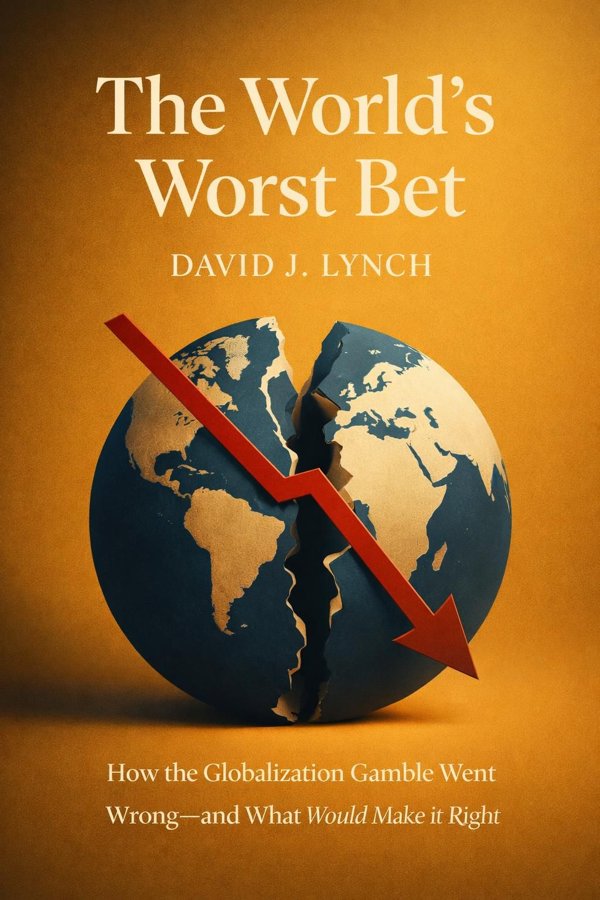
The World's Worst Bet: How the Globalization Gamble Went Wrong—and What Would Make It Right: Summary & Key Insights
 10 min4 chaptersAudio available
What Is The World's Worst Bet: How the Globalization Gamble Went Wrong—and What Would Make It Right About?
The World's Worst Bet: How the Globalization Gamble Went Wrong—and What Would Make It Right by David J. Lynch is a economics book spanning 4 pages. In The World's Worst Bet, David J. Lynch examines how the United States' embrace of globalization—once seen as a path to shared prosperity—ultimately led to economic dislocation, political backlash, and the rise of nationalism. Drawing on decades of reporting and analysis, Lynch traces the evolution of global trade, the offshoring of manufacturing, and the policy missteps that deepened inequality. The book offers a critical yet constructive look at how globalization can be reimagined to serve workers and communities in the 21st century.
This FizzRead summary covers all 4 key chapters of The World's Worst Bet: How the Globalization Gamble Went Wrong—and What Would Make It Right in approximately 10 minutes, distilling the most important ideas, arguments, and takeaways from David J. Lynch's work. Also available as an audio summary and Key Quotes Podcast.
The World's Worst Bet: How the Globalization Gamble Went Wrong—and What Would Make It Right
In The World's Worst Bet, David J. Lynch examines how the United States' embrace of globalization—once seen as a path to shared prosperity—ultimately led to economic dislocation, political backlash, and the rise of nationalism. Drawing on decades of reporting and analysis, Lynch traces the evolution of global trade, the offshoring of manufacturing, and the policy missteps that deepened inequality. The book offers a critical yet constructive look at how globalization can be reimagined to serve workers and communities in the 21st century.
Who Should Read The World's Worst Bet: How the Globalization Gamble Went Wrong—and What Would Make It Right?
This book is perfect for anyone interested in economics and looking to gain actionable insights in a short read. Whether you're a student, professional, or lifelong learner, the key ideas from The World's Worst Bet: How the Globalization Gamble Went Wrong—and What Would Make It Right by David J. Lynch will help you think differently.
- ✓Readers who enjoy economics and want practical takeaways
- ✓Professionals looking to apply new ideas to their work and life
- ✓Anyone who wants the core insights of The World's Worst Bet: How the Globalization Gamble Went Wrong—and What Would Make It Right in just 10 minutes
Want the full summary?
Get instant access to this book summary and 100K+ more with Fizz Moment.
Get Free SummaryAvailable on App Store • Free to download
Key Chapters
To understand how rational minds built an irrational structure, we must look at the invention of complex financial instruments — mortgage-backed securities, collateralized debt obligations, credit default swaps. These weren’t born of greed alone. They emerged from innovation, from the desire to stretch traditional finance into new forms that promised profit while distributing risk. At first, there was genius in this innovation. Economists and bankers envisioned a world where risk could be sliced thin, packaged neatly, and sold to investors around the globe, each bearing only a part of the exposure. In theory, such dispersion would create stability.
But somewhere along the way, the brilliance of the idea outpaced its ethics. The models predicted perpetual housing growth, the spreadsheets assumed perpetual liquidity, and so the instruments were built on untested optimism. Bankers began to believe their tools eliminated risk rather than merely relocated it. The intricate math, the algorithms, the AAA credit ratings — all these formed a reassuring symphony of precision masking a catastrophic ignorance.
As I interviewed traders who once helped generate these products, many admitted they had believed in their own creations. One told me, ‘We weren’t selling poison; we were selling certainty.’ That certainty became contagious. Soon, pension funds, municipalities, and foreign investors were buying securities they didn’t understand, trusting the system because the system had never failed them before.
The lesson buried inside that alchemy is a timeless one: complexity can often disguise fragility. When the underlying mortgages faltered, the instruments collapsed like paper folded in on itself. And with every collapse came disbelief — how could something so well-constructed prove hollow? The answer, I came to see, lies in the difference between engineering and accountability. The system was engineered to function beautifully, but nobody was accountable when it failed.
At the very heart of the global crisis sat a distinctly American illusion — the idea that home ownership was not only a right but a reflection of economic virtue. For decades, real estate values rose steadily, and by the early 2000s, the tide of optimism seemed unstoppable. Mortgage lenders turned from cautious custodians into aggressive salesmen. Subprime loans — once reserved for risky borrowers — became the growth engine for an entire economy.
Walking through Las Vegas subdivisions or Florida cul-de-sacs during my reporting, I saw the scale of this fantasy up close. Ordinary families, many with modest incomes, were offered loans they couldn’t possibly repay, wrapped in promises of refinancing or perpetual appreciation. Behind the scenes, Wall Street was purchasing these risky loans, bundling them into vast securities, and selling them globally. Each layer of transformation made the original risk appear smaller — until no one remembered where it came from.
The housing bubble represented an intersection of misplaced faiths: faith in endless appreciation, faith in the benevolence of lenders, and faith in the power of mathematical models to erase uncertainty. By 2006, cracks were visible. Default rates crept upward, foreclosures spread, but institutions clung to denial. They had bet billions on the continuity of the American dream, and unwinding that bet meant acknowledging systemic fragility.
By the time the bubble burst, entire neighborhoods had become ghost towns. The collapse wasn’t just financial; it was moral. A nation that equated borrowing with success discovered that prosperity built on debt was no prosperity at all. As I wrote in the book, the subprime crisis was a mirror reflecting back our cultural hunger for possession without restraint.
+ 2 more chapters — available in the FizzRead app
All Chapters in The World's Worst Bet: How the Globalization Gamble Went Wrong—and What Would Make It Right
About the Author
David J. Lynch is an American journalist and author who has covered global economics and finance for major publications including The Washington Post, Bloomberg, and USA Today. His reporting has taken him to more than 60 countries, and he is known for his clear, accessible analysis of complex economic issues.
Get This Summary in Your Preferred Format
Read or listen to the The World's Worst Bet: How the Globalization Gamble Went Wrong—and What Would Make It Right summary by David J. Lynch anytime, anywhere. FizzRead offers multiple formats so you can learn on your terms — all free.
Available formats: App · Audio · PDF · EPUB — All included free with FizzRead
Download The World's Worst Bet: How the Globalization Gamble Went Wrong—and What Would Make It Right PDF and EPUB Summary
Key Quotes from The World's Worst Bet: How the Globalization Gamble Went Wrong—and What Would Make It Right
“At the very heart of the global crisis sat a distinctly American illusion — the idea that home ownership was not only a right but a reflection of economic virtue.”
Frequently Asked Questions about The World's Worst Bet: How the Globalization Gamble Went Wrong—and What Would Make It Right
The World's Worst Bet: How the Globalization Gamble Went Wrong—and What Would Make It Right by David J. Lynch is a economics book that explores key ideas across 4 chapters. In The World's Worst Bet, David J. Lynch examines how the United States' embrace of globalization—once seen as a path to shared prosperity—ultimately led to economic dislocation, political backlash, and the rise of nationalism. Drawing on decades of reporting and analysis, Lynch traces the evolution of global trade, the offshoring of manufacturing, and the policy missteps that deepened inequality. The book offers a critical yet constructive look at how globalization can be reimagined to serve workers and communities in the 21st century.
You Might Also Like
Business Adventures
John Brooks
10 min
Nudge
Richard H. Thaler, Cass R. Sunstein
10 min
The Hitchhiker"s Guide to the Galaxy
Douglas Adams
10 minThe Muqaddimah
Ibn Khaldun
10 minThe Outsiders
William N. Thorndike
10 min
A Little History of Economics
Niall Kishtainy
10 minBrowse by Category
Ready to read The World's Worst Bet: How the Globalization Gamble Went Wrong—and What Would Make It Right?
Get the full summary and 100K+ more books with Fizz Moment.