
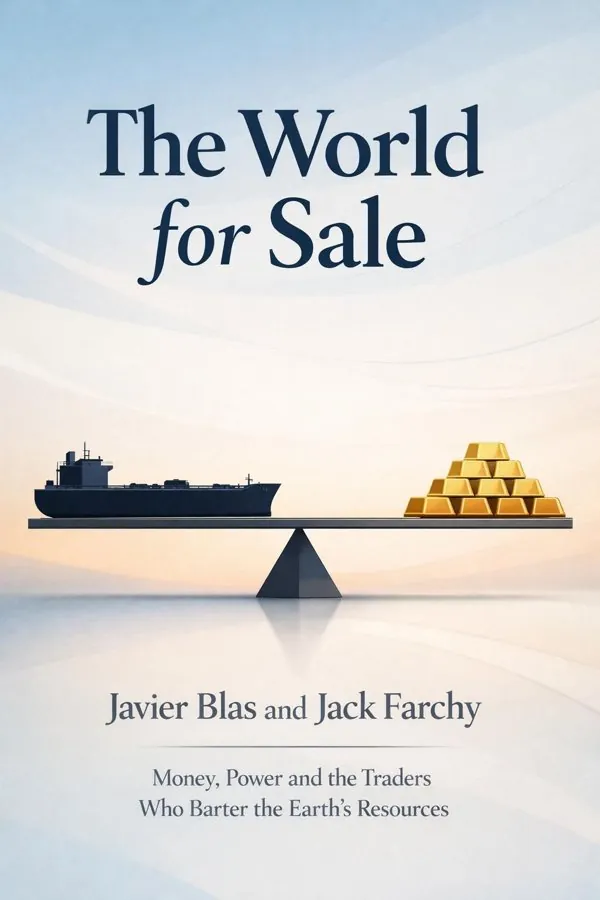
The World for Sale: Money, Power and the Traders Who Barter the Earth’s Resources: Summary & Key Insights
 10 min9 chaptersAudio available
What Is The World for Sale: Money, Power and the Traders Who Barter the Earth’s Resources About?
The World for Sale: Money, Power and the Traders Who Barter the Earth’s Resources by Javier Blas and Jack Farchy is a economics book spanning 9 pages. An investigative account of the secretive world of commodity trading, revealing how a handful of powerful traders control the flow of the world’s natural resources. The book explores the rise of these traders, their influence on global politics and economies, and the moral and environmental consequences of their actions.
This FizzRead summary covers all 9 key chapters of The World for Sale: Money, Power and the Traders Who Barter the Earth’s Resources in approximately 10 minutes, distilling the most important ideas, arguments, and takeaways from Javier Blas and Jack Farchy's work. Also available as an audio summary and Key Quotes Podcast.
The World for Sale: Money, Power and the Traders Who Barter the Earth’s Resources
An investigative account of the secretive world of commodity trading, revealing how a handful of powerful traders control the flow of the world’s natural resources. The book explores the rise of these traders, their influence on global politics and economies, and the moral and environmental consequences of their actions.
Who Should Read The World for Sale: Money, Power and the Traders Who Barter the Earth’s Resources?
This book is perfect for anyone interested in economics and looking to gain actionable insights in a short read. Whether you're a student, professional, or lifelong learner, the key ideas from The World for Sale: Money, Power and the Traders Who Barter the Earth’s Resources by Javier Blas and Jack Farchy will help you think differently.
- ✓Readers who enjoy economics and want practical takeaways
- ✓Professionals looking to apply new ideas to their work and life
- ✓Anyone who wants the core insights of The World for Sale: Money, Power and the Traders Who Barter the Earth’s Resources in just 10 minutes
Want the full summary?
Get instant access to this book summary and 100K+ more with Fizz Moment.
Get Free SummaryAvailable on App Store • Free to download
Key Chapters
The modern world of commodity trading emerged from the rubble of World War II, when economies were rebuilding and raw materials were essential to the reconstruction effort. Traders filled the vacuum between the state-run industries of producers and the growing demands of industrialized nations. In this period, commodity trading moved from small, local operations into global networks. These traders were not romantic adventurers—they were intermediaries, dealmakers who mastered logistics and negotiation in times of shortage and opportunity.
The 1950s and 1960s saw the transformation of trading from an adjunct to production into an independent enterprise. Former employees of large industrial companies realized that control over supply chains and contracts was more lucrative than ownership of mines or wells. This insight birthed firms that specialized in buying, moving, and selling commodities across borders—often where formal regulations didn’t yet exist. Traders thrived in ambiguity; they made a business out of finding gaps and exploiting inefficiencies. As nations rebuilt, the most skilled traders became indispensable partners, securing critical materials and ensuring industrial continuity. In their quiet ascendancy, they defined the rhythms of global commerce before governments had even noticed.
By the late twentieth century, a small number of trading firms had evolved from scrappy intermediaries into titans capable of influencing global markets. Companies like Glencore, Vitol, and Trafigura transformed commodity trading from an art of negotiation into a discipline of complex financial and geopolitical maneuvering. Their founders—often former renegades from larger corporations—shared an instinct for risk and opportunity. They understood that volatility was not an obstacle, but a commodity itself.
These firms thrived in moments of upheaval: wars, revolutions, currency crises. When others fled uncertainty, traders dove into it, buying when prices collapsed and selling when panic lifted. They financed entire governments, supplied armies, and stabilized or destabilized economies depending on their interests. What began as discreet supply operations evolved into global empires integrated into banking, shipping, and extractive enterprises.
Glencore, for instance, built its power on the model pioneered by Marc Rich—trading with sanctioned nations, leveraging insider knowledge of oil flows, and treating every political boundary as negotiable. Vitol and Trafigura refined this strategy, mastering risk management, logistics optimization, and speculative financial instruments. Behind each success lay a simple truth: control over information and assets equals control over power. Traders did not merely respond to markets—they created them.
+ 7 more chapters — available in the FizzRead app
All Chapters in The World for Sale: Money, Power and the Traders Who Barter the Earth’s Resources
About the Authors
Javier Blas and Jack Farchy are journalists specializing in global commodities and energy markets. Both have written extensively for the Financial Times and Bloomberg, covering the intersection of business, politics, and natural resources.
Get This Summary in Your Preferred Format
Read or listen to the The World for Sale: Money, Power and the Traders Who Barter the Earth’s Resources summary by Javier Blas and Jack Farchy anytime, anywhere. FizzRead offers multiple formats so you can learn on your terms — all free.
Available formats: App · Audio · PDF · EPUB — All included free with FizzRead
Download The World for Sale: Money, Power and the Traders Who Barter the Earth’s Resources PDF and EPUB Summary
Key Quotes from The World for Sale: Money, Power and the Traders Who Barter the Earth’s Resources
“The modern world of commodity trading emerged from the rubble of World War II, when economies were rebuilding and raw materials were essential to the reconstruction effort.”
“By the late twentieth century, a small number of trading firms had evolved from scrappy intermediaries into titans capable of influencing global markets.”
Frequently Asked Questions about The World for Sale: Money, Power and the Traders Who Barter the Earth’s Resources
The World for Sale: Money, Power and the Traders Who Barter the Earth’s Resources by Javier Blas and Jack Farchy is a economics book that explores key ideas across 9 chapters. An investigative account of the secretive world of commodity trading, revealing how a handful of powerful traders control the flow of the world’s natural resources. The book explores the rise of these traders, their influence on global politics and economies, and the moral and environmental consequences of their actions.
You Might Also Like
Business Adventures
John Brooks
10 min
Nudge
Richard H. Thaler, Cass R. Sunstein
10 min
The Hitchhiker"s Guide to the Galaxy
Douglas Adams
10 minThe Muqaddimah
Ibn Khaldun
10 minThe Outsiders
William N. Thorndike
10 min
A Little History of Economics
Niall Kishtainy
10 minBrowse by Category
Ready to read The World for Sale: Money, Power and the Traders Who Barter the Earth’s Resources?
Get the full summary and 100K+ more books with Fizz Moment.