
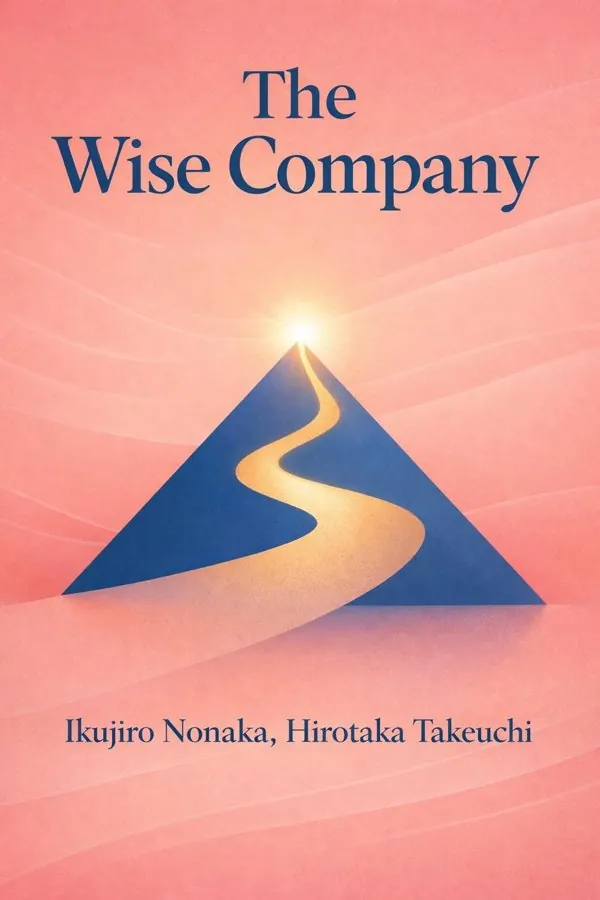
The Wise Company: How Companies Create Continuous Innovation: Summary & Key Insights
by Ikujiro Nonaka, Hirotaka Takeuchi
 10 min10 chaptersAudio available
What Is The Wise Company: How Companies Create Continuous Innovation About?
The Wise Company: How Companies Create Continuous Innovation by Ikujiro Nonaka, Hirotaka Takeuchi is a leadership book spanning 10 pages. The Wise Company explores how organizations can cultivate wisdom to achieve sustainable innovation and long-term success. Building on their earlier work on knowledge-creating companies, Nonaka and Takeuchi argue that true innovation arises from practical wisdom (phronesis) — the ability to make decisions that are both effective and ethically sound. Drawing on case studies from Japanese and global firms, the authors present a framework for leadership and organizational design that integrates knowledge, ethics, and purpose.
This FizzRead summary covers all 10 key chapters of The Wise Company: How Companies Create Continuous Innovation in approximately 10 minutes, distilling the most important ideas, arguments, and takeaways from Ikujiro Nonaka, Hirotaka Takeuchi's work. Also available as an audio summary and Key Quotes Podcast.
The Wise Company: How Companies Create Continuous Innovation
The Wise Company explores how organizations can cultivate wisdom to achieve sustainable innovation and long-term success. Building on their earlier work on knowledge-creating companies, Nonaka and Takeuchi argue that true innovation arises from practical wisdom (phronesis) — the ability to make decisions that are both effective and ethically sound. Drawing on case studies from Japanese and global firms, the authors present a framework for leadership and organizational design that integrates knowledge, ethics, and purpose.
Who Should Read The Wise Company: How Companies Create Continuous Innovation?
This book is perfect for anyone interested in leadership and looking to gain actionable insights in a short read. Whether you're a student, professional, or lifelong learner, the key ideas from The Wise Company: How Companies Create Continuous Innovation by Ikujiro Nonaka, Hirotaka Takeuchi will help you think differently.
- ✓Readers who enjoy leadership and want practical takeaways
- ✓Professionals looking to apply new ideas to their work and life
- ✓Anyone who wants the core insights of The Wise Company: How Companies Create Continuous Innovation in just 10 minutes
Want the full summary?
Get instant access to this book summary and 100K+ more with Fizz Moment.
Get Free SummaryAvailable on App Store • Free to download
Key Chapters
When I first developed the SECI model—Socialization, Externalization, Combination, and Internalization—it reflected my belief that organizational knowledge is dynamic. Tacit knowledge, rooted in human experience, interacts constantly with explicit knowledge to generate new ideas and practices. However, over the years, I observed that many organizations had mastered this process at a technical level but struggled at an ethical one. They could innovate efficiently, but not wisely.
Knowledge creation alone is not enough. What we need is the evolution from knowledge to wisdom—a movement from knowing to judging to acting. Knowledge provides possibilities; wisdom chooses among them with moral and contextual discernment. In Japan, companies such as Toyota have demonstrated how knowledge creation leads naturally into wise practice. Their philosophy of continuous improvement (kaizen) doesn’t just aim for efficiency; it embodies respect for people, humility, and learning from experience.
This transformation requires leaders to actively cultivate wisdom. It means embedding reflective practices within the organization—dialogue that connects purpose to daily action, storytelling that carries ethical meaning, and mentoring that transmits experiential insight. In such organizations, knowledge is not stored in databases or manuals; it lives in the hearts and actions of people who care deeply about what they do. The result is continuous innovation grounded in humanity.
Aristotle’s concept of *phronesis* has guided my thinking for decades. Unlike *sophia*, which refers to abstract theoretical wisdom, *phronesis* is about knowing how to act rightly in particular situations. It is contextual, ethical, and deeply human. For managers, this means that wisdom is the ability to discern what is good for both the organization and society, and to transform that discernment into effective action.
Practical wisdom begins with empathy—the ability to understand what truly matters to others. It also relies on experience, because only through repeated engagement with the world can we develop judgment. Finally, it demands courage, as wise decisions often challenge established routines or short-term interests. I have seen in practice that leaders who embody *phronesis* are capable of guiding their organizations through crises without losing sight of their moral compass. They question not only what works but also what is right.
To apply this concept in management, we focus on context rather than universal rules. Wisdom lives in the lived reality of everyday work—in negotiating with partners, responding to customer needs, or adjusting product design to changing circumstances. The wise leader does not merely analyze data; they interpret it through human understanding and ethical purpose. This orientation transforms business from mere competition to contribution.
+ 8 more chapters — available in the FizzRead app
All Chapters in The Wise Company: How Companies Create Continuous Innovation
About the Authors
Ikujiro Nonaka is a Japanese organizational theorist best known for his work on knowledge management and the SECI model of knowledge creation. Hirotaka Takeuchi is a professor at Harvard Business School and co-author of several influential works on innovation and management. Together, they have shaped modern understanding of how organizations create and sustain knowledge.
Get This Summary in Your Preferred Format
Read or listen to the The Wise Company: How Companies Create Continuous Innovation summary by Ikujiro Nonaka, Hirotaka Takeuchi anytime, anywhere. FizzRead offers multiple formats so you can learn on your terms — all free.
Available formats: App · Audio · PDF · EPUB — All included free with FizzRead
Download The Wise Company: How Companies Create Continuous Innovation PDF and EPUB Summary
Key Quotes from The Wise Company: How Companies Create Continuous Innovation
“When I first developed the SECI model—Socialization, Externalization, Combination, and Internalization—it reflected my belief that organizational knowledge is dynamic.”
“Aristotle’s concept of *phronesis* has guided my thinking for decades.”
Frequently Asked Questions about The Wise Company: How Companies Create Continuous Innovation
The Wise Company: How Companies Create Continuous Innovation by Ikujiro Nonaka, Hirotaka Takeuchi is a leadership book that explores key ideas across 10 chapters. The Wise Company explores how organizations can cultivate wisdom to achieve sustainable innovation and long-term success. Building on their earlier work on knowledge-creating companies, Nonaka and Takeuchi argue that true innovation arises from practical wisdom (phronesis) — the ability to make decisions that are both effective and ethically sound. Drawing on case studies from Japanese and global firms, the authors present a framework for leadership and organizational design that integrates knowledge, ethics, and purpose.
You Might Also Like

Extreme Ownership
Jocko Willink
10 min
Dare to Lead
Brene Brown
10 min
Leaders Eat Last
Simon Sinek
10 min
The 21 Irrefutable Laws of Leadership
John Maxwell
10 min
Start With Why
Simon Sinek
10 min
How to Lead When You're Not in Charge
Clay Scroggins
10 minBrowse by Category
Ready to read The Wise Company: How Companies Create Continuous Innovation?
Get the full summary and 100K+ more books with Fizz Moment.