
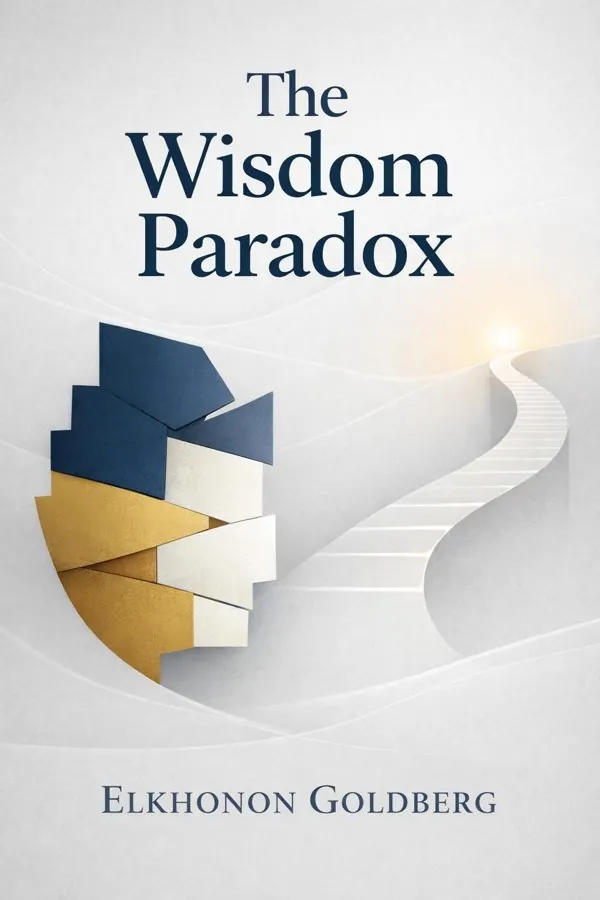
The Wisdom Paradox: How Your Mind Can Grow Stronger As Your Brain Grows Older: Summary & Key Insights
 10 min7 chaptersAudio available
What Is The Wisdom Paradox: How Your Mind Can Grow Stronger As Your Brain Grows Older About?
The Wisdom Paradox: How Your Mind Can Grow Stronger As Your Brain Grows Older by Elkhonon Goldberg is a neuroscience book spanning 7 pages. In this groundbreaking work, neuropsychologist Elkhonon Goldberg explores how the aging brain can retain and even enhance its cognitive powers. Drawing on decades of research, Goldberg explains the concept of the 'wisdom paradox'—the idea that while certain mental processes may slow with age, others, such as pattern recognition and decision-making, can improve. The book blends neuroscience, psychology, and personal insight to show how experience and knowledge can compensate for the decline in raw processing speed, offering a hopeful view of cognitive aging.
This FizzRead summary covers all 7 key chapters of The Wisdom Paradox: How Your Mind Can Grow Stronger As Your Brain Grows Older in approximately 10 minutes, distilling the most important ideas, arguments, and takeaways from Elkhonon Goldberg's work. Also available as an audio summary and Key Quotes Podcast.
The Wisdom Paradox: How Your Mind Can Grow Stronger As Your Brain Grows Older
In this groundbreaking work, neuropsychologist Elkhonon Goldberg explores how the aging brain can retain and even enhance its cognitive powers. Drawing on decades of research, Goldberg explains the concept of the 'wisdom paradox'—the idea that while certain mental processes may slow with age, others, such as pattern recognition and decision-making, can improve. The book blends neuroscience, psychology, and personal insight to show how experience and knowledge can compensate for the decline in raw processing speed, offering a hopeful view of cognitive aging.
Who Should Read The Wisdom Paradox: How Your Mind Can Grow Stronger As Your Brain Grows Older?
This book is perfect for anyone interested in neuroscience and looking to gain actionable insights in a short read. Whether you're a student, professional, or lifelong learner, the key ideas from The Wisdom Paradox: How Your Mind Can Grow Stronger As Your Brain Grows Older by Elkhonon Goldberg will help you think differently.
- ✓Readers who enjoy neuroscience and want practical takeaways
- ✓Professionals looking to apply new ideas to their work and life
- ✓Anyone who wants the core insights of The Wisdom Paradox: How Your Mind Can Grow Stronger As Your Brain Grows Older in just 10 minutes
Want the full summary?
Get instant access to this book summary and 100K+ more with Fizz Moment.
Get Free SummaryAvailable on App Store • Free to download
Key Chapters
Throughout our lives, two forms of intelligence coexist and interact—fluid and crystallized. Fluid intelligence is our ability to process new information quickly, to reason abstractly, and to solve novel problems. It is most vibrant in youth, when neural efficiency and speed are at their peak. Crystallized intelligence, on the other hand, represents the accumulated knowledge, vocabulary, and mental templates that derive from years of experience.
In the laboratory and in the clinic, I have seen how these two intelligences age differently. Fluid intelligence tends to decline earlier, as neuronal efficiency slows and synaptic plasticity becomes less agile. Yet crystallized intelligence—our library of lived understanding—tends to expand and strengthen late into life. It is the product of rich neural associations formed over decades, and it enables older adults to apply experience to new contexts in ways that young people often cannot. This asymmetry is what gives rise to the wisdom paradox: even while one aspect of mental ability declines, another may flourish.
From a neuroscientific standpoint, these two intelligences are not stored in separate compartments but reflect distinct patterns of neural engagement. The prefrontal cortex, long considered the brain’s command center, plays a central role. It is involved in decision-making, strategic planning, and the selection of actions consistent with long-term goals. As we age, the brain becomes increasingly adept at using this network for integrated reasoning, relying less on brute computation and more on abstraction. In this sense, an older individual may think more economically: rather than exploring every possible solution, they draw on prior templates, swiftly discarding irrelevant options and homing in on what truly matters. Wisdom emerges from this economy of thought.
To appreciate this dynamic is to transform our relationship with aging. Aging does not simply diminish capacity—it refines it. We trade speed for insight, detail for pattern, novelty for integration. And through that trade, we gain a deeper form of intelligence—one that embodies not only cognition, but judgment.
When I first began studying patients with neurological damage, I learned that the human brain is far less rigid than once believed. Individuals who suffered massive lesions to certain regions could, through therapy and time, often recover functions once thought permanently lost. The mechanism behind this phenomenon is neural plasticity—the brain’s ability to rewire itself by forming new connections and reorganizing functional networks.
This plasticity does not stop with youth. Although it changes in character with age, it remains a lifelong feature of the nervous system. In young brains, plasticity is explosive, allowing rapid acquisition of language and motor skills. In mature brains, it becomes more selective and deliberate, operating within the framework of accumulated knowledge. It is this refined form of plasticity that underlies wisdom.
When an older adult encounters a new situation, their brain no longer searches randomly for a solution. Instead, it draws upon an immense reservoir of prior experiences, reorganizing existing neural pathways to adapt the old to the new. This adaptive reuse of neural circuits ensures that learning continues across the lifespan, albeit at a slower but often more meaningful pace.
Research in neuroimaging has revealed that aging brains often recruit bilateral regions for tasks that in younger subjects activate only one hemisphere. This compensatory activation reflects not decline but adaptation—the enlistment of additional neural resources to achieve cognitive efficiency. The aged brain sacrifices specialization for integration, and in doing so, it sometimes gains remarkable flexibility.
Plasticity, then, is not merely about growth; it is about reconfiguration. Even when neurons die, networks evolve. In this continual remodeling lies our capacity for intellectual and emotional maturity. With each decade, the architecture of the brain tells a story of accumulated experience, trial, and adaptation—a living testament to the wisdom paradox itself.
+ 5 more chapters — available in the FizzRead app
All Chapters in The Wisdom Paradox: How Your Mind Can Grow Stronger As Your Brain Grows Older
About the Author
Elkhonon Goldberg is a clinical professor of neurology at New York University School of Medicine and a pioneering neuropsychologist known for his research on the frontal lobes and cognitive aging. A student and collaborator of Alexander Luria, Goldberg has written extensively on brain function, intelligence, and creativity, bridging neuroscience and everyday life.
Get This Summary in Your Preferred Format
Read or listen to the The Wisdom Paradox: How Your Mind Can Grow Stronger As Your Brain Grows Older summary by Elkhonon Goldberg anytime, anywhere. FizzRead offers multiple formats so you can learn on your terms — all free.
Available formats: App · Audio · PDF · EPUB — All included free with FizzRead
Download The Wisdom Paradox: How Your Mind Can Grow Stronger As Your Brain Grows Older PDF and EPUB Summary
Key Quotes from The Wisdom Paradox: How Your Mind Can Grow Stronger As Your Brain Grows Older
“Throughout our lives, two forms of intelligence coexist and interact—fluid and crystallized.”
“When I first began studying patients with neurological damage, I learned that the human brain is far less rigid than once believed.”
Frequently Asked Questions about The Wisdom Paradox: How Your Mind Can Grow Stronger As Your Brain Grows Older
The Wisdom Paradox: How Your Mind Can Grow Stronger As Your Brain Grows Older by Elkhonon Goldberg is a neuroscience book that explores key ideas across 7 chapters. In this groundbreaking work, neuropsychologist Elkhonon Goldberg explores how the aging brain can retain and even enhance its cognitive powers. Drawing on decades of research, Goldberg explains the concept of the 'wisdom paradox'—the idea that while certain mental processes may slow with age, others, such as pattern recognition and decision-making, can improve. The book blends neuroscience, psychology, and personal insight to show how experience and knowledge can compensate for the decline in raw processing speed, offering a hopeful view of cognitive aging.
You Might Also Like
Anxious
Joseph LeDoux
10 min
Hallucinations
Oliver Sacks
10 min
The Biological Mind: How Brain, Body, and Environment Collaborate to Make Us Who We Are
Alan Jasanoff
10 min
The Feeling of Life Itself: Why Consciousness Is Widespread but Can't Be Computed
Christof Koch
10 min
The No-Nonsense Meditation Book
Steven Laureys
10 min
A General Theory of Love
Thomas Lewis, Fari Amini, Richard Lannon
10 minBrowse by Category
Ready to read The Wisdom Paradox: How Your Mind Can Grow Stronger As Your Brain Grows Older?
Get the full summary and 100K+ more books with Fizz Moment.