
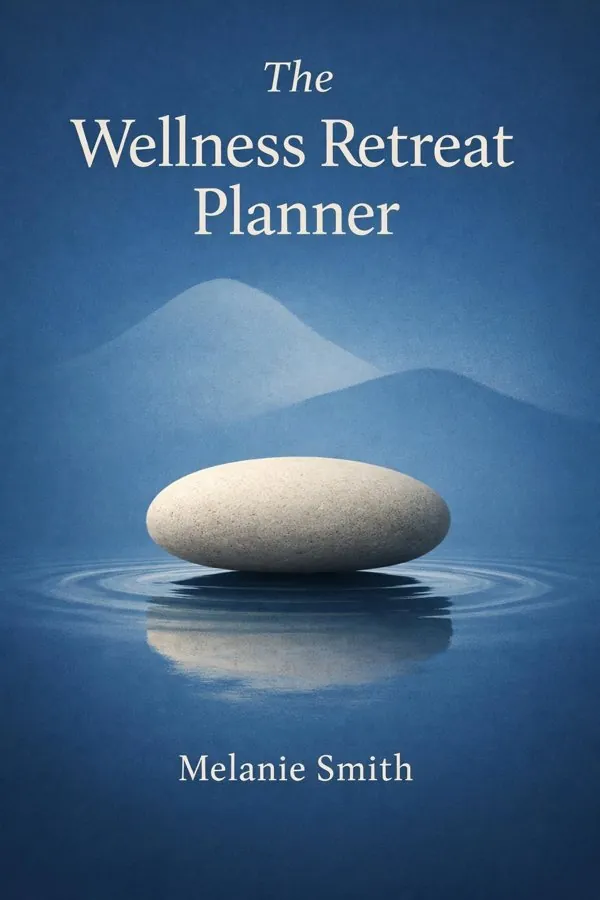
The Wellness Retreat Planner: Designing Short Restorative Programs: Summary & Key Insights
 10 min8 chaptersAudio available
Key Takeaways from The Wellness Retreat Planner: Designing Short Restorative Programs
A retreat is not powerful because people travel somewhere beautiful; it is powerful because it interrupts habitual living.
Great retreats feel effortless to participants because they are deeply structured underneath.
People do not heal in theory; they heal in places.
A retreat only becomes meaningful when participants feel seen, supported, and able to engage at their own pace.
More wellness activities do not automatically create more wellness.
What Is The Wellness Retreat Planner: Designing Short Restorative Programs About?
The Wellness Retreat Planner: Designing Short Restorative Programs by Melanie Smith is a wellness book spanning 3 pages. The Wellness Retreat Planner: Designing Short Restorative Programs is a practical guide for anyone who wants to create wellness experiences that are more than beautiful escapes. Melanie Smith shows how a short retreat can become a carefully designed intervention: a temporary environment that helps people step out of stress, reconnect with their bodies and minds, and return home with renewed clarity. Rather than treating retreats as improvised events or luxury add-ons, the book frames them as purposeful wellbeing programs shaped by evidence, logistics, and participant psychology. What makes the book especially valuable is its balance between vision and execution. Smith explains not only why restorative programs matter in an overworked, overstimulated world, but also how to build them—from choosing a concept and setting goals to sequencing activities, managing operations, and evaluating outcomes. Her expertise in wellness tourism and holistic health education gives the book both academic credibility and real-world usefulness. For retreat organizers, coaches, hospitality professionals, therapists, and wellness entrepreneurs, this is a grounded roadmap for designing short programs that feel cohesive, healing, and professionally delivered.
This FizzRead summary covers all 8 key chapters of The Wellness Retreat Planner: Designing Short Restorative Programs in approximately 10 minutes, distilling the most important ideas, arguments, and takeaways from Melanie Smith's work. Also available as an audio summary and Key Quotes Podcast.
The Wellness Retreat Planner: Designing Short Restorative Programs
The Wellness Retreat Planner: Designing Short Restorative Programs is a practical guide for anyone who wants to create wellness experiences that are more than beautiful escapes. Melanie Smith shows how a short retreat can become a carefully designed intervention: a temporary environment that helps people step out of stress, reconnect with their bodies and minds, and return home with renewed clarity. Rather than treating retreats as improvised events or luxury add-ons, the book frames them as purposeful wellbeing programs shaped by evidence, logistics, and participant psychology.
What makes the book especially valuable is its balance between vision and execution. Smith explains not only why restorative programs matter in an overworked, overstimulated world, but also how to build them—from choosing a concept and setting goals to sequencing activities, managing operations, and evaluating outcomes. Her expertise in wellness tourism and holistic health education gives the book both academic credibility and real-world usefulness. For retreat organizers, coaches, hospitality professionals, therapists, and wellness entrepreneurs, this is a grounded roadmap for designing short programs that feel cohesive, healing, and professionally delivered.
Who Should Read The Wellness Retreat Planner: Designing Short Restorative Programs?
This book is perfect for anyone interested in wellness and looking to gain actionable insights in a short read. Whether you're a student, professional, or lifelong learner, the key ideas from The Wellness Retreat Planner: Designing Short Restorative Programs by Melanie Smith will help you think differently.
- ✓Readers who enjoy wellness and want practical takeaways
- ✓Professionals looking to apply new ideas to their work and life
- ✓Anyone who wants the core insights of The Wellness Retreat Planner: Designing Short Restorative Programs in just 10 minutes
Want the full summary?
Get instant access to this book summary and 100K+ more with Fizz Moment.
Get Free SummaryAvailable on App Store • Free to download
Key Chapters
A retreat is not powerful because people travel somewhere beautiful; it is powerful because it interrupts habitual living. Smith begins by positioning wellness retreats within the broader wellness ecosystem, where they serve as short, intentional pauses that help participants recalibrate physically, mentally, and emotionally. Unlike a vacation, which may simply provide distraction or indulgence, a restorative retreat is designed around a clear wellbeing objective: stress reduction, sleep recovery, emotional reset, gentle movement, mindfulness, or lifestyle change.
This distinction matters because it shapes every planning decision. If organizers see a retreat merely as a collection of pleasant activities, the experience can feel fragmented. But if they see it as a structured container for transformation, then the schedule, environment, facilitators, food, and communication all align toward a meaningful outcome. Smith emphasizes that short retreats must be realistic in their ambitions. A three-day program cannot solve chronic burnout or deep trauma, but it can create space for awareness, regulation, and motivation for healthier habits.
For example, a weekend retreat for stressed professionals might center on nervous system recovery through slow movement, guided reflection, screen-free time, and sleep-supportive routines. A program for beginners in wellness may focus less on intensity and more on accessibility, helping participants experience simple practices they can maintain after returning home.
The central insight is that a retreat succeeds when its purpose is precise. Before building the program, define the retreat in one sentence: who it is for, what problem it addresses, and what kind of restoration it promises.
Great retreats feel effortless to participants because they are deeply structured underneath. Smith argues that every successful restorative program needs a framework that connects vision, target audience, duration, activities, and expected outcomes. Without this design logic, organizers often overload the itinerary, mix incompatible modalities, or promise more than a short retreat can realistically deliver.
A framework begins with core questions: Who is the retreat for? What state are participants likely arriving in? What should they feel, understand, or begin practicing by the end? What constraints exist in time, budget, venue, and staff capacity? Smith encourages planners to think in terms of progression. A retreat should not be a random sequence of sessions but a carefully staged experience that moves participants from arrival and decompression to engagement, reflection, and integration.
For instance, the first hours may be devoted to slowing down and orienting the group, not launching immediately into emotionally demanding workshops. Mid-program may include the most immersive experiences, such as nature immersion, bodywork, coaching, or creativity sessions. The final segment should focus on consolidation, helping participants identify what they want to take home.
This framework also helps avoid a common mistake: trying to please everyone. A retreat for people seeking spiritual exploration will differ from one focused on corporate burnout or menopausal wellbeing. Clarity creates consistency, and consistency builds trust.
The actionable lesson is to design your retreat backwards from outcomes. Start with the change you want participants to experience, then build the structure, content, and pacing that make that change possible within a short timeframe.
People do not heal in theory; they heal in places. Smith highlights that the retreat environment is not just a backdrop but an active contributor to restoration. Light, noise, natural surroundings, room layout, food access, transportation ease, and even signage influence whether participants feel safe, settled, and open to change. In short retreats especially, there is little time to recover from logistical friction. Confusing arrival instructions, uncomfortable rooms, poor acoustics, or rushed meal service can undermine the entire experience.
Smith therefore treats logistics as part of participant care. Venue selection should match the retreat’s purpose. A mindfulness retreat benefits from quiet, natural settings and uncluttered spaces, while a creative wellbeing retreat may need flexible rooms for workshops and collaborative activity. Organizers should think through arrival flow, check-in, dietary needs, accessibility, weather contingencies, staff roles, session transitions, and emergency planning. These are not secondary details; they determine whether participants can relax enough to engage.
A practical example is the difference between scheduling back-to-back sessions with no breathing room and designing gentle transition periods with tea, journaling, or outdoor walking. The latter supports regulation and reduces cognitive overload. Similarly, offering nourishing meals aligned with the retreat’s philosophy communicates coherence and care.
The deeper point is that restoration is often built through small signals of thoughtfulness. Participants notice when a program feels calm, prepared, and humane.
The actionable takeaway is to audit the retreat through the participant’s eyes: from first email to final departure, remove friction and design every logistical detail to support ease, safety, and emotional spaciousness.
A retreat only becomes meaningful when participants feel seen, supported, and able to engage at their own pace. Smith stresses that program design should begin not with the organizer’s favorite modalities but with participant needs, capacities, and expectations. This means understanding demographics, stress levels, prior wellness experience, physical ability, cultural background, and motivations for attending. A participant-centered retreat avoids one-size-fits-all assumptions and instead creates flexible pathways into restoration.
In practice, this might mean offering movement sessions with adaptations, balancing group activities with private reflection, or clearly labeling optional sessions for deeper emotional work. It also means setting the right tone from the outset. Participants need to know what the retreat is and is not. If the program promises gentle reset, it should not suddenly become an intensive therapeutic intervention. If it includes silence, detox practices, or digital disconnection, these expectations should be communicated in advance.
Smith also argues for evaluating outcomes, even in short programs. Retreats often rely on testimonials alone, but better assessment can strengthen quality and credibility. Organizers can use pre- and post-retreat questionnaires, mood scales, participant reflections, and follow-up surveys to understand changes in stress, energy, sleep, or confidence in maintaining wellness habits. These insights can improve future design and demonstrate value to partners or clients.
The key message is that good retreat planning combines empathy with evidence. The participant experience should feel personal, but its effectiveness should still be examined thoughtfully.
Action step: gather participant data before, during, and after the retreat, then use it to refine the experience so your program becomes more inclusive, responsive, and impactful over time.
More wellness activities do not automatically create more wellness. One of Smith’s most useful contributions is her warning against overstuffed retreat schedules. Short restorative programs work best when modalities are selected and combined with intention. Yoga, meditation, nutrition workshops, massage, forest walks, breathwork, journaling, sound healing, and coaching may all be valuable, but when too many are packed into a short period, participants can feel overstimulated rather than restored.
Smith encourages planners to think about complementarity. Each modality should support the retreat’s central goal and the likely condition of participants on arrival. If guests are exhausted and dysregulated, the program may need grounding practices such as gentle movement, sleep-supportive routines, nourishing meals, and quiet reflection, rather than demanding workouts or emotionally intense sessions. If the retreat is about confidence and lifestyle renewal, educational workshops may be useful, but they should be balanced with embodied and experiential practices.
A helpful model is to design around three layers: body, mind, and integration. The body layer may include stretching, massage, or mindful eating. The mind layer may include reflection, education, or guided meditation. The integration layer helps participants connect insight to daily life through action planning or group discussion. This creates variety without chaos.
The takeaway is simple but powerful: curation matters more than quantity. Choose fewer modalities, make sure they reinforce one another, and give each enough time to land. A short retreat becomes restorative when participants experience depth, rhythm, and coherence instead of constant activity.
Restoration depends as much on rhythm as on content. Smith shows that the psychological arc of a retreat matters enormously, especially in programs lasting only a few days. Participants often arrive carrying stress, travel fatigue, social caution, and mental noise. If the schedule is too intense too soon, they may comply outwardly while remaining inwardly tense. Effective retreat planning therefore respects the natural stages of settling, opening, engaging, and integrating.
The first phase should focus on decompression. Welcome rituals, simple orientation, nourishing food, and gentle activities help participants feel safe and present. The middle phase can introduce deeper experiences, whether educational workshops, body-based practices, or guided group processes. The final phase should not abruptly end after the last session; it should help participants reflect on what has shifted and how to sustain it.
Smith also highlights the importance of pauses. Empty space in the schedule is not wasted time. It allows reflection, digestion, nervous system regulation, and informal connection. A retreat that runs from one structured activity to another may feel productive, but it can leave participants too full to absorb anything. By contrast, a well-paced program uses intensity strategically and intersperses it with rest.
Imagine a day that begins with silent tea and stretching, moves into a workshop, leaves space for lunch and outdoor solitude, then closes with a restorative evening practice. The sense of flow itself becomes healing.
Actionable takeaway: map your retreat as an emotional journey, not just a timetable. Build in decompression, meaningful peaks, and spacious integration so participants can truly receive the program rather than merely attend it.
Participants often remember people more vividly than programs. Smith underscores that the quality of facilitation is central to a retreat’s effectiveness. A beautiful venue and elegant schedule cannot compensate for facilitators who are unclear, rigid, disorganized, or insensitive to group dynamics. In restorative settings, staff and practitioners do more than deliver content; they shape emotional climate, model presence, and hold boundaries that help people feel secure.
The book encourages organizers to select facilitators not only for technical expertise but also for interpersonal skill. A yoga teacher may be excellent in a studio but less suited to a diverse retreat group if they cannot adapt for different abilities. A coach may be insightful but inappropriate if they push disclosure or overstep the retreat’s purpose. Hosts need to know how to welcome, orient, reassure, and respond to participant needs without becoming invasive.
Emotional safety is especially important when retreats include practices that may surface vulnerability, such as meditation, reflective writing, or group sharing. Participants should never feel pressured to reveal personal experiences. Consent, confidentiality, clear framing, and optional participation are essential. Facilitators must also understand the limits of their role; a retreat is not a substitute for clinical treatment unless explicitly designed and staffed as such.
A strong team shares a common philosophy, communicates well behind the scenes, and knows who handles what.
The practical takeaway is to brief facilitators thoroughly on audience, outcomes, boundaries, and tone. Train your team to create warmth without intrusion, guidance without pressure, and professionalism without stiffness. That combination builds trust and allows restoration to unfold.
The true test of a retreat is not how people feel on the final afternoon, but what remains a week later. Smith emphasizes that short restorative programs should be designed for transfer, helping participants convert retreat experiences into everyday practices. Without integration, even a moving retreat can become a pleasant interruption rather than a catalyst for lasting wellbeing.
This means organizers should build continuity into the program from the start. During the retreat, facilitators can encourage participants to notice which practices feel realistic in ordinary life. Instead of presenting an idealized wellness routine that depends on abundant free time and special settings, the program should highlight small, sustainable actions: ten minutes of breathwork, an evening screen curfew, mindful meals, a weekly nature walk, or a personal check-in ritual.
Closing sessions are especially important. Rather than ending with vague inspiration, participants can identify one or two habits, likely obstacles, and practical supports. Some retreats may include printed guides, follow-up emails, digital resources, or post-retreat group calls. Even simple reminders can help maintain momentum and reinforce accountability.
For example, a burnout recovery retreat might send participants a two-week reflection sequence with prompts on energy management, sleep, and work boundaries. A mindfulness retreat might offer short recorded meditations for home use.
Smith’s broader insight is that a retreat should act as a bridge, not a bubble. It creates enough distance from daily life for insight to emerge, then helps participants carry that insight back into reality.
Action step: end every retreat with a clear integration plan so participants leave not only refreshed, but equipped to continue their wellbeing journey after they return home.
All Chapters in The Wellness Retreat Planner: Designing Short Restorative Programs
About the Author
Dr. Melanie Smith is a respected authority in wellness tourism, retreat design, and holistic health education. Her work focuses on how travel, place, and intentional programming can support physical, mental, and emotional wellbeing. Drawing from both academic research and applied practice, she has written extensively on wellness experiences and taught internationally on the planning and management of health-oriented programs. Smith is known for translating broad wellbeing concepts into practical frameworks that professionals can use in real settings, from retreats and resorts to educational environments. In The Wellness Retreat Planner, she brings together strategic thinking, operational insight, and participant-centered design, making her a trusted guide for readers who want to create short restorative programs that are both meaningful and professionally executed.
Get This Summary in Your Preferred Format
Read or listen to the The Wellness Retreat Planner: Designing Short Restorative Programs summary by Melanie Smith anytime, anywhere. FizzRead offers multiple formats so you can learn on your terms — all free.
Available formats: App · Audio · PDF · EPUB — All included free with FizzRead
Download The Wellness Retreat Planner: Designing Short Restorative Programs PDF and EPUB Summary
Key Quotes from The Wellness Retreat Planner: Designing Short Restorative Programs
“A retreat is not powerful because people travel somewhere beautiful; it is powerful because it interrupts habitual living.”
“Great retreats feel effortless to participants because they are deeply structured underneath.”
“People do not heal in theory; they heal in places.”
“A retreat only becomes meaningful when participants feel seen, supported, and able to engage at their own pace.”
“More wellness activities do not automatically create more wellness.”
Frequently Asked Questions about The Wellness Retreat Planner: Designing Short Restorative Programs
The Wellness Retreat Planner: Designing Short Restorative Programs by Melanie Smith is a wellness book that explores key ideas across 8 chapters. The Wellness Retreat Planner: Designing Short Restorative Programs is a practical guide for anyone who wants to create wellness experiences that are more than beautiful escapes. Melanie Smith shows how a short retreat can become a carefully designed intervention: a temporary environment that helps people step out of stress, reconnect with their bodies and minds, and return home with renewed clarity. Rather than treating retreats as improvised events or luxury add-ons, the book frames them as purposeful wellbeing programs shaped by evidence, logistics, and participant psychology. What makes the book especially valuable is its balance between vision and execution. Smith explains not only why restorative programs matter in an overworked, overstimulated world, but also how to build them—from choosing a concept and setting goals to sequencing activities, managing operations, and evaluating outcomes. Her expertise in wellness tourism and holistic health education gives the book both academic credibility and real-world usefulness. For retreat organizers, coaches, hospitality professionals, therapists, and wellness entrepreneurs, this is a grounded roadmap for designing short programs that feel cohesive, healing, and professionally delivered.
You Might Also Like

How We Heal: Uncover Your Power and Set Yourself Free
Alexandra Elle
10 min
A Year of Self-Care: Daily Practices and Inspiration for Caring for Yourself
Zoe Shaw
10 min
Biohacker’s Handbook: Upgrade Your Life
Olli Sovijärvi, Teemu Arina, Jaakko Halmetoja
10 min
Bliss More: How to Succeed in Meditation Without Really Trying
Light Watkins
10 min
Body Kindness: Transform Your Health from the Inside Out—and Never Say Diet Again
Rebecca Scritchfield
10 min
Cook, Eat, Run: Cook Fast, Boost Performance with 75 Ultimate Recipes for Runners
Charlie Watson
10 minBrowse by Category
Ready to read The Wellness Retreat Planner: Designing Short Restorative Programs?
Get the full summary and 100K+ more books with Fizz Moment.