
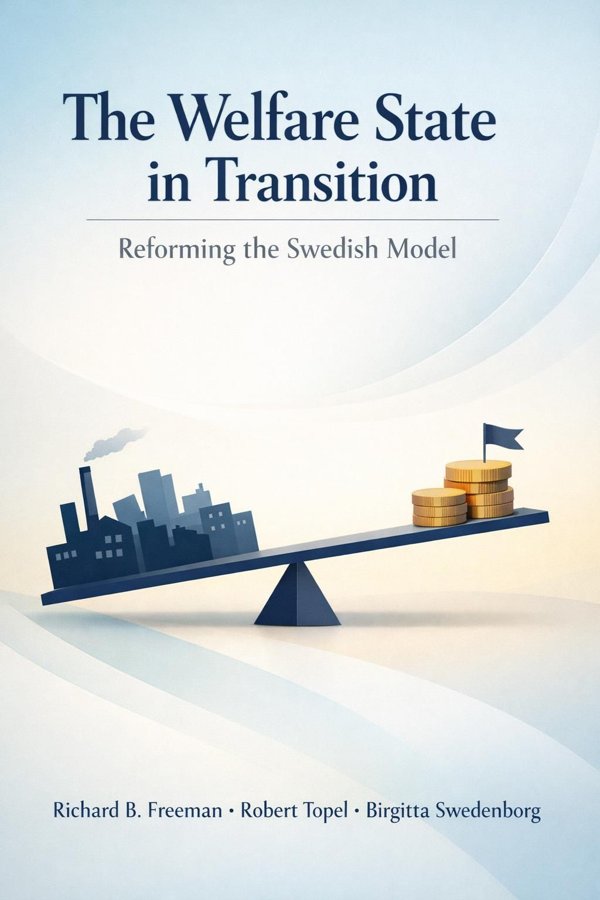
The Welfare State in Transition: Reforming the Swedish Model: Summary & Key Insights
by Richard B. Freeman, Robert Topel, Birgitta Swedenborg
 10 min7 chaptersAudio available
What Is The Welfare State in Transition: Reforming the Swedish Model About?
The Welfare State in Transition: Reforming the Swedish Model by Richard B. Freeman, Robert Topel, Birgitta Swedenborg is a economics book spanning 7 pages. This book examines the transformation of Sweden’s welfare state during the late twentieth century, analyzing how economic pressures, globalization, and policy reforms reshaped the Swedish model. It provides comparative studies of labor markets, taxation, and social welfare systems, offering insights into the challenges of maintaining equity and efficiency in advanced welfare economies.
This FizzRead summary covers all 7 key chapters of The Welfare State in Transition: Reforming the Swedish Model in approximately 10 minutes, distilling the most important ideas, arguments, and takeaways from Richard B. Freeman, Robert Topel, Birgitta Swedenborg's work. Also available as an audio summary and Key Quotes Podcast.
The Welfare State in Transition: Reforming the Swedish Model
This book examines the transformation of Sweden’s welfare state during the late twentieth century, analyzing how economic pressures, globalization, and policy reforms reshaped the Swedish model. It provides comparative studies of labor markets, taxation, and social welfare systems, offering insights into the challenges of maintaining equity and efficiency in advanced welfare economies.
Who Should Read The Welfare State in Transition: Reforming the Swedish Model?
This book is perfect for anyone interested in economics and looking to gain actionable insights in a short read. Whether you're a student, professional, or lifelong learner, the key ideas from The Welfare State in Transition: Reforming the Swedish Model by Richard B. Freeman, Robert Topel, Birgitta Swedenborg will help you think differently.
- ✓Readers who enjoy economics and want practical takeaways
- ✓Professionals looking to apply new ideas to their work and life
- ✓Anyone who wants the core insights of The Welfare State in Transition: Reforming the Swedish Model in just 10 minutes
Want the full summary?
Get instant access to this book summary and 100K+ more with Fizz Moment.
Get Free SummaryAvailable on App Store • Free to download
Key Chapters
By the late twentieth century, Sweden faced economic challenges that tested the very foundations of its welfare state. The model that had delivered stability and growth in the postwar era began to lose momentum. During the 1970s and 1980s, productivity growth slowed, inflation accelerated, and the fiscal burden rose steeply. The global oil shocks and the ensuing recessions exposed structural weaknesses in heavily unionized and regulated sectors.
From the standpoint of macroeconomic performance, Sweden moved from being one of Europe’s fastest-growing economies to one struggling under debt accumulation and rising unemployment. Public expenditures approached two-thirds of GDP, and the very generosity that once symbolized success now became a source of strain. The tax system, designed to redistribute income and sustain universal benefits, began to distort incentives to work and invest.
We analyze these developments within a broader macroeconomic narrative: the pressures of maintaining Keynesian-style full employment policies amid an open, high-wage economy. Persistent wage compression, though intended to foster solidarity, dampened innovation and productivity in some sectors while protecting less efficient firms. Inflationary pushes led to repeated devaluations of the krona, symptomatic of a weakening competitive base.
Understanding this context is essential, for it sets the stage for the sweeping reforms that followed. The economic slowdown was not simply a cyclical downturn—it signaled a deeper structural adjustment as Sweden entered a globalized world where capital mobility, technological shifts, and international integration demanded new policy responses.
The rising tide of globalization touched every sector of the Swedish economy. As advanced manufacturing shifted toward high-skill, high-tech production, Sweden’s traditional industrial champions—steel, shipbuilding, and basic manufacturing—faced unprecedented competitive pressures. Firms were forced to adapt or wither.
Technological change, particularly the information revolution, redefined the nature of work. Labor demand polarized: high-skilled workers saw expanding opportunities, while low-skilled employment declined. For a society built on equality, this posed acute challenges. The Swedish model’s centralized wage-setting institutions and active labor market policies aimed to prevent such divides. Yet global markets often moved faster than domestic institutions could adjust.
We observed how the structural transformation encouraged a more dynamic service sector and an expanding knowledge economy. Nonetheless, Sweden struggled to reconcile openness with solidarity. Policies promoting lifelong education and retraining were strengthened, but fiscal constraints increasingly limited their reach. The state that once guided industrial policy through coordinated bargains now had to rely on competitive flexibility and innovation.
In this sense, globalization did not destroy the Swedish model; it forced it to evolve. The question became whether its values—equity, participation, and cooperation—could thrive in a world of instantaneous capital flows and mobile production.
+ 5 more chapters — available in the FizzRead app
All Chapters in The Welfare State in Transition: Reforming the Swedish Model
About the Authors
Richard B. Freeman is an American labor economist and professor at Harvard University. Robert Topel is an economist at the University of Chicago specializing in labor and health economics. Birgitta Swedenborg is a Swedish economist and research director at the Center for Business and Policy Studies (SNS) in Stockholm.
Get This Summary in Your Preferred Format
Read or listen to the The Welfare State in Transition: Reforming the Swedish Model summary by Richard B. Freeman, Robert Topel, Birgitta Swedenborg anytime, anywhere. FizzRead offers multiple formats so you can learn on your terms — all free.
Available formats: App · Audio · PDF · EPUB — All included free with FizzRead
Download The Welfare State in Transition: Reforming the Swedish Model PDF and EPUB Summary
Key Quotes from The Welfare State in Transition: Reforming the Swedish Model
“By the late twentieth century, Sweden faced economic challenges that tested the very foundations of its welfare state.”
“The rising tide of globalization touched every sector of the Swedish economy.”
Frequently Asked Questions about The Welfare State in Transition: Reforming the Swedish Model
The Welfare State in Transition: Reforming the Swedish Model by Richard B. Freeman, Robert Topel, Birgitta Swedenborg is a economics book that explores key ideas across 7 chapters. This book examines the transformation of Sweden’s welfare state during the late twentieth century, analyzing how economic pressures, globalization, and policy reforms reshaped the Swedish model. It provides comparative studies of labor markets, taxation, and social welfare systems, offering insights into the challenges of maintaining equity and efficiency in advanced welfare economies.
You Might Also Like

Business Adventures
John Brooks
10 min
Nudge
Richard H. Thaler, Cass R. Sunstein
10 min
The Hitchhiker"s Guide to the Galaxy
Douglas Adams
10 minThe Muqaddimah
Ibn Khaldun
10 minThe Outsiders
William N. Thorndike
10 min
A Little History of Economics
Niall Kishtainy
10 minBrowse by Category
Ready to read The Welfare State in Transition: Reforming the Swedish Model?
Get the full summary and 100K+ more books with Fizz Moment.