
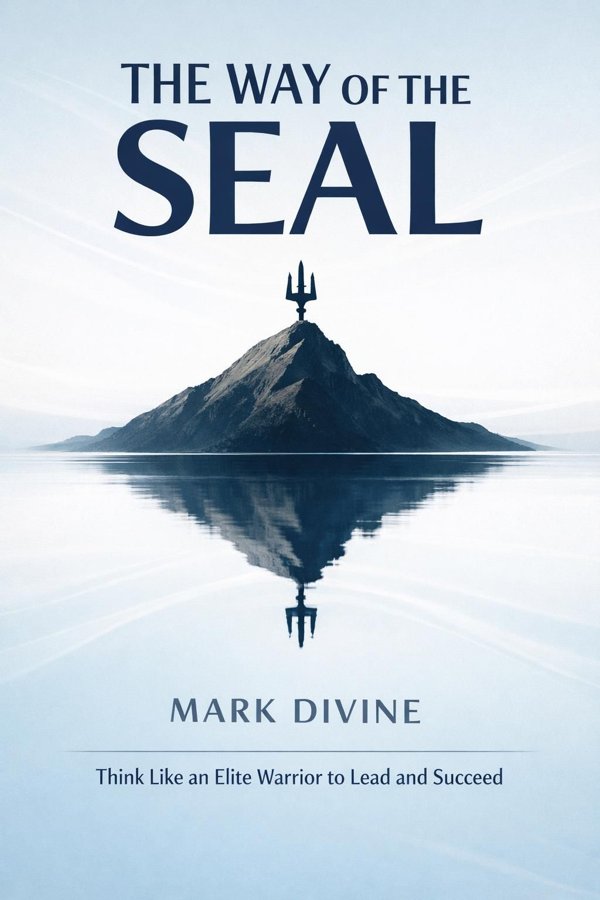
The Way of the SEAL: Think Like an Elite Warrior to Lead and Succeed: Summary & Key Insights
by Mark Divine
 10 min9 chaptersAudio available
Key Takeaways from The Way of the SEAL: Think Like an Elite Warrior to Lead and Succeed
When people hit their limits, purpose determines whether they stop or keep going.
In moments of pressure, the mind tends to scatter.
Confidence is not optimism; it is preparation.
Elite performance is built in ordinary moments long before the big test arrives.
The mind performs better when it has already rehearsed success.
What Is The Way of the SEAL: Think Like an Elite Warrior to Lead and Succeed About?
The Way of the SEAL: Think Like an Elite Warrior to Lead and Succeed by Mark Divine is a leadership book spanning 9 pages. What separates high performers from everyone else is rarely talent alone. More often, it is the ability to stay clear-headed under pressure, commit to a mission, and keep moving when comfort, fear, and distraction tell you to stop. In The Way of the SEAL, former Navy SEAL Commander Mark Divine translates the mindset of elite military training into a practical system for leadership, business, and personal growth. This is not a book about combat tactics. It is a guide to building mental toughness, disciplined focus, emotional control, and purpose-driven action. Divine argues that anyone can develop the inner qualities that make SEALs effective: resilience, calm intensity, adaptability, and trust-based leadership. Drawing on his experience in one of the world’s most demanding military environments, as well as his work as founder of SEALFIT and Unbeatable Mind, he offers exercises and principles that help readers train their minds as intentionally as they train their bodies. The result is a leadership book with unusual depth and practicality. For entrepreneurs, managers, athletes, and anyone facing chaos or transition, this book shows how to become mission-driven, decisive, and hard to shake.
This FizzRead summary covers all 9 key chapters of The Way of the SEAL: Think Like an Elite Warrior to Lead and Succeed in approximately 10 minutes, distilling the most important ideas, arguments, and takeaways from Mark Divine's work. Also available as an audio summary and Key Quotes Podcast.
The Way of the SEAL: Think Like an Elite Warrior to Lead and Succeed
What separates high performers from everyone else is rarely talent alone. More often, it is the ability to stay clear-headed under pressure, commit to a mission, and keep moving when comfort, fear, and distraction tell you to stop. In The Way of the SEAL, former Navy SEAL Commander Mark Divine translates the mindset of elite military training into a practical system for leadership, business, and personal growth. This is not a book about combat tactics. It is a guide to building mental toughness, disciplined focus, emotional control, and purpose-driven action.
Divine argues that anyone can develop the inner qualities that make SEALs effective: resilience, calm intensity, adaptability, and trust-based leadership. Drawing on his experience in one of the world’s most demanding military environments, as well as his work as founder of SEALFIT and Unbeatable Mind, he offers exercises and principles that help readers train their minds as intentionally as they train their bodies. The result is a leadership book with unusual depth and practicality. For entrepreneurs, managers, athletes, and anyone facing chaos or transition, this book shows how to become mission-driven, decisive, and hard to shake.
Who Should Read The Way of the SEAL: Think Like an Elite Warrior to Lead and Succeed?
This book is perfect for anyone interested in leadership and looking to gain actionable insights in a short read. Whether you're a student, professional, or lifelong learner, the key ideas from The Way of the SEAL: Think Like an Elite Warrior to Lead and Succeed by Mark Divine will help you think differently.
- ✓Readers who enjoy leadership and want practical takeaways
- ✓Professionals looking to apply new ideas to their work and life
- ✓Anyone who wants the core insights of The Way of the SEAL: Think Like an Elite Warrior to Lead and Succeed in just 10 minutes
Want the full summary?
Get instant access to this book summary and 100K+ more with Fizz Moment.
Get Free SummaryAvailable on App Store • Free to download
Key Chapters
When people hit their limits, purpose determines whether they stop or keep going. Mark Divine makes this point early: in extreme environments like Navy SEAL training, raw strength and ambition are not enough. Candidates who rely only on ego, toughness, or the desire to impress eventually break down. The people who endure are the ones connected to a deeper reason for suffering. Purpose gives meaning to pain, direction to effort, and stability when circumstances become brutal.
Divine explains that in any demanding mission, whether building a company, leading a team, changing careers, or recovering from failure, purpose acts like an internal compass. Without it, people get distracted by short-term discomfort, external praise, or emotional ups and downs. With it, they can align decisions, habits, and priorities around something larger than immediate gratification. This is why he urges readers to define their personal and professional mission with clarity. What do you stand for? What outcome matters enough that you are willing to train, sacrifice, and persist for it?
A clear purpose also improves leadership. Teams rally around meaningful missions, not vague slogans. A manager who can connect everyday tasks to a larger vision creates commitment instead of compliance. A founder who knows why the company exists beyond profit is more likely to stay steady during setbacks.
One practical application is to write a personal mission statement and a professional mission statement, then test your calendar against them. If your daily actions do not reflect your stated purpose, your mission is still theoretical.
Actionable takeaway: define your core mission in one sentence and review it every morning before beginning your most important work.
In moments of pressure, the mind tends to scatter. Divine’s idea of “front-sight focus” is a discipline for preventing that mental drift. Borrowed from marksmanship, the term refers to locking attention onto what matters most right now instead of getting lost in noise, fear, or future uncertainty. The principle is simple but powerful: success often comes from narrowing focus to the next critical action.
In combat, a distracted operator is dangerous. In business and life, distraction is less dramatic but equally costly. People lose energy by thinking about ten problems at once, replaying mistakes, and worrying about outcomes they cannot yet control. Front-sight focus trains you to reduce complexity. Instead of asking, “How will I handle everything?” you ask, “What is the next move that matters?” This preserves calm and creates momentum.
Divine also links focus to breath and awareness. When stress spikes, attention fragments. Controlled breathing and brief mental resets help bring the mind back to the present. A leader facing a tense negotiation, a student preparing for a major exam, or a parent managing family and work demands can all use this method. Rather than reacting emotionally to the whole battlefield, they return to the immediate target.
A practical example is during a crowded workday. Instead of multitasking across email, meetings, and strategic projects, identify the one task that best advances your mission for the day and give it uninterrupted attention. Another example is in conflict: focus first on listening clearly and defining the real issue before trying to solve everything at once.
Actionable takeaway: whenever stress rises, pause, take five slow breaths, and ask yourself, “What is my front sight right now?”
Confidence is not optimism; it is preparation. One of Divine’s strongest lessons is that elite performance depends on “bulletproofing” the mission before action starts. SEALs do not assume things will go smoothly. They plan rigorously, identify weak points, rehearse contingencies, and mentally walk through obstacles before stepping into the field. This approach reduces avoidable failure and increases adaptability when surprises happen.
In everyday leadership, people often confuse speed with readiness. They rush into launches, meetings, hires, or strategic shifts without clarifying objectives, roles, timelines, risks, and fallback options. Then, when problems emerge, they call the chaos “unexpected.” Divine’s framework pushes readers to prepare more deliberately. What is the mission? What does success look like? What resources are essential? What could derail the effort? What is Plan B if conditions change?
Bulletproofing also includes internal readiness. Are you emotionally steady enough to lead under pressure? Does the team share the same understanding of the mission? Have assumptions been challenged? Good preparation is not fear-based. It is a mark of respect for reality.
Consider a product launch. A bulletproof approach would include market validation, stakeholder alignment, scenario planning, communication protocols, and a clear after-action review process. Or imagine a difficult conversation with an employee. Preparation means clarifying your goal, anticipating reactions, and deciding how to stay constructive if emotions escalate.
This mindset does not eliminate uncertainty. It creates resilience within uncertainty. The better your preparation, the freer you are to adapt in real time.
Actionable takeaway: before any major initiative, run a mission checklist covering objective, roles, risks, contingencies, and what success will specifically look like.
Elite performance is built in ordinary moments long before the big test arrives. Divine emphasizes a simple but demanding principle: do the hard things now, especially when no one is watching. The willingness to embrace discomfort voluntarily is what separates those who grow from those who stagnate. Most people wait for motivation, ideal conditions, or external pressure. SEAL-style discipline means acting before you feel ready.
This idea is not about punishment or grinding endlessly. It is about strategic discomfort. When you consistently choose the demanding workout, the difficult conversation, the early planning session, or the disciplined financial decision, you expand your capacity. You teach yourself that resistance is not a stop sign. Over time, this compounds into confidence. You begin to trust yourself because you know you can do what is necessary, not just what is pleasant.
Divine’s message is especially relevant in modern environments built around convenience and distraction. Comfort can become a silent form of weakness if it prevents challenge, risk, or honest self-assessment. The person who avoids temporary discomfort often creates larger pain later: declining health, mediocre work, unresolved conflict, or missed opportunity.
In practice, this principle might mean making the sales call you have delayed for weeks, training consistently instead of sporadically, or setting aside time for strategic thinking instead of staying trapped in reactive tasks. Leaders can apply it by addressing underperformance quickly, giving candid feedback, and making principled decisions even when they are unpopular.
The point is not to become harsh. It is to become capable. Discipline creates freedom because it prepares you for the moments that matter most.
Actionable takeaway: choose one task you have been avoiding because it feels uncomfortable and complete it before noon tomorrow.
The mind performs better when it has already rehearsed success. Divine highlights visualization as a core training tool used by elite performers to prepare for pressure, reduce fear, and improve execution. This is not wishful thinking or fantasy. It is a deliberate mental practice in which you imagine specific scenarios, responses, obstacles, and outcomes so that when the moment arrives, your mind and body are less likely to freeze.
SEALs use mental rehearsal because reality is often too fast and unforgiving for first-time thinking. In business, sports, and leadership, the same principle applies. A presentation goes better when you have mentally walked through the room, the opening lines, the likely questions, and your calm response to setbacks. A difficult negotiation improves when you have imagined both ideal and adverse scenarios. Visualization builds familiarity, and familiarity lowers unnecessary stress.
Divine also stresses that useful visualization includes adversity. Do not only picture perfect success. Rehearse what you will do if technology fails, if the client pushes back, if your energy drops, or if plans change. This creates psychological flexibility. You are not attached to a fantasy; you are prepared for reality.
Athletes use this constantly, but professionals often ignore it despite its power. A leader can visualize entering a tense board meeting with composure. An entrepreneur can rehearse a pitch until confidence becomes embodied. A person making a major life change can imagine staying grounded through uncertainty instead of spiraling into self-doubt.
Visualization works best when paired with action. You still have to train, prepare, and execute. But mental rehearsal accelerates performance by reducing internal friction.
Actionable takeaway: spend five minutes each day mentally rehearsing one important event, including both success and how you will respond to obstacles.
Mental toughness is not a personality trait; it is a trainable capacity. Divine’s concept of the “unbeatable mind” is central to the book. He argues that most people let their minds run untrained, reacting automatically to stress, distraction, fear, and ego. SEALs, by contrast, cultivate awareness, emotional control, and disciplined thinking through repeated practice. The result is not invulnerability, but steadiness.
An unbeatable mind combines several elements: self-awareness, concentration, resilience, intuition, and the ability to act in alignment with mission rather than impulse. Divine believes this can be developed through practices such as breathing exercises, meditation, physical challenge, and reflection. These methods strengthen your ability to notice internal states without being ruled by them. Instead of being hijacked by anxiety or anger, you gain a space between stimulus and response.
This matters enormously for leaders. A reactive leader spreads stress through the whole organization. A centered leader can absorb pressure without transmitting panic. Likewise, in personal life, an untrained mind tends to exaggerate setbacks and cling to negative stories. A trained mind can acknowledge difficulty while staying constructive.
For example, if a project fails, an untrained response might be shame, blame, and frantic overcorrection. An unbeatable-mind response is different: pause, breathe, assess facts, learn quickly, then move forward. If a competitor gains advantage, you do not collapse into comparison; you sharpen your own execution.
Divine’s broader point is that peak performance starts internally. If your mind is weak, your skills and plans eventually get undermined. If your mind is steady, you can use setbacks as training rather than proof of inadequacy.
Actionable takeaway: start a daily 10-minute mental training practice using breath control, stillness, and reflection to strengthen awareness and emotional control.
No matter how capable you are, lone-wolf leadership eventually fails. Divine draws heavily on the SEAL lesson that true excellence is collective. Elite teams are not built on charisma or hierarchy alone. They are built on trust, shared mission, mutual accountability, and the confidence that every member will do their job under pressure. In that environment, leadership becomes a function of service, not ego.
One of the most valuable ideas here is that the best leaders focus first on making the team stronger. They set standards, model discipline, communicate clearly, and create alignment around the mission. They also know when to step back and let others lead based on expertise and circumstance. In dynamic situations, rigid command structures can slow response. Trust-based teams move faster because people understand intent, roles, and values.
Divine also suggests that teamwork begins with self-mastery. If you are defensive, unreliable, or glory-seeking, you weaken the group. Strong teams require humility. Members must be willing to train hard, share information, receive feedback, and support one another without losing accountability.
In a company, this might mean making sure everyone understands strategic priorities rather than just their isolated tasks. In a startup, it could mean hiring for character and resilience, not merely technical skill. In a family or community setting, teamwork may look like clearer roles, open communication, and consistency in follow-through.
A team becomes elite when people trust that others will remain steady in adversity. That trust is earned through repeated action, not slogans.
Actionable takeaway: strengthen your team by clarifying the mission, defining responsibilities, and asking each member what support and standards they need to perform at their best.
In uncertain conditions, hesitation can be more dangerous than imperfection. Divine teaches that elite performers make decisions with incomplete information, act decisively, and then adapt as reality unfolds. This is a crucial balance. Some people rush impulsively. Others overanalyze until the opportunity disappears. The SEAL mindset aims for disciplined decisiveness: prepare thoroughly, assess quickly, move, and adjust.
This principle matters because modern environments are volatile. Markets shift, teams change, competitors move, and crises emerge without warning. Waiting for certainty is often a disguised form of fear. Divine encourages leaders to replace the need for perfect control with readiness to respond. Decisive action creates momentum, reveals new information, and prevents paralysis.
At the same time, decisiveness should not become rigidity. A mission-first leader remains flexible. If conditions change, the plan must change too. What stays constant is the objective and the commitment to serve it. This adaptability is one of the book’s most practical leadership lessons. The strongest leaders are not those who cling stubbornly to the original plan, but those who can pivot without losing clarity or composure.
A business example is entering a new market with a strong strategy while remaining ready to modify pricing, messaging, or channels based on real feedback. A personal example is committing to a health goal while adjusting the method when injury, travel, or schedule constraints arise.
The deeper lesson is psychological. You must detach your identity from being right. Otherwise, adaptation feels like failure. Divine reframes it as strength.
Actionable takeaway: when facing an important decision, set a time limit, choose the best available course, and define in advance which signals would require you to adapt the plan.
All Chapters in The Way of the SEAL: Think Like an Elite Warrior to Lead and Succeed
About the Author
Mark Divine is a retired U.S. Navy SEAL Commander, leadership expert, entrepreneur, and author focused on mental toughness and human performance. Before joining the SEALs, he worked in the business world and earned an MBA from New York University, giving him a rare blend of military and corporate experience. He later founded SEALFIT, a training program that combines physical challenge with mindset development, and Unbeatable Mind, a system for building resilience, focus, intuition, and leadership capacity. Through his books, coaching, and speaking, Divine has helped business leaders, athletes, and professionals apply elite warrior principles to everyday life. His work centers on discipline, self-mastery, mission-driven action, and the belief that exceptional performance can be trained.
Get This Summary in Your Preferred Format
Read or listen to the The Way of the SEAL: Think Like an Elite Warrior to Lead and Succeed summary by Mark Divine anytime, anywhere. FizzRead offers multiple formats so you can learn on your terms — all free.
Available formats: App · Audio · PDF · EPUB — All included free with FizzRead
Download The Way of the SEAL: Think Like an Elite Warrior to Lead and Succeed PDF and EPUB Summary
Key Quotes from The Way of the SEAL: Think Like an Elite Warrior to Lead and Succeed
“When people hit their limits, purpose determines whether they stop or keep going.”
“In moments of pressure, the mind tends to scatter.”
“Confidence is not optimism; it is preparation.”
“Elite performance is built in ordinary moments long before the big test arrives.”
“The mind performs better when it has already rehearsed success.”
Frequently Asked Questions about The Way of the SEAL: Think Like an Elite Warrior to Lead and Succeed
The Way of the SEAL: Think Like an Elite Warrior to Lead and Succeed by Mark Divine is a leadership book that explores key ideas across 9 chapters. What separates high performers from everyone else is rarely talent alone. More often, it is the ability to stay clear-headed under pressure, commit to a mission, and keep moving when comfort, fear, and distraction tell you to stop. In The Way of the SEAL, former Navy SEAL Commander Mark Divine translates the mindset of elite military training into a practical system for leadership, business, and personal growth. This is not a book about combat tactics. It is a guide to building mental toughness, disciplined focus, emotional control, and purpose-driven action. Divine argues that anyone can develop the inner qualities that make SEALs effective: resilience, calm intensity, adaptability, and trust-based leadership. Drawing on his experience in one of the world’s most demanding military environments, as well as his work as founder of SEALFIT and Unbeatable Mind, he offers exercises and principles that help readers train their minds as intentionally as they train their bodies. The result is a leadership book with unusual depth and practicality. For entrepreneurs, managers, athletes, and anyone facing chaos or transition, this book shows how to become mission-driven, decisive, and hard to shake.
More by Mark Divine

You Might Also Like

Extreme Ownership
Jocko Willink
10 min
Dare to Lead
Brene Brown
10 min
Leaders Eat Last
Simon Sinek
10 min
The 21 Irrefutable Laws of Leadership
John Maxwell
10 min
Start With Why
Simon Sinek
10 min
How to Lead When You're Not in Charge
Clay Scroggins
10 minBrowse by Category
Ready to read The Way of the SEAL: Think Like an Elite Warrior to Lead and Succeed?
Get the full summary and 100K+ more books with Fizz Moment.