
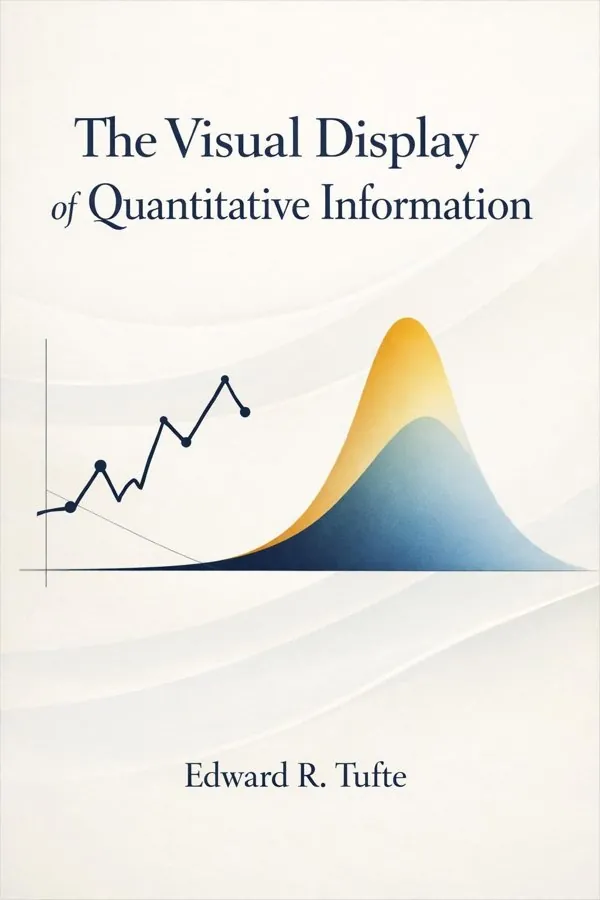
The Visual Display of Quantitative Information: Summary & Key Insights
 10 min8 chaptersAudio available
What Is The Visual Display of Quantitative Information About?
The Visual Display of Quantitative Information by Edward R. Tufte is a data_science book spanning 8 pages. This classic work by Edward R. Tufte explores the theory and practice of data graphics, emphasizing clarity, precision, and efficiency in the visual presentation of quantitative information. It analyzes historical and modern examples of charts, graphs, and statistical displays, offering principles for effective design and communication of complex data.
This FizzRead summary covers all 8 key chapters of The Visual Display of Quantitative Information in approximately 10 minutes, distilling the most important ideas, arguments, and takeaways from Edward R. Tufte's work. Also available as an audio summary and Key Quotes Podcast.
The Visual Display of Quantitative Information
This classic work by Edward R. Tufte explores the theory and practice of data graphics, emphasizing clarity, precision, and efficiency in the visual presentation of quantitative information. It analyzes historical and modern examples of charts, graphs, and statistical displays, offering principles for effective design and communication of complex data.
Who Should Read The Visual Display of Quantitative Information?
This book is perfect for anyone interested in data_science and looking to gain actionable insights in a short read. Whether you're a student, professional, or lifelong learner, the key ideas from The Visual Display of Quantitative Information by Edward R. Tufte will help you think differently.
- ✓Readers who enjoy data_science and want practical takeaways
- ✓Professionals looking to apply new ideas to their work and life
- ✓Anyone who wants the core insights of The Visual Display of Quantitative Information in just 10 minutes
Want the full summary?
Get instant access to this book summary and 100K+ more with Fizz Moment.
Get Free SummaryAvailable on App Store • Free to download
Key Chapters
To understand how we visualize data today, we must first look at where the idea of statistical graphics came from. The history of quantitative illustration is not long by human standards — most of the great breakthroughs occurred within just the last few centuries. Before that time, information was mostly tabular, verbal, or conceptual. Then came the innovators: William Playfair, Florence Nightingale, Charles Joseph Minard, and others who saw that one could use lines, bars, and maps to render ideas previously buried in numbers.
These pioneers understood that a chart is far more than an embellishment. It is a cognitive tool, an extension of reasoning itself. A line showing the price of wheat over time or a map depicting Napoleon’s march to Moscow can tell truths that no table of figures could ever match for immediacy or emotional force. In these early designs lies the seed of what I call 'graphical excellence' — the careful balancing of design and evidence.
In my research I have examined thousands of historical examples to understand what makes a visual display valuable. What emerges clearly is that the best graphics have always shared humanistic qualities: they respect the intelligence of the reader, they reward careful observation, and they never insult the data by oversimplifying it. The aim of this book is not nostalgia; it is continuity. By studying how our predecessors achieved compact, truthful communication, we can build modern graphics that retain those same virtues in an age of computers and complex data.
When a graphic lies, it does so with authority. A bar stretched too far, a scale omitted, an axis truncated — small choices like these can dramatically distort perception. That is why I insist that the integrity of graphical design is a moral issue. The task of presenting evidence carries ethical responsibility. We should never fool the eye to serve convenience, ideology, or the desire to impress.
Graphical integrity rests upon simple but inviolable principles. The representation of numbers should be proportional to their actual numerical magnitudes. The visual impact should correspond to genuine differences. Non-data ink — lines, shading, decoration — must never overwhelm the evidence itself. When the design exaggerates or conceals, it corrupts the reasoning process. Consider the 'lie factor' — a measure I developed to quantify distortion. When the size of a visual element changes in a way that does not match the change in the data, the lie factor departs from unity. Values below one or above one indicate deception, whether intentional or not.
Readers need not become mathematicians to judge honesty. Our eyes are remarkably sensitive to ratio and shape, but they are easily manipulated when designers abuse visual proportion. Thus, every curve, dot, or line on a chart must serve the truth. In this way, clarity becomes not only an aesthetic virtue but an ethical one.
+ 6 more chapters — available in the FizzRead app
All Chapters in The Visual Display of Quantitative Information
About the Author
Edward Rolf Tufte is an American statistician, artist, and professor emeritus of political science, statistics, and computer science at Yale University. He is widely recognized for his pioneering work in data visualization and information design.
Get This Summary in Your Preferred Format
Read or listen to the The Visual Display of Quantitative Information summary by Edward R. Tufte anytime, anywhere. FizzRead offers multiple formats so you can learn on your terms — all free.
Available formats: App · Audio · PDF · EPUB — All included free with FizzRead
Download The Visual Display of Quantitative Information PDF and EPUB Summary
Key Quotes from The Visual Display of Quantitative Information
“To understand how we visualize data today, we must first look at where the idea of statistical graphics came from.”
“When a graphic lies, it does so with authority.”
Frequently Asked Questions about The Visual Display of Quantitative Information
The Visual Display of Quantitative Information by Edward R. Tufte is a data_science book that explores key ideas across 8 chapters. This classic work by Edward R. Tufte explores the theory and practice of data graphics, emphasizing clarity, precision, and efficiency in the visual presentation of quantitative information. It analyzes historical and modern examples of charts, graphs, and statistical displays, offering principles for effective design and communication of complex data.
More by Edward R. Tufte
You Might Also Like
Data Science from Scratch: First Principles with Python
Joel Grus
10 min
Applied Predictive Modeling
Max Kuhn, Kjell Johnson
10 min
Better Data Visualizations: A Guide for Scholars, Researchers, and Wonks
Jonathan Schwabish
10 min
Big Data: A Revolution That Will Transform How We Live, Work, and Think
Viktor Mayer-Schönberger, Kenneth Cukier
10 min
Big Data: Principles and Best Practices of Scalable Real-Time Data Systems
Nathan Marz
10 min
Data Points: Visualization That Means Something
Nathan Yau
10 minBrowse by Category
Ready to read The Visual Display of Quantitative Information?
Get the full summary and 100K+ more books with Fizz Moment.