
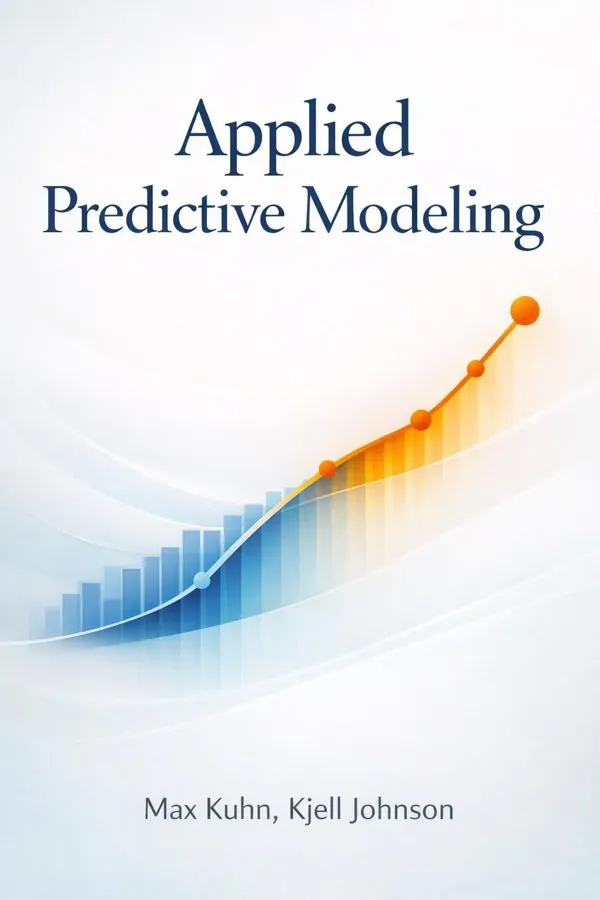
Applied Predictive Modeling: Summary & Key Insights
 10 min6 chaptersAudio available
What Is Applied Predictive Modeling About?
Applied Predictive Modeling by Max Kuhn, Kjell Johnson is a data_science book spanning 6 pages. Applied Predictive Modeling provides a practical, hands-on introduction to building predictive models using real-world data. The book covers data preprocessing, feature selection, model tuning, and performance evaluation, with examples implemented in R. It emphasizes understanding the modeling process and interpreting results rather than focusing solely on algorithms.
This FizzRead summary covers all 6 key chapters of Applied Predictive Modeling in approximately 10 minutes, distilling the most important ideas, arguments, and takeaways from Max Kuhn, Kjell Johnson's work. Also available as an audio summary and Key Quotes Podcast.
Applied Predictive Modeling
Applied Predictive Modeling provides a practical, hands-on introduction to building predictive models using real-world data. The book covers data preprocessing, feature selection, model tuning, and performance evaluation, with examples implemented in R. It emphasizes understanding the modeling process and interpreting results rather than focusing solely on algorithms.
Who Should Read Applied Predictive Modeling?
This book is perfect for anyone interested in data_science and looking to gain actionable insights in a short read. Whether you're a student, professional, or lifelong learner, the key ideas from Applied Predictive Modeling by Max Kuhn, Kjell Johnson will help you think differently.
- ✓Readers who enjoy data_science and want practical takeaways
- ✓Professionals looking to apply new ideas to their work and life
- ✓Anyone who wants the core insights of Applied Predictive Modeling in just 10 minutes
Want the full summary?
Get instant access to this book summary and 100K+ more with Fizz Moment.
Get Free SummaryAvailable on App Store • Free to download
Key Chapters
Predictive modeling is far more than training a regression or classification algorithm—it is a complete workflow that connects data understanding with decision-making. The first step is defining a clear predictive task. A model can only be as precise as its question is well-posed. When predicting customer retention, for instance, you must know whether the prediction horizon is a month, a quarter, or a year; whether you're predicting departure or engagement; and which actions will follow the model’s conclusion.
Next comes data collection and validation. In *Applied Predictive Modeling*, we highlight that understanding your data’s origin, quality, and biases is foundational. Every predictor carries implicit stories from its source: a medical variable might be influenced by collection protocols; a retail metric could reflect seasonal behavior rather than consumer sentiment. The process begins with careful examination—summary statistics, visualizations, correlations—to uncover inconsistencies and anomalies early.
Equally vital is establishing proper data splitting for validation. We emphasize this repeatedly: never judge a model solely on the data it was trained upon. Cross-validation and holdout sets are the safeguards against overconfidence. They simulate the world that the model will face after deployment. When properly used, they reveal whether your model has learned genuine patterns or merely memorized noise.
Throughout this stage, our focus is consistent—create reproducibility. Record every choice, random seed, and transformation. A predictive model is an evolving artifact; transparency ensures that others can audit and learn from your process. In practice, this discipline distinguishes professionals from tinkerers, and sustainable analytics pipelines from one-time experiments.
Good models are built from good data. Data preprocessing occupies the majority of practical modeling effort because real-world data is rarely clean. In the book, we explore methods for managing missing values, standardizing scales, transforming skewed distributions, and encoding categorical variables. These tasks may seem mundane, but they dictate the eventual accuracy and interpretability of your model.
Missing data, for example, must be treated according to its cause—not simply replaced. Imputation methods like mean substitution, nearest neighbor, or model-based imputation each carry assumptions that influence outcomes. Transformations can stabilize variance and normalize relationships between predictors and outcomes; sometimes, simple log or power transformations profoundly alter model clarity. We teach an approach guided by diagnostics rather than guesswork.
Equally central is data splitting—partitioning into training, validation, and test sets. This separation allows independent evaluation. We encourage strategies like stratified sampling to maintain class balance and ensure representative segments. Outlier detection and centering techniques further support model stability. Preprocessing is rarely glamorous, but it embodies craftsmanship: it turns chaos into signal.
In practice, we treat preprocessing as an iterative dialogue with the model. As we learn from residuals and performance metrics, we revisit transformations, adjust scales, and refine variable selections. Predictive modeling is not linear—it is cyclical learning. Each refinement sharpens our understanding not only of the data but of the domain itself.
+ 4 more chapters — available in the FizzRead app
All Chapters in Applied Predictive Modeling
About the Authors
Get This Summary in Your Preferred Format
Read or listen to the Applied Predictive Modeling summary by Max Kuhn, Kjell Johnson anytime, anywhere. FizzRead offers multiple formats so you can learn on your terms — all free.
Available formats: App · Audio · PDF · EPUB — All included free with FizzRead
Download Applied Predictive Modeling PDF and EPUB Summary
Key Quotes from Applied Predictive Modeling
“Predictive modeling is far more than training a regression or classification algorithm—it is a complete workflow that connects data understanding with decision-making.”
“Data preprocessing occupies the majority of practical modeling effort because real-world data is rarely clean.”
Frequently Asked Questions about Applied Predictive Modeling
Applied Predictive Modeling by Max Kuhn, Kjell Johnson is a data_science book that explores key ideas across 6 chapters. Applied Predictive Modeling provides a practical, hands-on introduction to building predictive models using real-world data. The book covers data preprocessing, feature selection, model tuning, and performance evaluation, with examples implemented in R. It emphasizes understanding the modeling process and interpreting results rather than focusing solely on algorithms.
You Might Also Like
Data Science from Scratch: First Principles with Python
Joel Grus
10 min
Better Data Visualizations: A Guide for Scholars, Researchers, and Wonks
Jonathan Schwabish
10 min
Big Data: A Revolution That Will Transform How We Live, Work, and Think
Viktor Mayer-Schönberger, Kenneth Cukier
10 min
Big Data: Principles and Best Practices of Scalable Real-Time Data Systems
Nathan Marz
10 min
Data Points: Visualization That Means Something
Nathan Yau
10 min
Data Visualisation: A Handbook for Data Driven Design
Andy Kirk
10 minBrowse by Category
Ready to read Applied Predictive Modeling?
Get the full summary and 100K+ more books with Fizz Moment.