
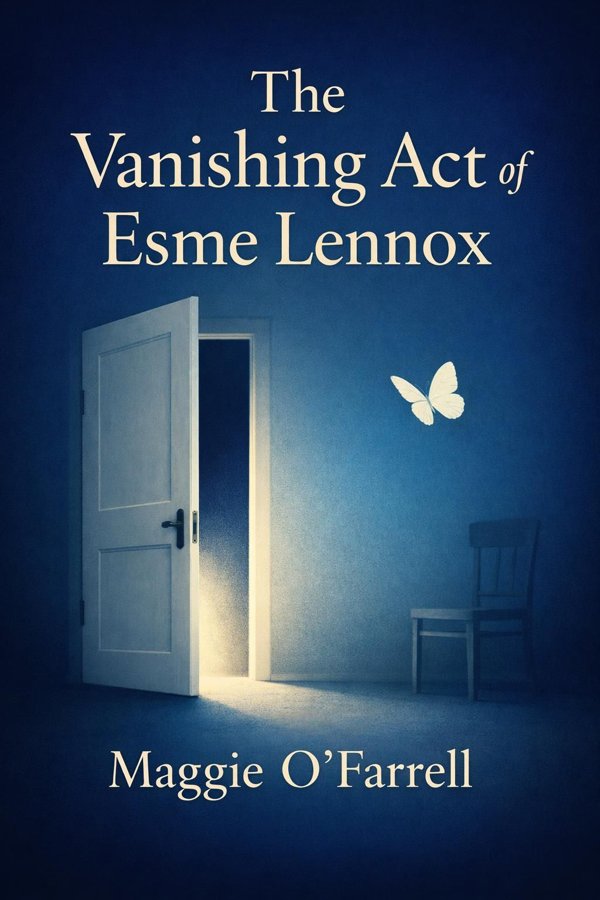
The Vanishing Act of Esme Lennox: Summary & Key Insights
 10 min5 chaptersAudio available
What Is The Vanishing Act of Esme Lennox About?
The Vanishing Act of Esme Lennox by Maggie O’Farrell is a bestsellers book spanning 5 pages. Set in Edinburgh, this novel tells the story of Esme Lennox, a woman who has spent decades in a psychiatric institution, and her great-niece Iris, who discovers her existence when the hospital closes. Through alternating perspectives and time shifts, the book explores family secrets, memory, and the treatment of women in mid-20th-century Britain.
This FizzRead summary covers all 5 key chapters of The Vanishing Act of Esme Lennox in approximately 10 minutes, distilling the most important ideas, arguments, and takeaways from Maggie O’Farrell's work. Also available as an audio summary and Key Quotes Podcast.
The Vanishing Act of Esme Lennox
Set in Edinburgh, this novel tells the story of Esme Lennox, a woman who has spent decades in a psychiatric institution, and her great-niece Iris, who discovers her existence when the hospital closes. Through alternating perspectives and time shifts, the book explores family secrets, memory, and the treatment of women in mid-20th-century Britain.
Who Should Read The Vanishing Act of Esme Lennox?
This book is perfect for anyone interested in bestsellers and looking to gain actionable insights in a short read. Whether you're a student, professional, or lifelong learner, the key ideas from The Vanishing Act of Esme Lennox by Maggie O’Farrell will help you think differently.
- ✓Readers who enjoy bestsellers and want practical takeaways
- ✓Professionals looking to apply new ideas to their work and life
- ✓Anyone who wants the core insights of The Vanishing Act of Esme Lennox in just 10 minutes
Want the full summary?
Get instant access to this book summary and 100K+ more with Fizz Moment.
Get Free SummaryAvailable on App Store • Free to download
Key Chapters
In Iris Lockhart, I wanted to create a woman of our time—young, self-assured, yet quietly fragmented. She moves through Edinburgh’s cobbled streets with a kind of restless grace, her vintage clothing store serving as both armor and metaphor. Each delicate dress, each muted color she restores, is a whisper from the past. Yet, while Iris may seem free from the constraints that bound her female ancestors, she is not untouched by them. Her affair with her married stepbrother underscores how easily one can mistake emotional entrapment for autonomy. Her independence, though enviable in modern terms, is threaded with uncertainty.
It is within this fragile equilibrium that the call interrupts: a psychiatric hospital is closing, and a patient named Esme Lennox must be placed in family care. Iris’s initial reaction is one of disbelief—she has never heard this name. How could someone from her own lineage have been forgotten so completely? When she confronts her mother and grandmother about Esme, she encounters only confusion and denial. The grandmother, Kitty, is lost in the fog of dementia; her memories tumble like fragments of broken glass, reflecting half-recognized faces and unspoken wrongs. The silence surrounding Esme is as heavy as the institutional walls that have kept her confined.
Iris’s journey begins not as an act of heroism but as a reluctant curiosity. Yet as she navigates the bureaucratic sterility of the hospital and finally meets the woman herself, she senses an unsettling recognition. Esme’s elegance and quiet intelligence disarm her. Something about the older woman—the precision of her speech, the sharp eyes that notice every detail—makes Iris realize she is not dealing with someone who has been mad but with someone who has been dismissed. Thus begins Iris’s slow awakening: the realization that her family’s refinement rests on buried guilt, and that the past she thought irrelevant is very much alive in her veins.
Through Esme’s recollections, the story retreats into the early twentieth century, to colonial India first, then to Scotland—a shift marked by color and texture, by the contrast between freedom and repression. As a child in India, Esme discovers her independence early, shaped by heat, open skies, and the scent of monsoon earth. Her sister Kitty, meticulously proper and obedient, is her opposite: the embodiment of all that is socially correct. Between them exists a love tinted with rivalry—two girls negotiating the narrowing path allotted to women. Esme is the one who questions, who dances barefoot at the wrong time, who refuses to curtsey, who will not be molded.
When the family relocates to Edinburgh, Esme’s defiance can no longer be excused as youthful eccentricity. Her refusal to pursue marriage, her disdain for suitors, her insistence on attending lectures and walking unchaperoned—all are acts of rebellion in a culture that defines womanhood through compliance. The more she challenges convention, the more her family interprets her behavior as sickness. Social decorum demands order, and Esme becomes the disorder to be corrected.
From my perspective as the storyteller, Esme’s fate illustrates a quieter kind of violence—the institutionalization of difference. It was not uncommon for women in mid-century Britain to be committed for less: for refusing a husband, for inconvenient passions, even for grief expressed too visibly. Esme’s errors are of vitality—she is too alive, too curious. For her, the hospital becomes both punishment and erasure. There, time stops. The girl who once questioned everything becomes the woman whose existence no one acknowledges.
Through Esme’s eyes, we see the thin line between social control and madness. The hospital, with its routines and silences, transforms her into a ghost while leaving her mind intact. Inside that imposed stillness, she preserves her identity like an ember, waiting for someone to open the door—all the while maintaining an ironic awareness of her own invisibility. Writing her voice was, for me, an act of resistance against that kind of historical extinguishing.
+ 3 more chapters — available in the FizzRead app
All Chapters in The Vanishing Act of Esme Lennox
About the Author
Maggie O’Farrell is a British novelist known for her lyrical prose and emotionally resonant storytelling. Born in Northern Ireland and raised in Wales and Scotland, she has written several acclaimed novels including 'Hamnet' and 'Instructions for a Heatwave'. Her works often explore family, loss, and the complexities of human relationships.
Get This Summary in Your Preferred Format
Read or listen to the The Vanishing Act of Esme Lennox summary by Maggie O’Farrell anytime, anywhere. FizzRead offers multiple formats so you can learn on your terms — all free.
Available formats: App · Audio · PDF · EPUB — All included free with FizzRead
Download The Vanishing Act of Esme Lennox PDF and EPUB Summary
Key Quotes from The Vanishing Act of Esme Lennox
“In Iris Lockhart, I wanted to create a woman of our time—young, self-assured, yet quietly fragmented.”
“As a child in India, Esme discovers her independence early, shaped by heat, open skies, and the scent of monsoon earth.”
Frequently Asked Questions about The Vanishing Act of Esme Lennox
The Vanishing Act of Esme Lennox by Maggie O’Farrell is a bestsellers book that explores key ideas across 5 chapters. Set in Edinburgh, this novel tells the story of Esme Lennox, a woman who has spent decades in a psychiatric institution, and her great-niece Iris, who discovers her existence when the hospital closes. Through alternating perspectives and time shifts, the book explores family secrets, memory, and the treatment of women in mid-20th-century Britain.
You Might Also Like

The Godfather
Mario Puzo
10 min
The Handmaid's Tale
Margaret Atwood
10 min
The Hunger Games
Suzanne Collins
10 min
The Nightingale
Kristin Hannah
10 min
The Seven Husbands of Evelyn Hugo
Taylor Jenkins Reid
10 min
Backwater Justice
Fern Michaels
10 minBrowse by Category
Ready to read The Vanishing Act of Esme Lennox?
Get the full summary and 100K+ more books with Fizz Moment.