
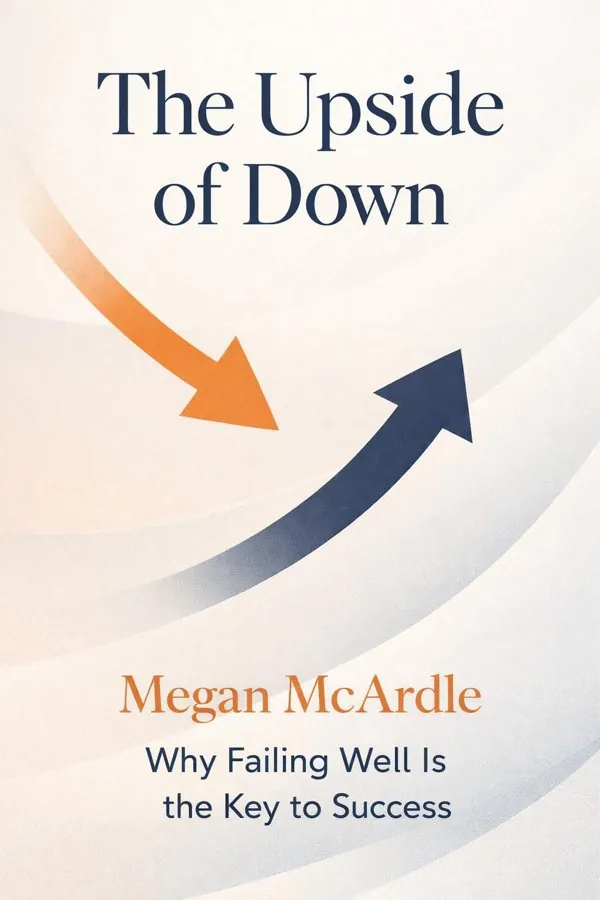
The Upside of Down: Why Failing Well Is the Key to Success: Summary & Key Insights
 10 min5 chaptersAudio available
What Is The Upside of Down: Why Failing Well Is the Key to Success About?
The Upside of Down: Why Failing Well Is the Key to Success by Megan McArdle is a economics book spanning 5 pages. In this book, journalist Megan McArdle explores how failure, rather than success, drives innovation, resilience, and personal growth. Drawing on research from psychology, economics, and business, she argues that learning to fail intelligently is essential for progress in both individual and societal contexts.
This FizzRead summary covers all 5 key chapters of The Upside of Down: Why Failing Well Is the Key to Success in approximately 10 minutes, distilling the most important ideas, arguments, and takeaways from Megan McArdle's work. Also available as an audio summary and Key Quotes Podcast.
The Upside of Down: Why Failing Well Is the Key to Success
In this book, journalist Megan McArdle explores how failure, rather than success, drives innovation, resilience, and personal growth. Drawing on research from psychology, economics, and business, she argues that learning to fail intelligently is essential for progress in both individual and societal contexts.
Who Should Read The Upside of Down: Why Failing Well Is the Key to Success?
This book is perfect for anyone interested in economics and looking to gain actionable insights in a short read. Whether you're a student, professional, or lifelong learner, the key ideas from The Upside of Down: Why Failing Well Is the Key to Success by Megan McArdle will help you think differently.
- ✓Readers who enjoy economics and want practical takeaways
- ✓Professionals looking to apply new ideas to their work and life
- ✓Anyone who wants the core insights of The Upside of Down: Why Failing Well Is the Key to Success in just 10 minutes
Want the full summary?
Get instant access to this book summary and 100K+ more with Fizz Moment.
Get Free SummaryAvailable on App Store • Free to download
Key Chapters
When we talk about failure, we often imagine it as an event—a single, traumatic moment when things go wrong. But failure is far more complex. It’s a process, a living feedback loop that tells us something essential about ourselves, our systems, and our assumptions. In both psychology and economics, failure appears as the most valuable signal we can receive, precisely because it disrupts what we think we know.
Psychologically, humans are hardwired to avoid failure. It triggers the same neural responses as physical pain. We recoil from it. That aversion, however, has a hidden cost—it prevents us from gaining the insights that only mistakes can teach. In behavioral economics, this is known as loss aversion: we fear losses more powerfully than we value equivalent gains. This fear leads individuals, organizations, and even entire societies to make risk-averse choices, protecting themselves from short-term embarrassment but sacrificing long-term learning.
The paradox is that progress itself requires failure. In markets, failed ventures free up resources for better ones. In science, disproven hypotheses push knowledge forward. In personal life, setbacks challenge our identity, forcing us to grow into our next version of ourselves. Failure isn’t an interruption in life’s journey—it *is* the journey.
What I wanted readers to realize here is that failure doesn’t mean you’re broken. It means you’re experimenting in a complex world. The question is not whether you will fail, but whether you will know how to use failure to your advantage. Because the truth is, every meaningful leap—whether in innovation or personal growth—rests on the ruins of something that didn’t work the first time.
Culturally, we glorify success stories but rarely tell the full truth behind them. We see the polished version—the launch day, the award, the triumphant headline—but not the long, messy process that led there. This selective storytelling fuels a dangerous myth: that success comes from talent, intelligence, or perfect planning. What it actually comes from are small, accumulated recoveries from repeated failures.
In America, especially, we weave success into our moral identity. Winners are virtuous; losers, somehow defective. Yet when I interviewed entrepreneurs, political leaders, and thinkers about their breakthroughs, none of them described a smooth climb. They described persistence in chaos. They described plans collapsing, funding disappearing, promises breaking. And then, through experimentation and humility, they discovered the next step.
The myth of success blinds us to the essential truth that trial and error isn’t a side road—it’s the main road. Thomas Edison didn’t fail thousands of times before inventing the light bulb; he succeeded thousands of times in discovering what didn’t work. This reframing changes everything. It allows us to see that success isn’t a static state but a dynamic process, and that fear of failure prevents more people from achieving their potential than failure itself ever does.
What matters most is not protecting our image of success but cultivating the capacity to rebuild. It’s the willingness to look foolish, to start again, to admit that our brilliant plan was wrong—and to keep going anyway. That courage, more than genius, is what defines real achievement.
+ 3 more chapters — available in the FizzRead app
All Chapters in The Upside of Down: Why Failing Well Is the Key to Success
About the Author
Megan McArdle is an American journalist and columnist known for her work on economics, business, and public policy. She has written for The Atlantic, Bloomberg View, and The Washington Post, and is recognized for her analytical approach to social and economic issues.
Get This Summary in Your Preferred Format
Read or listen to the The Upside of Down: Why Failing Well Is the Key to Success summary by Megan McArdle anytime, anywhere. FizzRead offers multiple formats so you can learn on your terms — all free.
Available formats: App · Audio · PDF · EPUB — All included free with FizzRead
Download The Upside of Down: Why Failing Well Is the Key to Success PDF and EPUB Summary
Key Quotes from The Upside of Down: Why Failing Well Is the Key to Success
“When we talk about failure, we often imagine it as an event—a single, traumatic moment when things go wrong.”
“Culturally, we glorify success stories but rarely tell the full truth behind them.”
Frequently Asked Questions about The Upside of Down: Why Failing Well Is the Key to Success
The Upside of Down: Why Failing Well Is the Key to Success by Megan McArdle is a economics book that explores key ideas across 5 chapters. In this book, journalist Megan McArdle explores how failure, rather than success, drives innovation, resilience, and personal growth. Drawing on research from psychology, economics, and business, she argues that learning to fail intelligently is essential for progress in both individual and societal contexts.
You Might Also Like

Business Adventures
John Brooks
10 min
Nudge
Richard H. Thaler, Cass R. Sunstein
10 min
The Hitchhiker"s Guide to the Galaxy
Douglas Adams
10 minThe Muqaddimah
Ibn Khaldun
10 minThe Outsiders
William N. Thorndike
10 min
A Little History of Economics
Niall Kishtainy
10 minBrowse by Category
Ready to read The Upside of Down: Why Failing Well Is the Key to Success?
Get the full summary and 100K+ more books with Fizz Moment.