
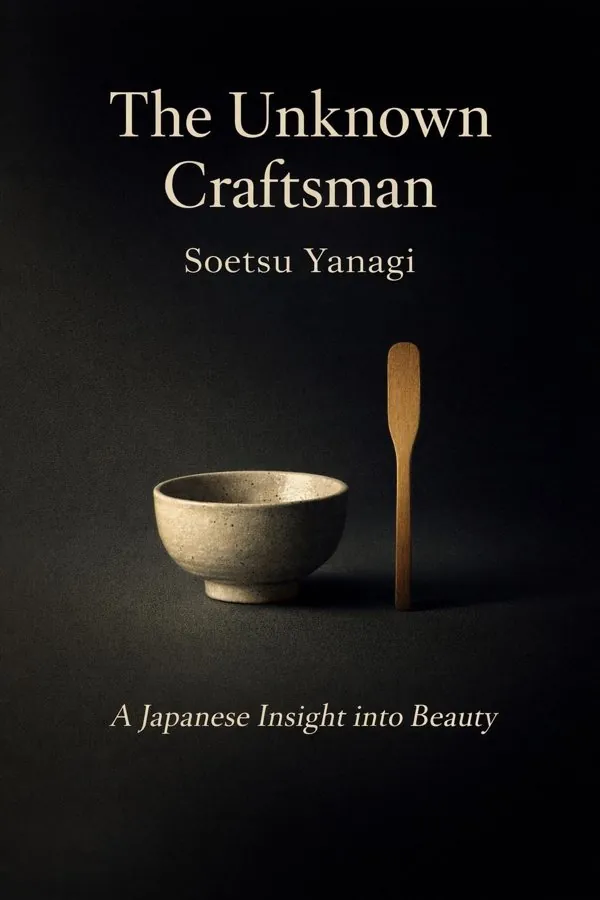
The Unknown Craftsman: A Japanese Insight into Beauty: Summary & Key Insights
 10 min4 chaptersAudio available
What Is The Unknown Craftsman: A Japanese Insight into Beauty About?
The Unknown Craftsman: A Japanese Insight into Beauty by Soetsu Yanagi is a design book spanning 4 pages. The Unknown Craftsman is a classic work on Japanese aesthetics and the philosophy of folk craft by Soetsu Yanagi, founder of the Mingei (folk craft) movement. The book explores the concept of 'the beauty of use' and celebrates the artistry of anonymous craftsmen whose work embodies simplicity, functionality, and spiritual depth. Through essays and reflections, Yanagi articulates a vision of beauty rooted in everyday life and the harmony between art and utility.
This FizzRead summary covers all 4 key chapters of The Unknown Craftsman: A Japanese Insight into Beauty in approximately 10 minutes, distilling the most important ideas, arguments, and takeaways from Soetsu Yanagi's work. Also available as an audio summary and Key Quotes Podcast.
The Unknown Craftsman: A Japanese Insight into Beauty
The Unknown Craftsman is a classic work on Japanese aesthetics and the philosophy of folk craft by Soetsu Yanagi, founder of the Mingei (folk craft) movement. The book explores the concept of 'the beauty of use' and celebrates the artistry of anonymous craftsmen whose work embodies simplicity, functionality, and spiritual depth. Through essays and reflections, Yanagi articulates a vision of beauty rooted in everyday life and the harmony between art and utility.
Who Should Read The Unknown Craftsman: A Japanese Insight into Beauty?
This book is perfect for anyone interested in design and looking to gain actionable insights in a short read. Whether you're a student, professional, or lifelong learner, the key ideas from The Unknown Craftsman: A Japanese Insight into Beauty by Soetsu Yanagi will help you think differently.
- ✓Readers who enjoy design and want practical takeaways
- ✓Professionals looking to apply new ideas to their work and life
- ✓Anyone who wants the core insights of The Unknown Craftsman: A Japanese Insight into Beauty in just 10 minutes
Want the full summary?
Get instant access to this book summary and 100K+ more with Fizz Moment.
Get Free SummaryAvailable on App Store • Free to download
Key Chapters
The Mingei movement was born from Japan’s encounter with modernity and my conviction that ordinary craftsmanship contained unseen spiritual depth. In the early 1920s, I traveled widely, encountering village artisans whose work revealed a truth: beauty thrives where self-interest fades. Their creations were made with deep attention yet without ego. I called this aesthetic Mingei—the art of the common people. It was not a theory I imposed; it was a recognition of what already lived in the people’s hands.
You must understand the social context. Japan’s swift modernization after Meiji brought machines, factories, and the logic of efficiency. While development had its merits, it also stifled the quiet intelligence of manual work. Machine-made goods lacked soul; they were too perfect, too detached from feeling. The craftsman’s rhythm—his breathing through the work—was missing. I realized that saving folk crafts was not mere nostalgia; it was a way of defending the human spirit itself.
The philosophy of Mingei lives in three words: simplicity, sincerity, and naturalness. Simplicity means a freedom from excess or hollow decoration; sincerity arises when the maker works honestly, unclouded by ambition; naturalness appears when form and function merge without strain. Together, these qualities mark true beauty. A humble clay bowl that fits well in the hand can be more beautiful than an ornate vase that demands attention. Simplicity serves life; vanity serves only the eye.
Mingei reminds us that collective wisdom is deeper than personal genius. The crafts of a region evolve through countless hands over centuries; each generation adds what is good and discards what is flawed. In this slow process, form matures into inevitability—it becomes right because it has been tested by living. That is why folk crafts, though anonymous, often approach perfection: they are embodiments of accumulated human experience made visible in matter.
The figure of the ‘unknown craftsman’ is central to understanding the meaning of Mingei. He is a person who makes without thought of self-expression, yet achieves a purity that even celebrated artists sometimes fail to reach. His anonymity is not a deficiency; it is his strength. By being detached from the marketplace and self-promotion, he can focus entirely on the work and its purpose—usefulness. That usefulness is where beauty arises most naturally.
The beauty of use means that the object’s form reveals itself perfectly through its function. A teacup should feel natural in your hand, the lip smooth against your mouth, its proportion neither too heavy nor too fragile. Such rightness is not merely technical; it reflects the maker’s feeling for life. When use determines beauty rather than fashion, the object gains harmony. You can feel that harmony even before thinking about it—it speaks directly to the heart.
The unknown craftsman works in the spirit of service. Crafting is not a way for him to assert individuality but to participate in a larger wholeness. His hands move with discipline and humility, guided by tradition rather than invention for its own sake. Yet paradoxically, this selflessness produces originality, because true freshness is born from sincerity. Just as a tree grows uniquely according to its environment, so does each handmade object manifest natural variation and character.
This philosophy resolves an enduring question: is art for art’s sake superior to art for use? I say they are not opposites. The most profound beauty is realized through usefulness—it lives through interaction with the user. An unused bowl, no matter how exquisite, is incomplete. Beauty must be touched, felt, and lived with. The unknown craftsman therefore creates not for contemplation alone, but for exchange between maker and user, mediated by the object itself.
+ 2 more chapters — available in the FizzRead app
All Chapters in The Unknown Craftsman: A Japanese Insight into Beauty
About the Author
Soetsu Yanagi (1889–1961) was a Japanese philosopher and art critic who founded the Mingei movement, which celebrated the beauty of ordinary, handcrafted objects. Educated at Tokyo Imperial University, Yanagi was deeply influenced by both Western philosophy and Japanese tradition. His writings on aesthetics and craftsmanship have had a lasting impact on design, art, and cultural studies worldwide.
Get This Summary in Your Preferred Format
Read or listen to the The Unknown Craftsman: A Japanese Insight into Beauty summary by Soetsu Yanagi anytime, anywhere. FizzRead offers multiple formats so you can learn on your terms — all free.
Available formats: App · Audio · PDF · EPUB — All included free with FizzRead
Download The Unknown Craftsman: A Japanese Insight into Beauty PDF and EPUB Summary
Key Quotes from The Unknown Craftsman: A Japanese Insight into Beauty
“The Mingei movement was born from Japan’s encounter with modernity and my conviction that ordinary craftsmanship contained unseen spiritual depth.”
“The figure of the ‘unknown craftsman’ is central to understanding the meaning of Mingei.”
Frequently Asked Questions about The Unknown Craftsman: A Japanese Insight into Beauty
The Unknown Craftsman: A Japanese Insight into Beauty by Soetsu Yanagi is a design book that explores key ideas across 4 chapters. The Unknown Craftsman is a classic work on Japanese aesthetics and the philosophy of folk craft by Soetsu Yanagi, founder of the Mingei (folk craft) movement. The book explores the concept of 'the beauty of use' and celebrates the artistry of anonymous craftsmen whose work embodies simplicity, functionality, and spiritual depth. Through essays and reflections, Yanagi articulates a vision of beauty rooted in everyday life and the harmony between art and utility.
More by Soetsu Yanagi
You Might Also Like
The Design of Everyday Things
Don Norman
10 min
The Better Angels of Our Nature
Steven Pinker
10 min
A Designer's Art
Paul Rand
10 min
Architects' Sketchbooks
Various Editors
10 min
Architectural Graphic Standards
The American Institute of Architects
10 min
Design Is Storytelling
Ellen Lupton
10 minBrowse by Category
Ready to read The Unknown Craftsman: A Japanese Insight into Beauty?
Get the full summary and 100K+ more books with Fizz Moment.