
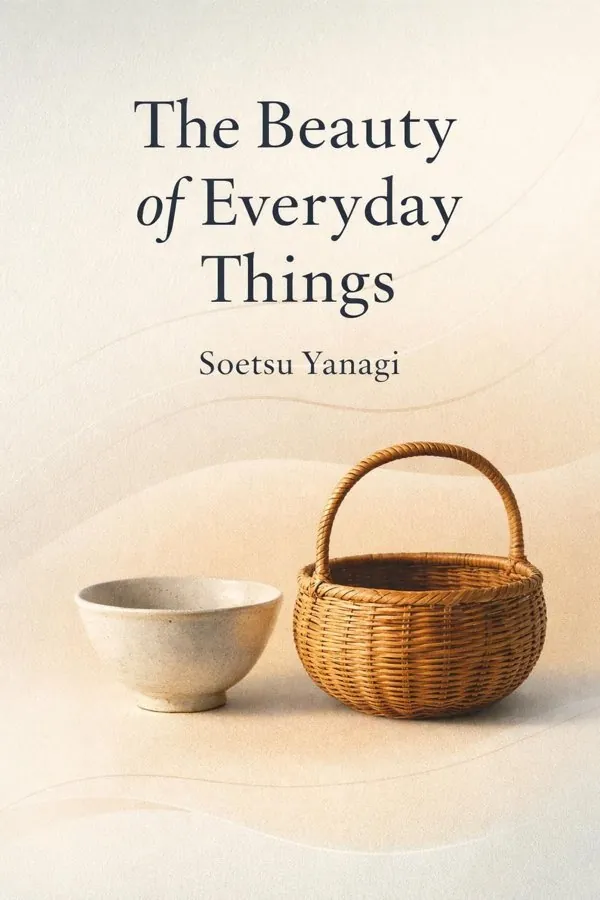
The Beauty of Everyday Things: Summary & Key Insights
 10 min6 chaptersAudio available
What Is The Beauty of Everyday Things About?
The Beauty of Everyday Things by Soetsu Yanagi is a design book spanning 6 pages. The Beauty of Everyday Things is a collection of essays by Soetsu Yanagi, founder of the Japanese Mingei (folk craft) movement. In this work, Yanagi explores the essence of beauty found in ordinary, handcrafted objects made by anonymous artisans. He argues that true beauty lies in simplicity, functionality, and sincerity, emphasizing the harmony between utility and aesthetics. The book has influenced modern design philosophy and continues to inspire appreciation for traditional craftsmanship.
This FizzRead summary covers all 6 key chapters of The Beauty of Everyday Things in approximately 10 minutes, distilling the most important ideas, arguments, and takeaways from Soetsu Yanagi's work. Also available as an audio summary and Key Quotes Podcast.
The Beauty of Everyday Things
The Beauty of Everyday Things is a collection of essays by Soetsu Yanagi, founder of the Japanese Mingei (folk craft) movement. In this work, Yanagi explores the essence of beauty found in ordinary, handcrafted objects made by anonymous artisans. He argues that true beauty lies in simplicity, functionality, and sincerity, emphasizing the harmony between utility and aesthetics. The book has influenced modern design philosophy and continues to inspire appreciation for traditional craftsmanship.
Who Should Read The Beauty of Everyday Things?
This book is perfect for anyone interested in design and looking to gain actionable insights in a short read. Whether you're a student, professional, or lifelong learner, the key ideas from The Beauty of Everyday Things by Soetsu Yanagi will help you think differently.
- ✓Readers who enjoy design and want practical takeaways
- ✓Professionals looking to apply new ideas to their work and life
- ✓Anyone who wants the core insights of The Beauty of Everyday Things in just 10 minutes
Want the full summary?
Get instant access to this book summary and 100K+ more with Fizz Moment.
Get Free SummaryAvailable on App Store • Free to download
Key Chapters
The philosophy of Mingei arises from compassion for the ordinary and gratitude toward anonymous makers. When I first encountered Korean and Japanese folk crafts, I felt an almost spiritual shock. These were not finely signed works of art but simple vessels and textiles made for daily use. Yet their beauty was profound. It dawned on me that the true path to beauty lies not in personal genius but in the collective wisdom of life itself.
A true Mingei object is never proud of itself. It possesses no design conceived to attract attention. Instead, its beauty unfolds naturally through use and utility. The maker does not seek praise but simply fulfills a need: to provide others with useful things made sincerely. That lack of self-assertion is the secret of their grace. Objects thus created become pure mirrors of the spirit—the spirit of labor, humility, and community.
Beauty, as I came to understand, is not in ornament or excess. It resides in things that are plain yet thoroughly alive. The folk crafts of Japan—baskets, pottery, textiles—embody the harmony between necessity and aesthetic truth. They teach that the humble path can reveal the most profound elegance. Once the eye learns to see this, it is freed from the tyranny of novelty and pretension.
Mingei asks us to awaken to what is right before us: the handwoven towel, the everyday cup, the simple grain of wood polished by time. These are not lesser beauties for their simplicity; they are the essence of it.
When we speak of simplicity, we do not mean austerity or lack of imagination. Simplicity is a kind of perfection—the state where nothing superfluous remains and everything serves its purpose. The shape of a teacup or the curve of a spoon achieves beauty precisely because it obeys the natural demands of use.
This unity of function and beauty is the heart of Mingei. The potter does not design with intellectual calculation. His hands move according to necessity and experience. Through this process, a form emerges that is right—neither too ornate nor too crude, but balanced, alive, and harmonious. Such object speaks not through decoration but through sincerity.
The craftsman creates what people will use every day, and so his first concern is comfort, durability, and tactile honesty. The more truly functional an object is, the more profound its beauty becomes. The smoothness of a well-handled bowl or the faded warmth of indigo cloth—these testify to the union of beauty and use. They remind us that beauty should serve life, not merely embellish it.
In our modern world, where complexity and excess often masquerade as sophistication, we have lost sight of this truth. Simplicity calls us back to the essence of things. It teaches that beauty is an act of moral clarity: doing what is necessary, and doing it well.
+ 4 more chapters — available in the FizzRead app
All Chapters in The Beauty of Everyday Things
About the Author
Soetsu Yanagi (1889–1961) was a Japanese philosopher, aesthetician, and founder of the Mingei movement, which celebrated the beauty of everyday crafts made by unknown artisans. A graduate of Tokyo Imperial University, Yanagi established the Japan Folk Crafts Museum in 1936 and played a key role in redefining Japanese aesthetics through his writings and advocacy for folk art.
Get This Summary in Your Preferred Format
Read or listen to the The Beauty of Everyday Things summary by Soetsu Yanagi anytime, anywhere. FizzRead offers multiple formats so you can learn on your terms — all free.
Available formats: App · Audio · PDF · EPUB — All included free with FizzRead
Download The Beauty of Everyday Things PDF and EPUB Summary
Key Quotes from The Beauty of Everyday Things
“The philosophy of Mingei arises from compassion for the ordinary and gratitude toward anonymous makers.”
“When we speak of simplicity, we do not mean austerity or lack of imagination.”
Frequently Asked Questions about The Beauty of Everyday Things
The Beauty of Everyday Things by Soetsu Yanagi is a design book that explores key ideas across 6 chapters. The Beauty of Everyday Things is a collection of essays by Soetsu Yanagi, founder of the Japanese Mingei (folk craft) movement. In this work, Yanagi explores the essence of beauty found in ordinary, handcrafted objects made by anonymous artisans. He argues that true beauty lies in simplicity, functionality, and sincerity, emphasizing the harmony between utility and aesthetics. The book has influenced modern design philosophy and continues to inspire appreciation for traditional craftsmanship.
More by Soetsu Yanagi
You Might Also Like
The Design of Everyday Things
Don Norman
10 min
The Better Angels of Our Nature
Steven Pinker
10 min
A Designer's Art
Paul Rand
10 min
Architects' Sketchbooks
Various Editors
10 min
Architectural Graphic Standards
The American Institute of Architects
10 min
Design Is Storytelling
Ellen Lupton
10 minBrowse by Category
Ready to read The Beauty of Everyday Things?
Get the full summary and 100K+ more books with Fizz Moment.