
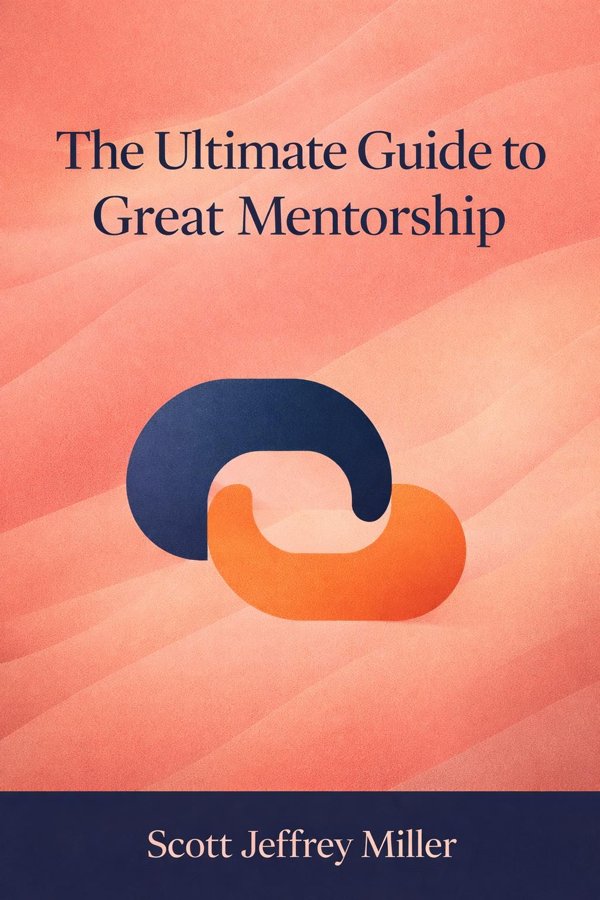
The Ultimate Guide to Great Mentorship: Summary & Key Insights
 10 min1 chaptersAudio available
What Is The Ultimate Guide to Great Mentorship About?
The Ultimate Guide to Great Mentorship by Scott Jeffrey Miller is a leadership book spanning 1 pages. The Ultimate Guide to Great Mentorship by Scott Jeffrey Miller provides a comprehensive framework for effective mentorship. It outlines thirteen distinct roles that mentors play, offering practical guidance on setting expectations, tracking progress, and fostering meaningful mentor-mentee relationships. The book draws on insights from top leaders and emphasizes how great mentorship leads to thriving, engaged employees and personal growth for both mentor and mentee.
This FizzRead summary covers all 1 key chapters of The Ultimate Guide to Great Mentorship in approximately 10 minutes, distilling the most important ideas, arguments, and takeaways from Scott Jeffrey Miller's work. Also available as an audio summary and Key Quotes Podcast.
The Ultimate Guide to Great Mentorship
The Ultimate Guide to Great Mentorship by Scott Jeffrey Miller provides a comprehensive framework for effective mentorship. It outlines thirteen distinct roles that mentors play, offering practical guidance on setting expectations, tracking progress, and fostering meaningful mentor-mentee relationships. The book draws on insights from top leaders and emphasizes how great mentorship leads to thriving, engaged employees and personal growth for both mentor and mentee.
Who Should Read The Ultimate Guide to Great Mentorship?
This book is perfect for anyone interested in leadership and looking to gain actionable insights in a short read. Whether you're a student, professional, or lifelong learner, the key ideas from The Ultimate Guide to Great Mentorship by Scott Jeffrey Miller will help you think differently.
- ✓Readers who enjoy leadership and want practical takeaways
- ✓Professionals looking to apply new ideas to their work and life
- ✓Anyone who wants the core insights of The Ultimate Guide to Great Mentorship in just 10 minutes
Want the full summary?
Get instant access to this book summary and 100K+ more with Fizz Moment.
Get Free SummaryAvailable on App Store • Free to download
Key Chapters
As a mentor, your influence doesn’t come from authority; it springs from versatility. Every great mentoring relationship evolves through multiple modes of engagement, and these modes are reflected in the thirteen roles I describe. Each role carries a unique purpose and asks you to step into a different kind of energy.
The journey begins with the Activator. This role is about helping mentees unlock clarity. You guide them to define what success looks like, not in abstract terms, but in tangible, achievable goals. You ask the tough questions that stir reflection — 'What drives you?' 'What do you truly want to create?' In this stage, your mentee often feels stuck or uncertain, and your role is to ignite momentum. I’ve seen Activator moments transform careers, because clarity multiplies confidence.
Once activated, growth requires tension — and that brings us to the Challenger. This is one of the hardest roles for mentors, because it demands courage and empathy in equal measure. To be a Challenger means you hold up a mirror, encouraging your mentee to see where comfort is limiting progress. You push, not with criticism, but with compassion. You invite your mentee to stretch beyond what’s safe and discover resilience that only emerges through discomfort. Great Challengers don’t demand perfection; they model persistence.
Another pivotal role is the Connector. Mentorship doesn’t exist in a vacuum — every career journey depends on access to relationships and networks. As a Connector, you use your social capital to help unlock new doors. You introduce mentees to peers, leaders, and communities where they can both contribute and learn. You teach them the art of building authentic connections. When a mentor functions as a Connector, opportunity suddenly feels possible.
Closely related is the Coach role. Coaches provide direction, accountability, and feedback. But in mentorship, coaching is far more about listening than talking. It’s about helping mentees set measurable goals and recognize patterns in their decision-making. The Coach holds space for reflection, ensuring that mentees translate lessons into action. You don’t shape them by telling; you help them shape themselves by exploring.
Trust is the foundation of every mentorship, and this brings us to the Confidant role. In this mode, you create psychological safety — that sacred space where vulnerability is not punished but valued. When mentees can share fears and doubts openly, transformation begins. Being a Confidant doesn’t mean being a therapist; it means being a reliable presence. I often remind mentors that silence, empathy, and non-judgment are their most powerful tools.
Equally transformative is the Sponsor role. It’s one thing to advise someone; it’s quite another to advocate for their advancement. The Sponsor uses their influence to champion the mentee in rooms where they themselves may not yet have access. It might involve recommending them for opportunities, endorsing their skills, or amplifying their achievements. Sponsorship builds credibility, helping mentees step into their next level of visibility.
Next comes the Teacher. Every mentor carries valuable lessons drawn from their own successes and failures. In my career, I’ve found that sharing stories is the most enduring form of teaching. When you narrate what worked and what didn’t — honestly and humbly — you offer practical wisdom, not perfection. Teaching in mentorship isn’t lecturing; it’s illuminating through experience.
Then there’s the Validator — a role often overlooked but essential. People thrive when their efforts are recognized. As a Validator, you affirm progress and remind mentees that growth is rarely linear. You notice small wins, verbalize their significance, and help mentees see how far they’ve come. Validation renews motivation.
And throughout all these roles, the mentor must skillfully balance structure and flexibility. It’s your responsibility to set expectations early — clarify the purpose of the relationship, time commitments, and boundaries. A well-defined framework prevents misalignment and builds trust. Mentorship succeeds on mutual respect, not assumption.
Effectiveness also depends on tracking progress. I encourage mentors to revisit goals periodically, celebrate milestones, and evaluate how the relationship is evolving. This self-awareness keeps the mentorship alive and purposeful rather than routine.
What gives this framework life are the leaders who exemplify it daily — individuals who recognize that mentorship is not a transaction but a legacy. Across organizations, I’ve seen these roles create thriving cultures. Employees become more engaged, turnover decreases, and innovation rises. The ripple effect is undeniable.
So when you think about mentorship, don’t restrict yourself to one dimension. You are, at different times, an Activator, a Challenger, a Connector, a Coach, a Confidant, a Sponsor, a Teacher, and a Validator. Each role requires awareness and intention. Collectively, they transform mentorship from guidance into growth, from conversation into catalyst.
All Chapters in The Ultimate Guide to Great Mentorship
About the Author
Scott Jeffrey Miller is a leadership expert, speaker, and author known for his work on mentorship and personal development. He has served as a senior advisor and executive at FranklinCovey and has written several books on leadership and career growth.
Get This Summary in Your Preferred Format
Read or listen to the The Ultimate Guide to Great Mentorship summary by Scott Jeffrey Miller anytime, anywhere. FizzRead offers multiple formats so you can learn on your terms — all free.
Available formats: App · Audio · PDF · EPUB — All included free with FizzRead
Download The Ultimate Guide to Great Mentorship PDF and EPUB Summary
Key Quotes from The Ultimate Guide to Great Mentorship
“As a mentor, your influence doesn’t come from authority; it springs from versatility.”
Frequently Asked Questions about The Ultimate Guide to Great Mentorship
The Ultimate Guide to Great Mentorship by Scott Jeffrey Miller is a leadership book that explores key ideas across 1 chapters. The Ultimate Guide to Great Mentorship by Scott Jeffrey Miller provides a comprehensive framework for effective mentorship. It outlines thirteen distinct roles that mentors play, offering practical guidance on setting expectations, tracking progress, and fostering meaningful mentor-mentee relationships. The book draws on insights from top leaders and emphasizes how great mentorship leads to thriving, engaged employees and personal growth for both mentor and mentee.
More by Scott Jeffrey Miller
You Might Also Like

Extreme Ownership
Jocko Willink
10 min
Dare to Lead
Brene Brown
10 min
Leaders Eat Last
Simon Sinek
10 min
The 21 Irrefutable Laws of Leadership
John Maxwell
10 min
Start With Why
Simon Sinek
10 min
How to Lead When You're Not in Charge
Clay Scroggins
10 minBrowse by Category
Ready to read The Ultimate Guide to Great Mentorship?
Get the full summary and 100K+ more books with Fizz Moment.