
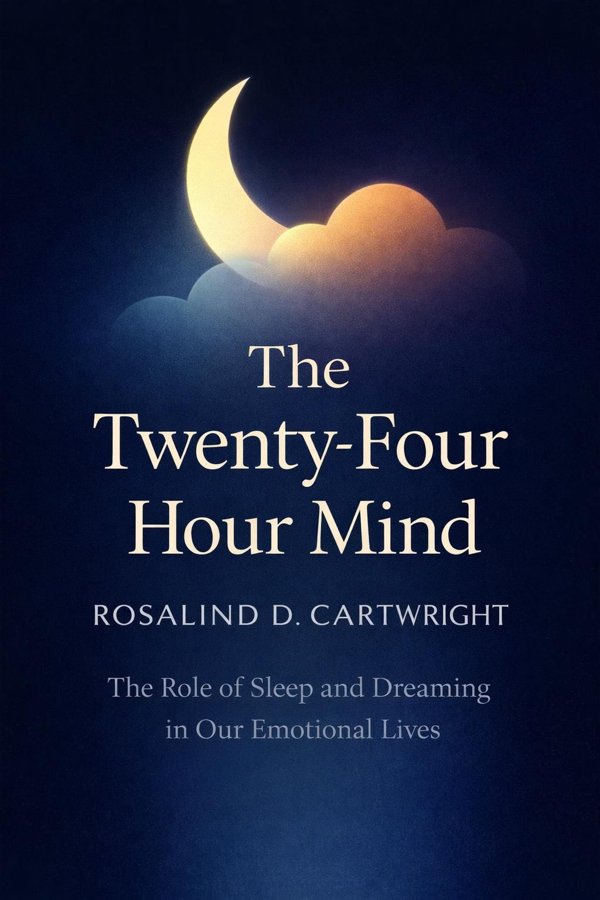
The Twenty-Four Hour Mind: The Role of Sleep and Dreaming in Our Emotional Lives: Summary & Key Insights
 10 min8 chapters
What Is The Twenty-Four Hour Mind: The Role of Sleep and Dreaming in Our Emotional Lives About?
The Twenty-Four Hour Mind: The Role of Sleep and Dreaming in Our Emotional Lives by Rosalind D. Cartwright is a neuroscience book spanning 8 pages. In this groundbreaking work, sleep researcher Rosalind D. Cartwright explores how sleep and dreaming contribute to emotional regulation and mental health. Drawing on decades of clinical and laboratory research, she explains how the sleeping brain processes emotional experiences, consolidates memories, and helps maintain psychological balance. The book offers insights into the science of sleep disorders, the role of dreams in coping with stress, and the therapeutic potential of understanding our nightly mental activity.
This FizzRead summary covers all 8 key chapters of The Twenty-Four Hour Mind: The Role of Sleep and Dreaming in Our Emotional Lives in approximately 10 minutes, distilling the most important ideas, arguments, and takeaways from Rosalind D. Cartwright's work.
The Twenty-Four Hour Mind: The Role of Sleep and Dreaming in Our Emotional Lives
In this groundbreaking work, sleep researcher Rosalind D. Cartwright explores how sleep and dreaming contribute to emotional regulation and mental health. Drawing on decades of clinical and laboratory research, she explains how the sleeping brain processes emotional experiences, consolidates memories, and helps maintain psychological balance. The book offers insights into the science of sleep disorders, the role of dreams in coping with stress, and the therapeutic potential of understanding our nightly mental activity.
Who Should Read The Twenty-Four Hour Mind: The Role of Sleep and Dreaming in Our Emotional Lives?
This book is perfect for anyone interested in neuroscience and looking to gain actionable insights in a short read. Whether you're a student, professional, or lifelong learner, the key ideas from The Twenty-Four Hour Mind: The Role of Sleep and Dreaming in Our Emotional Lives by Rosalind D. Cartwright will help you think differently.
- ✓Readers who enjoy neuroscience and want practical takeaways
- ✓Professionals looking to apply new ideas to their work and life
- ✓Anyone who wants the core insights of The Twenty-Four Hour Mind: The Role of Sleep and Dreaming in Our Emotional Lives in just 10 minutes
Want the full summary?
Get instant access to this book summary and 100K+ more with Fizz Moment.
Get Free SummaryAvailable on App Store • Free to download
Key Chapters
To appreciate how the sleeping mind works, you must first understand its complex structure. Sleep is composed of repeating cycles lasting about ninety minutes, each containing stages of non-REM and REM sleep. Non-REM sleep, especially its deeper stages, restores the body and organizes basic memory processes. REM—the stage most closely linked to dreaming—is where the emotional work takes place. During REM, the brain is almost as active as it is when awake, but the body remains largely paralyzed. The limbic system, the emotional core, flares with activity while the prefrontal cortex—our logical overseer—quiets down. This physiological choreography lets us reprocess feelings that waking logic might otherwise suppress.
I’ve monitored EEG traces that reveal these changes as patients sleep. The electrical patterns tell stories: bursts of theta rhythms marking the integration of memories, rapid-eye movements reflecting internal drama. Yet these aren’t random surges. They’re orchestrated acts of the mind in service of adaptation. In understanding sleep architecture, we uncover an elegant system that balances emotional reactivity with recovery. Night after night, these cycles recalibrate our moods, sort through social tensions, and make us emotionally ready for life again.
Human emotion is dynamic, and sleep is its silent therapist. In REM sleep, the brain revisits emotional events from the day, often in disguised or condensed form. Using dream reports gathered during controlled awakenings, I’ve seen a clear pattern: people process emotionally charged experiences during REM, especially in the nights immediately following significant stress. Over several nights, those emotions lose their sharp edge. The dream versions retain meaning but not the same pain. It is as if the mind has metabolized the experience into wisdom.
Neuroimaging supports this. The amygdala, our alarm center, stays active while chemicals like norepinephrine, which promote stress in waking life, drop to nearly zero. This biochemistry creates a safe emotional environment—one where distressing material can be revisited without the physiological storm of anxiety. The sleeping mind performs emotional exposure therapy faithfully and naturally.
When sleep is disrupted, this nightly repair falters. In depression, for instance, REM sleep often comes earlier, faster, and more intensively—suggesting that the brain is trying, but failing, to resolve emotion. Patients who recover from depression typically show normalized REM patterns. The implication is powerful: managing emotions is not just a matter of waking insight but also of nightly neural hygiene. By caring for our sleep, we care for our feelings.
+ 6 more chapters — available in the FizzRead app
All Chapters in The Twenty-Four Hour Mind: The Role of Sleep and Dreaming in Our Emotional Lives
About the Author
Rosalind D. Cartwright (1922–2021) was an American psychologist and sleep researcher known as a pioneer in the field of sleep science. She founded one of the first sleep disorder centers in the United States and conducted influential studies on the relationship between dreaming and emotional adaptation. Her work significantly advanced understanding of sleep’s role in mental health.
Get This Summary in Your Preferred Format
Read or listen to the The Twenty-Four Hour Mind: The Role of Sleep and Dreaming in Our Emotional Lives summary by Rosalind D. Cartwright anytime, anywhere. FizzRead offers multiple formats so you can learn on your terms — all free.
Available formats: App · Audio · PDF · EPUB — All included free with FizzRead
Download The Twenty-Four Hour Mind: The Role of Sleep and Dreaming in Our Emotional Lives PDF and EPUB Summary
Key Quotes from The Twenty-Four Hour Mind: The Role of Sleep and Dreaming in Our Emotional Lives
“To appreciate how the sleeping mind works, you must first understand its complex structure.”
“Human emotion is dynamic, and sleep is its silent therapist.”
Frequently Asked Questions about The Twenty-Four Hour Mind: The Role of Sleep and Dreaming in Our Emotional Lives
The Twenty-Four Hour Mind: The Role of Sleep and Dreaming in Our Emotional Lives by Rosalind D. Cartwright is a neuroscience book that explores key ideas across 8 chapters. In this groundbreaking work, sleep researcher Rosalind D. Cartwright explores how sleep and dreaming contribute to emotional regulation and mental health. Drawing on decades of clinical and laboratory research, she explains how the sleeping brain processes emotional experiences, consolidates memories, and helps maintain psychological balance. The book offers insights into the science of sleep disorders, the role of dreams in coping with stress, and the therapeutic potential of understanding our nightly mental activity.
You Might Also Like
Anxious
Joseph LeDoux
10 min
Hallucinations
Oliver Sacks
10 min
The Biological Mind: How Brain, Body, and Environment Collaborate to Make Us Who We Are
Alan Jasanoff
10 min
The Feeling of Life Itself: Why Consciousness Is Widespread but Can't Be Computed
Christof Koch
10 min
The No-Nonsense Meditation Book
Steven Laureys
10 min
A General Theory of Love
Thomas Lewis, Fari Amini, Richard Lannon
10 minBrowse by Category
Ready to read The Twenty-Four Hour Mind: The Role of Sleep and Dreaming in Our Emotional Lives?
Get the full summary and 100K+ more books with Fizz Moment.