
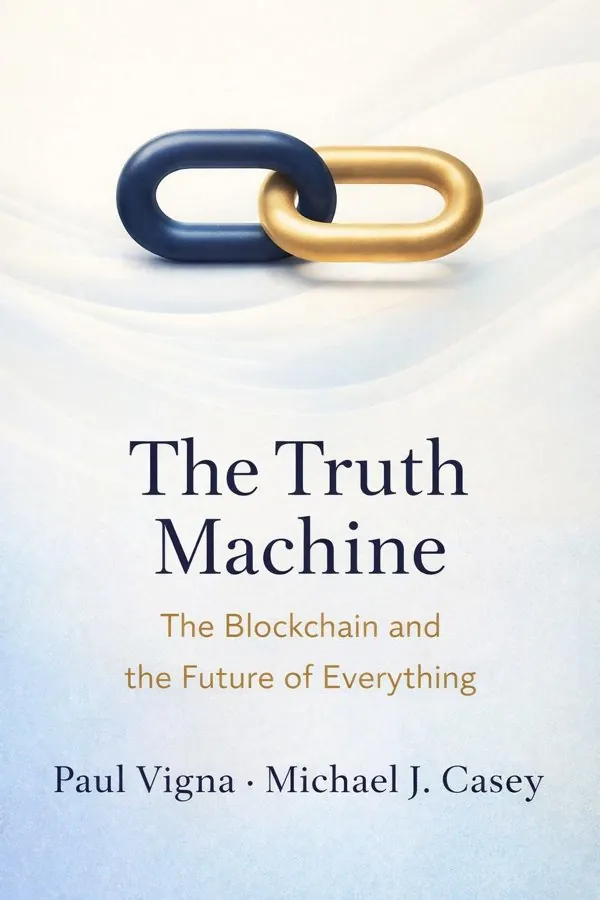
The Truth Machine: The Blockchain and the Future of Everything: Summary & Key Insights
by Paul Vigna, Michael J. Casey
 10 min9 chaptersAudio available
Key Takeaways from The Truth Machine: The Blockchain and the Future of Everything
Every economy runs on trust long before it runs on money.
Bitcoin’s deepest innovation was not digital money alone, but the demonstration that strangers can agree on ownership without a central bookkeeper.
A blockchain is best understood as a machine for synchronized agreement.
When technology removes intermediaries, it does more than save fees; it redistributes power.
The most exciting uses of blockchain may have little to do with currency.
What Is The Truth Machine: The Blockchain and the Future of Everything About?
The Truth Machine: The Blockchain and the Future of Everything by Paul Vigna, Michael J. Casey is a finance book spanning 13 pages. What if the most important innovation of the digital age is not a new app, platform, or currency, but a new way to create trust? In The Truth Machine, financial journalists Paul Vigna and Michael J. Casey argue that blockchain technology matters because it can reduce society’s dependence on central authorities and make economic coordination more open, verifiable, and inclusive. Rather than treating Bitcoin as a speculative curiosity, they frame it as the first working example of a deeper breakthrough: a distributed system for recording truth without relying on a single gatekeeper. The book traces the rise of blockchain from the invention of Bitcoin to its potential impact on banking, government, identity, contracts, and global development. Vigna and Casey show how blockchains may reshape institutions that currently control money, information, and access, while also confronting the technology’s limitations, risks, and political consequences. Their authority comes from years covering financial markets, digital currencies, and the emerging crypto economy. With reporting experience from The Wall Street Journal and deep engagement with the world of digital currency research, they offer a balanced, informed guide to one of the most consequential technologies of our time.
This FizzRead summary covers all 9 key chapters of The Truth Machine: The Blockchain and the Future of Everything in approximately 10 minutes, distilling the most important ideas, arguments, and takeaways from Paul Vigna, Michael J. Casey's work. Also available as an audio summary and Key Quotes Podcast.
The Truth Machine: The Blockchain and the Future of Everything
What if the most important innovation of the digital age is not a new app, platform, or currency, but a new way to create trust? In The Truth Machine, financial journalists Paul Vigna and Michael J. Casey argue that blockchain technology matters because it can reduce society’s dependence on central authorities and make economic coordination more open, verifiable, and inclusive. Rather than treating Bitcoin as a speculative curiosity, they frame it as the first working example of a deeper breakthrough: a distributed system for recording truth without relying on a single gatekeeper.
The book traces the rise of blockchain from the invention of Bitcoin to its potential impact on banking, government, identity, contracts, and global development. Vigna and Casey show how blockchains may reshape institutions that currently control money, information, and access, while also confronting the technology’s limitations, risks, and political consequences.
Their authority comes from years covering financial markets, digital currencies, and the emerging crypto economy. With reporting experience from The Wall Street Journal and deep engagement with the world of digital currency research, they offer a balanced, informed guide to one of the most consequential technologies of our time.
Who Should Read The Truth Machine: The Blockchain and the Future of Everything?
This book is perfect for anyone interested in finance and looking to gain actionable insights in a short read. Whether you're a student, professional, or lifelong learner, the key ideas from The Truth Machine: The Blockchain and the Future of Everything by Paul Vigna, Michael J. Casey will help you think differently.
- ✓Readers who enjoy finance and want practical takeaways
- ✓Professionals looking to apply new ideas to their work and life
- ✓Anyone who wants the core insights of The Truth Machine: The Blockchain and the Future of Everything in just 10 minutes
Want the full summary?
Get instant access to this book summary and 100K+ more with Fizz Moment.
Get Free SummaryAvailable on App Store • Free to download
Key Chapters
Bitcoin’s deepest innovation was not digital money alone, but the demonstration that strangers can agree on ownership without a central bookkeeper. That was the breakthrough of Satoshi Nakamoto’s design. Before Bitcoin, digital scarcity was difficult because any digital file could be copied. Bitcoin solved this through a decentralized ledger maintained by a network that follows shared rules and validates transactions collectively.
The authors explain that Bitcoin emerged from a moment of institutional disillusionment. After the global financial crisis, confidence in banks and governments had been shaken. Bitcoin offered an alternative: a monetary system with fixed issuance, open participation, and no central issuer able to arbitrarily alter balances. Whether or not one believes Bitcoin should replace traditional money, its symbolic importance is immense. It proved that decentralized trust could work in the real world, not just in theory.
The value of Bitcoin, then, is partly technological and partly social. It created a living experiment in governance, incentives, and consensus. Miners, developers, investors, users, and critics all became participants in testing whether digital communities can maintain rules without centralized command. That same architecture inspired thousands of projects seeking to decentralize more than currency.
A practical example is remittances. Traditional cross-border transfers can be slow and expensive, especially for people sending small amounts. Bitcoin showed that value could move globally on an open network, challenging assumptions about who gets to control payment rails.
Actionable takeaway: View Bitcoin less as a stock-like bet and more as the prototype that revealed what decentralized coordination can make possible across many industries.
When technology removes intermediaries, it does more than save fees; it redistributes power. That is one of the most important themes in The Truth Machine. Banks, clearinghouses, registries, and platforms do not merely process transactions. They decide who gets access, how disputes are resolved, what data is collected, and which rules matter. Blockchain threatens to loosen that control by enabling peer-to-peer exchange and shared governance.
The authors show that this shift has both liberating and disruptive consequences. On one hand, disintermediation can reduce rent-seeking behavior, lower transaction costs, and expand access for people excluded from legacy systems. On the other hand, intermediaries often perform valuable functions: customer support, fraud prevention, compliance, and legal recourse. Replacing them with code does not make these needs vanish. It forces societies to decide which institutional roles can be automated and which still require human judgment.
Consider online marketplaces. A decentralized platform might reduce dependence on a large tech company that sets opaque rules and extracts commissions. Yet users still need dispute resolution, reputation systems, and protections against abuse. The lesson is not that all middlemen are bad, but that many can be redesigned or made more accountable.
This is why blockchain debates often become political. They are not only about efficiency. They are about whether authority should sit with centralized institutions, distributed networks, or some hybrid model. The winners and losers of that transition will shape regulation, adoption, and public opinion.
Actionable takeaway: Whenever you hear that blockchain “eliminates the middleman,” ask which function is being removed, who gains control, and what new governance mechanism replaces the old one.
The most exciting uses of blockchain may have little to do with currency. Vigna and Casey emphasize that once a ledger can securely record ownership, permissions, and history, it can support many types of digital and real-world coordination. In that sense, blockchain is not just a payment technology but a foundational infrastructure for applications involving records, rights, and verification.
The book explores possibilities such as supply-chain tracking, digital identity, voting systems, intellectual property management, and tokenized assets. In each case, the attraction is similar: create a transparent and shared system that reduces duplication, reconciliation, and dependence on a dominant central operator. For industries built on paperwork and fragmented data, even modest improvements in coordination can be transformative.
Take food safety. If contamination occurs, tracing the source through traditional supply chains can take days because records are siloed across producers, shippers, processors, and retailers. A blockchain-based traceability system could shorten that process dramatically, helping companies isolate affected products faster and reduce waste. Or consider music royalties. A shared ledger of ownership and usage rights could improve payment distribution among artists, labels, and publishers.
The authors are careful not to imply that every database should become a blockchain. The real question is whether a network of independent actors needs a common source of truth and whether incentives can be aligned around it. Where that answer is yes, blockchain becomes more compelling.
Actionable takeaway: Think of blockchain as infrastructure for multi-party coordination. The best use cases are not flashy; they are often boring systems where mistrust, paperwork, and fragmented records create persistent inefficiency.
Money is only one part of economic life. Agreements and identity are just as important. That is why the book pays close attention to smart contracts and digital identity. Smart contracts are pieces of code that automatically execute when predefined conditions are met. Their appeal lies in reducing ambiguity, manual processing, and enforcement costs. Instead of relying entirely on a third party to monitor compliance, participants can embed some rules directly into a shared system.
Imagine insurance that pays out automatically when verified weather data shows a drought, or a bond that distributes interest according to transparent rules. In these cases, smart contracts can speed processes and reduce administrative overhead. But the authors also warn that code is not a substitute for all legal complexity. Real life is messy. Contracts often require interpretation, exceptions, and adaptation. Smart contracts work best where terms are clear, data inputs are reliable, and outcomes can be cleanly defined.
Digital identity is the companion issue. Many people around the world lack formal identification or have identities fragmented across institutions. Blockchain-based identity systems could give individuals more control over their credentials and allow selective sharing rather than constant overexposure of personal data. Instead of handing over full identity details for every interaction, users could prove a specific fact, such as age or citizenship, with less friction and greater privacy.
Together, programmable agreements and portable identity could reshape onboarding, lending, healthcare, education, and public services.
Actionable takeaway: Focus on narrow, high-friction processes where rules are standardized and identity verification is costly. Those are the places where smart contracts and self-sovereign identity can create immediate practical value.
A technology that reduces reliance on gatekeepers can expand freedom, but only if people can actually use it. The authors connect blockchain to financial inclusion and global development, arguing that decentralized systems may help populations underserved by banks, weak legal systems, or unstable currencies. For people living under inflation, capital controls, or corrupt bureaucracies, access to a neutral digital network can be more than a convenience; it can be a lifeline.
Examples include low-cost remittances, mobile savings, transparent aid distribution, and tamper-resistant land records in countries where property rights are insecure. If a farmer can prove ownership, gain access to credit, and receive payments without layers of extraction, the economic gains can be significant. Similarly, if humanitarian funds are traceable, donors and recipients may have greater confidence in the system.
Yet the book wisely avoids techno-utopianism. Inclusion is not automatic. Blockchain systems still require internet access, digital literacy, usable interfaces, and protection from scams. Governance also matters. If a network is technically decentralized but practically controlled by a small group of insiders, its emancipatory promise weakens. And when regulators act unpredictably, vulnerable users can be exposed to instability.
This is a recurring lesson of the book: technology design cannot be separated from social design. The benefits of decentralization depend on whether networks are open, comprehensible, and aligned with real human needs.
Actionable takeaway: Judge blockchain projects for inclusion by asking who can participate, who controls upgrades, who bears risks, and whether the product genuinely solves a problem for people excluded by traditional institutions.
The future of blockchain will be shaped as much by law and politics as by code. Vigna and Casey make clear that decentralized systems challenge existing regulatory frameworks because they blur familiar categories. Is a token money, property, a security, a utility, or something entirely new? Who is responsible when a decentralized network fails, is hacked, or is used for illicit activity? These questions cannot be answered by technologists alone.
The tension is especially sharp around privacy. Blockchain can increase transparency by making transactions visible on a shared ledger, but radical transparency may conflict with personal and commercial confidentiality. At the same time, users may want protection from surveillance by corporations and governments. Designing systems that balance verifiability with privacy is one of the field’s hardest problems.
Security adds another layer. Decentralized networks can be robust against single points of failure, yet users remain vulnerable through wallets, exchanges, coding flaws, social engineering, and poorly designed governance. A blockchain may be hard to alter, but access keys can still be stolen, and immutable code can preserve costly mistakes.
The authors argue that institutions will not disappear; they will evolve. Regulators, courts, auditors, and standards bodies still have roles to play in protecting users and legitimizing innovation. The challenge is crafting rules that curb abuse without crushing experimentation.
Actionable takeaway: Treat blockchain adoption as a governance project, not just a software deployment. Build with compliance, privacy design, user security, and dispute resolution in mind from the start rather than as afterthoughts.
The strongest technology books are persuasive without becoming blind, and this book earns credibility by acknowledging blockchain’s limits. Not every problem is a trust problem, and not every trust problem requires a blockchain. Some systems are better served by conventional databases, strong institutions, or simpler reforms. The authors emphasize that hype can obscure genuine value when promoters claim the technology will transform everything overnight.
Among the practical constraints are scalability, energy consumption in certain consensus models, governance conflicts, legal uncertainty, usability barriers, and the difficulty of connecting digital ledgers to messy real-world data. A property title on-chain is only meaningful if courts and governments recognize it. A smart contract depends on trustworthy external inputs. A decentralized protocol may still be dominated by wealthy holders or influential developers. In other words, technical decentralization does not guarantee political fairness.
The book also points to the speculative excess surrounding crypto markets. Price booms can attract talent and capital, but they can also distort priorities, reward hype over utility, and expose ordinary users to severe losses. For blockchain to fulfill its deeper promise, it must mature beyond obsession with short-term trading and toward durable public and institutional applications.
This realism strengthens the core thesis rather than weakens it. The technology’s significance lies not in instant disruption, but in opening a new design space for trust, governance, and value exchange.
Actionable takeaway: Approach blockchain with disciplined curiosity. Separate infrastructure from speculation, ask what specific problem is being solved, and demand evidence that decentralization improves outcomes rather than merely sounding revolutionary.
All Chapters in The Truth Machine: The Blockchain and the Future of Everything
About the Authors
Paul Vigna and Michael J. Casey are leading voices on cryptocurrency, financial systems, and the future of digital trust. Vigna is a longtime financial journalist best known for his reporting at The Wall Street Journal, where he covered cryptocurrency markets, blockchain developments, and broader trends in global finance. Casey is a veteran journalist, former Wall Street Journal columnist, and senior advisor to MIT Media Lab’s Digital Currency Initiative, where he has focused on the social and economic implications of decentralized technologies. Together, they combine strong reporting instincts with deep subject knowledge, making complex ideas accessible without oversimplifying them. Their work stands out for balancing enthusiasm about innovation with clear-eyed attention to risk, governance, and institutional change.
Get This Summary in Your Preferred Format
Read or listen to the The Truth Machine: The Blockchain and the Future of Everything summary by Paul Vigna, Michael J. Casey anytime, anywhere. FizzRead offers multiple formats so you can learn on your terms — all free.
Available formats: App · Audio · PDF · EPUB — All included free with FizzRead
Download The Truth Machine: The Blockchain and the Future of Everything PDF and EPUB Summary
Key Quotes from The Truth Machine: The Blockchain and the Future of Everything
“Every economy runs on trust long before it runs on money.”
“Bitcoin’s deepest innovation was not digital money alone, but the demonstration that strangers can agree on ownership without a central bookkeeper.”
“A blockchain is best understood as a machine for synchronized agreement.”
“When technology removes intermediaries, it does more than save fees; it redistributes power.”
“The most exciting uses of blockchain may have little to do with currency.”
Frequently Asked Questions about The Truth Machine: The Blockchain and the Future of Everything
The Truth Machine: The Blockchain and the Future of Everything by Paul Vigna, Michael J. Casey is a finance book that explores key ideas across 9 chapters. What if the most important innovation of the digital age is not a new app, platform, or currency, but a new way to create trust? In The Truth Machine, financial journalists Paul Vigna and Michael J. Casey argue that blockchain technology matters because it can reduce society’s dependence on central authorities and make economic coordination more open, verifiable, and inclusive. Rather than treating Bitcoin as a speculative curiosity, they frame it as the first working example of a deeper breakthrough: a distributed system for recording truth without relying on a single gatekeeper. The book traces the rise of blockchain from the invention of Bitcoin to its potential impact on banking, government, identity, contracts, and global development. Vigna and Casey show how blockchains may reshape institutions that currently control money, information, and access, while also confronting the technology’s limitations, risks, and political consequences. Their authority comes from years covering financial markets, digital currencies, and the emerging crypto economy. With reporting experience from The Wall Street Journal and deep engagement with the world of digital currency research, they offer a balanced, informed guide to one of the most consequential technologies of our time.
You Might Also Like


Browse by Category
Ready to read The Truth Machine: The Blockchain and the Future of Everything?
Get the full summary and 100K+ more books with Fizz Moment.