
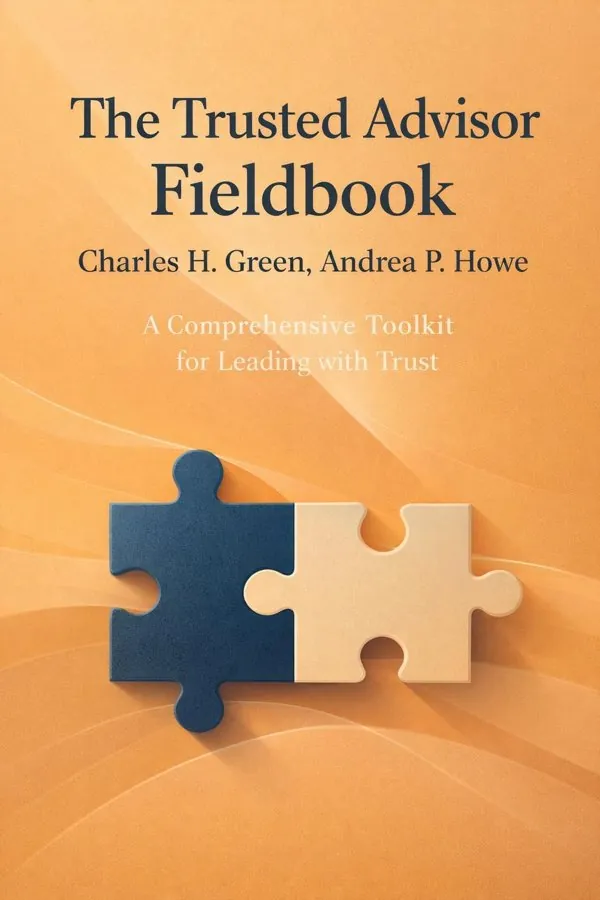
The Trusted Advisor Fieldbook: A Comprehensive Toolkit for Leading with Trust: Summary & Key Insights
by Charles H. Green, Andrea P. Howe
 10 min9 chaptersAudio available
Key Takeaways from The Trusted Advisor Fieldbook: A Comprehensive Toolkit for Leading with Trust
Most people think trust is mysterious, but one of the book’s most powerful insights is that trust can be understood and improved.
People rarely trust those who speak the most; they trust those who make them feel understood.
Many leaders assume trust comes from projecting certainty, but the fieldbook argues something more nuanced: trust grows when competence is paired with humanity.
Teams do not break down only because of poor strategy or unclear roles; they often break down because self-orientation overrides shared purpose.
One reason trust feels difficult is that people look for dramatic solutions when the real answer is repetition.
What Is The Trusted Advisor Fieldbook: A Comprehensive Toolkit for Leading with Trust About?
The Trusted Advisor Fieldbook: A Comprehensive Toolkit for Leading with Trust by Charles H. Green, Andrea P. Howe is a leadership book spanning 4 pages. Trust is often treated as a soft skill, yet in business it functions more like hard currency: it determines whether people listen, disclose, collaborate, buy, forgive mistakes, and stay loyal over time. The Trusted Advisor Fieldbook turns that truth into a practical operating manual. Building on the ideas introduced in The Trusted Advisor, Charles H. Green and Andrea P. Howe move from theory to application, offering exercises, reflection prompts, diagnostic tools, and real-world guidance for professionals who want to deepen client relationships, strengthen teams, and lead with credibility. What makes this book especially useful is its focus on behavior. Instead of speaking vaguely about authenticity or rapport, Green and Howe show how trust is built through small, repeatable actions: listening without agenda, lowering self-orientation, keeping commitments, handling conflict well, and becoming genuinely useful to others. Their perspective carries weight because it comes from decades of consulting experience helping advisors, leaders, and service professionals develop stronger relationships in high-stakes environments. This fieldbook matters because trust is no longer optional. In complex, uncertain, and highly relational work, the people who consistently earn trust become the ones others choose to follow, partner with, and remember.
This FizzRead summary covers all 9 key chapters of The Trusted Advisor Fieldbook: A Comprehensive Toolkit for Leading with Trust in approximately 10 minutes, distilling the most important ideas, arguments, and takeaways from Charles H. Green, Andrea P. Howe's work. Also available as an audio summary and Key Quotes Podcast.
The Trusted Advisor Fieldbook: A Comprehensive Toolkit for Leading with Trust
Trust is often treated as a soft skill, yet in business it functions more like hard currency: it determines whether people listen, disclose, collaborate, buy, forgive mistakes, and stay loyal over time. The Trusted Advisor Fieldbook turns that truth into a practical operating manual. Building on the ideas introduced in The Trusted Advisor, Charles H. Green and Andrea P. Howe move from theory to application, offering exercises, reflection prompts, diagnostic tools, and real-world guidance for professionals who want to deepen client relationships, strengthen teams, and lead with credibility.
What makes this book especially useful is its focus on behavior. Instead of speaking vaguely about authenticity or rapport, Green and Howe show how trust is built through small, repeatable actions: listening without agenda, lowering self-orientation, keeping commitments, handling conflict well, and becoming genuinely useful to others. Their perspective carries weight because it comes from decades of consulting experience helping advisors, leaders, and service professionals develop stronger relationships in high-stakes environments. This fieldbook matters because trust is no longer optional. In complex, uncertain, and highly relational work, the people who consistently earn trust become the ones others choose to follow, partner with, and remember.
Who Should Read The Trusted Advisor Fieldbook: A Comprehensive Toolkit for Leading with Trust?
This book is perfect for anyone interested in leadership and looking to gain actionable insights in a short read. Whether you're a student, professional, or lifelong learner, the key ideas from The Trusted Advisor Fieldbook: A Comprehensive Toolkit for Leading with Trust by Charles H. Green, Andrea P. Howe will help you think differently.
- ✓Readers who enjoy leadership and want practical takeaways
- ✓Professionals looking to apply new ideas to their work and life
- ✓Anyone who wants the core insights of The Trusted Advisor Fieldbook: A Comprehensive Toolkit for Leading with Trust in just 10 minutes
Want the full summary?
Get instant access to this book summary and 100K+ more with Fizz Moment.
Get Free SummaryAvailable on App Store • Free to download
Key Chapters
Most people think trust is mysterious, but one of the book’s most powerful insights is that trust can be understood and improved. Green and Howe revisit the famous Trust Equation: trustworthiness equals credibility plus reliability plus intimacy, divided by self-orientation. In plain terms, people trust you when they believe you know what you’re talking about, do what you say you’ll do, make them feel safe, and do not seem excessively focused on yourself.
Each part of the equation matters in a distinct way. Credibility is about expertise and sound judgment; reliability is consistency over time; intimacy is the emotional safety that allows others to be honest; self-orientation is the hidden trust killer, because when people sense that your priorities are your own status, sales goals, or need to be right, trust declines fast. The brilliance of the framework is that it gives professionals a diagnostic lens. If a client doubts your advice, the issue may be credibility. If a colleague hesitates to depend on you, reliability may be weak. If a team member withholds concerns, intimacy may be missing. If conversations feel guarded, your self-orientation may be showing.
Imagine a consultant who delivers sharp presentations but constantly redirects meetings toward their own methodology and achievements. Their credibility may be high, but their self-orientation erodes trust. By contrast, a manager who admits uncertainty, asks thoughtful questions, follows through, and protects confidential conversations steadily raises all parts of the equation.
The practical value here is simple: when trust is low, do not label it a personality problem. Diagnose it. Ask which variable needs attention, then change your behavior accordingly. Actionable takeaway: after your next important interaction, rate yourself on credibility, reliability, intimacy, and self-orientation, and identify one specific habit to improve the weakest factor.
People rarely trust those who speak the most; they trust those who make them feel understood. A central theme in the fieldbook is that empathic communication is not merely being nice. It is a disciplined way of listening, responding, and engaging that reduces defensiveness and creates connection. Green and Howe emphasize that trust grows when people experience your attention as sincere rather than strategic.
Empathic communication begins with listening to understand rather than listening to reply. That means resisting the urge to interrupt, advise too quickly, compare someone’s story to your own, or mentally prepare your next point while they are still speaking. It also requires curiosity about what is beneath the surface: not just the facts of a problem, but the worries, constraints, motivations, and stakes attached to it. In advisory work, this distinction is crucial. Clients often do not need instant answers; they need someone who can help them articulate the real issue.
A practical example is a leader handling an underperforming employee. A non-empathic response jumps straight to correction: “Here’s what you need to do better.” An empathic approach begins differently: “I’ve noticed some changes in your work. What’s been making this difficult lately?” That question may uncover confusion, overload, fear, or external stress. Once the reality is visible, problem-solving becomes more accurate and trust-preserving.
The book also highlights the importance of reflective statements, open-ended questions, and tolerance for silence. These skills invite others to elaborate and signal that their perspective matters. In tense conversations, empathy does not mean agreement; it means demonstrating that you grasp what the other person is experiencing.
Actionable takeaway: in your next high-stakes conversation, spend the first half asking clarifying questions and reflecting back what you hear before offering any recommendation at all.
Many leaders assume trust comes from projecting certainty, but the fieldbook argues something more nuanced: trust grows when competence is paired with humanity. People do not expect leaders to be perfect; they expect them to be real, grounded, and safe to work with. That is why vulnerability, used wisely, is not a weakness in leadership but a trust-building strength.
Vulnerability in this context does not mean oversharing or collapsing authority. It means being willing to admit mistakes, acknowledge limitations, ask for input, and speak honestly about challenges. These behaviors reduce distance. They show others that the leader values truth over ego. When leaders pretend to know everything, they often increase fear and reduce candor. Team members become less likely to raise concerns, challenge assumptions, or report bad news early. The result is not respect but silent dysfunction.
Consider a project director facing a delayed launch. A low-trust response is to deflect blame, issue vague reassurances, and conceal uncertainty. A high-trust response is to say, “We missed the mark on our timeline. Here’s what we know, what we do not know yet, and where I need your input.” That kind of communication creates psychological permission for others to be honest and constructive.
Green and Howe connect this to intimacy in the Trust Equation: trust deepens when people feel emotionally safe. Leaders create that safety not only through private empathy but through public norms. When they model curiosity, non-defensiveness, and accountability, they signal that the team can do the same.
Actionable takeaway: choose one area where you usually hide uncertainty, and in your next team interaction, replace posturing with a clear admission of what you are still learning and where others can help.
Teams do not break down only because of poor strategy or unclear roles; they often break down because self-orientation overrides shared purpose. One of the fieldbook’s strongest leadership lessons is that collaboration depends on trust, and trust erodes when individuals prioritize personal credit, control, or image over collective success. This is especially true in cross-functional environments where power, expertise, and incentives differ.
Green and Howe show that trust-based collaboration begins with intent. Colleagues can sense whether you are trying to solve a problem together or subtly win the interaction. Behaviors such as dominating meetings, dismissing concerns too quickly, withholding information, or using expertise as a weapon all increase defensiveness. By contrast, collaborative trust is built through transparency, generous attribution, open information-sharing, and sincere invitations for others to contribute.
A practical example can be seen in product development. Suppose marketing wants speed, engineering wants stability, and finance wants cost discipline. Without trust, each function protects its own turf and meetings become negotiations. With trust, leaders help the group articulate a shared outcome, surface hidden concerns, and make tradeoffs visible without personalizing disagreement. The conversation shifts from “my priority versus yours” to “what serves the decision best?”
The fieldbook also suggests that collaboration requires repeated, low-drama reliability. People trust partners who answer messages, meet deadlines, and communicate early when they cannot. Grand statements about teamwork mean little if everyday behavior is inconsistent.
Actionable takeaway: in your next collaborative project, deliberately lower self-orientation by giving visible credit to others, sharing information early, and asking one question that helps another person’s perspective shape the final decision.
One reason trust feels difficult is that people look for dramatic solutions when the real answer is repetition. The Trusted Advisor Fieldbook treats trust not as a one-time achievement but as a disciplined practice. It is built in accumulated moments: showing up prepared, keeping promises, being honest when uncomfortable, and aligning your actions with your stated values. These behaviors seem ordinary, but their cumulative effect is profound.
The book’s toolkit approach is valuable because it recognizes that insight alone does not change conduct. Professionals may agree that trust matters and still default to hurried listening, defensive communication, or inconsistent follow-through under pressure. That is why Green and Howe emphasize exercises, self-assessment, and reflection. Trustworthy behavior must be rehearsed until it becomes natural, especially in stressful situations where instinct tends to narrow and ego tends to rise.
For example, a relationship manager may intend to be client-centered but repeatedly overpromise in order to appear responsive. In the short term, that can look helpful. Over time, missed deadlines damage reliability and trust erodes. A better practice is honest expectation-setting: “We can deliver this by Friday if we reduce scope, or by next Tuesday in full.” Such clarity may feel less impressive in the moment, but it strengthens confidence over the long run.
Sustaining trust also requires repair. Everyone fails occasionally. What matters is the speed and quality of the response: acknowledge the miss, take responsibility, understand the impact, and state what will change.
Actionable takeaway: pick one trust-building ritual to practice daily for the next two weeks, such as ending every meeting with clear commitments and following up in writing within twenty-four hours.
Advice becomes powerful when people feel it is for them, not about you. One of the deepest insights in the book is that self-orientation is often the hidden barrier between expertise and influence. Professionals may have strong ideas, impressive credentials, and good intentions, yet still fail to become trusted advisors because their behavior signals self-concern. That concern can appear as a need to impress, a rush to solve, attachment to being right, or an unconscious focus on closing the deal.
Reducing self-orientation does not mean erasing ambition or pretending not to care about outcomes. It means decentering your ego enough to truly enter the other person’s situation. In practical terms, this looks like asking before prescribing, exploring context before presenting solutions, and tailoring recommendations to what the client or colleague genuinely values. It also means noticing your internal chatter. Are you trying to sound smart, secure approval, or steer the conversation toward your preferred answer? If so, trust may be leaking.
Consider a financial advisor meeting a nervous client. A self-oriented conversation quickly moves into performance data, credentials, and product options. A low-self-orientation conversation starts with, “What are you most worried about right now?” That question changes everything. It surfaces fear, family dynamics, and decision criteria that numbers alone cannot reveal. Only then can advice become relevant and welcomed.
The fieldbook pushes readers to examine their motives, not just their methods. This is uncomfortable but necessary. The more your presence feels helpful rather than self-serving, the more influence you naturally gain.
Actionable takeaway: before your next advisory conversation, write down the other person’s likely concerns and your own hidden agenda, then enter the meeting committed to serving the first more than satisfying the second.
Many people assume trust is fragile because conflict destroys it. The fieldbook offers a more useful view: mishandled conflict weakens trust, but honest, respectful conflict can deepen it. In fact, one sign of a high-trust relationship is the ability to address tension without avoidance, drama, or hidden resentment. When people know they can speak candidly and still remain in relationship, trust becomes more durable.
Green and Howe encourage readers to treat difficult conversations as opportunities to combine truth with empathy. That means being direct about the issue while staying curious about the other person’s perspective. It also means separating observation from accusation. Saying, “We agreed on a Friday delivery and I did not receive the draft until Monday” is very different from saying, “You are unreliable.” The first invites discussion; the second triggers defense.
A manager giving corrective feedback can apply this by describing the behavior, naming its impact, and asking for the employee’s view. A consultant facing a disappointed client can acknowledge the frustration without becoming defensive, then work jointly toward repair. The goal is not to avoid discomfort but to move through it cleanly.
An important lesson here is timing. Delayed conversations often accumulate emotional charge and become harder than necessary. Addressing issues early, while stakes are still manageable, protects the relationship. Trust is not maintained by silence; it is maintained by respectful candor.
Actionable takeaway: identify one conversation you have been postponing, and prepare for it using three steps: state the facts clearly, express the impact calmly, and ask at least two genuine questions before proposing a solution.
It may seem counterintuitive, but trust does not grow from endless openness alone; it also depends on boundaries. The fieldbook shows that trustworthy people are not only warm and empathic, they are also clear about roles, expectations, confidentiality, and limits. Without boundaries, relationships become confusing, promises become unrealistic, and disappointment becomes more likely.
Boundaries support reliability because they make commitments credible. If you say yes to everything, people may initially perceive you as helpful, but eventually they discover that your promises are unstable. Likewise, intimacy does not require unlimited access. In professional relationships especially, trust is strengthened when people know what will be kept confidential, what decisions belong to whom, and what kind of support can reasonably be expected.
Think of a team leader who prides themselves on being available at all times. At first this may seem admirable. Over time, however, it can create dependency, burnout, and inconsistent responsiveness. A more trust-enhancing approach is to define communication norms, decision rights, and escalation paths. Paradoxically, structure creates safety. People know where they stand and can rely on the system as well as the person.
The same applies in client work. A consultant who clearly sets scope, turnaround times, and feedback processes often earns more trust than one who tries to appear endlessly flexible. Clear boundaries reduce ambiguity and make delivery more dependable.
Actionable takeaway: review one important relationship and identify where ambiguity exists around expectations, confidentiality, timing, or responsibilities; then clarify those boundaries explicitly instead of assuming mutual understanding.
The book repeatedly suggests that trust-building begins internally before it appears externally. Skills like listening, empathy, candor, and reliability are easier to discuss than to sustain because they are influenced by self-awareness. When leaders are unaware of their habits under stress, they unintentionally sabotage trust. They interrupt when anxious, micromanage when uncertain, overtalk when they want approval, or withdraw when challenged.
Green and Howe encourage reflection because the trusted advisor role is as much about presence as technique. People respond not only to what you say, but to how you show up. Are you calm or hurried? Curious or performative? Open or defensive? Self-aware professionals notice these patterns in real time and adjust. They understand that trust leaks through tone, pacing, body language, and unspoken motives as much as through formal decisions.
A useful example is a senior executive who believes they are empowering their team, yet routinely jumps in with answers before others have finished thinking aloud. The team interprets this as a lack of trust, even if the executive’s intention is efficiency. Through feedback and reflection, the executive may realize the behavior is driven by discomfort with silence. Once seen, the pattern can be changed.
This is why the fieldbook’s exercises matter. They help readers surface blind spots, examine assumptions, and turn ideals into habits. Trusted leadership is not an identity you declare; it is a practice you refine through awareness and feedback.
Actionable takeaway: after your next meeting, ask yourself two questions: “Where did my ego show up?” and “Where did my curiosity show up?” Use the answers to guide one behavioral adjustment in your next interaction.
All Chapters in The Trusted Advisor Fieldbook: A Comprehensive Toolkit for Leading with Trust
About the Authors
Charles H. Green is the founder and CEO of Trusted Advisor Associates and one of the best-known voices on trust-based business relationships. He has spent decades advising professionals and organizations on client development, leadership, collaboration, and the role trust plays in long-term success. He is widely recognized for popularizing the Trust Equation and for helping readers connect relationship quality with real business outcomes. Andrea P. Howe is a consultant, speaker, and collaborator in the field of trust-building, with a focus on client relationships, communication, and practical professional development. Together, Green and Howe combine conceptual depth with applied experience, making complex interpersonal dynamics usable for leaders, advisors, and teams seeking to lead more effectively through trust.
Get This Summary in Your Preferred Format
Read or listen to the The Trusted Advisor Fieldbook: A Comprehensive Toolkit for Leading with Trust summary by Charles H. Green, Andrea P. Howe anytime, anywhere. FizzRead offers multiple formats so you can learn on your terms — all free.
Available formats: App · Audio · PDF · EPUB — All included free with FizzRead
Download The Trusted Advisor Fieldbook: A Comprehensive Toolkit for Leading with Trust PDF and EPUB Summary
Key Quotes from The Trusted Advisor Fieldbook: A Comprehensive Toolkit for Leading with Trust
“Most people think trust is mysterious, but one of the book’s most powerful insights is that trust can be understood and improved.”
“People rarely trust those who speak the most; they trust those who make them feel understood.”
“Many leaders assume trust comes from projecting certainty, but the fieldbook argues something more nuanced: trust grows when competence is paired with humanity.”
“Teams do not break down only because of poor strategy or unclear roles; they often break down because self-orientation overrides shared purpose.”
“One reason trust feels difficult is that people look for dramatic solutions when the real answer is repetition.”
Frequently Asked Questions about The Trusted Advisor Fieldbook: A Comprehensive Toolkit for Leading with Trust
The Trusted Advisor Fieldbook: A Comprehensive Toolkit for Leading with Trust by Charles H. Green, Andrea P. Howe is a leadership book that explores key ideas across 9 chapters. Trust is often treated as a soft skill, yet in business it functions more like hard currency: it determines whether people listen, disclose, collaborate, buy, forgive mistakes, and stay loyal over time. The Trusted Advisor Fieldbook turns that truth into a practical operating manual. Building on the ideas introduced in The Trusted Advisor, Charles H. Green and Andrea P. Howe move from theory to application, offering exercises, reflection prompts, diagnostic tools, and real-world guidance for professionals who want to deepen client relationships, strengthen teams, and lead with credibility. What makes this book especially useful is its focus on behavior. Instead of speaking vaguely about authenticity or rapport, Green and Howe show how trust is built through small, repeatable actions: listening without agenda, lowering self-orientation, keeping commitments, handling conflict well, and becoming genuinely useful to others. Their perspective carries weight because it comes from decades of consulting experience helping advisors, leaders, and service professionals develop stronger relationships in high-stakes environments. This fieldbook matters because trust is no longer optional. In complex, uncertain, and highly relational work, the people who consistently earn trust become the ones others choose to follow, partner with, and remember.
You Might Also Like

Extreme Ownership
Jocko Willink
10 min
Dare to Lead
Brene Brown
10 min
Leaders Eat Last
Simon Sinek
10 min
The 21 Irrefutable Laws of Leadership
John Maxwell
10 min
Start With Why
Simon Sinek
10 min
How to Lead When You're Not in Charge
Clay Scroggins
10 minBrowse by Category
Ready to read The Trusted Advisor Fieldbook: A Comprehensive Toolkit for Leading with Trust?
Get the full summary and 100K+ more books with Fizz Moment.