
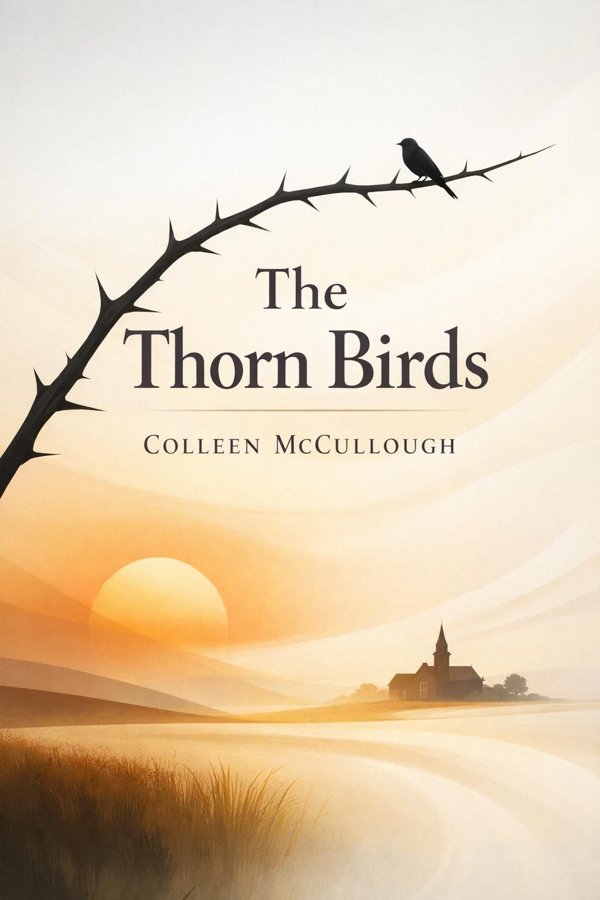
The Thorn Birds: Summary & Key Insights
 10 min9 chaptersAudio available
Key Takeaways from The Thorn Birds
A new beginning often carries the seeds of both hope and heartbreak.
Power is rarely expressed only through money; just as often, it moves through charm, influence, and emotional dependence.
The deepest conflicts are often the ones in which both sides feel sacred.
Catastrophe does not create character from nothing; it reveals what was already there.
When desire is denied, people often try to build a substitute life that looks sensible from the outside.
What Is The Thorn Birds About?
The Thorn Birds by Colleen McCullough is a bestsellers book spanning 6 pages. Some novels tell a story; The Thorn Birds builds an entire emotional world. Colleen McCullough’s modern classic is a sweeping family saga set largely on Drogheda, an immense sheep station in the Australian Outback, where the Cleary family struggles through poverty, ambition, longing, and loss across three generations. At its center is one of literature’s most memorable forbidden relationships: the bond between Meggie Cleary and Father Ralph de Bricassart, a brilliant, ambitious priest divided between worldly advancement in the Catholic Church and a deeply human love he cannot fully renounce. But this is far more than a romance. It is a novel about what people worship—God, status, family, passion, duty—and what those devotions cost them. McCullough writes with unusual authority about emotional conflict, social pressure, and the harsh Australian landscape, turning intimate choices into epic drama. Her background as a disciplined scientist perhaps helps explain the precision with which she dissects desire, sacrifice, and power. The result is a bestselling novel that remains compelling because it asks an enduring question: what happens when the life we most want is the one we believe we cannot have?
This FizzRead summary covers all 9 key chapters of The Thorn Birds in approximately 10 minutes, distilling the most important ideas, arguments, and takeaways from Colleen McCullough's work. Also available as an audio summary and Key Quotes Podcast.
The Thorn Birds
Some novels tell a story; The Thorn Birds builds an entire emotional world. Colleen McCullough’s modern classic is a sweeping family saga set largely on Drogheda, an immense sheep station in the Australian Outback, where the Cleary family struggles through poverty, ambition, longing, and loss across three generations. At its center is one of literature’s most memorable forbidden relationships: the bond between Meggie Cleary and Father Ralph de Bricassart, a brilliant, ambitious priest divided between worldly advancement in the Catholic Church and a deeply human love he cannot fully renounce. But this is far more than a romance. It is a novel about what people worship—God, status, family, passion, duty—and what those devotions cost them. McCullough writes with unusual authority about emotional conflict, social pressure, and the harsh Australian landscape, turning intimate choices into epic drama. Her background as a disciplined scientist perhaps helps explain the precision with which she dissects desire, sacrifice, and power. The result is a bestselling novel that remains compelling because it asks an enduring question: what happens when the life we most want is the one we believe we cannot have?
Who Should Read The Thorn Birds?
This book is perfect for anyone interested in bestsellers and looking to gain actionable insights in a short read. Whether you're a student, professional, or lifelong learner, the key ideas from The Thorn Birds by Colleen McCullough will help you think differently.
- ✓Readers who enjoy bestsellers and want practical takeaways
- ✓Professionals looking to apply new ideas to their work and life
- ✓Anyone who wants the core insights of The Thorn Birds in just 10 minutes
Want the full summary?
Get instant access to this book summary and 100K+ more with Fizz Moment.
Get Free SummaryAvailable on App Store • Free to download
Key Chapters
A new beginning often carries the seeds of both hope and heartbreak. The Thorn Birds opens with the Cleary family leaving the modest security of New Zealand for Drogheda, the enormous Australian sheep station owned by the wealthy and formidable Mary Carson. Paddy Cleary is decent, hardworking, and humble; his wife Fiona is emotionally distant, marked by secrets of her own; and their children, especially the only daughter, Meggie, step into a world as harsh as it is full of possibility. Drogheda is not simply a setting but a force that shapes character. Its heat, dust, scale, and remoteness demand endurance and expose weakness.
McCullough uses the family’s arrival to establish one of the novel’s central truths: environment can magnify both love and suffering. The Clearys gain economic opportunity, but they also become entangled in hierarchies of class, power, and inheritance. Mary Carson’s authority over the station gives her power over everyone on it, and this imbalance quietly determines the family’s future long before they understand it.
In practical terms, this opening section speaks to anyone who has ever relocated, started over, or entered a world controlled by other people’s rules. New opportunities often come attached to hidden dependencies. A job, marriage, or move may look like liberation while also binding us to new forms of obligation. The Clearys’ story reminds us to ask not only what we gain from a new beginning, but what structures of power come with it.
Actionable takeaway: when entering any new chapter in life, look beyond the promise of opportunity and identify who holds power, what the unspoken rules are, and what emotional costs may follow.
Power is rarely expressed only through money; just as often, it moves through charm, influence, and emotional dependence. Into the Clearys’ world comes Father Ralph de Bricassart, a handsome, intelligent Irish priest sent to the outback after conflict with his superiors. Ralph quickly becomes central to life at Drogheda, not only because of his spiritual role but because he understands people’s ambitions and weaknesses. Mary Carson, wealthy and lonely, becomes fascinated by him. Meggie, still young, is drawn to him with innocent devotion that matures into lifelong love.
This section reveals a triangle built not merely on affection but on competing desires. Mary wants Ralph and knows she cannot fully have him as a woman, so she seeks to possess him through wealth and manipulation. Ralph desires significance as much as intimacy; he is not a villain, but he is profoundly susceptible to prestige. Meggie wants love in its most personal and faithful form. Each of them reaches for the same emotional center from a different angle.
McCullough shows how ambition can coexist with tenderness, making Ralph compelling rather than simple. In everyday life, we often imagine people as either sincere or self-interested, but many of the most consequential relationships involve both. A mentor may care for us yet also use us. A leader may be idealistic yet hungry for recognition. Understanding this complexity helps us judge character more realistically.
Actionable takeaway: when evaluating important relationships, ask what each person truly wants—not just what they say they value, but what they repeatedly choose when love, status, and security come into conflict.
The deepest conflicts are often the ones in which both sides feel sacred. As Meggie grows from a lonely girl into a young woman, her attachment to Ralph becomes more defined, more dangerous, and more painful. Ralph loves her in a way he never fully admits into action, yet he also loves the prospect of rising within the Church. His emotional life is split between private yearning and public destiny. Meggie, by contrast, experiences her love with less abstraction. For her, the question is simpler and therefore more brutal: if he loves her, why will he not choose her?
This part of the novel gives emotional shape to the book’s central tragedy. Ralph’s priesthood is not only a religious calling; it is also his route to power, refinement, and influence. Meggie understands this at an intuitive level even before she can articulate it. She sees that she is competing not just with God, but with Ralph’s ambition. That insight transforms girlish longing into wounded maturity.
In real life, many painful relationships endure because one person keeps interpreting delay as uncertainty when it is actually a decision. Ralph’s inability to choose Meggie is itself a choice. McCullough captures how people can remain bound to those who love them incompletely, hoping eventually to become the exception to someone else’s priorities.
Actionable takeaway: if someone continually postpones choosing you in favor of duty, ambition, or convenience, believe the pattern. Clarity often begins when you accept repeated behavior as the true answer.
Catastrophe does not create character from nothing; it reveals what was already there. One of the most powerful dimensions of The Thorn Birds is its depiction of the Cleary family facing the brutal realities of life on the land. Drought, labor, distance, and especially fire turn Drogheda into a place of trial. The family’s hardships are not decorative background for the romance; they are central to the novel’s understanding of survival. Tragedy comes with little warning, and the emotional consequences are permanent.
Paddy and the sons embody a stoic, physically demanding masculinity shaped by work and danger. Fiona, often reserved and difficult to read, emerges as a woman whose restraint conceals enormous reserves of feeling. Meggie learns early that love does not protect people from suffering. These experiences make the family’s later decisions more understandable: when life repeatedly proves fragile, people cling harder to whatever form of meaning they can find—family loyalty, religion, desire, or ambition.
For readers, this section has a practical emotional lesson. Hardship often changes the scale of our concerns. Minor resentments fade; foundational truths become visible. Families under pressure discover who assumes responsibility, who collapses, who comforts, and who cannot adapt. While few readers will face the exact dangers of an Australian sheep station, many will recognize the way crisis reorganizes relationships.
Actionable takeaway: during difficult periods, pay attention to what adversity uncovers in yourself and others. Use crisis not only to survive, but to identify the relationships, values, and responsibilities that actually endure.
When desire is denied, people often try to build a substitute life that looks sensible from the outside. Unable to have Ralph, Meggie marries Luke O’Neill, hoping action will succeed where waiting has failed. Luke appears strong, practical, and worldly, but the marriage quickly exposes itself as another form of loneliness. He is driven by material self-interest, emotionally withholding, and largely indifferent to Meggie’s inner life. Their move away from Drogheda becomes not an escape into freedom, but an exile into disappointment.
Yet this stage of Meggie’s life is crucial because it transforms her from passive sufferer into a woman who begins to reclaim agency. She learns that marriage alone does not cure longing, and that choosing a life reactively—simply to escape pain—can create fresh captivity. Her eventual return to Drogheda is not a retreat into childhood but a return with knowledge. She comes back more realistic, less romantic, and more determined to define value on her own terms.
This section offers a practical insight that reaches beyond the novel. Many life choices are made not out of conviction but out of exhaustion: leaving one path because it hurts, not because the next path is right. Careers, relationships, and relocations can become emotional rebounds. McCullough suggests that such choices may provide movement without healing.
Actionable takeaway: before making a major life decision in response to heartbreak or frustration, ask whether you are moving toward a meaningful future or merely running away from an unbearable present.
Children often inherit not only their parents’ features, but also their unfinished emotional stories. Meggie’s son Dane grows into one of the novel’s most symbolic figures. Charismatic, gifted, and deeply spiritual, he becomes the living embodiment of the bond between Meggie and Ralph. Though his origins are complicated, his presence intensifies every central theme in the book: love, secrecy, sacrifice, religion, and fate. Ralph sees in Dane a reflection of himself and a kind of redemption, while Meggie sees both joy and danger in the son who carries the weight of her deepest desire.
Dane’s attraction to the priesthood is especially poignant because it repeats the structure of loss that defined Meggie’s life. Once again, someone she loves is drawn toward the Church. But Dane’s faith feels less entangled with ambition than Ralph’s. In him, vocation appears purer, more innocent, and therefore even more heartbreaking. Through Dane, McCullough asks whether the patterns that wound one generation quietly shape the next.
In everyday terms, families often pass down unresolved longings, expectations, and emotional scripts. A child may pursue the path a parent once admired, feared, or lost. Without intending to, families recreate old dramas in new forms. Recognizing this can help us distinguish genuine calling from inherited pressure.
Actionable takeaway: reflect on whether your strongest ambitions are truly your own or part of a family pattern. Understanding what you inherited emotionally can help you choose more consciously.
Some of the most decisive power in The Thorn Birds belongs to women who are denied formal authority. Although the novel is often remembered for Meggie and Ralph, McCullough also offers a layered portrait of women navigating social limits through endurance, manipulation, intelligence, and restraint. Mary Carson uses wealth and cunning to influence lives after her death. Fiona survives through emotional self-control, revealing how silence can be both wound and armor. Meggie evolves from neglected girl to resilient matriarch, learning that survival may require compromise without surrender.
What makes this theme compelling is that none of these women fits a simple heroic mold. Mary is vindictive yet perceptive. Fiona is cold-seeming yet deeply damaged. Meggie is loving yet stubborn, passionate yet proud. Together they show that female power in constrained worlds often appears indirectly. When social institutions privilege male authority—priests, husbands, landowners, sons—women may exert influence through inheritance, memory, strategic withdrawal, or the management of family life.
Modern readers can apply this insight broadly. In many workplaces and families, official titles do not fully explain who shapes outcomes. Informal influence, emotional intelligence, and long-term persistence can matter more than visible control. The novel encourages us to look beyond status and ask who is truly directing the emotional economy of a household or institution.
Actionable takeaway: when assessing power in any group, notice the people who shape decisions indirectly—through loyalty, resources, silence, timing, or emotional leverage—not just those with the loudest authority.
One of the boldest insights in The Thorn Birds is that religious calling and personal ambition can become nearly indistinguishable. Ralph’s conflict is not simply between God and romantic love. It is also between humility and advancement, vocation and vanity, service and self-elevation. The Church offers him structure, prestige, and a ladder upward; his spiritual commitment is real, but so is his hunger for significance. That mixture makes his choices tragic because they are never entirely noble or entirely selfish.
McCullough refuses to flatten faith into hypocrisy. Ralph genuinely believes, genuinely serves, and genuinely loves Meggie. Yet he also repeatedly chooses the path that enlarges his status. This nuanced portrayal matters because it mirrors how ambition works in many modern settings. People may pursue careers in education, medicine, ministry, activism, or public service for meaningful reasons while also craving recognition, influence, or legacy. Idealism and ego often travel together.
The practical lesson is not that ambition is bad, but that unexamined ambition can distort even our highest commitments. A person can convince themselves they are sacrificing for a noble cause while repeatedly selecting the option that flatters their identity most. Self-deception thrives where moral language is available.
Actionable takeaway: regularly examine whether your stated mission aligns with your actual choices. If every sacrifice conveniently increases your status, pause and ask whether devotion has become a disguise for ambition.
The novel’s central symbol suggests a painful paradox: the most beautiful song may come from the deepest wound. The legend of the thorn bird tells of a bird that seeks a single thorn, impales itself upon it, and sings one perfect song before dying. This image gives the book its title and its philosophical core. For McCullough, human beings are often drawn toward the very thing that will cost them most. They do not always choose against their own happiness by mistake; sometimes they sense that meaning, intensity, and identity are bound up in that suffering.
Meggie and Ralph embody this idea most clearly, but it extends to the whole novel. Characters repeatedly devote themselves to loves or ambitions that bring both fulfillment and destruction. The point is not to glorify pain for its own sake, but to acknowledge that some of life’s defining experiences cannot be separated from loss. We become ourselves not only through what comforts us, but through what wounds us deeply enough to reveal what matters.
Applied to ordinary life, this theme encourages mature reflection rather than melodrama. Not every painful desire is worth pursuing. But some commitments—raising a family, creating art, serving a vocation, loving imperfectly—carry unavoidable sacrifice. The question is whether the thorn we embrace produces emptiness or meaning.
Actionable takeaway: choose your sacrifices consciously. Since every meaningful life involves some pain, ask whether the struggle you are enduring is making you smaller and bitter—or helping you express your truest values.
All Chapters in The Thorn Birds
About the Author
Colleen McCullough (1937–2015) was an Australian novelist whose global reputation was cemented by The Thorn Birds, one of the bestselling novels of the modern era. Before turning fully to fiction, she trained and worked as a neurophysiologist in Australia, Britain, and the United States, including research and teaching roles that reflected her disciplined, analytical mind. That intellectual rigor carried into her writing, which is known for combining emotional intensity with careful observation of human motivation. McCullough wrote across genres, producing contemporary fiction, historical novels, and the acclaimed Masters of Rome series. Her work often explores ambition, power, love, family conflict, and moral compromise. She remains one of Australia’s most widely read literary figures, admired for her ability to unite sweeping narrative scale with intimate psychological depth.
Get This Summary in Your Preferred Format
Read or listen to the The Thorn Birds summary by Colleen McCullough anytime, anywhere. FizzRead offers multiple formats so you can learn on your terms — all free.
Available formats: App · Audio · PDF · EPUB — All included free with FizzRead
Download The Thorn Birds PDF and EPUB Summary
Key Quotes from The Thorn Birds
“A new beginning often carries the seeds of both hope and heartbreak.”
“Power is rarely expressed only through money; just as often, it moves through charm, influence, and emotional dependence.”
“The deepest conflicts are often the ones in which both sides feel sacred.”
“Catastrophe does not create character from nothing; it reveals what was already there.”
“When desire is denied, people often try to build a substitute life that looks sensible from the outside.”
Frequently Asked Questions about The Thorn Birds
The Thorn Birds by Colleen McCullough is a bestsellers book that explores key ideas across 9 chapters. Some novels tell a story; The Thorn Birds builds an entire emotional world. Colleen McCullough’s modern classic is a sweeping family saga set largely on Drogheda, an immense sheep station in the Australian Outback, where the Cleary family struggles through poverty, ambition, longing, and loss across three generations. At its center is one of literature’s most memorable forbidden relationships: the bond between Meggie Cleary and Father Ralph de Bricassart, a brilliant, ambitious priest divided between worldly advancement in the Catholic Church and a deeply human love he cannot fully renounce. But this is far more than a romance. It is a novel about what people worship—God, status, family, passion, duty—and what those devotions cost them. McCullough writes with unusual authority about emotional conflict, social pressure, and the harsh Australian landscape, turning intimate choices into epic drama. Her background as a disciplined scientist perhaps helps explain the precision with which she dissects desire, sacrifice, and power. The result is a bestselling novel that remains compelling because it asks an enduring question: what happens when the life we most want is the one we believe we cannot have?
You Might Also Like

The Godfather
Mario Puzo
10 min
The Handmaid's Tale
Margaret Atwood
10 min
The Hunger Games
Suzanne Collins
10 min
The Nightingale
Kristin Hannah
10 min
The Seven Husbands of Evelyn Hugo
Taylor Jenkins Reid
10 min
Backwater Justice
Fern Michaels
10 minBrowse by Category
Ready to read The Thorn Birds?
Get the full summary and 100K+ more books with Fizz Moment.