
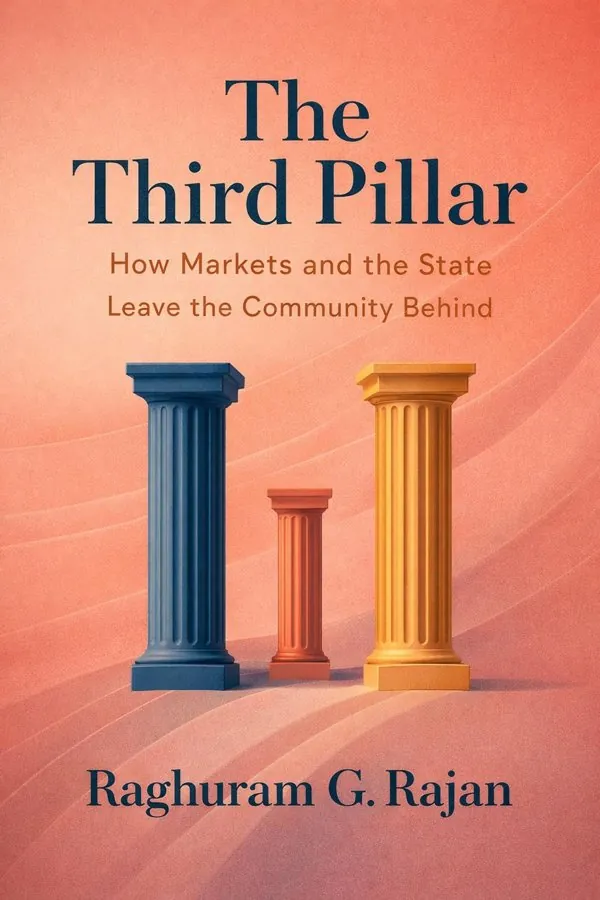
The Third Pillar: How Markets and the State Leave the Community Behind: Summary & Key Insights
 10 min8 chaptersAudio available
What Is The Third Pillar: How Markets and the State Leave the Community Behind About?
The Third Pillar: How Markets and the State Leave the Community Behind by Raghuram G. Rajan is a economics book spanning 8 pages. In this influential work, economist Raghuram G. Rajan explores the delicate balance between the three pillars of society: the state, the market, and the community. He argues that the erosion of community institutions has destabilized both markets and governments, leading to inequality and populism. Rajan proposes a rebalancing that empowers local communities to restore social cohesion and economic resilience.
This FizzRead summary covers all 8 key chapters of The Third Pillar: How Markets and the State Leave the Community Behind in approximately 10 minutes, distilling the most important ideas, arguments, and takeaways from Raghuram G. Rajan's work. Also available as an audio summary and Key Quotes Podcast.
The Third Pillar: How Markets and the State Leave the Community Behind
In this influential work, economist Raghuram G. Rajan explores the delicate balance between the three pillars of society: the state, the market, and the community. He argues that the erosion of community institutions has destabilized both markets and governments, leading to inequality and populism. Rajan proposes a rebalancing that empowers local communities to restore social cohesion and economic resilience.
Who Should Read The Third Pillar: How Markets and the State Leave the Community Behind?
This book is perfect for anyone interested in economics and looking to gain actionable insights in a short read. Whether you're a student, professional, or lifelong learner, the key ideas from The Third Pillar: How Markets and the State Leave the Community Behind by Raghuram G. Rajan will help you think differently.
- ✓Readers who enjoy economics and want practical takeaways
- ✓Professionals looking to apply new ideas to their work and life
- ✓Anyone who wants the core insights of The Third Pillar: How Markets and the State Leave the Community Behind in just 10 minutes
Want the full summary?
Get instant access to this book summary and 100K+ more with Fizz Moment.
Get Free SummaryAvailable on App Store • Free to download
Key Chapters
From the earliest feudal orders to the dawn of industrial capitalism, the State, Market, and Community grew together in a symbiotic dance. In medieval Europe, for instance, the community was the primary bedrock of social organization. Guilds, parishes, and neighborhood associations governed trade, enforced norms, and supported those in need. The market did not stand apart from morality; it was embedded within communal trust. The State, still embryonic, relied heavily on local structures for legitimacy and tax collection. This balance between the three was sustained by intimate knowledge and accountability within small social circles.
As central monarchies expanded, the State began to assert bureaucratic reach beyond local areas, gradually taking over the functions once managed by community. The market, especially with mercantilism and early industry, grew to transcend geography. Yet even then, community structures adapted: they offered apprenticeship, social insurance, and stability amidst change. The Industrial Revolution, however, introduced scale and speed that communal institutions could not easily match. Factories drew workers away from rural cohesion into urban anonymity, loosening the local bonds that had long mediated between market forces and political authority.
What fascinates me in this transformation is how each pillar interacted rather than evolved in isolation. Technological advances and global markets expanded opportunities, but also demanded new institutions of trust. The State responded with modern regulation and guaranteed property rights; the community—under pressure—began to erode in the face of mobility and specialization. By the nineteenth century, we had effectively entered a world where the Market and the State defined development, while the Community increasingly seemed archaic. This historical background is essential to grasp the crisis of belonging and inequality visible today.
Industrialization brought unprecedented prosperity. The Market became the great engine of progress, generating wealth and innovation. The State partnered as regulator, builder of infrastructure, and enforcer of contracts. But together, they began crowding out the spaces where individuals encountered one another not as producers or citizens, but as neighbors. The local economy, once built upon mutual reliance, was redefined by wage labor and consumer identity. Governance shifted upward; production expanded outward.
Through the twentieth century and especially after World War II, globalization accelerated this dynamic. Nations constructed welfare states to buffer citizens against market shocks. Yet, the administrative structures necessary for such security also centralized power. Local communities, now mediated by bureaucratic programs rather than grassroots solidarity, lost agency. The Market, likewise, began serving consumers and shareholders far removed from local contexts. Decisions affecting livelihoods were made in corporate headquarters and government capitals rather than town halls.
This concentration of capital and authority was masked by technological optimism and material growth. People experienced more wealth but less voice. The community that once softened conflict between self-interest and collective good ceased to function effectively. In developing economies, where traditional social ties remained strong, modernization often replicated this imbalance, displacing older forms of reciprocity with market participation and state control. Thus, globally, the two dominant pillars became highly intertwined—leaving the third marginalized, underfunded, and invisible in public policy debates.
+ 6 more chapters — available in the FizzRead app
All Chapters in The Third Pillar: How Markets and the State Leave the Community Behind
About the Author
Raghuram G. Rajan is an Indian economist and professor at the University of Chicago Booth School of Business. He served as the 23rd Governor of the Reserve Bank of India and was previously Chief Economist at the International Monetary Fund. Rajan is known for his prescient warnings about the 2008 financial crisis and his influential work on global finance and development.
Get This Summary in Your Preferred Format
Read or listen to the The Third Pillar: How Markets and the State Leave the Community Behind summary by Raghuram G. Rajan anytime, anywhere. FizzRead offers multiple formats so you can learn on your terms — all free.
Available formats: App · Audio · PDF · EPUB — All included free with FizzRead
Download The Third Pillar: How Markets and the State Leave the Community Behind PDF and EPUB Summary
Key Quotes from The Third Pillar: How Markets and the State Leave the Community Behind
“From the earliest feudal orders to the dawn of industrial capitalism, the State, Market, and Community grew together in a symbiotic dance.”
“Industrialization brought unprecedented prosperity.”
Frequently Asked Questions about The Third Pillar: How Markets and the State Leave the Community Behind
The Third Pillar: How Markets and the State Leave the Community Behind by Raghuram G. Rajan is a economics book that explores key ideas across 8 chapters. In this influential work, economist Raghuram G. Rajan explores the delicate balance between the three pillars of society: the state, the market, and the community. He argues that the erosion of community institutions has destabilized both markets and governments, leading to inequality and populism. Rajan proposes a rebalancing that empowers local communities to restore social cohesion and economic resilience.
You Might Also Like
Business Adventures
John Brooks
10 min
Nudge
Richard H. Thaler, Cass R. Sunstein
10 min
The Hitchhiker"s Guide to the Galaxy
Douglas Adams
10 minThe Muqaddimah
Ibn Khaldun
10 minThe Outsiders
William N. Thorndike
10 min
A Little History of Economics
Niall Kishtainy
10 minBrowse by Category
Ready to read The Third Pillar: How Markets and the State Leave the Community Behind?
Get the full summary and 100K+ more books with Fizz Moment.