
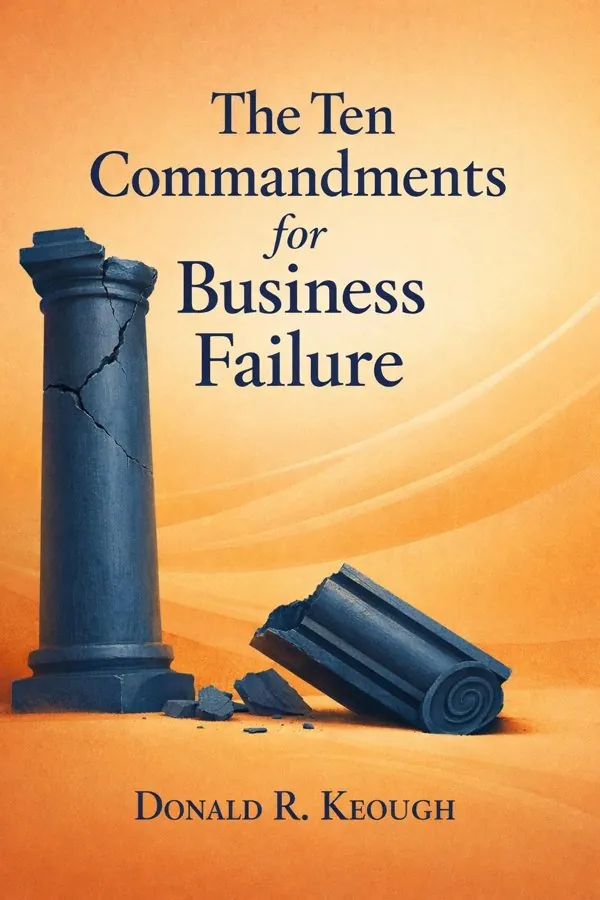
The Ten Commandments for Business Failure: Summary & Key Insights
 10 min10 chaptersAudio available
Key Takeaways from The Ten Commandments for Business Failure
The fastest way to become irrelevant is to confuse safety with wisdom.
Yesterday’s winning formula can become tomorrow’s trap.
Leaders fail when they stop hearing the truth.
Arrogance often arrives wearing the clothes of confidence.
A company rarely collapses from one giant ethical leap; more often, it decays through small tolerated compromises.
What Is The Ten Commandments for Business Failure About?
The Ten Commandments for Business Failure by Donald R. Keough is a leadership book spanning 10 pages. What causes successful companies to collapse? Donald R. Keough’s The Ten Commandments for Business Failure answers that question with unusual wit, blunt honesty, and decades of executive wisdom. Rather than offering another formula for success, Keough takes the reverse approach: he identifies the behaviors, habits, and leadership mistakes that almost guarantee decline. The result is a sharp, memorable guide to what destroys organizations from the inside out. Keough writes from rare experience. As former president and COO of The Coca-Cola Company, he spent his career observing how great businesses grow, stumble, recover, and sometimes disappear. He saw firsthand that failure is seldom caused by a single dramatic event. More often, it emerges through arrogance, rigidity, ethical shortcuts, bureaucracy, weak communication, and fear of change. What makes this book endure is its practicality. Keough’s “commandments” are ironic warnings, but they reveal serious truths about leadership, culture, and decision-making. For executives, entrepreneurs, managers, and anyone responsible for guiding people or strategy, this book is a compact masterclass in avoiding self-inflicted disaster. It reminds us that long-term success depends less on brilliance than on humility, clarity, courage, and constant vigilance.
This FizzRead summary covers all 10 key chapters of The Ten Commandments for Business Failure in approximately 10 minutes, distilling the most important ideas, arguments, and takeaways from Donald R. Keough's work. Also available as an audio summary and Key Quotes Podcast.
The Ten Commandments for Business Failure
What causes successful companies to collapse? Donald R. Keough’s The Ten Commandments for Business Failure answers that question with unusual wit, blunt honesty, and decades of executive wisdom. Rather than offering another formula for success, Keough takes the reverse approach: he identifies the behaviors, habits, and leadership mistakes that almost guarantee decline. The result is a sharp, memorable guide to what destroys organizations from the inside out.
Keough writes from rare experience. As former president and COO of The Coca-Cola Company, he spent his career observing how great businesses grow, stumble, recover, and sometimes disappear. He saw firsthand that failure is seldom caused by a single dramatic event. More often, it emerges through arrogance, rigidity, ethical shortcuts, bureaucracy, weak communication, and fear of change.
What makes this book endure is its practicality. Keough’s “commandments” are ironic warnings, but they reveal serious truths about leadership, culture, and decision-making. For executives, entrepreneurs, managers, and anyone responsible for guiding people or strategy, this book is a compact masterclass in avoiding self-inflicted disaster. It reminds us that long-term success depends less on brilliance than on humility, clarity, courage, and constant vigilance.
Who Should Read The Ten Commandments for Business Failure?
This book is perfect for anyone interested in leadership and looking to gain actionable insights in a short read. Whether you're a student, professional, or lifelong learner, the key ideas from The Ten Commandments for Business Failure by Donald R. Keough will help you think differently.
- ✓Readers who enjoy leadership and want practical takeaways
- ✓Professionals looking to apply new ideas to their work and life
- ✓Anyone who wants the core insights of The Ten Commandments for Business Failure in just 10 minutes
Want the full summary?
Get instant access to this book summary and 100K+ more with Fizz Moment.
Get Free SummaryAvailable on App Store • Free to download
Key Chapters
The fastest way to become irrelevant is to confuse safety with wisdom. Keough argues that businesses begin failing the moment they stop taking intelligent risks. Fear of mistakes often feels responsible, especially after a period of success, but caution can quietly harden into paralysis. When leaders become more concerned with protecting what they have than creating what comes next, innovation fades, initiative dries up, and the organization starts living off old victories.
This commandment does not suggest recklessness. Keough’s point is that progress always requires some willingness to experiment, to back uncertain ideas, and to accept the possibility of being wrong. Markets change, customers evolve, and competitors rarely stand still. A company that refuses risk is still making a bet—it is betting that the world will remain exactly as it is. That is usually the most dangerous gamble of all.
In practice, this lesson applies to product development, hiring, expansion, and even internal culture. A company that punishes every failed initiative will soon train employees not to think boldly. Teams will bring only polished, low-impact ideas to leadership because they know creativity is risky and conformity is rewarded. Over time, the organization becomes efficient at maintaining the status quo while more adaptive rivals move ahead.
Leaders can counter this by rewarding thoughtful experimentation, separating bad judgment from good-faith failure, and asking whether caution is protecting value or merely protecting comfort. A useful test is simple: if your biggest strategic moves all feel completely safe, they may already be too late. Actionable takeaway: build a culture where calculated risk is expected, discussed openly, and treated as a necessary cost of staying alive.
Yesterday’s winning formula can become tomorrow’s trap. Keough warns that inflexibility is one of the most common causes of organizational decline because success often creates attachment to old assumptions. Companies start to believe that the methods that worked before must continue working indefinitely. Instead of adapting to new conditions, they defend outdated strategies with increasing confidence and decreasing relevance.
Rigidity shows up in many forms: clinging to a legacy product, refusing to rethink customer needs, resisting new technology, or dismissing changing market signals as temporary noise. Leaders may call this consistency or discipline, but when facts change and strategy does not, inflexibility becomes denial. Business history is full of once-dominant firms that failed not because they lacked resources, but because they could not change their minds.
Keough’s insight is especially useful for leaders managing strong brands or successful systems. Stability can be valuable, but only if it does not turn into dogma. The question is not whether your core values should remain steady; they should. The question is whether your tactics, structures, and assumptions are evolving to meet present reality. A healthy organization distinguishes between what must stay constant and what must be continuously reexamined.
One practical application is to create regular moments of strategic challenge. Invite dissenting views. Ask what a new competitor would do differently. Review which traditions still serve customers and which exist only because they are familiar. Leaders should also watch for language like “that’s how we’ve always done it,” because it often signals complacency disguised as experience.
Actionable takeaway: protect your principles, but constantly update your methods. If your organization cannot change course without feeling threatened, it may already be heading toward failure.
Leaders fail when they stop hearing the truth. Keough cautions that isolation is a subtle but deadly habit, especially for those in positions of power. As leaders rise, people around them often become more careful, more deferential, and less willing to challenge them. Without realizing it, executives can end up in an echo chamber where only reassuring information reaches the top. Once that happens, poor decisions multiply because the leader is operating from a false picture of reality.
Isolation can come from hierarchy, ego, busyness, or physical distance from customers and frontline employees. A CEO surrounded by filtered reports may believe operations are healthy while morale is collapsing. A founder who speaks only with loyal insiders may miss how customers actually experience the product. An executive team that avoids bad news can remain confident even as the business weakens.
Keough’s deeper point is that access to information is not the same as access to truth. Organizations produce endless data, but leaders still need honest voices, firsthand exposure, and the humility to listen. Some of the most dangerous corporate failures happen when warning signs are visible throughout the company but never truly acknowledged at the center.
Practical leaders fight isolation deliberately. They visit stores, talk to customers, walk factory floors, and create channels where dissent is safe. They ask people lower in the organization what senior management is missing. They reward candor instead of punishing unpleasant facts. They also resist the temptation to surround themselves only with people who are agreeable or politically cautious.
Actionable takeaway: design your leadership routine so that unfiltered reality reaches you regularly. If no one ever surprises, challenges, or disagrees with you, you may not be leading from clarity—you may be leading from isolation.
Arrogance often arrives wearing the clothes of confidence. Keough’s fourth commandment warns that leaders who assume their own infallibility become dangerous to their organizations. Success can distort self-perception. A string of good decisions may convince an executive that judgment is nearly flawless, instincts are superior, and criticism comes only from those who do not understand the bigger picture. That mindset is intoxicating—and destructive.
When leaders believe they cannot be wrong, they stop asking questions that protect them from error. They dismiss contrary evidence, reinterpret failures as someone else’s fault, and create a climate where disagreement feels risky. Over time, teams learn that the safest move is to validate the boss’s view. The result is not stronger leadership but weaker thinking across the whole organization.
Keough is not arguing against conviction. Effective leaders must often decide with incomplete information and stand behind difficult choices. But conviction without humility turns into blindness. Strong leadership means being decisive while remaining open to correction. The best executives know that experience improves judgment, but never eliminates the possibility of being mistaken.
A practical way to avoid this trap is to institutionalize challenge. Before major decisions, assign someone to argue the opposite case. Ask what assumptions would have to be false for the plan to fail. Conduct after-action reviews that focus on learning rather than defending reputations. Leaders should also model phrases like “I may be missing something” or “Tell me what’s wrong with this idea.” Those simple habits reduce fear and improve decision quality.
Actionable takeaway: replace the need to be right with the desire to get it right. Confidence builds momentum, but humility keeps a business from marching confidently in the wrong direction.
A company rarely collapses from one giant ethical leap; more often, it decays through small tolerated compromises. Keough’s warning about playing the game close to the foul line is a lesson in integrity, judgment, and long-term reputation. When leaders focus on what they can get away with rather than what is clearly right, they invite legal, financial, and cultural trouble. The short-term gain may seem clever, but the long-term cost can be devastating.
This commandment matters because ethical erosion is usually incremental. A misleading claim, an aggressive accounting assumption, a pressure-filled sales target, a dubious expense, a half-truth to investors—each may seem manageable on its own. But together they shape a culture where bending rules becomes normal. Once that culture forms, people start rationalizing behavior that would once have been unthinkable.
Keough’s broader insight is that trust is one of the most valuable assets any organization has, yet it is often treated casually until it is lost. Customers may forgive mistakes, but they are slower to forgive deception. Employees can endure hard conditions, but they disengage when they feel leadership lacks integrity. Investors may accept volatility, but not dishonesty. Reputations built over decades can be damaged in weeks.
Practically, leaders should create standards that stay well inside the line, not right on top of it. They should ask not only “Is this legal?” but also “Would we be proud to see this publicly explained?” Compensation systems should avoid rewarding results at any cost, and ethical concerns should be easy to raise without retaliation.
Actionable takeaway: make integrity a strategic discipline, not a public-relations slogan. If a decision feels clever because it exploits a gray area, that may be the strongest reason to walk away from it.
One of the most dangerous executive habits is mistaking motion for progress. Keough argues that organizations fail when leaders become so consumed by meetings, reports, deadlines, and reaction that they stop making time to think. In many workplaces, constant activity is admired. The busiest person appears the most committed. But a business can be full of energy and still move in the wrong direction.
Strategic failure often begins not with laziness, but with unmanaged busyness. Leaders race from issue to issue, solving immediate problems while neglecting larger questions: Where is the market going? What assumptions are becoming outdated? What capabilities must we build now? What signals are we missing? Without reflection, decisions become purely tactical, and the company slowly loses its sense of direction.
Keough’s insight is that thinking is not a luxury separate from leadership; it is one of leadership’s primary responsibilities. The most important work of a senior executive is often not visible. It includes weighing trade-offs, connecting patterns, anticipating consequences, and distinguishing urgent noise from meaningful change. An organization that never pauses to think will eventually find itself surprised by outcomes that were entirely predictable.
The practical application is simple but demanding: create space for disciplined reflection. Schedule regular time without interruption for strategic review. Encourage teams to ask what they are learning, not just what they are doing. Use postmortems to identify recurring mistakes. Read broadly outside your industry to challenge narrow thinking. Even frontline managers can apply this by stepping back from daily firefighting to identify root causes rather than repeatedly treating symptoms.
Actionable takeaway: protect time for real thinking as fiercely as you protect time for execution. A company can survive a bad quarter; it is much harder to survive years of unexamined assumptions.
Expert advice is useful—until it replaces judgment. Keough warns against the temptation to hand over difficult decisions to consultants, analysts, specialists, or any group presented as possessing superior knowledge. Expertise has real value, but businesses get into trouble when leaders stop thinking for themselves and start treating expert opinion as a substitute for responsibility.
This happens because experts can be comforting. They bring charts, models, terminology, and apparent certainty. In complex situations, leaders may feel safer aligning with prestigious outside opinions than relying on their own incomplete understanding. But experts are limited by their assumptions, incentives, and distance from the organization’s lived reality. They may understand theory while missing culture, timing, customer sentiment, or practical constraints.
Keough’s point is not anti-intellectual. He respects knowledge and experience. His concern is dependence. A healthy leader uses experts to inform decisions, not to evade them. The final burden of judgment belongs to those accountable for the organization. When executives hide behind expert recommendations, they often lose touch with intuition, context, and common sense.
In practical terms, seek outside advice, but interrogate it. Ask what assumptions underlie the recommendation. Ask what the experts might be underestimating. Compare external analysis with frontline feedback and internal knowledge. A consultant may identify a restructuring opportunity, for example, but employees inside the company may know which informal networks actually keep the business functioning. Both views matter.
Leaders should also beware of “expert inflation,” where only credentialed voices are heard and practical wisdom is ignored. Some of the most important insights come from salespeople, plant managers, customer service agents, and long-tenured operators who understand the business intimately.
Actionable takeaway: use expertise as input, not authority. Respect specialists, but never outsource your own judgment, accountability, or connection to the real workings of your business.
Systems are meant to support performance, but bureaucracy often survives long after it stops serving customers. Keough identifies excessive bureaucracy as a reliable engine of failure because it slows decisions, drains energy, and replaces accountability with procedure. Rules multiply, approvals expand, and organizations begin protecting process more carefully than results.
Bureaucracy usually grows from good intentions. A company adds reporting to improve control, layers management to coordinate complexity, and creates policies to ensure consistency. But over time, these mechanisms can harden into a culture where people focus on navigating the system rather than solving problems. Initiative declines because every action requires permission. Creativity weakens because unconventional ideas do not fit the template. Talented employees become frustrated because they spend more time justifying work than doing it.
Keough’s warning is especially relevant for successful organizations. As companies grow, they naturally need structure. The challenge is preventing structure from becoming a self-protective machine. When forms, titles, and committees become ends in themselves, the organization starts serving its internal architecture instead of the market.
A practical test is to ask how quickly important decisions get made and how close decision-makers are to the customer. If simple issues must climb multiple layers for approval, bureaucracy is likely suffocating responsiveness. Leaders can counter this by simplifying processes, clarifying ownership, removing unnecessary approvals, and measuring outcomes rather than activity. They should also examine whether internal language emphasizes compliance more than contribution.
The healthiest organizations combine discipline with agility. They have clear standards, but they do not worship paperwork. They use process to enable good work, not to control every move.
Actionable takeaway: audit your systems regularly and remove whatever no longer adds value. If employees need heroics to overcome internal obstacles, the problem may not be the people—it may be the bureaucracy they are trapped inside.
Culture breaks down when leaders say one thing and reward another. Keough’s ninth commandment focuses on the destructive power of mixed messages. An organization cannot align around strategy or values if leadership communication is inconsistent, vague, or contradictory. Employees listen closely not only to what leaders announce, but to what they tolerate, prioritize, and celebrate. When those signals conflict, confusion spreads quickly.
Mixed messages appear in familiar forms: leaders preach teamwork but reward individual politics; they announce innovation but punish failed experiments; they emphasize ethics while promoting high performers who cut corners; they claim people matter while making decisions that show the opposite. In each case, the spoken message is less influential than the lived one. Employees adapt to the real incentives, not the official language.
Keough understood that credibility is the foundation of leadership communication. If people cannot tell what truly matters, they hesitate, disengage, or create their own interpretations. Departments begin pursuing conflicting goals. Managers filter messages through personal agendas. The company loses coherence, and execution weakens because no one is fully sure what the organization actually stands for.
Practical leadership requires ruthless consistency. Priorities should be few, clear, and repeated often. Performance systems should match stated values. Senior leaders must coordinate their messages so the organization is not receiving one strategy from finance, another from operations, and a third from marketing. Most importantly, behavior must reinforce words. If leaders want candor, they must respond well to bad news. If they want customer focus, they must treat customer problems as urgent.
Actionable takeaway: examine whether your incentives, decisions, and daily behaviors support your declared values. In leadership, clarity is not just about saying the right thing—it is about making it unmistakably true in practice.
Nothing weakens a company faster than a fearful relationship with change. Keough’s final commandment warns that businesses fail when they face the future defensively rather than creatively. Fear of what is coming—new technology, new competitors, new customer expectations, new business models—can cause leaders to cling to shrinking advantages instead of building new ones.
This fear often hides behind reasonable language. Leaders say they are preserving the brand, protecting margins, or waiting for more certainty. Sometimes prudence is necessary. But when caution becomes habitual, the organization begins treating the future as a threat to survive rather than an opportunity to shape. It spends more time defending existing structures than imagining what customers will need next.
Keough’s perspective is powerful because it connects future-readiness with mindset. Companies that thrive over time are not those that predict everything correctly. They are the ones that remain curious, experimental, and emotionally resilient. They understand that uncertainty is not an interruption to business; it is the environment of business. The goal is not to eliminate uncertainty but to build the capacity to respond to it well.
Practically, leaders should spend less time asking how to preserve today’s model forever and more time asking what could make it obsolete. Scenario planning, small-scale experimentation, and continuous customer learning can all reduce fear by turning vague threats into manageable questions. Teams should be encouraged to explore emerging trends before they become emergencies.
Actionable takeaway: treat the future as something to engage, not avoid. The organizations most likely to endure are not the ones that feel safest today, but the ones most willing to learn, adapt, and move before change becomes unavoidable.
All Chapters in The Ten Commandments for Business Failure
About the Author
Donald R. Keough (1926–2015) was an influential American business leader best known for his long career at The Coca-Cola Company, where he served as president and chief operating officer. Over the course of several decades, he helped guide one of the world’s most recognizable brands and earned a reputation for sharp judgment, humility, and unwavering integrity. Keough was also active beyond Coca-Cola, serving on the boards of major corporations and advising business, educational, and philanthropic institutions. He became widely respected not just for operational excellence, but for his wisdom about leadership, ethics, and organizational culture. In his writing and public speaking, Keough combined executive experience with clarity and wit, making complex business lessons accessible to leaders at every level.
Get This Summary in Your Preferred Format
Read or listen to the The Ten Commandments for Business Failure summary by Donald R. Keough anytime, anywhere. FizzRead offers multiple formats so you can learn on your terms — all free.
Available formats: App · Audio · PDF · EPUB — All included free with FizzRead
Download The Ten Commandments for Business Failure PDF and EPUB Summary
Key Quotes from The Ten Commandments for Business Failure
“The fastest way to become irrelevant is to confuse safety with wisdom.”
“Yesterday’s winning formula can become tomorrow’s trap.”
“Leaders fail when they stop hearing the truth.”
“Arrogance often arrives wearing the clothes of confidence.”
“A company rarely collapses from one giant ethical leap; more often, it decays through small tolerated compromises.”
Frequently Asked Questions about The Ten Commandments for Business Failure
The Ten Commandments for Business Failure by Donald R. Keough is a leadership book that explores key ideas across 10 chapters. What causes successful companies to collapse? Donald R. Keough’s The Ten Commandments for Business Failure answers that question with unusual wit, blunt honesty, and decades of executive wisdom. Rather than offering another formula for success, Keough takes the reverse approach: he identifies the behaviors, habits, and leadership mistakes that almost guarantee decline. The result is a sharp, memorable guide to what destroys organizations from the inside out. Keough writes from rare experience. As former president and COO of The Coca-Cola Company, he spent his career observing how great businesses grow, stumble, recover, and sometimes disappear. He saw firsthand that failure is seldom caused by a single dramatic event. More often, it emerges through arrogance, rigidity, ethical shortcuts, bureaucracy, weak communication, and fear of change. What makes this book endure is its practicality. Keough’s “commandments” are ironic warnings, but they reveal serious truths about leadership, culture, and decision-making. For executives, entrepreneurs, managers, and anyone responsible for guiding people or strategy, this book is a compact masterclass in avoiding self-inflicted disaster. It reminds us that long-term success depends less on brilliance than on humility, clarity, courage, and constant vigilance.
You Might Also Like

Extreme Ownership
Jocko Willink
10 min
Dare to Lead
Brene Brown
10 min
Leaders Eat Last
Simon Sinek
10 min
The 21 Irrefutable Laws of Leadership
John Maxwell
10 min
Start With Why
Simon Sinek
10 min
How to Lead When You're Not in Charge
Clay Scroggins
10 minBrowse by Category
Ready to read The Ten Commandments for Business Failure?
Get the full summary and 100K+ more books with Fizz Moment.