
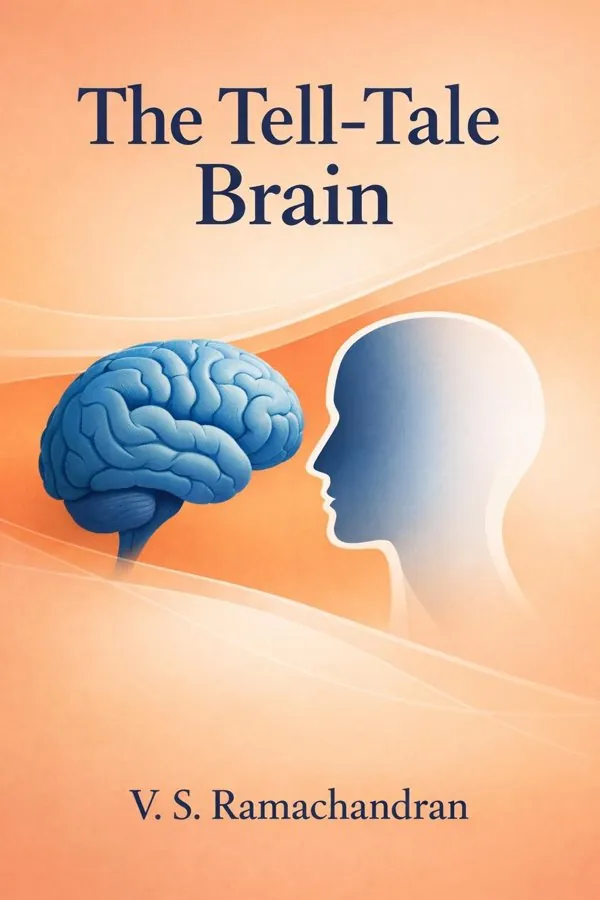
The Tell-Tale Brain: A Neuroscientist's Quest for What Makes Us Human: Summary & Key Insights
 10 min9 chaptersAudio available
What Is The Tell-Tale Brain: A Neuroscientist's Quest for What Makes Us Human About?
The Tell-Tale Brain: A Neuroscientist's Quest for What Makes Us Human by V. S. Ramachandran is a neuroscience book spanning 9 pages. In this groundbreaking work, neuroscientist V. S. Ramachandran explores the mysteries of the human brain and what makes us uniquely human. Drawing on case studies, experiments, and insights from neurology and psychology, he examines how the brain constructs our sense of self, creativity, and consciousness. The book delves into phenomena such as synesthesia, phantom limbs, and mirror neurons to reveal the intricate connections between brain structure and human experience.
This FizzRead summary covers all 9 key chapters of The Tell-Tale Brain: A Neuroscientist's Quest for What Makes Us Human in approximately 10 minutes, distilling the most important ideas, arguments, and takeaways from V. S. Ramachandran's work. Also available as an audio summary and Key Quotes Podcast.
The Tell-Tale Brain: A Neuroscientist's Quest for What Makes Us Human
In this groundbreaking work, neuroscientist V. S. Ramachandran explores the mysteries of the human brain and what makes us uniquely human. Drawing on case studies, experiments, and insights from neurology and psychology, he examines how the brain constructs our sense of self, creativity, and consciousness. The book delves into phenomena such as synesthesia, phantom limbs, and mirror neurons to reveal the intricate connections between brain structure and human experience.
Who Should Read The Tell-Tale Brain: A Neuroscientist's Quest for What Makes Us Human?
This book is perfect for anyone interested in neuroscience and looking to gain actionable insights in a short read. Whether you're a student, professional, or lifelong learner, the key ideas from The Tell-Tale Brain: A Neuroscientist's Quest for What Makes Us Human by V. S. Ramachandran will help you think differently.
- ✓Readers who enjoy neuroscience and want practical takeaways
- ✓Professionals looking to apply new ideas to their work and life
- ✓Anyone who wants the core insights of The Tell-Tale Brain: A Neuroscientist's Quest for What Makes Us Human in just 10 minutes
Want the full summary?
Get instant access to this book summary and 100K+ more with Fizz Moment.
Get Free SummaryAvailable on App Store • Free to download
Key Chapters
To understand what makes the human brain unique, we must first travel millions of years back in time. Our story begins with primates whose brains were scarcely more complex than those of today’s apes. Yet, somewhere along this evolutionary trajectory, the human brain began to balloon in size, particularly the neocortex — that thin sheet responsible for abstract thought, planning, art, and language. It is not simply the size, but the complex network of connections that allowed for emergent functions unimaginable in our primate cousins.
From an evolutionary standpoint, I have often emphasized that the pressures driving this expansion were not solely about tool use or survival; they were about social intelligence. Humans evolved as collaborative apes. Our ancestors thrived not merely because they could wield stones but because they could read each other’s intentions, build community, and communicate through gesture and expression. These new cognitive abilities required a brain that could simulate other minds — laying the seeds for language, culture, and morality.
When we examine how the visual and prefrontal cortices interact, we see a remarkable degree of re-purposing. Evolution, being a tinkerer rather than a designer, didn’t start from scratch. It built on older modules, co-opting brain circuits originally serving different purposes. For instance, the mirror neuron system that allows us to recognize and imitate actions might have evolved into a capacity for empathy and complex theory of mind. Thus, the human brain is a mosaic, a bricolage of adaptations layered over one another to produce a mind capable of imagination and reflection.
In studying the evolutionary story of the brain, one lesson becomes clear: every uniquely human trait — our art, humor, morality, and even our self-consciousness — owes its existence to this cascade of neural innovations. The brain did not merely grow; it became a self-referential storyteller, enabling its owner to ask, ‘Who am I?’
Among the most haunting experiences I have encountered in my clinical career is that of the phantom limb — a sensation so real that patients swear they can move, itch, or feel a limb that has long been amputated. Through the study of these phenomena, I realized that the brain does not merely receive signals from the body; it constructs a dynamic internal model of it, constantly updating and adjusting to change.
In the somatosensory cortex, each part of the body maps onto a corresponding region — the so-called cortical homunculus. But after injury or amputation, these representations do not disappear. Instead, adjacent areas can invade the now-silent region, leading to cross-wiring effects in which touching the face may evoke sensations in the missing hand. This extraordinary plasticity overturned the old notion that the adult brain is hardwired. It is, in fact, perpetually malleable, capable of reorganizing itself in response to experience.
Through simple but ingenious experiments, such as the mirror box, I helped patients “trick” their brains into seeing and moving their phantom limbs. By restoring visual feedback, the brain’s map of the body could sometimes recalibrate itself, alleviating pain or restoring a sense of wholeness. These insights not only transformed therapy for amputees but also demonstrated that our sense of self is largely a brain-generated simulation.
The broader implication is profound: your body, as you experience it, exists as a construct of neural representation. Whether or not a limb exists in reality is secondary to whether the brain believes it does. The lesson of the phantom is that the ‘self’ we feel in our bones is, in truth, a mirage created by the brain — a necessary fiction that allows us to move and interact coherently with the world.
+ 7 more chapters — available in the FizzRead app
All Chapters in The Tell-Tale Brain: A Neuroscientist's Quest for What Makes Us Human
About the Author
Vilayanur S. Ramachandran is an Indian-American neuroscientist known for his research in behavioral neurology and visual psychophysics. He is a professor at the University of California, San Diego, and director of the Center for Brain and Cognition. His work has contributed significantly to understanding brain plasticity, phantom limb sensations, and the neurological basis of human consciousness.
Get This Summary in Your Preferred Format
Read or listen to the The Tell-Tale Brain: A Neuroscientist's Quest for What Makes Us Human summary by V. S. Ramachandran anytime, anywhere. FizzRead offers multiple formats so you can learn on your terms — all free.
Available formats: App · Audio · PDF · EPUB — All included free with FizzRead
Download The Tell-Tale Brain: A Neuroscientist's Quest for What Makes Us Human PDF and EPUB Summary
Key Quotes from The Tell-Tale Brain: A Neuroscientist's Quest for What Makes Us Human
“To understand what makes the human brain unique, we must first travel millions of years back in time.”
Frequently Asked Questions about The Tell-Tale Brain: A Neuroscientist's Quest for What Makes Us Human
The Tell-Tale Brain: A Neuroscientist's Quest for What Makes Us Human by V. S. Ramachandran is a neuroscience book that explores key ideas across 9 chapters. In this groundbreaking work, neuroscientist V. S. Ramachandran explores the mysteries of the human brain and what makes us uniquely human. Drawing on case studies, experiments, and insights from neurology and psychology, he examines how the brain constructs our sense of self, creativity, and consciousness. The book delves into phenomena such as synesthesia, phantom limbs, and mirror neurons to reveal the intricate connections between brain structure and human experience.
You Might Also Like
Anxious
Joseph LeDoux
10 min
Hallucinations
Oliver Sacks
10 min
The Biological Mind: How Brain, Body, and Environment Collaborate to Make Us Who We Are
Alan Jasanoff
10 min
The Feeling of Life Itself: Why Consciousness Is Widespread but Can't Be Computed
Christof Koch
10 min
The No-Nonsense Meditation Book
Steven Laureys
10 min
A General Theory of Love
Thomas Lewis, Fari Amini, Richard Lannon
10 minBrowse by Category
Ready to read The Tell-Tale Brain: A Neuroscientist's Quest for What Makes Us Human?
Get the full summary and 100K+ more books with Fizz Moment.