
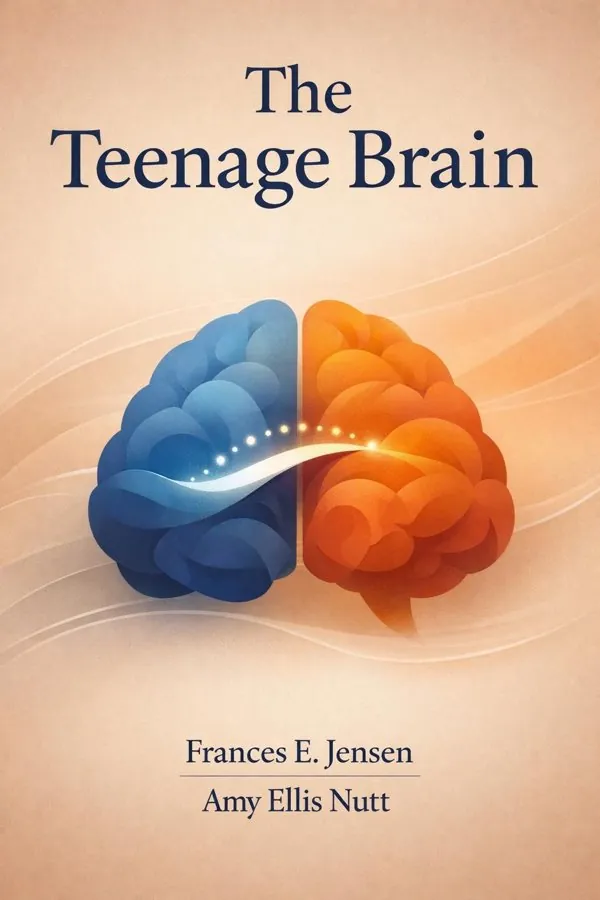
The Teenage Brain: A Neuroscientist's Survival Guide to Raising Adolescents and Young Adults: Summary & Key Insights
by Frances E. Jensen, Amy Ellis Nutt
 10 min11 chaptersAudio available
What Is The Teenage Brain: A Neuroscientist's Survival Guide to Raising Adolescents and Young Adults About?
The Teenage Brain: A Neuroscientist's Survival Guide to Raising Adolescents and Young Adults by Frances E. Jensen, Amy Ellis Nutt is a neuroscience book spanning 11 pages. Written by neuroscientist Frances E. Jensen with journalist Amy Ellis Nutt, this book explores the unique neurological development of the adolescent brain. It explains how teenagers think, learn, and make decisions differently from adults, offering insights for parents, educators, and teens themselves. The book combines cutting-edge neuroscience with practical advice on education, risk-taking, addiction, and emotional regulation during adolescence.
This FizzRead summary covers all 11 key chapters of The Teenage Brain: A Neuroscientist's Survival Guide to Raising Adolescents and Young Adults in approximately 10 minutes, distilling the most important ideas, arguments, and takeaways from Frances E. Jensen, Amy Ellis Nutt's work. Also available as an audio summary and Key Quotes Podcast.
The Teenage Brain: A Neuroscientist's Survival Guide to Raising Adolescents and Young Adults
Written by neuroscientist Frances E. Jensen with journalist Amy Ellis Nutt, this book explores the unique neurological development of the adolescent brain. It explains how teenagers think, learn, and make decisions differently from adults, offering insights for parents, educators, and teens themselves. The book combines cutting-edge neuroscience with practical advice on education, risk-taking, addiction, and emotional regulation during adolescence.
Who Should Read The Teenage Brain: A Neuroscientist's Survival Guide to Raising Adolescents and Young Adults?
This book is perfect for anyone interested in neuroscience and looking to gain actionable insights in a short read. Whether you're a student, professional, or lifelong learner, the key ideas from The Teenage Brain: A Neuroscientist's Survival Guide to Raising Adolescents and Young Adults by Frances E. Jensen, Amy Ellis Nutt will help you think differently.
- ✓Readers who enjoy neuroscience and want practical takeaways
- ✓Professionals looking to apply new ideas to their work and life
- ✓Anyone who wants the core insights of The Teenage Brain: A Neuroscientist's Survival Guide to Raising Adolescents and Young Adults in just 10 minutes
Want the full summary?
Get instant access to this book summary and 100K+ more with Fizz Moment.
Get Free SummaryAvailable on App Store • Free to download
Key Chapters
When we think of brain development, most of us imagine that by adolescence, the process is largely complete. This could not be further from the truth. The human brain is not fully mature until the mid-twenties. During adolescence, the brain undergoes a series of structural and functional refinements, particularly in the prefrontal cortex—the area responsible for reasoning, judgment, planning, and impulse control.
This delayed maturation means that while the emotional centers of the brain, such as the amygdala, are already highly active, the 'CEO' of the brain, the prefrontal cortex, is still wiring itself. This imbalance explains why teenagers often act on emotion before logic; they are literally operating on a brain whose regulatory systems are still calibrating. Their decisions can seem rash, their moods volatile, yet these patterns reflect a temporary but necessary developmental phase.
As we grow, our neurons communicate through electrochemical signals across synapses. In adolescence, those synaptic networks proliferate, connecting faster and in more complex patterns. This exuberant growth is what gives teens formidable learning potential—but also makes them prone to emotional overdrive. The brain’s white matter, which consists of myelinated axons, grows steadily into young adulthood, improving communication speed between regions. Until that process reaches maturity, a teenager may have to work harder to regulate impulses and manage long-term plans.
When parents and educators understand that the teenage brain is work-in-progress, they can begin responding with more patience and strategy rather than frustration. The teenager who forgets a responsibility or acts impulsively is not defying reason on purpose; their brain is still learning how to coordinate thought and emotion. The challenge is to hold them accountable without mistaking growth for defiance.
One of the fascinating features of adolescence is that the brain becomes both more efficient and more selective. This process, called synaptic pruning, involves trimming away weaker neural connections in order to strengthen the ones most used. Imagine a sculptor paring down marble to reveal the statue within—that’s what the adolescent brain is doing, refining itself based on experience and environment.
During childhood, the brain overproduces synaptic connections, creating a dense network primed for potential. But keeping all those connections active is metabolically expensive. As puberty unfolds, the brain identifies which connections are valuable—those linked to repeated practice, deep emotion, or critical skills—and it fortifies them. Meanwhile, pathways that aren’t reinforced begin to fade. This makes adolescence a time when habits, both beneficial and destructive, set like plaster.
Hand in hand with pruning comes myelination, the coating of neural axons with a fatty sheath called myelin that speeds up communication between cells. Myelination makes thinking faster, coordination more precise, and memory networks more stable. Yet, because myelination follows a back-to-front sequence in the brain, the prefrontal cortex—the seat of judgment—finishes last. That order partly explains the gap between teenage enthusiasm and adult foresight.
The takeaway from these processes is profound: experience sculpts the teen brain. Every hour of study, every skill practiced, every challenge faced is literally shaping their neural architecture. Environments rich in learning, curiosity, and support can hard-wire pathways that serve a lifetime. Conversely, neglect, chronic stress, or harmful habits can prune the wrong branches. Understanding this makes our role as guides critical; adolescence is not a time to step back but to engage deeply and consistently.
+ 9 more chapters — available in the FizzRead app
All Chapters in The Teenage Brain: A Neuroscientist's Survival Guide to Raising Adolescents and Young Adults
About the Authors
Frances E. Jensen, M.D., is a professor and chair of the Department of Neurology at the University of Pennsylvania’s Perelman School of Medicine. Her research focuses on brain development and neuroplasticity. Amy Ellis Nutt is a Pulitzer Prize–winning journalist and author specializing in science and health writing.
Get This Summary in Your Preferred Format
Read or listen to the The Teenage Brain: A Neuroscientist's Survival Guide to Raising Adolescents and Young Adults summary by Frances E. Jensen, Amy Ellis Nutt anytime, anywhere. FizzRead offers multiple formats so you can learn on your terms — all free.
Available formats: App · Audio · PDF · EPUB — All included free with FizzRead
Download The Teenage Brain: A Neuroscientist's Survival Guide to Raising Adolescents and Young Adults PDF and EPUB Summary
Key Quotes from The Teenage Brain: A Neuroscientist's Survival Guide to Raising Adolescents and Young Adults
“When we think of brain development, most of us imagine that by adolescence, the process is largely complete.”
“One of the fascinating features of adolescence is that the brain becomes both more efficient and more selective.”
Frequently Asked Questions about The Teenage Brain: A Neuroscientist's Survival Guide to Raising Adolescents and Young Adults
The Teenage Brain: A Neuroscientist's Survival Guide to Raising Adolescents and Young Adults by Frances E. Jensen, Amy Ellis Nutt is a neuroscience book that explores key ideas across 11 chapters. Written by neuroscientist Frances E. Jensen with journalist Amy Ellis Nutt, this book explores the unique neurological development of the adolescent brain. It explains how teenagers think, learn, and make decisions differently from adults, offering insights for parents, educators, and teens themselves. The book combines cutting-edge neuroscience with practical advice on education, risk-taking, addiction, and emotional regulation during adolescence.
You Might Also Like

Anxious
Joseph LeDoux
10 min
Hallucinations
Oliver Sacks
10 min
The Biological Mind: How Brain, Body, and Environment Collaborate to Make Us Who We Are
Alan Jasanoff
10 min
The Feeling of Life Itself: Why Consciousness Is Widespread but Can't Be Computed
Christof Koch
10 min
The No-Nonsense Meditation Book
Steven Laureys
10 min
A General Theory of Love
Thomas Lewis, Fari Amini, Richard Lannon
10 minBrowse by Category
Ready to read The Teenage Brain: A Neuroscientist's Survival Guide to Raising Adolescents and Young Adults?
Get the full summary and 100K+ more books with Fizz Moment.