
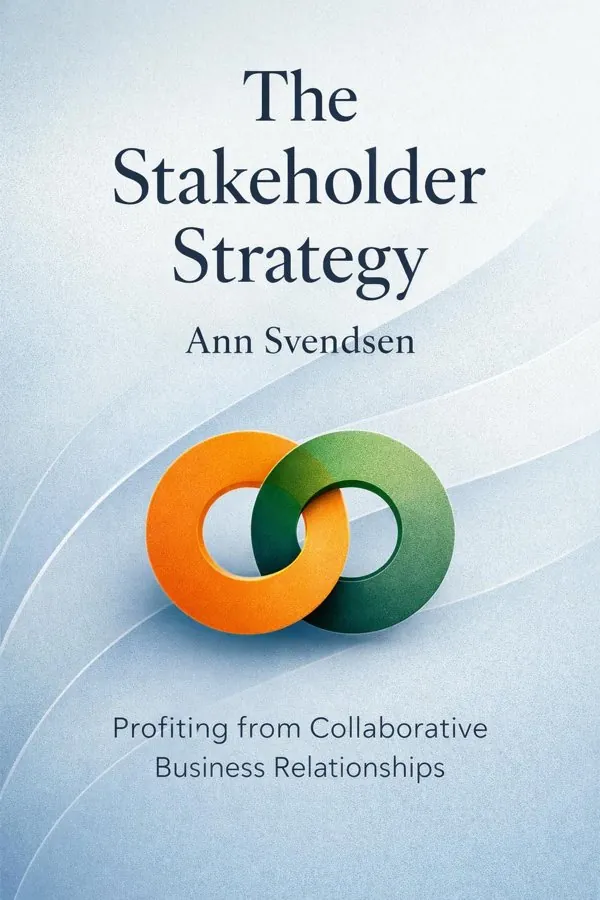
The Stakeholder Strategy: Profiting from Collaborative Business Relationships: Summary & Key Insights
by Ann Svendsen
 10 min7 chaptersAudio available
What Is The Stakeholder Strategy: Profiting from Collaborative Business Relationships About?
The Stakeholder Strategy: Profiting from Collaborative Business Relationships by Ann Svendsen is a leadership book spanning 7 pages. The Stakeholder Strategy introduces a collaborative approach to business management, emphasizing the importance of building mutually beneficial relationships with stakeholders. Ann Svendsen outlines practical frameworks for identifying, engaging, and maintaining partnerships that enhance corporate profitability and social responsibility. The book provides case studies and actionable models for integrating stakeholder collaboration into strategic decision-making.
This FizzRead summary covers all 7 key chapters of The Stakeholder Strategy: Profiting from Collaborative Business Relationships in approximately 10 minutes, distilling the most important ideas, arguments, and takeaways from Ann Svendsen's work. Also available as an audio summary and Key Quotes Podcast.
The Stakeholder Strategy: Profiting from Collaborative Business Relationships
The Stakeholder Strategy introduces a collaborative approach to business management, emphasizing the importance of building mutually beneficial relationships with stakeholders. Ann Svendsen outlines practical frameworks for identifying, engaging, and maintaining partnerships that enhance corporate profitability and social responsibility. The book provides case studies and actionable models for integrating stakeholder collaboration into strategic decision-making.
Who Should Read The Stakeholder Strategy: Profiting from Collaborative Business Relationships?
This book is perfect for anyone interested in leadership and looking to gain actionable insights in a short read. Whether you're a student, professional, or lifelong learner, the key ideas from The Stakeholder Strategy: Profiting from Collaborative Business Relationships by Ann Svendsen will help you think differently.
- ✓Readers who enjoy leadership and want practical takeaways
- ✓Professionals looking to apply new ideas to their work and life
- ✓Anyone who wants the core insights of The Stakeholder Strategy: Profiting from Collaborative Business Relationships in just 10 minutes
Want the full summary?
Get instant access to this book summary and 100K+ more with Fizz Moment.
Get Free SummaryAvailable on App Store • Free to download
Key Chapters
For decades, business thinking has been dominated by the logic of competition. The metaphor of 'the market as a battlefield' shaped every element of management—from marketing strategies to internal performance reviews. Yet, as global connectivity deepened and stakeholder expectations diversified, that model began to show cracks. Organizations found that pure competition could not address issues like sustainability, reputation, and social legitimacy. In truth, success in the twenty-first century depends on the ability to **collaborate intelligently**.
I argue that collaboration does not replace competitive drive but refines it. It repositions competition within a broader network where mutual success is possible. The old model treated all external groups as instruments for achieving internal goals; the new model recognizes them as partners in co-creating value. The transition from competition to collaboration asks leaders to rethink relationships—from adversarial negotiation toward shared exploration.
Consider the difference between a supplier squeezed for price and one invited to co-develop innovation. In the latter case, the company gains insights, stability, and a reputation for fairness; the supplier gains partnership, commitment, and profit. Both win, and the market rewards authenticity. In shifting to collaboration, businesses begin to see that their stakeholders possess essential intelligence that can drive efficiency, creativity, and resilience.
As I show throughout this book, collaborative enterprises outperform competitive ones in complex environments because they have access to wider knowledge networks and deeper trust reserves. This paradigm shift is not theoretical—it is observable in industries from technology to energy. The key is leadership capable of dialogue, empathy, and systems thinking: qualities traditionally considered 'soft' but now proved essential for hard results.
The term 'stakeholder' refers to anyone who affects or is affected by the activities of an organization. This inclusive definition embraces more than shareholders—it recognizes employees, customers, suppliers, local communities, governments, and even advocacy groups. Each carries expectations and capacities that influence organizational outcomes.
Through decades of consulting, I found that companies often overlook vital stakeholders simply because they do not appear on balance sheets. Yet, the attitudes and relationships of these uncounted groups shape the firm's license to operate. A community’s trust determines project approvals; a supplier’s reliability affects innovation cycles; an employee’s sense of belonging drives productivity. When these connections align through shared understanding, they create an ecosystem of resilience.
To manage this complexity, we must learn to map stakeholder networks. In the book, I present processes for identifying core, strategic, and peripheral stakeholders. This mapping reveals the flows of influence and the points of potential collaboration. Once understood, the map serves as a living strategic tool to help businesses anticipate concerns, build alliances, and sustain dialogue.
The challenge lies not in listing names but in grasping what matters to each group—its values, motivations, and measures of success. Only then can a company create mutual benefits. It is this recognition—the humanity behind every relationship—that transforms stakeholder management from obligation into opportunity.
+ 5 more chapters — available in the FizzRead app
All Chapters in The Stakeholder Strategy: Profiting from Collaborative Business Relationships
About the Author
Ann Svendsen is a management consultant and author specializing in stakeholder relations and corporate social responsibility. She has advised numerous organizations on developing collaborative strategies that align business success with social and environmental goals.
Get This Summary in Your Preferred Format
Read or listen to the The Stakeholder Strategy: Profiting from Collaborative Business Relationships summary by Ann Svendsen anytime, anywhere. FizzRead offers multiple formats so you can learn on your terms — all free.
Available formats: App · Audio · PDF · EPUB — All included free with FizzRead
Download The Stakeholder Strategy: Profiting from Collaborative Business Relationships PDF and EPUB Summary
Key Quotes from The Stakeholder Strategy: Profiting from Collaborative Business Relationships
“For decades, business thinking has been dominated by the logic of competition.”
“The term 'stakeholder' refers to anyone who affects or is affected by the activities of an organization.”
Frequently Asked Questions about The Stakeholder Strategy: Profiting from Collaborative Business Relationships
The Stakeholder Strategy: Profiting from Collaborative Business Relationships by Ann Svendsen is a leadership book that explores key ideas across 7 chapters. The Stakeholder Strategy introduces a collaborative approach to business management, emphasizing the importance of building mutually beneficial relationships with stakeholders. Ann Svendsen outlines practical frameworks for identifying, engaging, and maintaining partnerships that enhance corporate profitability and social responsibility. The book provides case studies and actionable models for integrating stakeholder collaboration into strategic decision-making.
You Might Also Like

Extreme Ownership
Jocko Willink
10 min
Dare to Lead
Brene Brown
10 min
Leaders Eat Last
Simon Sinek
10 min
The 21 Irrefutable Laws of Leadership
John Maxwell
10 min
Start With Why
Simon Sinek
10 min
How to Lead When You're Not in Charge
Clay Scroggins
10 minBrowse by Category
Ready to read The Stakeholder Strategy: Profiting from Collaborative Business Relationships?
Get the full summary and 100K+ more books with Fizz Moment.