
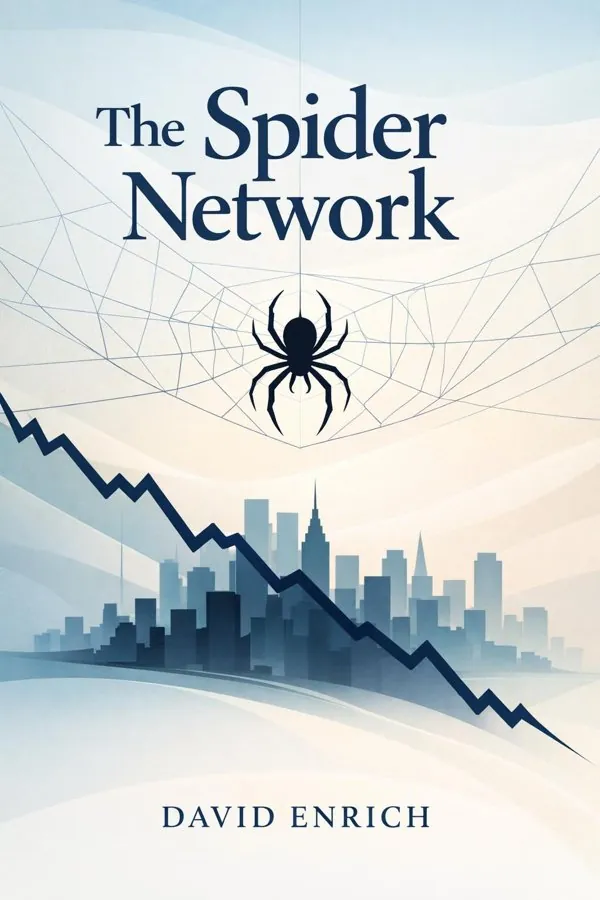
The Spider Network: The Wild Story of a Math Genius, a Gang of Backstabbing Bankers, and One of the Greatest Scams in Financial History: Summary & Key Insights
by David Enrich
 10 min4 chaptersAudio available
What Is The Spider Network: The Wild Story of a Math Genius, a Gang of Backstabbing Bankers, and One of the Greatest Scams in Financial History About?
The Spider Network: The Wild Story of a Math Genius, a Gang of Backstabbing Bankers, and One of the Greatest Scams in Financial History by David Enrich is a finance book spanning 4 pages. The Spider Network recounts the true story of Tom Hayes, a brilliant but socially awkward mathematician who became the central figure in the global LIBOR scandal. Through meticulous reporting, David Enrich exposes how a network of traders and bankers manipulated one of the world’s most important interest rates, revealing the culture of greed and moral compromise that pervaded high finance in the years leading up to the 2008 financial crisis.
This FizzRead summary covers all 4 key chapters of The Spider Network: The Wild Story of a Math Genius, a Gang of Backstabbing Bankers, and One of the Greatest Scams in Financial History in approximately 10 minutes, distilling the most important ideas, arguments, and takeaways from David Enrich's work. Also available as an audio summary and Key Quotes Podcast.
The Spider Network: The Wild Story of a Math Genius, a Gang of Backstabbing Bankers, and One of the Greatest Scams in Financial History
The Spider Network recounts the true story of Tom Hayes, a brilliant but socially awkward mathematician who became the central figure in the global LIBOR scandal. Through meticulous reporting, David Enrich exposes how a network of traders and bankers manipulated one of the world’s most important interest rates, revealing the culture of greed and moral compromise that pervaded high finance in the years leading up to the 2008 financial crisis.
Who Should Read The Spider Network: The Wild Story of a Math Genius, a Gang of Backstabbing Bankers, and One of the Greatest Scams in Financial History?
This book is perfect for anyone interested in finance and looking to gain actionable insights in a short read. Whether you're a student, professional, or lifelong learner, the key ideas from The Spider Network: The Wild Story of a Math Genius, a Gang of Backstabbing Bankers, and One of the Greatest Scams in Financial History by David Enrich will help you think differently.
- ✓Readers who enjoy finance and want practical takeaways
- ✓Professionals looking to apply new ideas to their work and life
- ✓Anyone who wants the core insights of The Spider Network: The Wild Story of a Math Genius, a Gang of Backstabbing Bankers, and One of the Greatest Scams in Financial History in just 10 minutes
Want the full summary?
Get instant access to this book summary and 100K+ more with Fizz Moment.
Get Free SummaryAvailable on App Store • Free to download
Key Chapters
Tom Hayes was, by all conventional measures, an unlikely criminal mastermind. He was a mathematician at heart—awkward in conversation, intensely logical, and obsessed with patterns. When he entered the world of high finance, first at UBS and later at Citigroup and other institutions, he found himself surrounded by personalities larger and noisier than his own. Yet his brilliance in derivatives trading quickly earned him a reputation as one of the most capable minds in the field. In a business ruled by volatility, Hayes brought precision and calm rationality.
The culture he entered was aggressively competitive. Traders lived by daily profit tallies, and success was rewarded not with quiet satisfaction but with lavish bonuses, public recognition, and loyalty from peers. Hayes learned fast that performance was everything and ethics were mostly window dressing. What began as a pursuit of efficiency and mastery soon evolved into a dangerous game—an unspoken competition over who could bend the system more effectively without getting caught.
LIBOR, an interest rate at the very heart of the global financial system, offered an irresistible opportunity. Used to price everything from student loans to mortgages and complex derivatives, it was based not on transactions but on estimates submitted by bankers about what they *would* pay to borrow from one another. Hayes noticed the gap between theory and practice. If those estimates could be gently influenced, billions could shift hands invisibly. He didn’t invent the idea of LIBOR manipulation; rather, he perfected it, joining a network of brokers and traders who communicated casually across banks through chatrooms and phone lines. They called in favors, nudged submissions, and celebrated tiny rate shifts that meant enormous profits downstream.
To Hayes, this was sophisticated mathematics meeting real-world impact. To regulators, later, it would look like conspiracy. But within the culture of trading, it felt like cooperation—just another day at work. He was a cog in a machine that rewarded wins and overlooked means. And in that distinction lay the heart of the coming disaster.
The LIBOR rate, on the surface, was a mundane calculation: each morning, a panel of banks submitted estimates of their borrowing costs; the highest and lowest were discarded, and the rest averaged. But in practice, this process wasn’t neutral—it relied on honesty within institutions built to maximize profit. Traders like Tom Hayes quickly discovered that if they could persuade colleagues in LIBOR-submitting teams to shade the numbers by just a fraction of a basis point, they could vastly improve their derivatives positions.
Through a network of cooperative brokers, text messages, and casual calls, Hayes coordinated these actions. The tone was often lighthearted: traders promised lunch, praise, or small favors in exchange for rate moves. The language of manipulation was wrapped in irony and camaraderie—a natural outcome of an environment that treated millions like pocket change. But under this surface banter lay a profound ethical collapse.
The spider network expanded as other traders from rival banks joined the enterprise, each benefiting from the shared manipulation. UBS, Citigroup, and Barclays—giants of modern finance—participated through informal coordination that blurred the line between competition and collusion. To most insiders, this was neither fraud nor corruption; it was symbiosis. They believed everyone did it.
Yet by the mid-2000s, whispers began circulating inside the industry. Internal compliance units occasionally raised questions, and still nothing changed. LIBOR’s very design—dependent on unverifiable input—made exploitation easy and detection hard. By the time the financial crisis hit in 2008, manipulation had become institutional habit. It was so woven into daily practice that few could imagine the market without it.
+ 2 more chapters — available in the FizzRead app
All Chapters in The Spider Network: The Wild Story of a Math Genius, a Gang of Backstabbing Bankers, and One of the Greatest Scams in Financial History
About the Author
David Enrich is an American journalist and author, currently serving as the finance editor at The New York Times. He is known for his investigative reporting on the banking industry and corporate misconduct, and has written several acclaimed books on financial scandals.
Get This Summary in Your Preferred Format
Read or listen to the The Spider Network: The Wild Story of a Math Genius, a Gang of Backstabbing Bankers, and One of the Greatest Scams in Financial History summary by David Enrich anytime, anywhere. FizzRead offers multiple formats so you can learn on your terms — all free.
Available formats: App · Audio · PDF · EPUB — All included free with FizzRead
Download The Spider Network: The Wild Story of a Math Genius, a Gang of Backstabbing Bankers, and One of the Greatest Scams in Financial History PDF and EPUB Summary
Key Quotes from The Spider Network: The Wild Story of a Math Genius, a Gang of Backstabbing Bankers, and One of the Greatest Scams in Financial History
“Tom Hayes was, by all conventional measures, an unlikely criminal mastermind.”
“The LIBOR rate, on the surface, was a mundane calculation: each morning, a panel of banks submitted estimates of their borrowing costs; the highest and lowest were discarded, and the rest averaged.”
Frequently Asked Questions about The Spider Network: The Wild Story of a Math Genius, a Gang of Backstabbing Bankers, and One of the Greatest Scams in Financial History
The Spider Network: The Wild Story of a Math Genius, a Gang of Backstabbing Bankers, and One of the Greatest Scams in Financial History by David Enrich is a finance book that explores key ideas across 4 chapters. The Spider Network recounts the true story of Tom Hayes, a brilliant but socially awkward mathematician who became the central figure in the global LIBOR scandal. Through meticulous reporting, David Enrich exposes how a network of traders and bankers manipulated one of the world’s most important interest rates, revealing the culture of greed and moral compromise that pervaded high finance in the years leading up to the 2008 financial crisis.
More by David Enrich

You Might Also Like

Browse by Category
Ready to read The Spider Network: The Wild Story of a Math Genius, a Gang of Backstabbing Bankers, and One of the Greatest Scams in Financial History?
Get the full summary and 100K+ more books with Fizz Moment.