
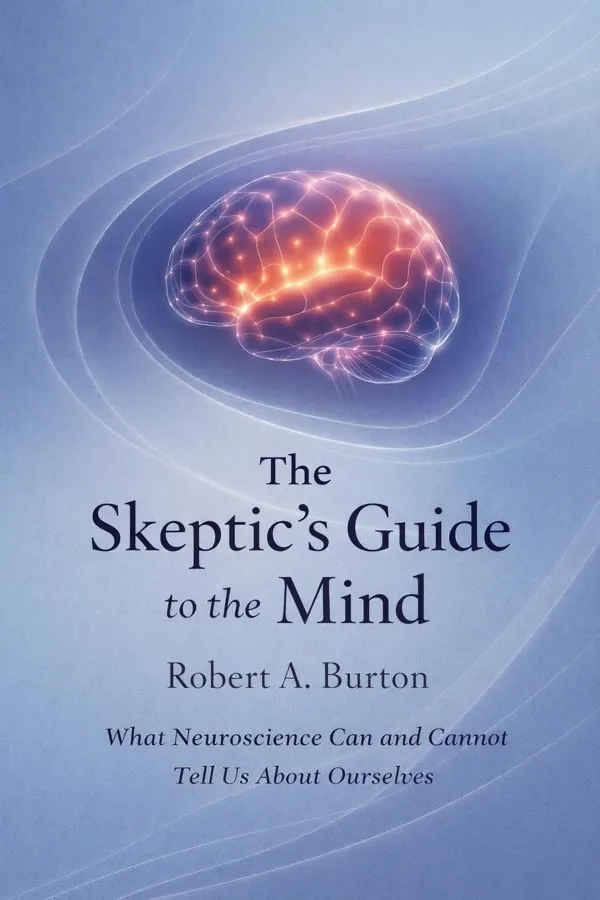
The Skeptic’s Guide to the Mind: What Neuroscience Can and Cannot Tell Us About Ourselves: Summary & Key Insights
 10 min11 chaptersAudio available
What Is The Skeptic’s Guide to the Mind: What Neuroscience Can and Cannot Tell Us About Ourselves About?
The Skeptic’s Guide to the Mind: What Neuroscience Can and Cannot Tell Us About Ourselves by Robert A. Burton is a neuroscience book spanning 11 pages. In this thought-provoking work, neurologist Robert A. Burton explores the limits of neuroscience in explaining human consciousness, belief, and self-awareness. He argues that while brain science has made remarkable progress, it cannot yet fully account for subjective experience or the nature of thought. Through accessible examples and critical analysis, Burton challenges the reader to reconsider what we can truly know about the mind and the boundaries of scientific inquiry.
This FizzRead summary covers all 11 key chapters of The Skeptic’s Guide to the Mind: What Neuroscience Can and Cannot Tell Us About Ourselves in approximately 10 minutes, distilling the most important ideas, arguments, and takeaways from Robert A. Burton's work. Also available as an audio summary and Key Quotes Podcast.
The Skeptic’s Guide to the Mind: What Neuroscience Can and Cannot Tell Us About Ourselves
In this thought-provoking work, neurologist Robert A. Burton explores the limits of neuroscience in explaining human consciousness, belief, and self-awareness. He argues that while brain science has made remarkable progress, it cannot yet fully account for subjective experience or the nature of thought. Through accessible examples and critical analysis, Burton challenges the reader to reconsider what we can truly know about the mind and the boundaries of scientific inquiry.
Who Should Read The Skeptic’s Guide to the Mind: What Neuroscience Can and Cannot Tell Us About Ourselves?
This book is perfect for anyone interested in neuroscience and looking to gain actionable insights in a short read. Whether you're a student, professional, or lifelong learner, the key ideas from The Skeptic’s Guide to the Mind: What Neuroscience Can and Cannot Tell Us About Ourselves by Robert A. Burton will help you think differently.
- ✓Readers who enjoy neuroscience and want practical takeaways
- ✓Professionals looking to apply new ideas to their work and life
- ✓Anyone who wants the core insights of The Skeptic’s Guide to the Mind: What Neuroscience Can and Cannot Tell Us About Ourselves in just 10 minutes
Want the full summary?
Get instant access to this book summary and 100K+ more with Fizz Moment.
Get Free SummaryAvailable on App Store • Free to download
Key Chapters
One of the most misleading sensations the human brain produces is the feeling of being right. In *The Skeptic’s Guide to the Mind*, I take pains to show how this feeling—so fundamental to our sense of identity—is not a reliable marker of truth. The brain does not simply process information; it constructs belief. Through a cascade of neural processes involving the prefrontal cortex, limbic system, and midbrain, the brain confers upon us the subjective experience of certainty. We feel something is true not because it objectively is, but because our brain delivers the emotional signature of conviction.
This illusion is pervasive, touching everything from our political ideologies to our personal memories. I discuss how patients with neurological damage sometimes cling to obviously false beliefs, convinced of their accuracy, a phenomenon neurologists call ‘confabulation.’ But the truth is that all of us, healthy or not, live within varying degrees of confabulated belief. The emotional texture of certainty has been evolutionarily preserved because it enables swift decision-making, not because it guarantees correctness. Recognizing this should make us humble in our convictions and more empathetic toward the certainty of others.
When we understand that certainty is an experience rather than a proof, we open the door to genuine skepticism. I urge readers to see doubt as not a weakness, but an intellectual safeguard—an adaptive countermeasure to the brain’s built-in bias toward confident illusion.
In examining thought, neuroscience has given us exquisite details about the firing of neurons, the synchrony of oscillations, and the flow of neurotransmitters. Yet, as I argue, knowing which regions light up when we think about love or solve a puzzle tells us almost nothing about what the subjective experience of thought feels like. There is a deep philosophical problem lurking behind the data: correlation is not comprehension. To say that a thought occurs when certain neurons fire is to describe a shadow, not the substance.
I walk readers through examples from clinical neurology where brain damage alters thinking in bizarre ways that defy mechanistic explanation. Some patients lose the sense of familiarity, others cease to feel emotions while retaining logic. These cases demonstrate that thought cannot be localized like a lesion; it is a dynamic property of a system too complex to reduce to its parts. Functional imaging gives us the footprints, but not the walker.
Recognizing this should inspire what I call respectful ignorance—the willingness to admit that our maps of neural activity are not the territory of subjective meaning. Just as seeing the sheet music doesn’t convey the music’s emotional resonance, seeing brain activity does not reveal how thought feels from within.
+ 9 more chapters — available in the FizzRead app
All Chapters in The Skeptic’s Guide to the Mind: What Neuroscience Can and Cannot Tell Us About Ourselves
About the Author
Robert A. Burton, M.D., is a neurologist and author known for his works on the intersection of neuroscience and philosophy. He served as Chief of Neurology at Mount Zion Hospital in San Francisco and has written extensively on how the brain constructs belief and certainty.
Get This Summary in Your Preferred Format
Read or listen to the The Skeptic’s Guide to the Mind: What Neuroscience Can and Cannot Tell Us About Ourselves summary by Robert A. Burton anytime, anywhere. FizzRead offers multiple formats so you can learn on your terms — all free.
Available formats: App · Audio · PDF · EPUB — All included free with FizzRead
Download The Skeptic’s Guide to the Mind: What Neuroscience Can and Cannot Tell Us About Ourselves PDF and EPUB Summary
Key Quotes from The Skeptic’s Guide to the Mind: What Neuroscience Can and Cannot Tell Us About Ourselves
“One of the most misleading sensations the human brain produces is the feeling of being right.”
“In examining thought, neuroscience has given us exquisite details about the firing of neurons, the synchrony of oscillations, and the flow of neurotransmitters.”
Frequently Asked Questions about The Skeptic’s Guide to the Mind: What Neuroscience Can and Cannot Tell Us About Ourselves
The Skeptic’s Guide to the Mind: What Neuroscience Can and Cannot Tell Us About Ourselves by Robert A. Burton is a neuroscience book that explores key ideas across 11 chapters. In this thought-provoking work, neurologist Robert A. Burton explores the limits of neuroscience in explaining human consciousness, belief, and self-awareness. He argues that while brain science has made remarkable progress, it cannot yet fully account for subjective experience or the nature of thought. Through accessible examples and critical analysis, Burton challenges the reader to reconsider what we can truly know about the mind and the boundaries of scientific inquiry.
You Might Also Like
Anxious
Joseph LeDoux
10 min
Hallucinations
Oliver Sacks
10 min
The Biological Mind: How Brain, Body, and Environment Collaborate to Make Us Who We Are
Alan Jasanoff
10 min
The Feeling of Life Itself: Why Consciousness Is Widespread but Can't Be Computed
Christof Koch
10 min
The No-Nonsense Meditation Book
Steven Laureys
10 min
A General Theory of Love
Thomas Lewis, Fari Amini, Richard Lannon
10 minBrowse by Category
Ready to read The Skeptic’s Guide to the Mind: What Neuroscience Can and Cannot Tell Us About Ourselves?
Get the full summary and 100K+ more books with Fizz Moment.