
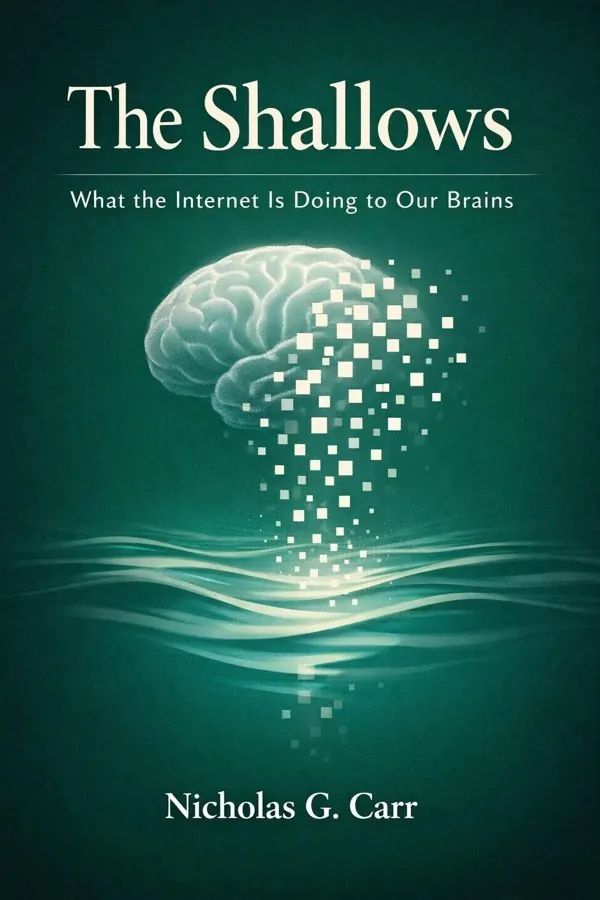
The Shallows: What the Internet Is Doing to Our Brains: Summary & Key Insights
 10 min8 chaptersAudio available
What Is The Shallows: What the Internet Is Doing to Our Brains About?
The Shallows: What the Internet Is Doing to Our Brains by Nicholas G. Carr is a digital_culture book spanning 8 pages. In this influential work, Nicholas Carr explores how the Internet is reshaping our brains and altering the way we think, read, and remember. Drawing on neuroscience and cultural history, Carr argues that the constant distractions of the digital world are eroding our capacity for deep focus and contemplation, replacing it with a more superficial mode of thought.
This FizzRead summary covers all 8 key chapters of The Shallows: What the Internet Is Doing to Our Brains in approximately 10 minutes, distilling the most important ideas, arguments, and takeaways from Nicholas G. Carr's work. Also available as an audio summary and Key Quotes Podcast.
The Shallows: What the Internet Is Doing to Our Brains
In this influential work, Nicholas Carr explores how the Internet is reshaping our brains and altering the way we think, read, and remember. Drawing on neuroscience and cultural history, Carr argues that the constant distractions of the digital world are eroding our capacity for deep focus and contemplation, replacing it with a more superficial mode of thought.
Who Should Read The Shallows: What the Internet Is Doing to Our Brains?
This book is perfect for anyone interested in digital_culture and looking to gain actionable insights in a short read. Whether you're a student, professional, or lifelong learner, the key ideas from The Shallows: What the Internet Is Doing to Our Brains by Nicholas G. Carr will help you think differently.
- ✓Readers who enjoy digital_culture and want practical takeaways
- ✓Professionals looking to apply new ideas to their work and life
- ✓Anyone who wants the core insights of The Shallows: What the Internet Is Doing to Our Brains in just 10 minutes
Want the full summary?
Get instant access to this book summary and 100K+ more with Fizz Moment.
Get Free SummaryAvailable on App Store • Free to download
Key Chapters
To understand the digital revolution, we must remember that every leap in technology reshapes the mental patterns of humanity. When maps were first introduced, they altered not just navigation but imagination itself—turning the vast, unknown world into abstractions on parchment. The clock disciplined our perception of time, dividing life into fragments, schedules, and mechanical precision. And then the printing press arrived, disciplining attention into long, linear reading—a mode that fostered reasoning, introspection, and the very shape of modern thought.
Throughout history, we have absorbed our tools into our minds. The medium doesn’t just deliver information—it changes the way we process it. The Gutenberg revolution trained generations to follow argument, to concentrate, to dwell in complexity. The Internet, by contrast, bombards us with stimuli, encouraging constant shifts of focus. As I trace these parallels, I emphasize that technology is never neutral. Each medium carries an intellectual bias: mapping privileges abstraction, the clock privileges precision, print privileges depth. The Internet privileges immediacy.
This historical lens reminds us that our current transformation follows an ancient rhythm. What distinguishes our moment is speed and scale—the neurological consequences are measurable within a single lifespan. We are witnessing the most rapid cognitive reengineering in the record of human culture.
Print culture trained us to follow the writer’s mind slowly, step by step. A book demands time. It rewards patience. When we read deeply, we engage in a silent dialogue with ideas; our mind builds conceptual bridges, storing insights and reflections. This depth is not automatic—it was cultivated through centuries of literary tradition.
Digital reading, however, is a different experience. The hyperlinked structure of the Internet invites us to jump rather than to dwell. We skim headlines, we scroll feeds, we browse fragments. Each click fractures continuity. The attention once sustained over paragraphs is now divided among tabs, updates, and alerts. Studies I cite show that comprehension declines when reading on screens, not because the text changes, but because the medium encourages multitasking. The Internet’s design, fostering constant novelty, trains our minds not to persist but to seek stimulation.
I illustrate this shift with personal reflection: where I once found pleasure in long stretches of prose, now my thoughts hunger for the next link. Reading becomes grazing—a hunt for snippets rather than synthesis. What once was a contemplative act has turned into a restless one. This doesn’t mean we can’t read deeply online—it means we must fight against the current to do so.
+ 6 more chapters — available in the FizzRead app
All Chapters in The Shallows: What the Internet Is Doing to Our Brains
About the Author
Nicholas G. Carr is an American writer who has published widely on technology, culture, and economics. He is best known for his books and essays examining the social and cognitive effects of the Internet, including 'The Shallows' and 'The Glass Cage'.
Get This Summary in Your Preferred Format
Read or listen to the The Shallows: What the Internet Is Doing to Our Brains summary by Nicholas G. Carr anytime, anywhere. FizzRead offers multiple formats so you can learn on your terms — all free.
Available formats: App · Audio · PDF · EPUB — All included free with FizzRead
Download The Shallows: What the Internet Is Doing to Our Brains PDF and EPUB Summary
Key Quotes from The Shallows: What the Internet Is Doing to Our Brains
“To understand the digital revolution, we must remember that every leap in technology reshapes the mental patterns of humanity.”
“Print culture trained us to follow the writer’s mind slowly, step by step.”
Frequently Asked Questions about The Shallows: What the Internet Is Doing to Our Brains
The Shallows: What the Internet Is Doing to Our Brains by Nicholas G. Carr is a digital_culture book that explores key ideas across 8 chapters. In this influential work, Nicholas Carr explores how the Internet is reshaping our brains and altering the way we think, read, and remember. Drawing on neuroscience and cultural history, Carr argues that the constant distractions of the digital world are eroding our capacity for deep focus and contemplation, replacing it with a more superficial mode of thought.
You Might Also Like
An Ugly Truth: Inside Facebook’s Battle for Domination
Sheera Frenkel, Cecilia Kang
10 min
Cyber Citizens
Ian Goodfellow
10 min
Digital Minimalism: Choosing a Focused Life in a Noisy World
Cal Newport
10 min
E‑Books & Beyond
Various Authors
10 min
The Future of Media
Various Authors
10 min
This Is Why We Can't Have Nice Things
Whitney Phillips
10 minBrowse by Category
Ready to read The Shallows: What the Internet Is Doing to Our Brains?
Get the full summary and 100K+ more books with Fizz Moment.