
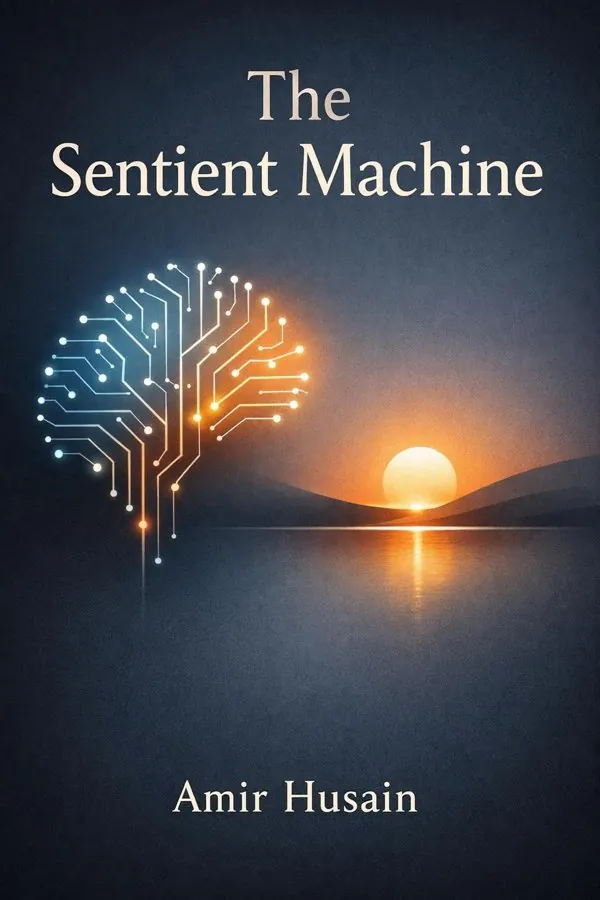
The Sentient Machine: The Coming Age of Artificial Intelligence: Summary & Key Insights
by Amir Husain
 10 min11 chaptersAudio available
What Is The Sentient Machine: The Coming Age of Artificial Intelligence About?
The Sentient Machine: The Coming Age of Artificial Intelligence by Amir Husain is a ai_ml book spanning 11 pages. In this thought-provoking work, Amir Husain explores the rise of artificial intelligence and its profound implications for humanity. He examines how intelligent machines are transforming industries, reshaping economies, and challenging our understanding of consciousness and creativity. The book offers both a visionary and cautionary perspective on the coming age of AI, urging readers to consider how society can coexist with increasingly autonomous systems.
This FizzRead summary covers all 11 key chapters of The Sentient Machine: The Coming Age of Artificial Intelligence in approximately 10 minutes, distilling the most important ideas, arguments, and takeaways from Amir Husain's work. Also available as an audio summary and Key Quotes Podcast.
The Sentient Machine: The Coming Age of Artificial Intelligence
In this thought-provoking work, Amir Husain explores the rise of artificial intelligence and its profound implications for humanity. He examines how intelligent machines are transforming industries, reshaping economies, and challenging our understanding of consciousness and creativity. The book offers both a visionary and cautionary perspective on the coming age of AI, urging readers to consider how society can coexist with increasingly autonomous systems.
Who Should Read The Sentient Machine: The Coming Age of Artificial Intelligence?
This book is perfect for anyone interested in ai_ml and looking to gain actionable insights in a short read. Whether you're a student, professional, or lifelong learner, the key ideas from The Sentient Machine: The Coming Age of Artificial Intelligence by Amir Husain will help you think differently.
- ✓Readers who enjoy ai_ml and want practical takeaways
- ✓Professionals looking to apply new ideas to their work and life
- ✓Anyone who wants the core insights of The Sentient Machine: The Coming Age of Artificial Intelligence in just 10 minutes
Want the full summary?
Get instant access to this book summary and 100K+ more with Fizz Moment.
Get Free SummaryAvailable on App Store • Free to download
Key Chapters
Human history is punctuated by unavoidable revolutions. Fire and tools made survival possible; electricity extended our reach; computation began to redefine thought itself. Artificial intelligence belongs naturally within this continuum. When I speak of inevitability, I do not mean predestination—but rather the logical outcome of human innovation. As our curiosity deepened, we built systems that could simulate language, vision, and decision-making. We did this first to understand ourselves better, then to conquer complexity beyond what a human mind could handle.
Machine cognition emerged when data became ubiquitous. Sensors, networks, and digital storage created an ocean of information. From that ocean, algorithms began to fish insights, patterns, and predictions. Each success accelerated the next: when we trained machines to play Go, translate language, and pilot drones, we glimpsed the raw power of learning systems unconstrained by human fatigue or bias. This evolution followed the same arc as all transformations—at first misunderstood and feared, later integrated, and finally indispensable.
There is nothing mystical in AI’s inevitability; it arises from the same impulse that drew our ancestors to shape stones into tools. Intelligence is a survival mechanism. If machines can amplify that mechanism, evolution will embrace the result. We are now at the stage where digital intelligence becomes the scaffolding for every decision we make—from commerce to medicine, from warfare to art. The transformative force of AI lies not in its novelty, but in its constancy: it keeps learning, refining, and expanding every moment of interaction.
This opening recognition—that AI’s ascent is a natural continuity—sets the tone for the journey ahead. It allows us to understand not only what machines do, but why they do it, and more importantly, what their presence means for the human condition.
+ 9 more chapters — available in the FizzRead app
All Chapters in The Sentient Machine: The Coming Age of Artificial Intelligence
About the Author
Amir Husain is a Pakistani-American entrepreneur, inventor, and author known for his work in artificial intelligence. He is the founder and CEO of SparkCognition, an AI technology company, and has been recognized for his contributions to the field of machine learning and cognitive computing.
Get This Summary in Your Preferred Format
Read or listen to the The Sentient Machine: The Coming Age of Artificial Intelligence summary by Amir Husain anytime, anywhere. FizzRead offers multiple formats so you can learn on your terms — all free.
Available formats: App · Audio · PDF · EPUB — All included free with FizzRead
Download The Sentient Machine: The Coming Age of Artificial Intelligence PDF and EPUB Summary
Key Quotes from The Sentient Machine: The Coming Age of Artificial Intelligence
“Human history is punctuated by unavoidable revolutions.”
“Each great technological revolution redefines what human labor and creativity mean.”
Frequently Asked Questions about The Sentient Machine: The Coming Age of Artificial Intelligence
The Sentient Machine: The Coming Age of Artificial Intelligence by Amir Husain is a ai_ml book that explores key ideas across 11 chapters. In this thought-provoking work, Amir Husain explores the rise of artificial intelligence and its profound implications for humanity. He examines how intelligent machines are transforming industries, reshaping economies, and challenging our understanding of consciousness and creativity. The book offers both a visionary and cautionary perspective on the coming age of AI, urging readers to consider how society can coexist with increasingly autonomous systems.
You Might Also Like
Life 3.0
Max Tegmark
10 min
Superintelligence
Nick Bostrom
10 min
TensorFlow in Action
Thushan Ganegedara
10 min
AI Made Simple: A Beginner’s Guide to Generative AI, ChatGPT, and the Future of Work
Rajeev Kapur
10 min
AI Snake Oil
Arvind Narayanan, Sayash Kapoor
10 min
AI Superpowers: China, Silicon Valley, and the New World Order
Kai-Fu Lee
10 minBrowse by Category
Ready to read The Sentient Machine: The Coming Age of Artificial Intelligence?
Get the full summary and 100K+ more books with Fizz Moment.