
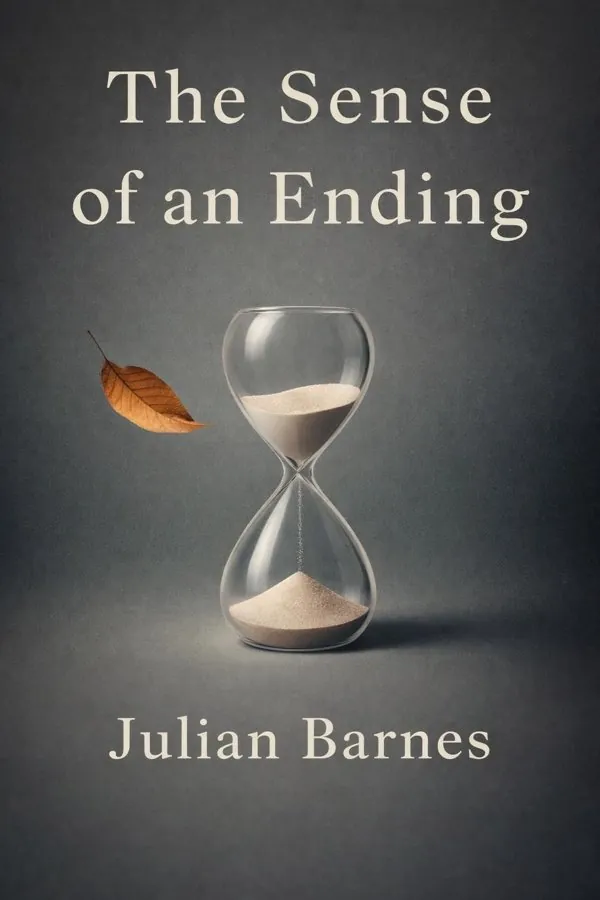
The Sense of an Ending: Summary & Key Insights
 10 min8 chaptersAudio available
Key Takeaways from The Sense of an Ending
We often imagine youth as a time of openness, yet it is also when we begin rehearsing the versions of ourselves we will later defend.
Intimacy often reveals not what we know about another person, but how much we project onto them.
Aging does not merely change what we remember; it changes the meaning we assign to what we remember.
Sometimes a life changes not through a dramatic event, but through the arrival of evidence.
The most painful truths are often not new facts, but new meanings attached to old facts.
What Is The Sense of an Ending About?
The Sense of an Ending by Julian Barnes is a classics book spanning 4 pages. Julian Barnes’s The Sense of an Ending is a slim novel with the force of a moral reckoning. On the surface, it tells the story of Tony Webster, a retired and seemingly ordinary man who looks back on his schooldays, his first serious relationship, and the suicide of a brilliant friend. But what begins as a calm recollection becomes something far more unsettling: an inquiry into memory, self-deception, guilt, and the stories people construct in order to live with themselves. When Tony receives an unexpected bequest linked to his past, he is compelled to revisit events he thought he understood, only to discover that time has not clarified his life so much as edited it. What makes the novel enduring is its precision. Barnes is less interested in dramatic twists than in the quiet ways people revise history, soften blame, and mistake partial knowledge for truth. The book matters because it captures a universal experience: realizing that our most confident memories may be incomplete or self-serving. Barnes, one of contemporary Britain’s most admired novelists and the 2011 Booker Prize winner for this work, brings philosophical sharpness and emotional restraint to a story that asks how well any of us really know our own past.
This FizzRead summary covers all 8 key chapters of The Sense of an Ending in approximately 10 minutes, distilling the most important ideas, arguments, and takeaways from Julian Barnes's work. Also available as an audio summary and Key Quotes Podcast.
The Sense of an Ending
Julian Barnes’s The Sense of an Ending is a slim novel with the force of a moral reckoning. On the surface, it tells the story of Tony Webster, a retired and seemingly ordinary man who looks back on his schooldays, his first serious relationship, and the suicide of a brilliant friend. But what begins as a calm recollection becomes something far more unsettling: an inquiry into memory, self-deception, guilt, and the stories people construct in order to live with themselves. When Tony receives an unexpected bequest linked to his past, he is compelled to revisit events he thought he understood, only to discover that time has not clarified his life so much as edited it.
What makes the novel enduring is its precision. Barnes is less interested in dramatic twists than in the quiet ways people revise history, soften blame, and mistake partial knowledge for truth. The book matters because it captures a universal experience: realizing that our most confident memories may be incomplete or self-serving. Barnes, one of contemporary Britain’s most admired novelists and the 2011 Booker Prize winner for this work, brings philosophical sharpness and emotional restraint to a story that asks how well any of us really know our own past.
Who Should Read The Sense of an Ending?
This book is perfect for anyone interested in classics and looking to gain actionable insights in a short read. Whether you're a student, professional, or lifelong learner, the key ideas from The Sense of an Ending by Julian Barnes will help you think differently.
- ✓Readers who enjoy classics and want practical takeaways
- ✓Professionals looking to apply new ideas to their work and life
- ✓Anyone who wants the core insights of The Sense of an Ending in just 10 minutes
Want the full summary?
Get instant access to this book summary and 100K+ more with Fizz Moment.
Get Free SummaryAvailable on App Store • Free to download
Key Chapters
We often imagine youth as a time of openness, yet it is also when we begin rehearsing the versions of ourselves we will later defend. Tony Webster starts his story with schooldays shared with a small circle of bright, self-conscious boys, among them the dazzling and intellectually serious Adrian Finn. Their conversations are full of history, philosophy, and moral speculation, giving them the comforting illusion that intelligence is maturity. They debate responsibility and causation as if life were an argument to be solved. But Barnes shows that youthful thoughtfulness can mask emotional naivete. These boys are forming not only opinions, but identities, and those identities are still brittle.
This early section matters because it establishes the gap between how people see themselves and how they actually behave. Tony remembers his younger self as moderately decent, observant, and slightly passive. Yet even in these early recollections, the reader senses omission and smoothing-over. Friendship in the novel is not merely companionship; it is a mirror in which each person seeks confirmation of his own worth. Adrian’s brilliance gives the group seriousness, while Tony’s ordinariness lets him avoid deep scrutiny.
In practical terms, Barnes invites readers to think about how formative environments shape lifelong self-narratives. Many people still define themselves by school friendships, first reputations, and adolescent hierarchies, even decades later. We continue to say, in effect, “I am the kind of person I was becoming back then,” without noticing how selective that memory may be.
Actionable takeaway: Revisit one defining story you tell about your younger self and ask not just whether it is true, but what it conveniently leaves out.
Intimacy often reveals not what we know about another person, but how much we project onto them. Tony’s relationship with Veronica Ford is one of the novel’s most important emotional strands because it exposes the limits of interpretation. Tony remembers Veronica as enigmatic, withholding, and faintly superior. Their courtship is awkward, sexually frustrated, and marked by class-coded discomforts and emotional mismatch. He feels judged by her family, puzzled by her signals, and unable to secure the clarity he wants. In his memory, he is mostly a confused but reasonable young man caught in a relationship he cannot decode.
Barnes uses this romance to show how misunderstanding becomes narrative. Tony explains Veronica rather than understanding her. He turns uncertainty into a fixed view of her character: difficult, manipulative, obscure. But this simplification says as much about Tony’s needs as about Veronica herself. When she later becomes involved with Adrian, Tony feels betrayed and responds with bitterness. A relationship that might have remained one youthful disappointment becomes morally consequential because resentment hardens into judgment.
The broader application is strikingly contemporary. People often leave relationships carrying a story that protects their dignity: the other person was impossible, cold, confusing, unfair. Sometimes that story contains truth, but it may also conceal our impatience, vanity, or unwillingness to confront emotional complexity. Misunderstanding becomes especially dangerous when we convert private hurt into certainty about another person’s motives.
Barnes suggests that failed relationships do not end when they end; they continue inside memory, where they are edited, rehearsed, and weaponized. The question is not simply who was right, but what later life costs us when we cling to a flattering version of our own innocence.
Actionable takeaway: When reflecting on a painful relationship, try rewriting the story once from the other person’s possible perspective before settling on your final judgment.
Aging does not merely change what we remember; it changes the meaning we assign to what we remember. In The Sense of an Ending, Tony’s later life appears calm, almost uneventful. He is retired, divorced but on good terms with his ex-wife, and settled into routines that suggest moderation and decency. This quiet present gives him the confidence to believe he has become a reliable interpreter of his past. Yet Barnes shows that age can create not wisdom alone, but narrative comfort. Tony’s older self is less passionate than his younger self, but not necessarily more truthful.
This is one of the novel’s most subtle ideas. We tend to imagine that time clarifies. Distance, we say, brings perspective. Barnes complicates that assumption by suggesting that distance may also dull sharp edges, minimize guilt, and transform active harm into passive regret. Tony does not remember his life as a liar would. He remembers it as many ordinary people do: selectively, defensively, and with enough sincerity to make the distortions hard to detect. His calm voice is itself part of the novel’s strategy, because it tempts readers to trust him.
In practical life, this insight has wide reach. Families, former friends, and ex-partners often discover that they remember the same event in incompatible ways. Over time, each person creates a version that fits the identity they want to preserve: the dutiful child, the misunderstood spouse, the generous friend. These revisions are not always conscious. They are often the psyche’s way of making life bearable.
Barnes’s achievement lies in showing that maturity includes recognizing the instability of one’s own testimony. The past does not sit waiting like a file in a cabinet. It is continuously reauthored by the present self.
Actionable takeaway: The next time you feel certain about an old memory, ask what your current identity gains from remembering it that way.
Sometimes a life changes not through a dramatic event, but through the arrival of evidence. The novel’s plot turns when Tony receives a solicitor’s letter informing him that Veronica’s mother has left him a small sum of money and, more importantly, Adrian’s diary. That diary, however, remains out of reach, in Veronica’s possession. This bequest is not just a mystery device; it is the mechanism by which the past refuses to stay settled. Tony is forced to ask why Veronica’s mother remembered him, why Adrian’s private writings matter, and what still remains unresolved in a story he believed was long over.
The diary carries symbolic power. Diaries promise access to truth because they seem immediate, intimate, and unfiltered. Tony imagines that Adrian’s writing might explain motives, justify actions, and solve the puzzle of his suicide. Barnes cleverly uses this desire to explore a familiar human impulse: when our memory wavers, we crave documents, messages, letters, and records that can stabilize reality. Yet the novel resists the fantasy that a single document can fully redeem uncertainty. Even when evidence emerges, interpretation remains contested.
This has practical relevance in an age saturated with digital traces. Emails, screenshots, and old messages often feel like objective proof, but they do not automatically produce understanding. A text can confirm wording while obscuring tone; a diary can reveal a thought while hiding a larger context. Facts matter, but they do not remove the burden of moral interpretation.
The bequest also serves as a psychological summons. Tony is not merely invited to remember; he is compelled to reconsider. What he seeks in Adrian’s diary is not information alone, but absolution. Barnes suggests that our hunger for the truth is often inseparable from our hope that the truth will exonerate us.
Actionable takeaway: When searching for evidence from the past, notice whether you are seeking understanding—or simply looking for proof that you were right.
The most painful truths are often not new facts, but new meanings attached to old facts. As Tony pursues Veronica and the missing diary, he gradually uncovers the inadequacy of his earlier version of events. What he had treated as a sad but distant episode involving Adrian’s suicide and Veronica’s complexity begins to look like a chain of consequences in which his own actions mattered more than he admitted. The late revelations in the novel do not function as sensational twists for their own sake. Instead, they expose how self-image depends on omission.
Barnes is especially interested in guilt that arrives belatedly. Immediate guilt can provoke apology or repair, but delayed guilt is harder to metabolize because the moment for action has passed. Tony must confront the possibility that a cruel letter written in youthful bitterness had moral weight far beyond what he allowed himself to remember. This realization is devastating precisely because it implicates ordinary malice rather than monstrous evil. The novel insists that harm is not always theatrical. A few sentences, written with spite and then forgotten by the sender, can echo through other lives.
This theme applies to everyday conduct. Many people carry a flattering distinction between what they meant and what they did. They tell themselves that a harsh email, a careless betrayal, or a dismissive remark was “just” anger, sarcasm, or immaturity. Barnes pushes readers to recognize that intention does not erase consequence. Nor does the passage of time automatically reduce responsibility.
What makes the revelation morally rich is that it does not restore clean certainty. Tony learns more, but not everything. The novel preserves ambiguity while still demanding accountability. In life too, we rarely receive complete explanations before judgment becomes necessary.
Actionable takeaway: Think of one past action you have minimized because it was long ago, and ask what its consequences may have been from the other side.
Memory feels private, but it is one of the most persuasive forms of self-argument. Throughout the novel, Barnes demonstrates that remembering is not passive retrieval. Tony does not open a vault and report what he finds; he reconstructs, edits, and arranges. He fills gaps, softens tones, and emphasizes details that support coherence. The result is a voice that sounds candid while remaining deeply unreliable. This is not because Tony is uniquely deceptive, but because memory itself is shaped by emotion, shame, pride, and repetition.
The novel’s brilliance lies in making readers experience this instability rather than merely telling them about it. As Tony’s account shifts, we see how people create moral continuity for themselves. They remember being “young,” “upset,” or “confused” in ways that frame misconduct as understandable. They forget exact words while preserving exculpatory feelings. They retain grievances vividly while allowing their own offenses to blur. In this sense, memory is not a camera but a collaborator.
This insight is useful beyond literature. In workplaces, families, and public life, conflicts often persist because each party trusts memory as if it were neutral evidence. But recollection is vulnerable to rehearsal: the more often we tell a story, the more polished and convincing it becomes, even to ourselves. Recognizing this does not mean abandoning truth. It means approaching our own certainty with humility.
Barnes also distinguishes between factual memory and ethical memory. You may remember events incorrectly, but you may also remember them in a way that protects your conscience. That second distortion can be even more consequential because it shapes character. To remember badly is human; to refuse correction is moral failure.
Actionable takeaway: In any unresolved conflict, separate what you know happened from what you have inferred, and treat those two categories differently.
One of the novel’s quiet achievements is its link between personal memory and the study of history. Early in the book, Tony and his school friends discuss history in abstract terms, considering causation, responsibility, and the difference between what happened and what gets recorded. These conversations are not decorative intellectualism. They establish the novel’s central analogy: a life, like history, is shaped by competing interpretations, incomplete records, and the bias of whoever tells it.
Adrian, especially, brings philosophical rigor to these discussions. He seems able to think beyond cliché, to ask what responsibility means when actions ripple outward in unforeseeable ways. Tony admires him, but perhaps also uses Adrian’s brilliance as a way of staying one step removed from moral seriousness himself. Later, when Tony tries to understand his own past, he is forced into the role of historian, sorting fragmentary evidence and confronting the possibility that his prior account resembled propaganda more than truth.
The practical application is powerful. We all act as historians of our own lives. We assign causes: “That relationship failed because she was impossible,” “My family was cold,” “I never knew what was going on.” These interpretations may contain truth, but they are still interpretations. Barnes reminds us that responsibility begins when we question the narratives that most flatter us.
The novel also suggests that explanation is not the same as exoneration. Understanding how an event happened does not cancel the human cost. Good history, whether public or private, demands both context and moral clarity. Without context, we become simplistic; without moral clarity, we become evasive.
Actionable takeaway: When recounting a major event from your life, ask yourself what evidence a skeptical historian would require before accepting your version.
Not every life is outwardly dramatic, yet every life contains buried moral complexity. Tony Webster is not a hero, villain, or extraordinary sufferer. He is deliberately ordinary: educated, moderately successful, emotionally restrained, and largely unremarkable. Barnes chooses such a narrator to argue that ethical seriousness does not belong only to spectacular lives. Quiet people with conventional biographies are just as capable of self-deception, injury, and belated awakening.
This matters because literature often trains readers to look for significance in extremes. Barnes does the opposite. He finds existential weight in retirement, in old letters, in awkward visits, in the afterlife of youthful resentment. Tony’s life appears manageable because he has reduced it to manageable terms. The novel gradually reveals the cost of that reduction. His normalcy is not innocence; it is a setting in which avoidance can flourish unnoticed.
In everyday experience, many people assume that because they have not committed spectacular wrongs, they are fundamentally in the clear. But moral life is not measured only by crises. It is shaped by how we speak when hurt, how we remember when challenged, and whether we accept discomforting truths when they arrive. Barnes suggests that what finally defines a person is not whether he was ever mistaken, but whether he can bear to revise himself.
This idea is oddly liberating. If ordinary life contains moral depth, then ordinary reflection matters too. One does not need a public scandal or dramatic downfall to undertake serious self-examination. Small reconsiderations, honest admissions, and revised judgments can themselves be profound acts.
Actionable takeaway: Do not wait for a major life collapse to examine your conscience; review the small stories you tell about being “basically decent” and test them for convenience.
All Chapters in The Sense of an Ending
About the Author
Julian Barnes is an acclaimed English novelist, essayist, and critic born in Leicester in 1946. Educated at the City of London School and Magdalen College, Oxford, he became one of the most respected voices in contemporary British literature. Barnes is known for his polished prose, intellectual elegance, and ability to blend philosophical reflection with emotional precision. His major works include Flaubert’s Parrot, Arthur & George, England, England, and Levels of Life. Across his writing, he frequently explores themes such as memory, love, art, history, and mortality. In 2011, he won the Man Booker Prize for The Sense of an Ending, a novel widely praised for its subtle treatment of self-deception and moral reckoning. Barnes remains celebrated for fiction that is both formally controlled and deeply humane.
Get This Summary in Your Preferred Format
Read or listen to the The Sense of an Ending summary by Julian Barnes anytime, anywhere. FizzRead offers multiple formats so you can learn on your terms — all free.
Available formats: App · Audio · PDF · EPUB — All included free with FizzRead
Download The Sense of an Ending PDF and EPUB Summary
Key Quotes from The Sense of an Ending
“We often imagine youth as a time of openness, yet it is also when we begin rehearsing the versions of ourselves we will later defend.”
“Intimacy often reveals not what we know about another person, but how much we project onto them.”
“Aging does not merely change what we remember; it changes the meaning we assign to what we remember.”
“Sometimes a life changes not through a dramatic event, but through the arrival of evidence.”
“The most painful truths are often not new facts, but new meanings attached to old facts.”
Frequently Asked Questions about The Sense of an Ending
The Sense of an Ending by Julian Barnes is a classics book that explores key ideas across 8 chapters. Julian Barnes’s The Sense of an Ending is a slim novel with the force of a moral reckoning. On the surface, it tells the story of Tony Webster, a retired and seemingly ordinary man who looks back on his schooldays, his first serious relationship, and the suicide of a brilliant friend. But what begins as a calm recollection becomes something far more unsettling: an inquiry into memory, self-deception, guilt, and the stories people construct in order to live with themselves. When Tony receives an unexpected bequest linked to his past, he is compelled to revisit events he thought he understood, only to discover that time has not clarified his life so much as edited it. What makes the novel enduring is its precision. Barnes is less interested in dramatic twists than in the quiet ways people revise history, soften blame, and mistake partial knowledge for truth. The book matters because it captures a universal experience: realizing that our most confident memories may be incomplete or self-serving. Barnes, one of contemporary Britain’s most admired novelists and the 2011 Booker Prize winner for this work, brings philosophical sharpness and emotional restraint to a story that asks how well any of us really know our own past.
More by Julian Barnes




You Might Also Like






Browse by Category
Ready to read The Sense of an Ending?
Get the full summary and 100K+ more books with Fizz Moment.