
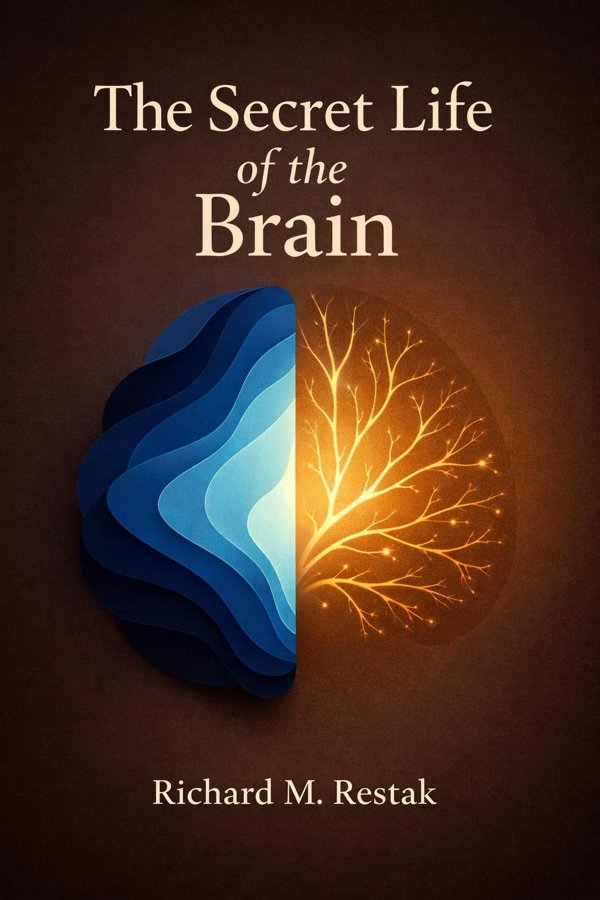
The Secret Life of the Brain: Summary & Key Insights
 10 min6 chaptersAudio available
What Is The Secret Life of the Brain About?
The Secret Life of the Brain by Richard M. Restak is a neuroscience book spanning 6 pages. This book explores the intricate workings of the human brain, revealing how our thoughts, emotions, and behaviors are shaped by neural processes. Restak, a neurologist, combines scientific insight with accessible explanations to illuminate the brain’s development, function, and adaptability throughout life.
This FizzRead summary covers all 6 key chapters of The Secret Life of the Brain in approximately 10 minutes, distilling the most important ideas, arguments, and takeaways from Richard M. Restak's work. Also available as an audio summary and Key Quotes Podcast.
The Secret Life of the Brain
This book explores the intricate workings of the human brain, revealing how our thoughts, emotions, and behaviors are shaped by neural processes. Restak, a neurologist, combines scientific insight with accessible explanations to illuminate the brain’s development, function, and adaptability throughout life.
Who Should Read The Secret Life of the Brain?
This book is perfect for anyone interested in neuroscience and looking to gain actionable insights in a short read. Whether you're a student, professional, or lifelong learner, the key ideas from The Secret Life of the Brain by Richard M. Restak will help you think differently.
- ✓Readers who enjoy neuroscience and want practical takeaways
- ✓Professionals looking to apply new ideas to their work and life
- ✓Anyone who wants the core insights of The Secret Life of the Brain in just 10 minutes
Want the full summary?
Get instant access to this book summary and 100K+ more with Fizz Moment.
Get Free SummaryAvailable on App Store • Free to download
Key Chapters
In the earliest stages of life, the brain’s story unfolds in silence. Long before birth, neural cells embark on an astonishing journey—multiplying, migrating, connecting. By the time a baby is born, over a hundred billion neurons have emerged, each one ready to form intricate networks of communication. Yet at birth, the brain is far from finished. Experience becomes its sculptor, and the environment its workshop.
I emphasize in the book that development is not merely genetic destiny. The infant brain thrives on interaction. Touch, sound, eye contact—all become powerful stimuli that shape the architecture of the brain. Synapses, those tiny junctions between neurons, proliferate rapidly in early life, creating an overabundance of connections. Then, in what may seem a harsh but efficient process, the brain prunes away unused links, refining its circuitry for optimal function. This sculpting by experience explains why early childhood—those first years of sensory exploration and emotional bonding—is critical. A neglected brain will wire itself differently from a nurtured one.
Through anecdotes from my medical practice and neuroscience research, I discuss how early trauma, love, and learning leave indelible imprints. Brain imaging reveals that the infant’s world, so seemingly chaotic, is in fact a laboratory of experiments—each smile, sound, and movement strengthening certain neural pathways while letting others fade. By understanding early brain development, we better appreciate both the vulnerability and resilience of the human mind.
Once the brain begins to interact with the world, it must learn to interpret the flood of sensory data that surrounds it. In this section, I explore how perception is not a passive reception of stimuli but an active, dynamic construction. Your eyes, ears, skin, and tongue send signals to the brain, but the brain itself decides what you see, hear, and feel.
Vision, for instance, occupies a vast portion of the cerebral cortex, yet sight is far more than simple input. When you look at a face, your brain instantly integrates shape, color, and motion, drawing from memory and context to create meaning. Similar processes occur in hearing and touch. The sounds of language, the rhythm of music, or the texture of a familiar object—all require the brain to filter, predict, and reconstruct information.
I tell stories of patients who, after brain injury, perceived the world differently: colorless, fragmented, or distorted. Such cases remind us how fragile and interpretive reality can be. What we perceive is the brain’s best hypothesis of what exists, filtered through past knowledge and current emotion. Perception, therefore, is a dialogue between sensation and memory—a continuous act of imagination grounded in biology.
+ 4 more chapters — available in the FizzRead app
All Chapters in The Secret Life of the Brain
About the Author
Richard M. Restak is an American neurologist and neuropsychiatrist known for his popular science books on the brain and behavior. He has written extensively on neuroscience and has served as a clinical professor of neurology at George Washington University School of Medicine and Health Sciences.
Get This Summary in Your Preferred Format
Read or listen to the The Secret Life of the Brain summary by Richard M. Restak anytime, anywhere. FizzRead offers multiple formats so you can learn on your terms — all free.
Available formats: App · Audio · PDF · EPUB — All included free with FizzRead
Download The Secret Life of the Brain PDF and EPUB Summary
Key Quotes from The Secret Life of the Brain
“In the earliest stages of life, the brain’s story unfolds in silence.”
“Once the brain begins to interact with the world, it must learn to interpret the flood of sensory data that surrounds it.”
Frequently Asked Questions about The Secret Life of the Brain
The Secret Life of the Brain by Richard M. Restak is a neuroscience book that explores key ideas across 6 chapters. This book explores the intricate workings of the human brain, revealing how our thoughts, emotions, and behaviors are shaped by neural processes. Restak, a neurologist, combines scientific insight with accessible explanations to illuminate the brain’s development, function, and adaptability throughout life.
You Might Also Like
Anxious
Joseph LeDoux
10 min
Hallucinations
Oliver Sacks
10 min
The Biological Mind: How Brain, Body, and Environment Collaborate to Make Us Who We Are
Alan Jasanoff
10 min
The Feeling of Life Itself: Why Consciousness Is Widespread but Can't Be Computed
Christof Koch
10 min
The No-Nonsense Meditation Book
Steven Laureys
10 min
A General Theory of Love
Thomas Lewis, Fari Amini, Richard Lannon
10 minBrowse by Category
Ready to read The Secret Life of the Brain?
Get the full summary and 100K+ more books with Fizz Moment.