
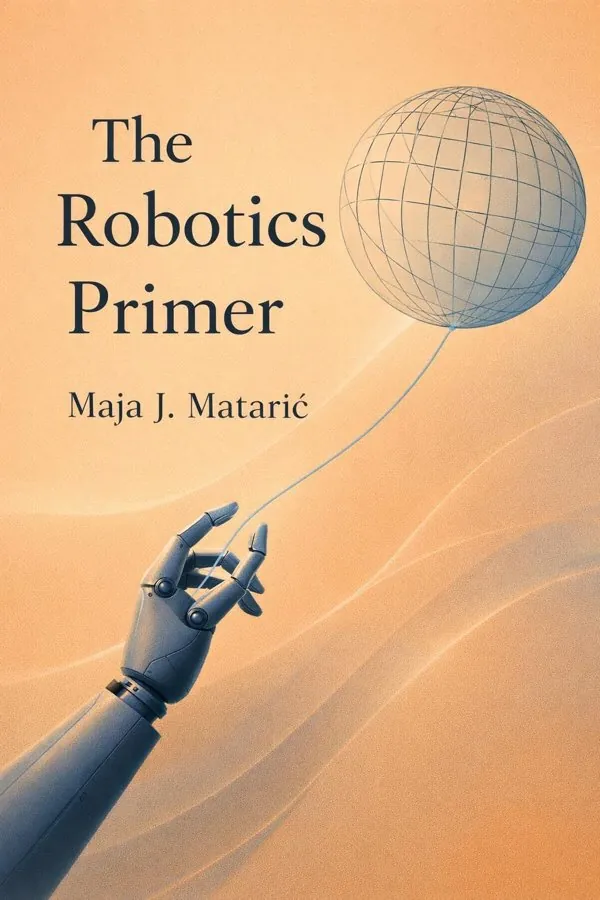
The Robotics Primer: Summary & Key Insights
 10 min9 chaptersAudio available
Key Takeaways from The Robotics Primer
A robot is never just a machine; it is a meeting point of many kinds of knowledge.
Our dreams of intelligent machines are far older than modern computers.
No robot can be intelligent if it cannot sense, move, and regulate itself.
Seeing is not the same as understanding.
Intelligence becomes visible when a robot must decide what to do next.
What Is The Robotics Primer About?
The Robotics Primer by Maja J. Matarić is a ai_ml book spanning 6 pages. Robotics is often imagined as a field of futuristic machines, but The Robotics Primer shows that it is really a disciplined way of thinking about intelligence, action, and interaction in the physical world. In this accessible introduction, Maja J. Matarić explains how robots sense their surroundings, represent information, make decisions, learn from experience, and act in ways that produce useful outcomes. Rather than overwhelming readers with dense mathematics, she builds a conceptual foundation that makes the logic of robotics understandable to students, curious general readers, and anyone interested in artificial intelligence embodied in machines. What makes the book especially valuable is its balance between breadth and clarity. It introduces the major components of robotics—sensors, actuators, control, perception, planning, learning, and human-robot interaction—while also showing how these pieces connect in real systems. Matarić writes with the authority of a leading researcher whose work spans computer science, neuroscience, and socially assistive robotics. The result is a primer that does more than define technical terms: it reveals robotics as an interdisciplinary field that forces us to ask profound questions about intelligence, design, autonomy, and the future relationship between humans and machines.
This FizzRead summary covers all 9 key chapters of The Robotics Primer in approximately 10 minutes, distilling the most important ideas, arguments, and takeaways from Maja J. Matarić's work. Also available as an audio summary and Key Quotes Podcast.
The Robotics Primer
Robotics is often imagined as a field of futuristic machines, but The Robotics Primer shows that it is really a disciplined way of thinking about intelligence, action, and interaction in the physical world. In this accessible introduction, Maja J. Matarić explains how robots sense their surroundings, represent information, make decisions, learn from experience, and act in ways that produce useful outcomes. Rather than overwhelming readers with dense mathematics, she builds a conceptual foundation that makes the logic of robotics understandable to students, curious general readers, and anyone interested in artificial intelligence embodied in machines.
What makes the book especially valuable is its balance between breadth and clarity. It introduces the major components of robotics—sensors, actuators, control, perception, planning, learning, and human-robot interaction—while also showing how these pieces connect in real systems. Matarić writes with the authority of a leading researcher whose work spans computer science, neuroscience, and socially assistive robotics. The result is a primer that does more than define technical terms: it reveals robotics as an interdisciplinary field that forces us to ask profound questions about intelligence, design, autonomy, and the future relationship between humans and machines.
Who Should Read The Robotics Primer?
This book is perfect for anyone interested in ai_ml and looking to gain actionable insights in a short read. Whether you're a student, professional, or lifelong learner, the key ideas from The Robotics Primer by Maja J. Matarić will help you think differently.
- ✓Readers who enjoy ai_ml and want practical takeaways
- ✓Professionals looking to apply new ideas to their work and life
- ✓Anyone who wants the core insights of The Robotics Primer in just 10 minutes
Want the full summary?
Get instant access to this book summary and 100K+ more with Fizz Moment.
Get Free SummaryAvailable on App Store • Free to download
Key Chapters
A robot is never just a machine; it is a meeting point of many kinds of knowledge. One of the book’s most important insights is that robotics cannot be understood through a single discipline alone. To build even a modest autonomous system, you need the mechanics of movement, the computation of decision-making, the sensing of the physical world, and the behavioral logic that ties perception to action. Robotics stands at the intersection of mechanical engineering, electrical engineering, computer science, artificial intelligence, cognitive science, and increasingly biology and design.
Matarić emphasizes that this interdisciplinarity is not a side feature but the essence of the field. A mobile robot that navigates a room needs hardware to move, sensors to detect obstacles, algorithms to interpret incoming data, and control systems to convert those interpretations into action. A social robot in a hospital adds yet another layer: communication, human psychology, trust, and interface design. This is why robotics often feels both exciting and difficult. It asks researchers and practitioners to integrate theories that were historically developed in separate domains.
This perspective also explains why robotics matters beyond engineering. It becomes a laboratory for studying intelligence itself. When we try to make a machine act effectively in the world, we are forced to clarify what perception, learning, adaptation, and interaction really mean. In that sense, robotics is not only about building devices; it is also about testing ideas about mind, behavior, and embodiment.
A useful practical lesson follows from this: if you want to understand robotics, do not study parts in isolation. Learn to ask how body, brain, environment, and task shape one another. The actionable takeaway is to approach any robot as a system of connected layers rather than a collection of components.
Our dreams of intelligent machines are far older than modern computers. Matarić places robotics in a historical arc that begins with myths of artificial beings and mechanical servants, continues through ingenious automata built for entertainment or demonstration, and culminates in modern autonomous systems designed to operate in complex environments. This history matters because it reveals that robotics has always reflected human aspirations: to imitate life, extend labor, and understand intelligence.
Early automatons could mimic movement but lacked adaptability. They followed fixed mechanisms, like clockwork figures that played instruments or moved through prearranged sequences. Their fascination came from appearance and craftsmanship, not autonomy. Modern robots differ because they can sense, respond, and, to varying degrees, make decisions under uncertainty. That transition—from scripted motion to situated behavior—is one of the defining shifts in the field.
The historical overview also helps readers separate fantasy from engineering reality. Popular culture often imagines robots as fully humanlike beings with general intelligence. Real robotics has developed more pragmatically, through industrial arms, mobile platforms, vacuum robots, drones, planetary rovers, warehouse systems, and medical assistants. Each breakthrough emerged not from magic but from advances in sensing, control, computing power, and design.
Examples make this clear. A factory robot revolutionized manufacturing not because it looked human, but because it repeated precise movements reliably. A Mars rover mattered not because it resembled a person, but because it could navigate a distant terrain under severe constraints. History shows that useful robotics often progresses through narrow competence before broad versatility.
The actionable takeaway is to evaluate robots by what problems they solve, not by how closely they resemble science fiction. That shift in perspective makes the field easier to understand and more grounded in real innovation.
No robot can be intelligent if it cannot sense, move, and regulate itself. At the heart of robotics lies a simple but powerful loop: sensors gather information, actuators produce movement or other physical effects, and control systems connect the two. Matarić uses this triad to explain how robots become functional agents rather than passive machines.
Sensors are the robot’s access to the world. They may include cameras, sonar, lidar, infrared detectors, force sensors, GPS units, or tactile systems. But sensing is never perfect. Real environments are noisy, cluttered, and incomplete, so sensor data must be interpreted carefully. Actuators, by contrast, are how a robot affects the world: wheels turn, arms lift, grippers close, and motors adjust position. Yet movement is also uncertain. Surfaces vary, joints slip, loads shift, and batteries drain. This is where control becomes essential.
Control systems regulate behavior by comparing intended states with actual outcomes and making corrections. A simple thermostat uses control; so does a balancing robot that constantly adjusts its wheels to remain upright. In advanced systems, control may involve multiple interacting loops running simultaneously, managing speed, orientation, stability, and precision. Industrial robotic arms are a classic example: they rely on highly refined control to place components accurately again and again.
Matarić’s larger point is that robotics is embodied intelligence. Thinking alone is not enough; intelligence must operate through imperfect hardware in real time. A robot that plans brilliantly but cannot execute safely is ineffective. Likewise, strong mechanics without adaptive control remain brittle.
The actionable takeaway is to remember that every impressive robotic behavior rests on this basic foundation. When evaluating or designing a robot, first ask: what can it sense, how can it act, and how does it close the loop between the two?
Seeing is not the same as understanding. One of the most important lessons in The Robotics Primer is that perception in robotics is not merely collecting sensor readings; it is transforming raw data into usable information about the world. Cameras produce pixels, lidars return distance points, and microphones capture signals, but none of that automatically tells a robot where it is, what objects surround it, or what action it should take.
Matarić explains that perception requires interpretation. A robot must detect features, distinguish relevant from irrelevant input, estimate position, and identify patterns under uncertainty. For example, a warehouse robot may use laser scans to recognize aisle boundaries and avoid workers. A self-driving system may combine cameras and depth sensors to detect lanes, pedestrians, and vehicles. A home robot may need to determine whether a surface is open floor or a dangerous staircase.
This challenge leads to representation: how a robot internally models its environment. Some tasks require maps, coordinates, and object labels. Others use simpler behavior-based cues like “follow wall” or “move toward charging station.” The choice of representation influences what the robot can do efficiently. Richer models can support more flexible planning, but they also demand more computation and can be harder to maintain in changing settings.
A key insight here is that robotic perception is always task-driven. A surgical robot and a cleaning robot do not need the same world model. Good robotic design asks not for perfect understanding but for sufficient understanding to complete a goal reliably.
The actionable takeaway is to think of perception as purposeful interpretation. Whenever you encounter a robot application, ask what information the robot truly needs, what representation it uses, and what uncertainties it must overcome to act effectively.
Intelligence becomes visible when a robot must decide what to do next. After perception and representation come planning: selecting actions that move the system from its current state toward a goal. Matarić shows that planning in robotics is not abstract chess-like reasoning alone. It is decision-making under physical constraints, limited information, time pressure, and uncertainty.
In simple settings, planning may involve pathfinding from one location to another while avoiding obstacles. In richer environments, it can include sequencing tasks, coordinating multiple goals, or adjusting to dynamic changes. A delivery robot in an office, for instance, may need to choose a route, avoid crowds, decide when to recharge, and recover when a hallway is blocked. A planetary rover may plan conservatively because errors are costly and communication delays prevent instant human correction.
The book clarifies that planning methods vary with the problem. Some robots rely on detailed maps and explicit search algorithms. Others use reactive strategies, responding directly to environmental cues without constructing a full long-term plan. Neither approach is universally superior. Deliberative methods can be powerful but computationally expensive; reactive methods are fast and robust in local situations but may struggle with longer-term coordination. Many successful robots combine both.
What matters most is the fit between architecture and task. A robot operating in a predictable factory can use highly structured planning. A robot navigating a crowded public space must remain flexible and responsive. This is why robotics often favors practical hybrid solutions over theoretically elegant but brittle systems.
The actionable takeaway is to view robotic planning as constrained problem-solving. When thinking about autonomy, ask not whether a robot can plan in general, but whether it can choose useful actions quickly and reliably in the specific world it inhabits.
A robot becomes truly useful when it can do more than execute fixed routines. Matarić explores how action and learning enable robots to adapt to variation, improve performance, and cope with environments that cannot be fully anticipated in advance. This is a central step from automation toward autonomy.
Action in robotics is not just motion; it is purposeful behavior linked to goals and feedback. A robot vacuum changes direction when it encounters furniture. A warehouse robot reroutes when a passage is blocked. A robotic arm adjusts grip force depending on object size and texture. These examples show that effective action depends on coupling behavior to changing conditions.
Learning expands that capability. Instead of relying only on hand-coded responses, robots can refine their performance through experience. They might learn to classify objects more accurately, improve navigation through repeated exploration, or optimize movement to conserve energy. In socially assistive robotics, a system might learn how an individual user responds best to prompts and encouragement. This is one area where Matarić’s expertise is especially significant: robots can be designed not only to perform tasks, but to interact in supportive, personalized ways.
Still, the book does not treat learning as magic. Learned systems inherit the limitations of their training data, sensors, and objectives. A robot that learns in one context may fail in another. Adaptation must therefore be paired with safety, interpretability, and robust design.
The deeper lesson is that intelligence in robotics is often incremental and situated. Robots do not need to become universally smart to be valuable; they need to become better at the specific behaviors that matter in their domain.
The actionable takeaway is to ask of any robot: what can it improve through experience, and where must fixed safeguards remain in place? That balance is the key to practical adaptivity.
Intelligence looks different when it has a body. A recurring insight throughout Matarić’s treatment of robotics is that embodiment fundamentally shapes cognition. A robot does not think in a vacuum; it operates through a physical form with specific sensors, actuators, limits, and opportunities. This means that intelligent behavior is not only a matter of internal computation but also of how body and environment work together.
A wheeled robot, a drone, a humanoid platform, and a robotic fish each face different possibilities and constraints. A drone can bypass floor obstacles but must manage flight stability and energy use. A legged robot can handle uneven terrain but faces difficult balance problems. A robotic arm may achieve remarkable precision in a fixed workspace yet be limited outside it. In each case, the body influences what counts as a good strategy.
This idea has practical implications. Sometimes a better mechanical design can simplify software. A passive gripper shaped to conform to an object may reduce the need for complex force calculations. A robot built to follow walls physically may require less perception than one intended to map an open room from scratch. In other words, intelligence can be distributed across hardware, software, and environment rather than concentrated solely in algorithms.
Embodiment also explains why robotics is such a powerful lens on AI. Abstract systems can appear capable in simulation while failing in the real world because physical noise, friction, delays, and uncertainty expose hidden assumptions. Robots force theories of intelligence to confront reality.
The actionable takeaway is to treat form and function as inseparable. When evaluating a robot, ask how its body helps or hinders the behavior you expect from it. In robotics, design intelligence often begins with embodiment.
The more capable robots become, the more important it is to ask not only what they can do, but what they should do. Matarić frames robotics as a field with deep social consequences. Questions of safety, responsibility, labor, privacy, accessibility, and human dignity are not peripheral concerns; they are built into the deployment of robots in everyday life.
Consider a care robot in an elder-care facility. It may improve consistency, reduce routine burdens, and extend assistance to underserved populations. But it may also raise concerns about surveillance, emotional dependency, reduced human contact, and uneven quality of care. Similarly, robots in warehouses can increase efficiency while transforming labor conditions. Autonomous systems in public settings may gather data in ways users do not fully understand. Ethical robotics therefore requires more than compliance with technical standards; it requires thoughtful design rooted in human needs and social context.
Human-centered robotics aims to build systems that are safe, transparent, inclusive, and beneficial. That means designing interfaces users can understand, ensuring fail-safes for unpredictable situations, accounting for vulnerable populations, and recognizing that technological success is not the same as human success. A robot can perform its assigned function and still be harmful if it undermines autonomy, fairness, or trust.
Matarić’s broader message is optimistic but disciplined. Robotics can contribute enormously to medicine, education, mobility, disaster response, and daily convenience, but only if guided by values as well as technical ambition.
The actionable takeaway is to include ethical questions in every assessment of robotics: Who benefits, who bears risk, what human problem is being solved, and how can the system be designed to support people rather than merely optimize tasks?
All Chapters in The Robotics Primer
About the Author
Maja J. Matarić is a leading roboticist, educator, and researcher whose work has helped shape modern thinking about autonomous systems and human-robot interaction. She is a professor at the University of Southern California, with appointments spanning Computer Science, Neuroscience, and Pediatrics. Her research is especially well known in the area of socially assistive robotics, where robots are designed to support people through coaching, engagement, rehabilitation, and care. Matarić has published extensively on robot learning, multi-robot systems, and human-centered design, and she is widely respected for making complex technical subjects accessible to students and general readers. In The Robotics Primer, she brings together scholarly depth, practical insight, and a broad interdisciplinary perspective, offering readers an authoritative introduction to the science, engineering, and social significance of robotics.
Get This Summary in Your Preferred Format
Read or listen to the The Robotics Primer summary by Maja J. Matarić anytime, anywhere. FizzRead offers multiple formats so you can learn on your terms — all free.
Available formats: App · Audio · PDF · EPUB — All included free with FizzRead
Download The Robotics Primer PDF and EPUB Summary
Key Quotes from The Robotics Primer
“A robot is never just a machine; it is a meeting point of many kinds of knowledge.”
“Our dreams of intelligent machines are far older than modern computers.”
“No robot can be intelligent if it cannot sense, move, and regulate itself.”
“Seeing is not the same as understanding.”
“Intelligence becomes visible when a robot must decide what to do next.”
Frequently Asked Questions about The Robotics Primer
The Robotics Primer by Maja J. Matarić is a ai_ml book that explores key ideas across 9 chapters. Robotics is often imagined as a field of futuristic machines, but The Robotics Primer shows that it is really a disciplined way of thinking about intelligence, action, and interaction in the physical world. In this accessible introduction, Maja J. Matarić explains how robots sense their surroundings, represent information, make decisions, learn from experience, and act in ways that produce useful outcomes. Rather than overwhelming readers with dense mathematics, she builds a conceptual foundation that makes the logic of robotics understandable to students, curious general readers, and anyone interested in artificial intelligence embodied in machines. What makes the book especially valuable is its balance between breadth and clarity. It introduces the major components of robotics—sensors, actuators, control, perception, planning, learning, and human-robot interaction—while also showing how these pieces connect in real systems. Matarić writes with the authority of a leading researcher whose work spans computer science, neuroscience, and socially assistive robotics. The result is a primer that does more than define technical terms: it reveals robotics as an interdisciplinary field that forces us to ask profound questions about intelligence, design, autonomy, and the future relationship between humans and machines.
You Might Also Like

Life 3.0
Max Tegmark
10 min
Superintelligence
Nick Bostrom
10 min
TensorFlow in Action
Thushan Ganegedara
10 min
AI Made Simple: A Beginner’s Guide to Generative AI, ChatGPT, and the Future of Work
Rajeev Kapur
10 min
AI Snake Oil
Arvind Narayanan, Sayash Kapoor
10 min
AI Superpowers: China, Silicon Valley, and the New World Order
Kai-Fu Lee
10 minBrowse by Category
Ready to read The Robotics Primer?
Get the full summary and 100K+ more books with Fizz Moment.